Accessories

Best Jump Ropes of 2026

A jump rope costs less than lunch, which is exactly why so many end up kinked on a hook in the garage. The plastic ones tangle, the cords whip your shins, and the handles are sized for somebody else's hands. A good one fixes all of that quietly: it spins when you flick your wrist, it stays at the length you set, and it doesn't fight you on the third round. I've skipped rope for years, and over the past four months my team and I put 16 ropes through daily workouts to find the ones actually worth keeping.

Here's what nobody tells you first: length matters more than price. A rope two inches too long forces you to swing your arms wide, and suddenly you're jumping twice as high as you need to. Weight is the other half of it — a cable so light it disappears punishes sloppy form, while a slightly heavier one tells your hands where it is in the air. Everything below earned its spot in the third minute, not the first.

#1

Leeboom Beaded Jump Rope

Top Pick
Leeboom Beaded Jump Rope

Learning rhythm

Our Score 9.2/10
Check Price

Worth Noting

  • Runs short for adults around 5 feet 7 and up
Pack
Three ropes
Design
Soft segmented beads
Handle
Polypropylene with rubber grip
Rope Length
110 inches
Read the full review

The soft beads click against the floor with every turn, and that sound is why we like the Leeboom for anyone learning: it gives you an audible rhythm to time your feet against, and a bead hitting your shin hurts far less than a bare steel cable. Three ropes come in the pack, in green, pink, and blue.

At 110 inches it arrives long enough for most adults, and you shorten it by sliding beads off the nylon cord — measure first, because threading them back on is fiddly. The rubber grips are small but secure, and the weight of the beads carries the rope around in a slow, predictable arc that suits practice far better than speed.

Tall jumpers should look elsewhere: past about 5 feet 7 the rope runs tight at the length it ships in, and taking beads off only shortens it further. For a household with kids, though, three color-coded ropes and a soft hit make this the easiest set here to hand out.

Bottom line: We recommend the Leeboom for beginners and family households: the beads teach rhythm, misses don't hurt, and the three-pack covers several jumpers at once.

#2

WOD Nation Speed Jump Rope

WOD Nation Speed Jump Rope

Speed work

Our Score 9.0/10
Check Price

Worth Noting

  • Thin cable stings on missed jumps
Handle
Plastic body, urethane grip
Item Weight
6.35 oz
Rope Material
Alloy steel
Cables In The Box
Two
Read the full review

Two steel cables come in the WOD Nation pouch, along with a small tool and a carry bag. That spare is the detail that changes ownership: the jacket on a speed cable is the part that wears, so a second cable turns a dying rope into a quick re-rig instead of a replacement purchase. We keep the unused one coiled in the pouch and swap it over the moment the working cable starts looking scuffed.

For an adult who wants one rope for cardio and is working toward double unders, this is the one we recommend first. The alloy steel cable is thin, quick, and the smoothest spinner in this group, and the urethane grips stay planted once hands get sweaty. What ends a set on this rope is your breathing, not your wrists.

Setup takes cutters and a minute: you measure, trim, and lock the cable into the handle, and that length then belongs to that cable. Fine for one jumper, awkward for a household of three. It also wants a smooth floor. On concrete or asphalt the jacket scuffs and frays quickly, while a mat, a gym floor, or wood keeps it going — and that is precisely the wear the second cable exists to answer.

Bottom line: Buy the WOD Nation if you want one fast, smooth rope for cardio and double unders and you jump indoors; the spare cable makes its wear item a non-event.

#3

Redify Weighted Jump Rope 1LB

Redify Weighted Jump Rope 1LB

Strength and conditioning

Our Score 9.0/10
Check Price

Worth Noting

  • Rope frays sooner than the aluminum build suggests
Handle
Aluminum with silicone grip
Rope Length
120 inches
Total Weight
About 1 pound
Ropes Included
9 mm cotton and 9 mm PVC
Read the full review

A one-pound rope is a different exercise, and you feel it within a couple of minutes. The Redify swings slowly and heavily enough that the work moves up into your shoulders and forearms, and the turn comes from bigger arm circles rather than quick wrist flicks.

Two ropes come with it — a 9 mm braided cotton one and a 9 mm PVC one, both 10 feet long — on aluminum handles with a raised silicone grip. Swapping them takes a minute, and the built-in lock slides to fit your height without tools. The cotton rope is the one we keep coming back to; it turns with a soft, weighted pull that makes the PVC feel clinical by comparison.

We like it for conditioning days, for boxers, and for anyone whose light speed rope has stopped feeling like a workout. It is not the rope for double unders or for high-volume beginner sessions: the swing is too slow, and a pound gets heavy fast when your shoulders are not used to it. Start with short sets and let the weight do the teaching.

Bottom line: Buy the Redify if you want skipping to build shoulders and forearms rather than just lungs; it is the best weighted rope here and it comes with two different cords.

#4

Wastou Speed Jump Rope

Wastou Speed Jump Rope

Fast intervals

Our Score 9.0/10
Check Price

Worth Noting

  • Cable can work loose from the handle
  • Coated cable frays with hard use
Handle
Aluminum with silicone grip
Weight
5.29 oz
Bearings
Dual ball bearings
Rope Length
9.8 feet
Read the full review

The Wastou's handles are aluminum rather than plastic, and that single choice changes the feel: there is mass in your palms, the silicone grip is tacky instead of spongy, and the rope sits more solidly than the foam-handled models here.

Dual bearings keep the rotation free, and the 9.8-foot cable can be extended with the spare rope in the box for taller jumpers. Setup is the usual trim-and-clamp job, and the length held once it was set.

It is heavier in the hand than a foam-handled rope, which is a matter of taste rather than a fault. We liked the solidity, and noticed the extra mass in the forearms on very long sets. The coated steel cable is the wear item, as it is on every speed rope in this group, so treat the coating as the part with a clock on it.

If you dislike the skinny, hollow feel of plastic handles, this is the rope to buy. It is the most substantial handle in this group, it spins fast enough for CrossFit-style intervals, and the silicone grip is the surest thing here once a session gets sweaty.

Bottom line: Buy the Wastou if you want aluminum handles and a silicone grip on a fast rope; it is the most substantial-feeling handle here for daily interval work.

#5

LIFEEZY Speed Jump Rope

LIFEEZY Speed Jump Rope

Shared households

Our Score 9.0/10
Check Price

Worth Noting

  • Cable and coating wear before the handles
  • Excess cable hangs below the handles
Handle
Aluminum with synthetic rubber grip
Weight
7.41 oz
Adjustment
Self-locking, screw-free
Rope Length
10 feet
Read the full review

Adjustment on the LIFEEZY is push-and-lock: feed the cable into the handle, it grips, and the excess hangs out of the bottom. There are no screws to lose and no cutters involved, which makes it the quickest length change in this group.

That makes it our pick for a rope two people share, or for anyone who wants to fine-tune between sets without hunting for a tool. The aluminum handles and dual bearings spin smoothly, and the 10-foot PU-coated cable is quick enough for double unders once the length is dialed in.

Durability is where it gives ground: the cable and its coating are the wear items, and the rope as a whole does not feel as tough as the WOD Nation's steel. It is a sensible choice for a household that shares one — just expect to replace the cable before the handles.

Bottom line: Buy the LIFEEZY if two people share one rope: the push-and-lock adjustment is the fastest here, and the aluminum handles spin well, though the cable wears before the handles do.

#6

Loocio Jump Rope

Loocio Jump Rope

Everyday cardio

Our Score 8.8/10
Check Price

Worth Noting

  • Handle plastic is the first part to wear
Handle Grip
Foam
Rope Length
280 centimeters
Rope Material
PVC-coated steel
Handle Material
PVC
Read the full review

The Loocio is the rope we point beginners to, and the reason is what you get for very little: a PVC-coated steel cable on ball bearings, foam handles that are soft rather than slippery, and a length you can change with your hands. It spins smoothly enough to feel like a proper rope rather than a toy, and it weighs so little that it disappears into a gym bag.

At 280 centimeters it arrives long, so most adults shorten it and shorter jumpers shorten it a lot; the lock holds once it is set. We found it stayed tangle-free at a steady cardio pace, and the bearings kept the rotation even when we picked things up.

It is not the rope for a tall jumper chasing speed. The cable is light, and the feedback through the handles is softer than a speed cable's, so the rhythm comes easily but the snap is not there. For twenty minutes of steady skipping that softness is a kindness, and it is why this is a first rope rather than a last one.

Bottom line: The Loocio is the rope we hand a beginner: smooth bearings, easy length changes, and a low enough outlay that trying jump rope stays a small experiment.

#7

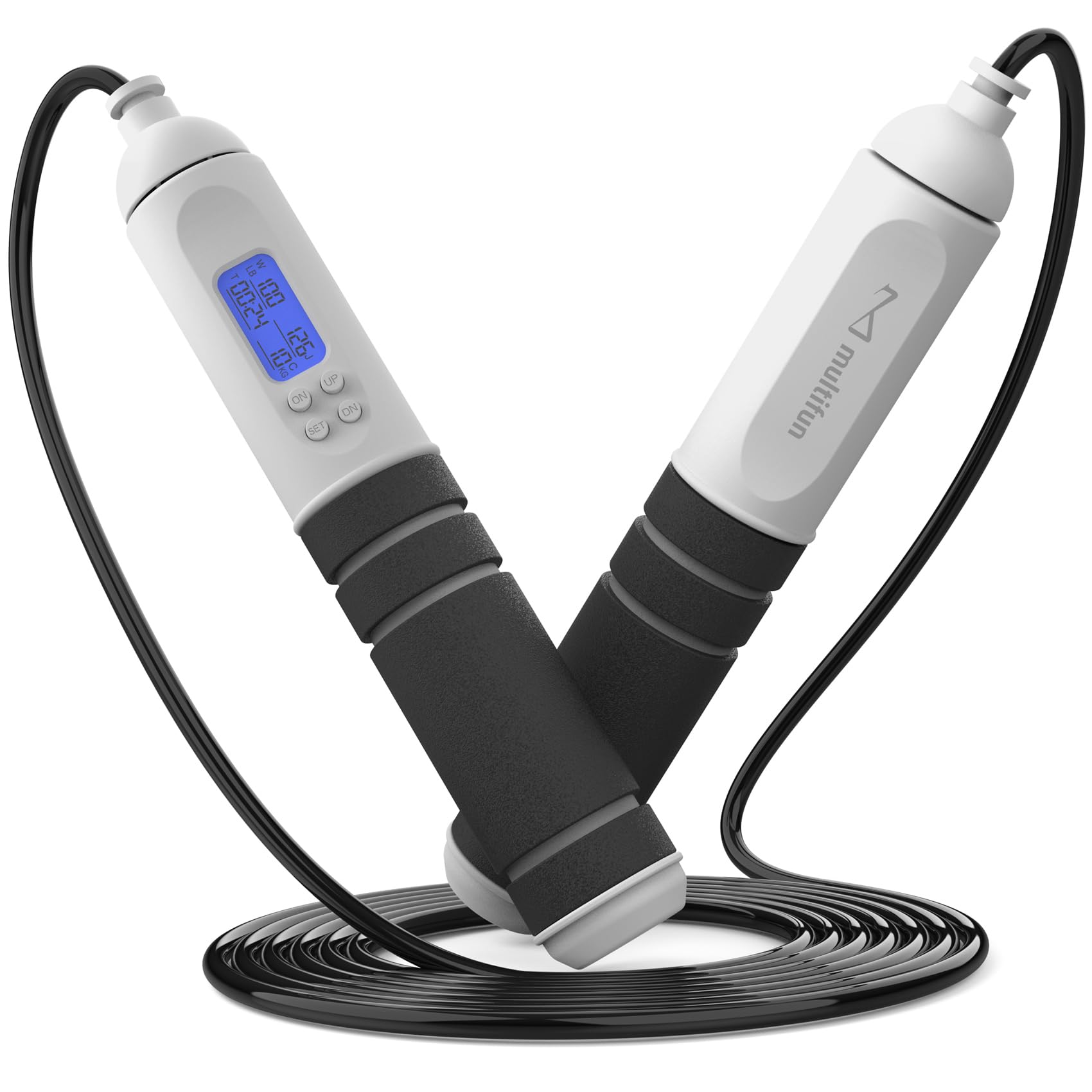
multifun Smart Digital Jump Rope

multifun Smart Digital Jump Rope

Tracking workouts

Our Score 8.8/10
Check Price

Worth Noting

  • Count can drift on fast, uneven sets
  • Handle is bulkier than a plain speed rope
Weight
7.76 oz
Tracking
Jumps, time, calories
Rope Length
118 inches
Cable Material
PVC-coated steel
Read the full review

There is a small backlit screen and two buttons in the multifun's handle, and it counts jumps, time, and calories while you work. That sounds like a gimmick right up until you are three rounds into intervals and have lost track of whether you are at 200 skips or 600.

Setup is genuinely tool-free: you feed the steel cable into the handle, it locks, and you trim the tail. Three modes cover free jumping, a countdown, and a goal, and the beep at your target is loud enough to hear over a gym playlist. The 118-inch cable leaves room for a tall jumper, and the foam grips stayed comfortable through longer sessions.

We recommend it to anyone whose training is interval-based, because a count is what keeps a session honest when attention wanders. The counter is good rather than perfect — quick, uneven sets can nudge the number by a jump or two — and the calorie figure is only as good as the body weight you program in. Neither flaw matters much once you use it to pace rounds rather than to audit yourself.

Bottom line: Buy the multifun if you want to stop counting in your head; it tracks jumps, time, and calories and adjusts without tools, and it is accurate enough to pace intervals.

How We Picked and Tested 16 Jump Ropes

We started with every rope we could find that let you change the length without a trip to the hardware store, which cut the field roughly in half. Cord material, handle bearings, and whether the maker sells replacement cables mattered more than price. From there we bought 16 ropes, from cheap beaded ones to weighted training ropes, and worked them into four months of real training: my own 10-minute warm-up blocks, a colleague's twice-weekly conditioning class, and a few complete beginners.

Each rope got used on garage concrete, rubber gym flooring, and asphalt, because the surface is what actually kills a cord. We set every rope to the standard length — handles at roughly armpit height — and timed how long the adjustment took with no instructions, then checked a month later whether the setting had slipped. We weighed each rope and noted whether it gave enough feedback to feel the rhythm or spun so light that a sloppy wrist sent it sideways. Two of us wore ropes out on purpose, dragging them across pavement and coiling them a hundred times, watching for kinks, frayed coating, and wobble where the cord meets the handle.

For ease of use, we handed each rope to someone who'd never jumped before and counted how many tries it took to string together 20 unbroken jumps. Sweaty hands got their own round: which handles stayed put and which slid. Value came down to what's in the box — a spare cable and tool-free adjustment are worth more than a fancy finish. A few ropes didn't survive the first month; the ones below are the ones we kept reaching for.

How to Choose Jump Ropes

Match the rope to the work, not the picture

Thin steel speed cables are the fastest thing here, and they reward compact arm circles: excellent for double unders, unforgiving while you learn. Beaded ropes turn in a slower, heavier arc that gives you a rhythm to time your feet against, which is why we point beginners at them. Weighted ropes are their own category — a pound turns skipping into shoulder and forearm work and rules out fast turnover altogether.

Pick the work first. Steady cardio suits a light coated-steel rope like the Loocio, speed work wants a bare cable like the WOD Nation, strength work wants the Redify, and a household teaching children to skip wants beads.

Length, and how the rope actually adjusts

Height fit decides whether you enjoy the first month, and adjustment comes in four flavors: trim-and-clamp on most speed cables, screw-set collars, push-and-lock handles, and bead removal on beaded ropes. Adjustable on a listing does not mean tool-free or reversible, so check the mechanism before you buy — especially if two people will share the rope.

The LIFEEZY's push-and-lock is the friendliest here for a shared rope, because nothing is cut and nothing is lost. The WOD Nation's trim is the fastest to live with once it is set, but that length belongs to that cable from then on.

Handles, grips, and what bearings really do

Foam is soft and cheap; silicone and urethane stay grippier once your hands sweat. Aluminum handles feel more substantial but add mass you notice in long sets, while plastic keeps a rope light in the palm. Bearings matter less than the marketing suggests — a single decent bearing spins freely — but a dual setup does stop the cable from torquing the handle.

If your grip or wrists tire quickly, go lighter rather than fancier. A slim handle with a thin grip is easier to hold for twenty minutes than a chunky aluminum one, however good the metal feels in the shop.

The surface is what kills ropes

Nearly every rope here wears out at the coating, not the handle, and the floor decides how quickly. Concrete and asphalt grind the jacket on a steel cable and fray a beaded rope's cord; a mat, a wooden floor, or a gym surface adds months of life.

Store it coiled loosely or hanging rather than stuffed in a bag with a kink, and check the cable where it enters the handle, because that is where a break starts. A spare cable, which a few of these include, is the cheapest insurance in the category.

Frequently Asked Questions

Final Verdict

Start with the WOD Nation. It spins more smoothly than anything else in this group, the grips stay secure when your hands don't stay dry, and the spare cable turns the part that wears into a quick swap. Keep it on a mat or a smooth floor and it holds up far better than the same rope dragged across concrete.

If you aren't sure jumping rope will stick, buy the Loocio instead. It is the least expensive way to find out whether you enjoy skipping, and its bearings and foam handles make the first month far more pleasant than a fixed-length rope from a discount bin.