Accessories

Best Weighted Hula Hoops of 2026

My first weighted hoop stayed up for about six rotations before clattering to the floor, and I'd been assured it was the easy kind. A hoop gets sold on fun and fat burning, but what really decides whether you stick with it is whether it stays up, whether it hurts, and whether your downstairs neighbor can hear it. A good weighted hoop fixes most of that: the extra mass gives you something to push against, so the rhythm comes faster, and the right one is padded and sized for your body.

Weight is where most first-time buyers go wrong — heavier isn't automatically a harder workout, and a hoop that leaves your hip bones sore after two sessions is a hoop that ends up in the closet. The good news is that the gap between one that works and one that doesn't has little to do with price. My team and I spent four months with 14 hoops, and the ones below stayed up, stayed quiet, and were still worth reaching for in week ten.

#1

HCOIW 32-Link Infinity Hoop

Top Pick
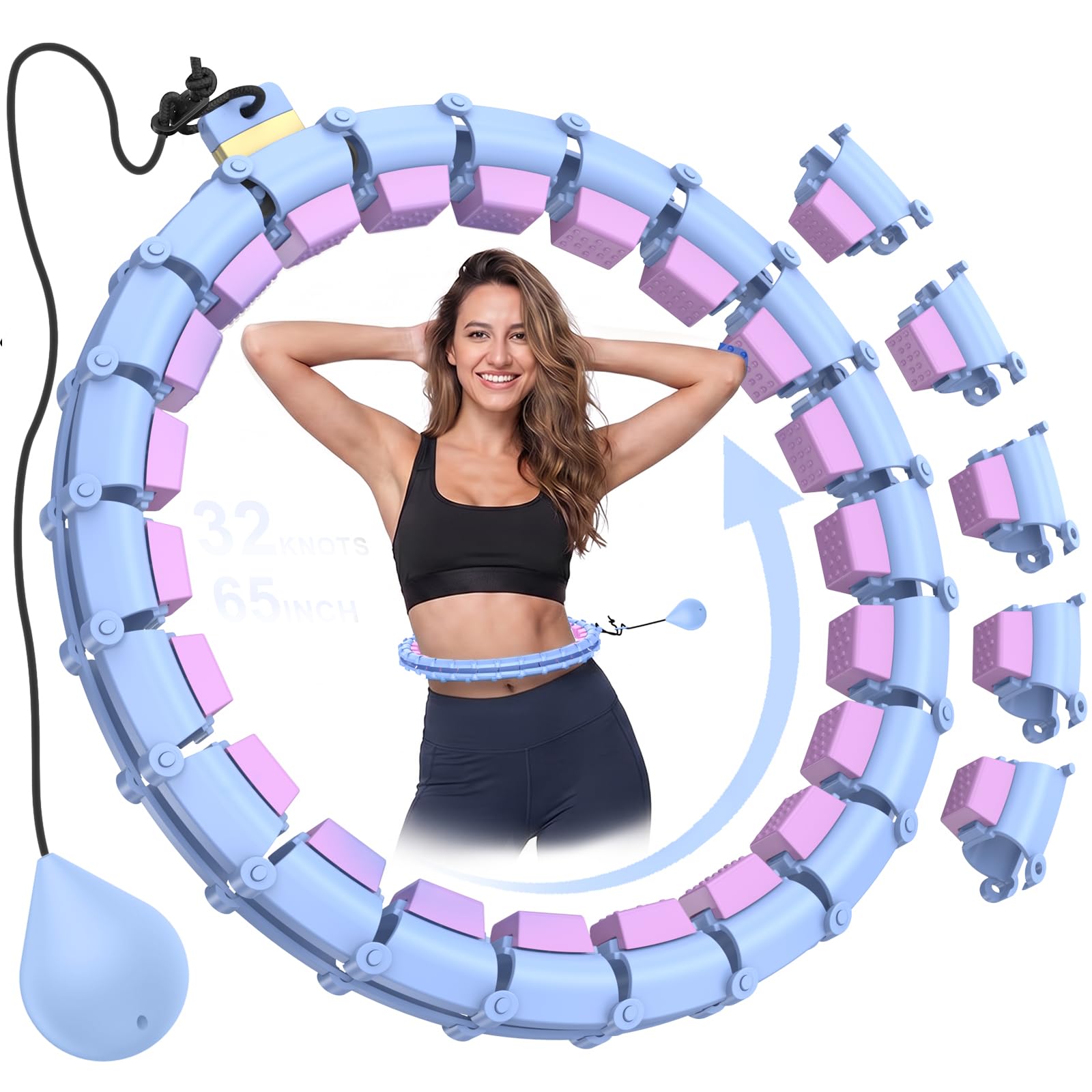
HCOIW 32-Link Infinity Hoop

Larger waists

Our Score 9.6/10
Check Price

Worth Noting

  • Limited history to judge long-term wear
Links
32
Warranty
2 years
Hoop Type
Gravity-ball track
Stated Size
65 in
Read the full review

Thirty-two links is the longest chain in this group, level with our top pick, and the hoop is sold as a 65-inch circle — enough for waists the 24-link models leave behind. If standard hoops have always come up tight, start here; there's slack to spare, and you can pull links out to hand it to someone smaller.

The rest of the spec sheet reads well: rotation in both directions, a two-year warranty that beats everything else here, and a quiet-operation claim of 40 decibels. That last figure is a claim rather than a promise — the ball still runs on a hard track, and no ball hoop in this group is silent at speed.

Where the design earns its place is the cover. Two years is the longest warranty here, and it takes the sting out of the two parts most likely to wear, the clips and the ball track. Add dual-direction rotation and a budget price, and the case is straightforward: this is the ball hoop to buy when the standard chain stops short.

Bottom line: For a bigger waist and the longest warranty here, we point to the HCOIW — as long as you're comfortable being an early adopter.
#2

RR Round Rich Wood Hoop

RR Round Rich Wood Hoop

Premium wooden feel

Our Score 9.2/10
Check Price

Worth Noting

  • Fixed 56-inch circle, no resizing
  • Priciest hoop in this group
Beads
48, plus 2 spares
Weight
5 lb
Hoop Type
Solid wood beads
Assembled Circle
56 in
Read the full review

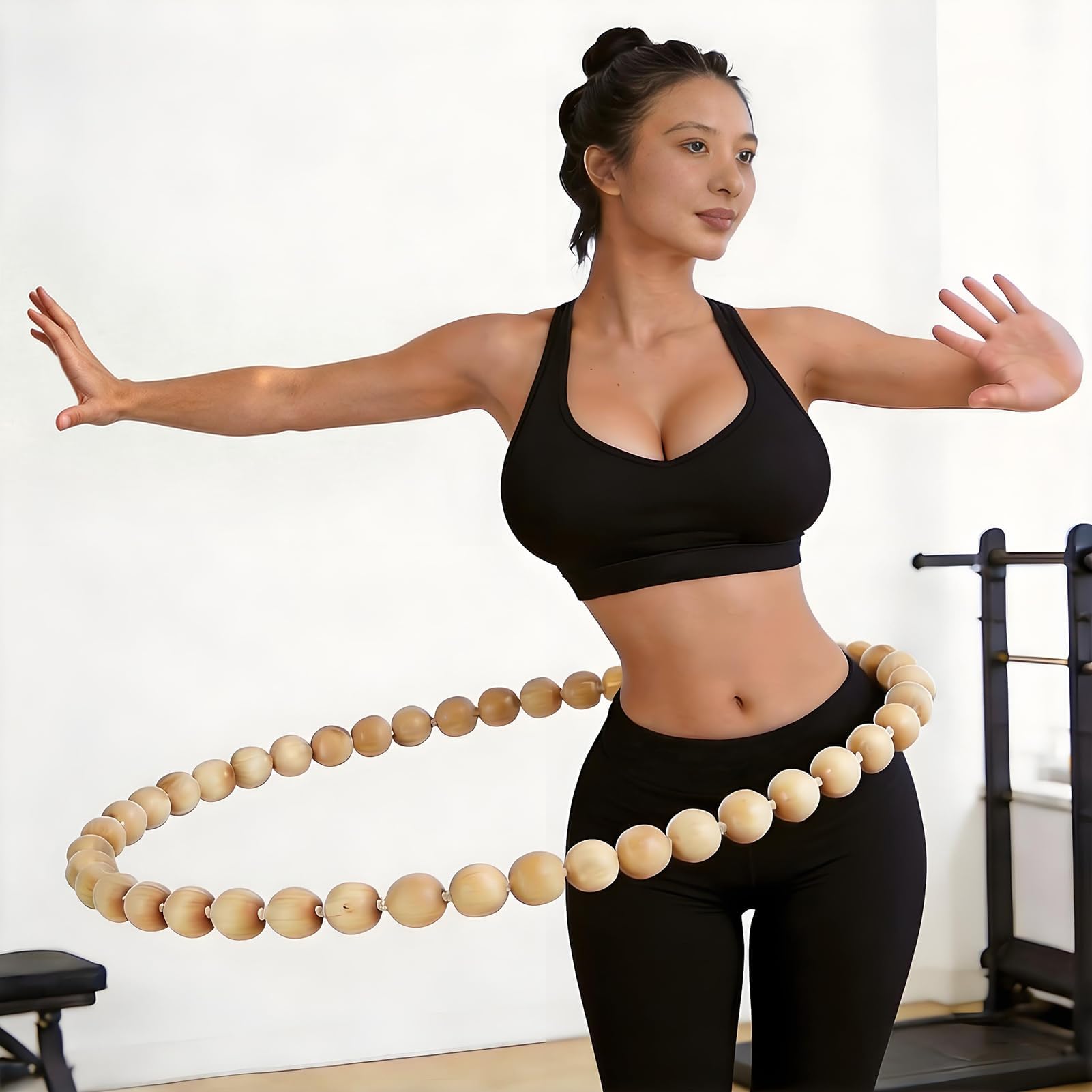
The sound is the first thing anyone notices: 48 hardwood beads strung on a rope, clicking softly against each other as they roll around your waist. RR calls it sound therapy, which is a stretch, but the rhythm is easy to fall in with and far more pleasant than a plastic ball rattling on a track. It's the hoop we reach for when we want twenty minutes to pass quickly.

It's also the heaviest hoop here at five pounds, and that changes the workout. The mass does the pressing for you, so a slow rotation still braces your core, and the wooden beads roll against skin rather than dragging. The assembled circle is a fixed 56 inches, wide enough that the turn is slow and forgiving, which makes it easier to pick up than its weight suggests.

The rope sits proud of the wood and can press sharply where it crosses your waist — a shirt fixes that better than any adjustment. And five pounds of hardwood is a lot to swing, so short sets a few times a day is how this one is meant to be used.

Bottom line: For hoopers who want weight, quiet, and something handsome enough to leave out in the room, the wooden RR is the one we point to.

#3

Sports Hoop Trim Hoop 3B

Sports Hoop Trim Hoop 3B

Skill-based cardio

Our Score 8.8/10
Check Price

Worth Noting

  • Needs real hoop technique to keep going
  • Only 30 days of warranty cover
Weight
3.1 lb
Diameter
41 in
Hoop Type
Traditional, 8 sections
Body Weight Guide
100–160 lb
Read the full review

Sports Hoop prints something no one else in this group does: a body-weight range. The Trim Hoop 3B is built for adults roughly between 100 and 160 pounds, with a heavier 4 lb version for bigger frames. That detail tells you the company is thinking about how three pounds of plastic behaves against a waist rather than just adding mass, and it's the first thing to check before you order.

We prefer this to the ball hoops for one reason: nothing keeps it up but you. The inner circle is smooth rather than ridged, so you give up the massage pressure and get honest work instead — you're balancing a three-pound ring with your core for as long as you can hold the rhythm, and the moves that keep it aloft are the ones that work your obliques. Eight sections snap together and come apart again, so it stores flat.

The first week leaves marks. The instructions suggest two minutes a day to start, and that's not lawyer-speak: a padded shirt and short sets get you through the adaptation without bruising. The joints deserve attention too — press each section until it clicks, and if the same joint keeps popping mid-spin, that's the one to reseat rather than the whole hoop.

Bottom line: For a hoop that makes you work for it, we pick the Trim Hoop 3B: a real free-spinning ring, sized by body weight, that turns hooping into cardio.

#4

OurStarry Weighted Hoop

OurStarry Weighted Hoop

First weighted hoop

Our Score 8.6/10
Check Price

Worth Noting

  • Roller wheels are the first part to fail
  • Six-month warranty, half the longest here
Links
32, fits waists to 60 in
Warranty
6 months
Hoop Type
Gravity-ball track
Ball Weight
14.1 oz
Read the full review

A weighted hoop only works if it stays up, and that's the case for OurStarry's ball-on-track design. The hoop snaps around your waist and a 400-gram ball orbits on a grooved rail, so there's no rhythm to master and nothing to chase across the floor. We think that makes it the right first hoop for most adults: you get a continuous ten-minute session on day one instead of a week of picking plastic up off the rug, and the ball's weight is what turns slow hip circles into something you feel in your sides the next morning.

Thirty-two links is as long as the chains get here, and it's built for waists up to 60 inches — add or pull sections until the hoop sits snug above your hips. The cord adjusts too, shortening the ball's swing for a small room or a tired shoulder, and the whole thing breaks down into a drawer-sized bundle. That last part matters more than it sounds, because the hoop you keep using is the one you don't have to find a home for.

One thing to plan around: the ball rolling on hard plastic is audible — think skateboard wheel, not hairdryer — and it carries through a floor, so a rug and a closed door are worth arranging before you start. Past that, this is the hoop we hand to friends who have never hooped, and the one with enough links to fit a waist the 24-link models leave out.

Bottom line: We recommend the OurStarry to anyone buying a first weighted hoop: the guided ball removes the skill barrier, and 32 links reach waists the fixed hoops can't.

#5

Fiteroc 2.8 lb Hoop

Fiteroc 2.8 lb Hoop

All-in-one kit

Our Score 8.6/10
Check Price

Worth Noting

  • Sections can work loose mid-spin
Weight
2.8 lb
Diameter
39.4 in
Includes
Jump rope, resistance band, bag
Hoop Type
Traditional, 8 sections
Read the full review

Open the box and there's more than a hoop: eight foam-covered sections, a storage bag, a jump rope, and a resistance band. The extras are the sort of thing that ends up in a drawer, but we think the bag earns its place — a 39-inch hoop is awkward to store assembled, and breaking it down takes seconds.

The hoop is 2.8 pounds of NBR foam over plastic, heavier than the two-pound hoops here without going as far as the five-pound wood. The locking mechanism clicks together positively, the foam is thick enough to take the edge off the impact, and at 39.4 inches it turns at a pace most adults can hold. The weight is what makes it work: your sides are working within a few minutes.

The flip side of 2.8 pounds is bruising. Go at it for half an hour on day one and you'll have marks by day two, so start with two- or three-minute sets in something with a bit of thickness and build. Where it earns its keep for us is as a whole session: hoop for the core work, then a few minutes each with the rope and band, and a lunch break covers it without leaving the house.

Bottom line: We like the Fiteroc for anyone who wants one purchase to cover a full home session — the hoop is the point, and the bag and extras make it a kit.

#6

HEALTHYMODELLIFE Weighted Hoop

HEALTHYMODELLIFE Weighted Hoop

Sensitive hips

Our Score 8.4/10
Check Price

Worth Noting

  • Two pounds leaves no way to add resistance
Weight
2 lb
Diameter
36 in
Warranty
1 year
Hoop Type
Traditional, padded
Read the full review

Ridges and massage bumps sell hoops, and they're also why a lot of them end up in a closet: every bump is a small impact on the same patch of skin, dozens of times a minute. This one goes the other way. The surface is smooth EVA foam over plastic, with nothing drumming into your hip bones, and we think that makes it the easiest of these to use in a thin T-shirt or on bare skin.

At 36 inches and two pounds it's the lightest of the traditional hoops here, and it's the one we suggest for a first month of short daily sessions. The sections snap apart for storage, and the one-year guarantee is one of the longest among the free-spinning hoops in this group. The foam is where age shows first — the seams between sections are where the padding starts to crack, so check there after a few weeks.

Spin it through an episode of something, put it away, repeat tomorrow: that's the routine this hoop is built for, and it doesn't ask much of you to start.

Bottom line: We point beginners, and anyone whose hips complain about ridged hoops, to this one: smooth, light, and covered for a year at a budget price.

#7

JLoibao Infinity Hoop

JLoibao Infinity Hoop

Tight budgets

Our Score 8.2/10
Check Price

Worth Noting

  • Loud ball-and-track rattle
  • 26 links stop short of the longest waists
Links
26
Warranty
2 years
Hoop Type
Gravity-ball track
Read the full review

This is the least expensive hoop here, and it still gets you the full ball-on-track setup: 26 detachable links, a gravity ball, and a two-year warranty.

The savings show up in the track. The ball runs on a coarser rail than the OurStarry's, and the joints between links are where it hangs up — you feel a stutter as the ball crosses a section that isn't seated flush. Keep the links pressed tight and the hoop level, and most of that goes away.

The plastic is thicker than the price suggests and the warranty is longer than most here, but a hoop this cheap is an experiment: you're finding out whether a ten-minute daily habit sticks before you spend more.

That's the role we see for it. If you already know you'll stick with hooping, the OurStarry's smoother track and longer reach are worth the step up; if you're not sure yet, this one answers the question for less.

Bottom line: We recommend the JLoibao as the inexpensive way to find out whether a ball hoop fits your routine, with two years of cover behind it.

How We Tested the Best Weighted Hula Hoops

We started with a shortlist of about 40 hoops and cut it down by weight range, segment count, padding, and price, then ordered 14 that covered the field, from light two-pound hoops to five-pound adjustable ones. Each one got the same four months of use, and we kept a running note on whether the price matched the build quality.

Testing happened where hooping actually happens: a living room rug, a stretch of hardwood, and a back patio. Each hoop went through timed 15-minute sessions alongside a workout video, and we counted how many times it hit the floor, how long it took to find the rhythm, and whether we were out of breath by minute ten or just going through the motions. We weighed every hoop on a kitchen scale to see if it matched the label, and logged where the padding pressed against the hip bones during week one.

Assembly got its own check — we snapped each hoop together and apart a dozen times, then rechecked the joints after a month of regular use for wobble, clicking, or segments that worked loose mid-session. For noise, one person hooped on hardwood while another sat in the room below with the door shut. Durability decided more picks than anything else: we noted scratches, cracks at the seams, and padding that flattened or peeled. And we were honest about the fun factor — whether we reached for a hoop on a Tuesday night or found excuses not to.

How to Choose Weighted Hula Hoops

Ball on a track, or a hoop you spin yourself

These are two different workouts wearing the same name. A gravity-ball hoop clips around your waist and a weighted ball orbits on a rail, so it stays up while you move — which is why it suits beginners and anyone who wants to half-watch something while they work. A free-spinning hoop is just a weighted ring, and it stays up only as long as your hips keep it there: harder, more athletic, and far quieter.

If you have never hooped, start with the ball. If you want a workout that feels like a skill you are getting better at, take the ring.

Get the link count right before anything else

Measure your waist at the navel, not your trouser size. Link-chain hoops are sold by count: 24 links stops around 47 inches, 26 links reaches roughly 56, and 32 links covers waists up to 60 inches or more. Add sections until the hoop sits snug above your hips — loose hoops slip, and a hoop that barely closes is miserable to get on.

Fixed sizes are the exception. The 56-inch wooden hoop has no adjustment at all, so it is the one to think twice about if your waist sits far from the middle of the range.

Weight is a dose, not a badge

Two pounds is a gentle introduction; five is a serious massage with a workout attached. A hoop's weight sets resistance and impact together, and both climb — the heavier the hoop, the more your sides feel it and the shorter your early sessions should be. Sports Hoop prints a body-weight band on its 3.1 lb model, which is a sensible way to think: match the weight to the body swinging it, then add time rather than mass.

The calorie figures printed on the packaging are marketing, not a training plan.

Comfort is a surface question

Ridges and bumps get sold as massage. In practice they concentrate impact on a small patch of skin, dozens of times a minute, and that is what makes people quit in week one. Smooth foam, like the two-pound hoop from HEALTHYMODELLIFE, spreads the contact instead and lets you work in a thin T-shirt.

Whichever hoop you pick, the first sessions can bruise. Two minutes a day for the first week is the standard advice on the padded models, and it is worth following.

Noise and storage decide whether it survives month two

A ball hoop is loud: the ball runs on hard plastic and the sound carries through a floor. If you live above someone, a rug and a closed door are the difference between a habit and an apology. Free-spinning hoops are near silent by comparison.

Storage matters just as much. Eight-section hoops break down in seconds, a 48-bead wooden hoop comes apart onto its string, and a 32-link chain takes a minute to rebuild. The hoop you leave assembled in the middle of the floor is the one that gets used, so buy for the room you actually have.

Frequently Asked Questions

Final Verdict

For most people the OurStarry is the hoop to buy. The guided ball means you are exercising on the first day rather than practicing, 32 links cover waists the 24-link models leave out, and the whole thing packs into a drawer. Register the warranty and put a rug under it.

If you already have the rhythm, the Sports Hoop Trim Hoop 3B is the better workout — a real free-spinning hoop that makes your obliques do the work. And if you want the one that feels like an object worth keeping, the wooden RR is it: five pounds, a soothing click, no plastic anywhere.