Accessories

Best Running Hydration Packs of 2026

The first rule of running with water is that you should forget you're carrying it. A pack that bounces or rides up your ribcage will ruin a long run faster than tired legs—I've ditched more than one bottle belt mid-trail for exactly that reason. What you want is a pack that sits close, holds enough for the distance, and stays quiet mile after mile. Over the past six months, my team and I ran in 12 hydration packs on roads and trails to find the ones that disappear on your back.

The tricky part is that 'enough storage' means different things to a 5K runner and someone training for an ultra: too much pack sags when it's half empty, while too little forces you to choose between water and a rain shell. We weighed each pack empty and loaded, filled every bladder to its stated limit, and checked seams and bite valves for drips. Fit got the most attention—sternum and shoulder straps adjusted over t-shirts and rain jackets—and we factored in whether the price matched the build. The picks below earned their spot.

#1

MOKURA Soft Flask Vest

Top Pick
MOKURA Soft Flask Vest

Phone-first runs

Our Score 9.4/10
Check Price

Worth Noting

  • 500 ml flask is limited for long runs
  • Can shift if chest straps are not dialed in
Weight
9.6 oz
Pockets
5
Soft Flask
500 ml
Read the full review

We were struck by the MOKURA vest's retractable phone lanyard. Instead of unzipping a pocket every time you want to check a map or change a track, you pull the phone out on a coiled leash and let it snap back. That makes it feel more thoughtfully designed than the usual pocket-and-flask vest, especially for runners who use their phone for music or navigation.

The rest of the package is built for short, fast runs: a 500 ml soft flask, five pockets, and a 9.6-ounce weight. The chest straps and stretch waist panels are meant to keep it close, and the reflective accents are a useful touch for early or late runs. We like that the phone holder is touchscreen-friendly and separate from the gel pockets, so sticky fingers don't end up on the screen.

The soft flask collapses as you drink, which keeps the front from sloshing, and the harness is easy to snug down before you head out. The separate phone sleeve also means your keys and gels are not rubbing against the screen in the same pocket.

The phone lanyard is the rare feature that changes how you use the pack, not just how it looks. On a short run where you want music, a map, and a drink, that is a convincing combination.

Bottom line: The MOKURA earns our vote for phone-carrying runners doing short to half-marathon distances, where the retractable phone holder and light fit matter more than a big reservoir.

#2

Azarxis 5L Running Vest

Azarxis 5L Running Vest

Everyday trail runs

Our Score 9.0/10
Check Price

Worth Noting

  • 1.5 L bladder is modest for unsupported ultras
Weight
12 oz
Pockets
9
Pack Capacity
5 L
Bladder Capacity
1.5 L
Read the full review

A 1.5-liter bladder inside a 5-liter vest could feel like a compromise, but the Azarxis makes the smaller reservoir work because the whole package stays close to your back. At 0.34 kg, it disappears once the chest and waist straps are set; the wide mesh shoulder straps spread the load instead of digging in. Nine pockets give you places for a phone, gels, keys, and a light shell, so you're not choosing between water and the things that get you home.

What we like most is the focus. This is a running vest first: the bottle sits high and tight, the waistband keeps the lower edge from swinging, and the pocket layout is reachable without a full stop. We choose it for everyday trail runs and long training days because 1.5 liters is enough for most outings, and the 5-liter body swallows essentials without turning into a daypack.

The harness is adjusted entirely by straps rather than a size run, so check the torso range before you commit. The rose-red shell is easy to spot at a group meetup, if not the quietest look in the closet.

Bottom line: Our best overall is the Azarxis 5L Running Vest: a light, secure harness, nine useful pockets, and a 1.5L bladder make it the easiest default for everyday trail runs.

#3

Teton Oasis Trailrunner

Teton Oasis Trailrunner

Long trail days

Our Score 9.0/10
Check Price

Worth Noting

  • Can overwhelm smaller frames
  • Waist strap has been a weak point
Weight
14.4 oz
Pockets
6
Rain Cover
Sewn-in
Bladder Capacity
2 L
Read the full review

The Trailrunner's sewn-in rain cover is the detail that earns it a place, and it is why we choose this pack for wet, mixed trail days. When weather turns on a long trail day, you don't want to stop and dig out a loose cover while your layers soak through. It also carries a 2-liter bladder, six pockets, and a low-profile athletic cut that is meant to sit close rather than sway. At 14.4 ounces, it's not a race vest, but it's light enough for a day of running and hiking.

We appreciate the bladder details: a kink-free sip tube, a cushioned bite valve, and a large 2-inch opening that makes filling and drying less of a chore. The pocket layout is practical for a shell, snacks, and a phone, and the harness has plenty of adjustment. The material mix of ripstop nylon reads as trail-ready rather than delicate.

The Trailrunner is best treated as a one-pack answer for trail days rather than a race-day splurge. Leave it packed when the forecast is uncertain; that built-in cover is the kind of insurance a race vest can't offer.

Bottom line: The Trailrunner is our pick for wet, mixed trail days, with a rain cover and a 2L bladder that make it a better all-weather companion than a pure race vest.

#4

N NEVO RHINO 12L

N NEVO RHINO 12L

Budget trail miles

Our Score 9.0/10
Check Price

Worth Noting

  • Not a bounce-free race vest
  • Side bottle holders are too small
Weight
8.5 oz
Material
Nylon
Pack Capacity
12 L
Bladder Capacity
2 L
Read the full review

At 8.5 ounces, the N NEVO RHINO is the lightest pack in this group, and that changes how often you reach for it. It holds a 2-liter bladder and 12 liters of gear, which is enough for a long trail run, a hike, or a day at a festival without feeling like a framed backpack. The vest-style shoulder straps are the reason it works: they keep the load close instead of letting a full bladder swing behind you.

We value the simple approach. The main compartment takes the bladder, the front pockets handle a phone and snacks, and the shoulder pouches are useful for items you want without stopping. The price is the other obvious advantage; this is the least expensive way to get a usable bladder-and-pack combo here, and it doesn't feel like a disposable toy. The fabric is waterproof and tear-resistant, which is reassuring for brushy trails.

It is built for versatility rather than race pace, and the 12-liter body gives you room for a shell, snacks, and a first-aid kit. The shoulder straps adjust from 19 to 34 inches and the chest strap slides vertically, so it can be shared across a range of bodies. That makes it an unusually practical spare or family pack.

Bottom line: We recommend the N NEVO RHINO as the budget pick for casual runners and hikers who want a light 12L pack with a 2L bladder, not a race-day harness.

#5

Criuage Running Vest

Criuage Running Vest

Pocket-heavy carry

Our Score 9.0/10
Check Price

Worth Noting

  • Heavy at 750 g for fast running
Weight
1.65 lb
Pockets
8
Pack Capacity
5 L
Bladder Capacity
2 L
Read the full review

Eight pockets is a lot for a running vest, and the Criuage leans into that; it is the pack we choose when a run needs to carry more than water. Four pockets sit across the front and four across the back, so you can split phone, keys, gels, and a light layer without stuffing everything into one compartment. The 5-liter body and 2-liter bladder make it a small pack rather than a race harness, but the chest-oriented layout keeps the weight from feeling like a backpack.

We appreciate the pocketing for long days when you're carrying more than water: a shell, snacks, a phone, and a small first-aid kit all have a place. The material feels sturdy, and the harness adjusts widely enough to fit over a base layer or a light jacket. The patent claim is marketing, not something we weigh in the buying decision; what matters is that the front pockets are usable without taking the vest off.

The front pocket stack makes the chest busier than a minimal race vest, and the 5-liter body is more pack than you need for a quick 10K. For a runner who wants one pack for long trail efforts, though, that organization is the point. The 5L body leaves room for a shell and a small first-aid kit, which is more than most runners need on a club run but exactly the point on a remote trail.

Bottom line: The Criuage suits the runner who carries a lot, and we accept the extra weight for eight pockets and a 5L body that swallows long-day gear.

#6

Zelvot Soft Flask Vest

Zelvot Soft Flask Vest

Race day

Our Score 8.8/10
Check Price

Worth Noting

  • Sizing can run small for broader builds
Weight
12.3 oz
Pockets
9
Material
Neoprene
Soft Flask
500 ml
Read the full review

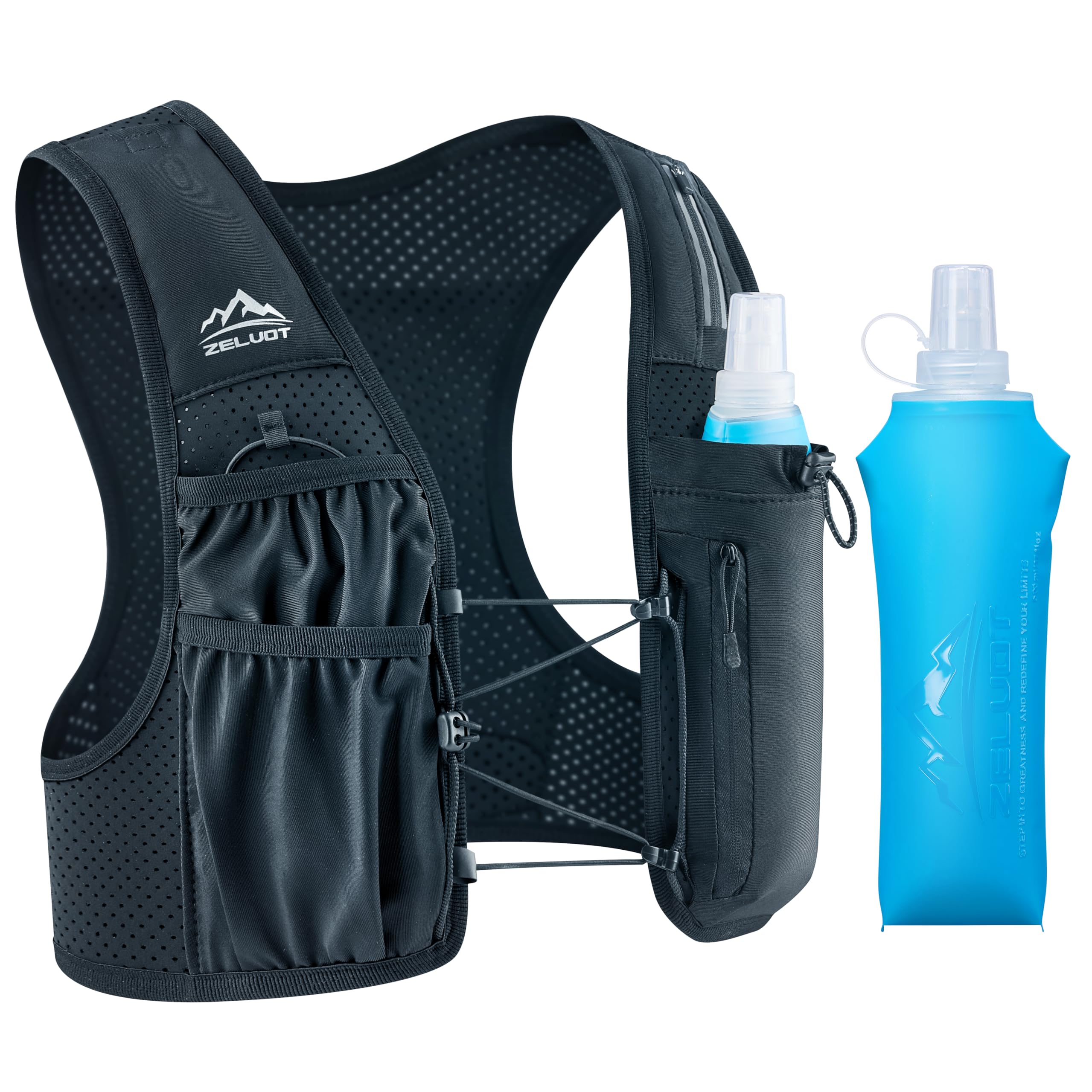
The first thing we noticed about the Zelvot soft-flask vest is how little there is to it: 0.35 kg before you fill the flask, with a stretchy neoprene body that sits against your chest rather than hanging off your back. For a 10K, half marathon, or fast trail session, that is the point. The 500 ml flask is enough to top up at aid stations, and the nine pockets keep gels, a phone, and a key within reach.

We prefer the pocket geography to the raw number. Two quick-access shoulder pockets, front zip pockets, and a rear stretch pocket mean you can separate a phone from sticky gels. The three chest straps are the part that makes it feel like a vest rather than a small backpack; snug them down and the load stays quiet. The soft flask also collapses as it empties, which keeps the front from sloshing when you're moving fast.

As a race-day vest, this is the one we reach for: it is the lightest and least fussy option here, and the soft flask is easy to rinse and refill at an aid station. Half a liter is a short-race tool, not a long-trail reservoir, so plan a refill or a second flask if your route is dry.

Bottom line: For race day, we reach for the Zelvot soft-flask vest: it's the lightest, quietest way to carry the essentials here, as long as you can refill or add a flask.

#7

Zelvot 2L Running Vest

Zelvot 2L Running Vest

Gear-heavy runs

Our Score 8.8/10
Check Price

Worth Noting

  • Shoulder straps can loosen mid-run
Weight
1.43 lb
Material
900D Oxford
Bladder Capacity
2 L
Front Zip Pockets
3
Read the full review

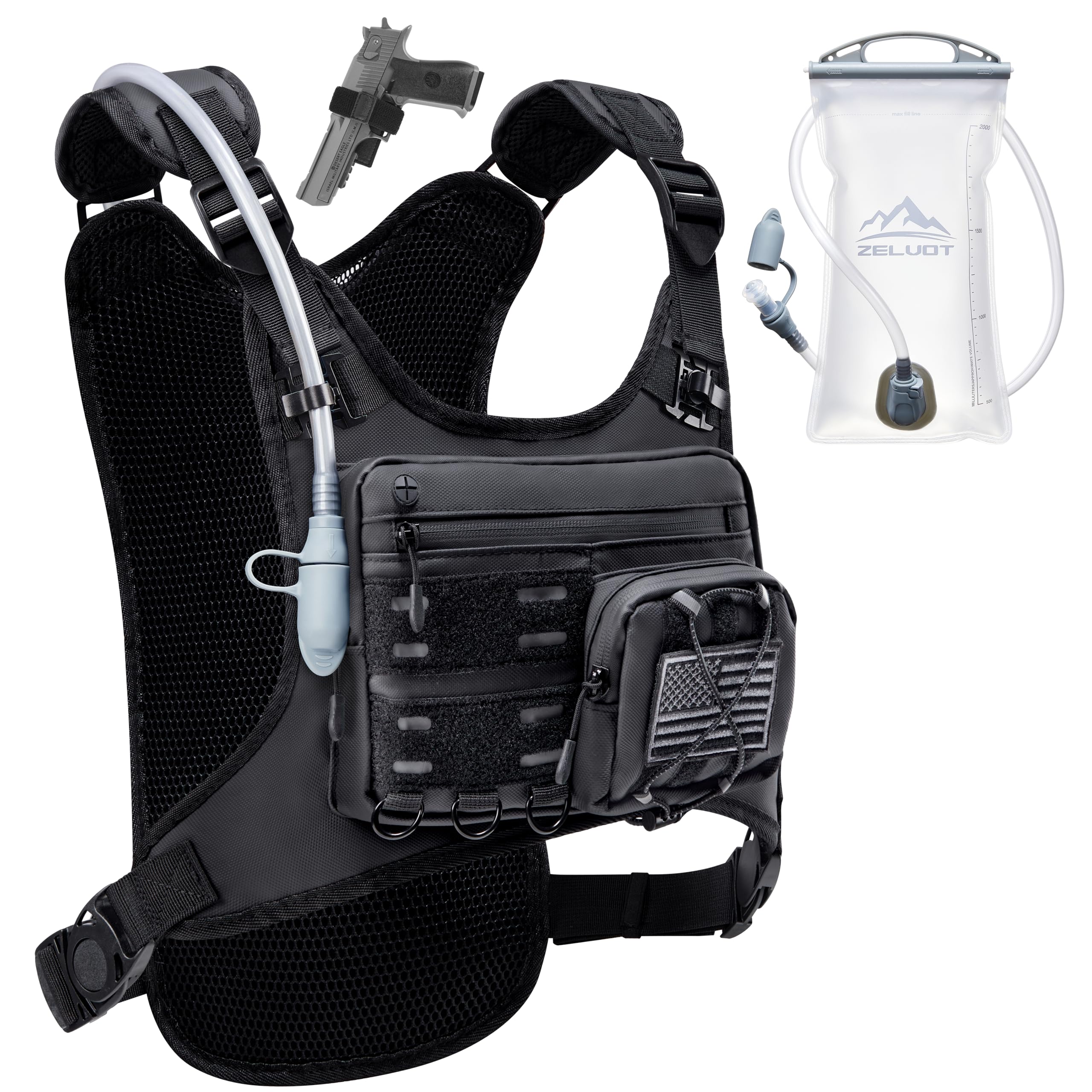
The 2-liter Zelvot is the opposite of the soft-flask version: where that vest is a race-day wisp, this one is a small armored pack. The 900D Oxford front panel and three waterproof zip pockets are built for keys, a phone, and gels that need to survive weather and abrasion. A 2-liter bladder sits in the back, so you get more water than the 500 ml flask without adding a second container.

This is the one we keep in the rotation for gear-heavy runs and run commutes, not for tempo sessions. The front chest pack keeps essentials in view, and the adjustable shoulder and waist straps distribute the load well enough that a full bladder doesn't sag. The wide straps are comfortable, and the reflective trim is useful when a run spills into dusk. It feels more durable than the race vests here, which is why we keep it in the rotation for rough weather and longer outings.

At 0.65 kg, it is one of the heavier options here, and that is the cost of the fabric and storage. We accept it for steady trail runs and commutes because the front pocket layout keeps a phone and gels accessible without stopping. For a fast 10K, the lighter vests are easier to ignore.

Bottom line: The Zelvot 2L is the rugged option we choose for gear-heavy runs and commutes, with room for a full 2L bladder and a front pocket layout that keeps essentials close.

#8

Maelstrom Hydration Pack

Maelstrom Hydration Pack

Simple everyday pack

Our Score 8.8/10
Check Price

Worth Noting

  • Bladder and mouthpiece can fail early
  • Heavier than the lightest race vests
Weight
1.1 lb
Pockets
4
Bladder Capacity
2 L
Chest Strap Range
22.4–61 in
Read the full review

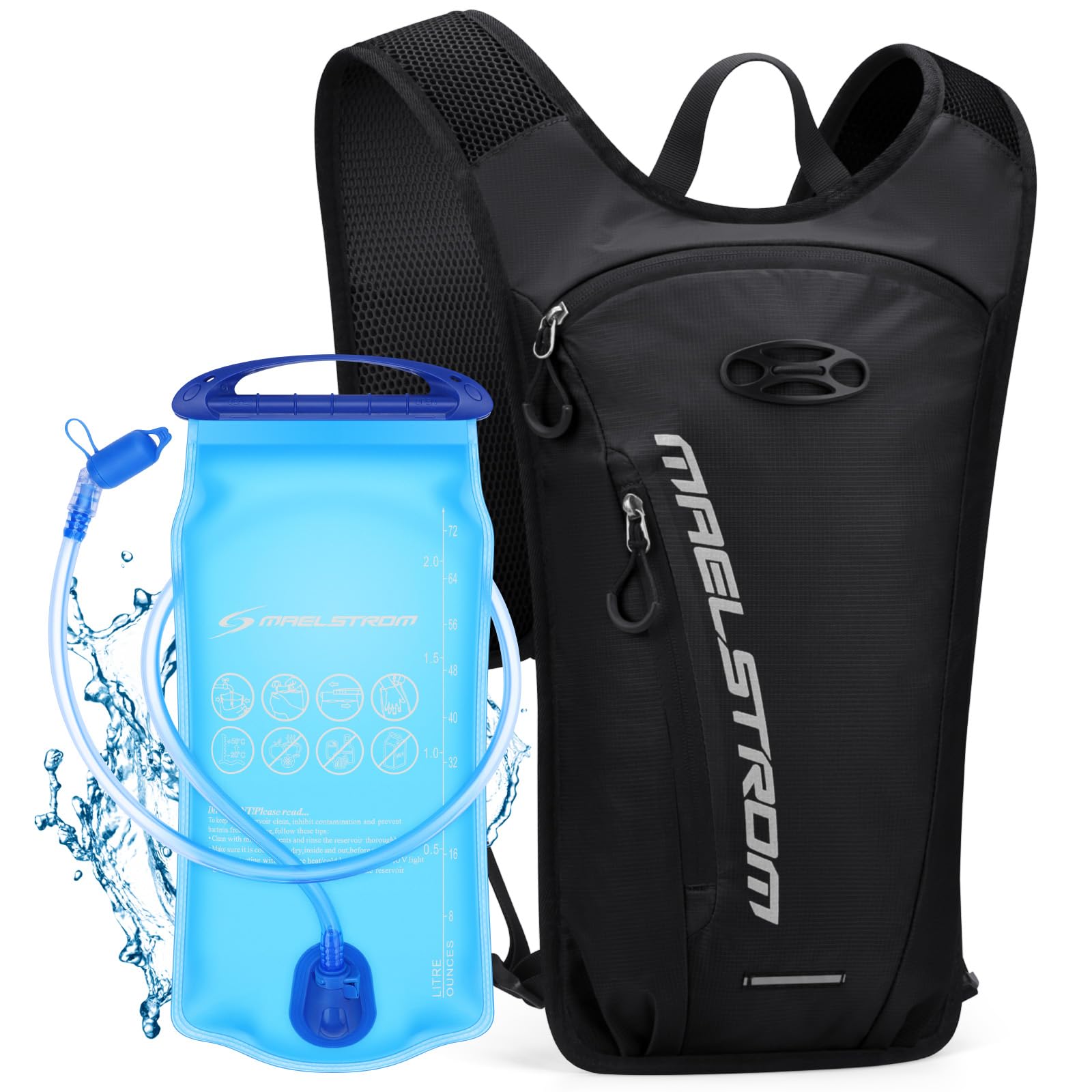
The Maelstrom's helmet clips are the first clue that it isn't a single-purpose race vest. It carries a 2-liter bladder, four storage pockets, and a chest strap that adjusts across a huge range, so it can sit over a T-shirt or a jacket.

For a bike-to-run commute or a mixed outdoor day, that flexibility is more useful than a stripped-down harness. The bladder sits in the main compartment, the bite valve is easy to use, and the reflective strips add visibility without turning the pack into a safety billboard.

The 1.1-pound weight is reasonable for a pack with this much adjustment, and the helmet storage is a genuine convenience if you ride to the trailhead. We noted that the harness hardware is the kind that needs a check before a long day, but the layout is simple enough to live with.

The chest strap range is the practical detail that makes it shareable across body types and layers. That, more than the helmet clips, is why we keep it in the mix for casual runs and mixed outdoor days.

Bottom line: We keep the Maelstrom on the list for mixed bike-and-run days, thanks to its wide adjustment and helmet clips, but a dedicated race vest is a safer bet for fast efforts.

How We Tested Running Hydration Packs

We started by pulling together a shortlist of hydration packs from brands we know, then narrowing it by capacity, bladder size, and price so we had a mix of minimal race vests and larger training packs. We landed on 12 models and tested them for six months. Every pack went on at least one long weekend trail run, several weekday road runs, and a hill session, because a pack that feels fine on flat ground can turn into a metronome on descents.

To compare storage, we packed the same kit into every pack: a phone, keys, two gels, a light rain shell, and a small first-aid pouch. We noted what fit, what had to be crammed, and whether the pack sagged once loaded. We weighed each one empty and full, then filled every bladder to its stated capacity and left it upside down on a paper towel overnight to catch slow leaks. Bite valves got the squeeze test, too.

Fit and stability got the most road time. Testers adjusted sternum and shoulder straps over a t-shirt, then over a rain jacket, and ran the same hilly loop to see what shifted, rubbed, or bounced. We paid attention to size range—whether the pack cinched down for smaller frames or maxed out on broader shoulders—and to durability after repeated washes, checking seams, zippers, and fabric abrasion. Finally, we weighed each pack's price against its build and capacity; a pack can be light and roomy, but not if the materials feel disposable.

How to Choose Running Hydration Packs

Match Water Capacity to the Run

Hydration capacity is not a scoreboard. A 500 ml soft flask is enough for a fast 10K or half marathon with aid stations; a 1.5 L bladder is the versatile middle for everyday trail runs; a 2 L bladder earns its weight on long, self-supported days.

We start with how long you'll be out and how often you can refill, not with the biggest number on the listing. If you often run the same loop with a water fountain, a soft-flask vest is easier to top up and carries less weight. If your routes are remote, a bladder keeps the weight on your back and lets you drink without stopping. The Azarxis' 1.5 L bladder is a sensible default for most training; the Zelvot soft-flask vest is the race-day tool when speed matters more than volume.

Fit and Bounce Matter More Than Pocket Count

A pack that swings is worse than a smaller one that stays put. Look for a harness that hugs the ribcage without restricting your breathing, with chest straps that sit above the bust line and a waist strap that keeps the lower edge from riding up. Adjustable straps are only useful if the torso range matches yours; check the stated range before ordering.

Before a long run, load the bladder and jog in place, then tighten the chest straps until the pack is quiet. If it rides up, loosen the shoulders and take up the waist; if it presses on your neck, the torso length is wrong. The Teton Trailrunner has a full adjustment set, but its larger shape can overwhelm a smaller frame, so fit is the first thing to verify.

Bladder or Soft Flask?

Bladders are convenient on the move and hold more water, but they are fussier to fill, clean, and check for leaks. Soft flasks sit in front, collapse as you drink, and are easy to refill at an aid station; the trade-off is capacity. We treat the choice as a route decision: bladder for long, unsupported runs, flasks for races and shorter efforts.

Whichever you choose, test the bite valve and hose connection before a long day. A leaking bladder soaks the gear you packed to stay dry, and a stiff valve can make you drink less than you should. The Zelvot soft-flask vest and the Azarxis bladder pack represent the two ends of that trade-off cleanly.

Storage, Weight, and Weather

A running pack does not need to carry a weekend kit. Five liters is plenty for a shell, phone, food, and a small first-aid pouch; 12 to 18 liters starts to make sense when a run doubles as a hike or a commute. Extra pockets add weight and bulk, so choose the smallest layout that holds your regular kit.

Weather protection and visibility are worth paying for if you run in exposed terrain or low light. A sewn-in rain cover, like the Teton's, is easier to live with than a loose one. Reflective trim helps at dawn and dusk. The Criuage shows how quickly pockets add up; the N NEVO shows how little pack you can carry when the route is simple.

Frequently Asked Questions

Final Verdict

Our default is the Azarxis 5L Running Vest. It hits the balance most runners need: a 1.5L bladder, nine pockets, and a harness that stays close without weighing you down.

If your race is short and fast, the Zelvot soft-flask vest is the lighter choice; if the forecast is ugly or the day mixes running and hiking, the Teton Trailrunner's rain cover and 2L bladder make more sense. Start with the run you actually do, then choose the reservoir and harness that fit it.