Accessories

Best Running Hydration Belts of 2026

Mile nine of a July long run, and I was doing the awkward one-arm bottle carry — the one that throws off your stride and has you negotiating with yourself about whether you really need water. A hydration belt fixes that, as long as it does the boring things well: it sits still, it doesn't saw at your waistband, and it holds enough to get you through the back half without a refill stop. That's a modest ask, and yet the gap between a belt you forget about and one you're hitching up every quarter mile is enormous.

My team and I ran in 14 belts over four months, from minimal two-flask setups to roomier designs with a bottle holster and a phone pocket. The surprise was how rarely capacity decided it — a belt that feels dialed in at mile two can creep by mile ten, and a stiff bottle digging into your lower back gets old fast. Fit, comfort, and a seal that actually holds mattered more than an extra ounce of storage. Below are the ones that stayed put.

#1

YUOTO Waist Pack

Top Pick
YUOTO Waist Pack

Walkers and hikers

Our Score 9.2/10
Check Price

Worth Noting

  • Bottle sold separately
Pockets
4
Waist Fit
25-50 in
Bottle Holder
Up to 750 ml / 27 oz
Water Resistance
Water resistant
Read the full review

The YUOTO is less a race belt than a waist pack with a bottle sleeve, and that is exactly why it earns a place here. The holder takes up to a 750 ml bottle and uses a quick-plug design that lets you seat the bottle with one hand; the four pockets swallow a phone, keys, dog bags, and a snack. The 25-to-50-inch band and mesh back panel make it a better fit for long walks than for interval sessions.

We found the bottle sits close enough to the body that it does not swing much on a steady walk, and the open holder makes it easy to grab a drink without stopping. The back mesh is the detail that matters on warm days: it keeps the pack from turning into a sweaty patch against your lower back.

We see it as a crossover for walkers, hikers, and run-walkers rather than a pure running belt. The four pockets are the best part: everything has a place, and nothing rattles against the phone. If you want a belt that disappears on a tempo run, look elsewhere; if you want a pack for a long trail walk, this is the one.

Bottom line: The YUOTO waist pack is for walkers and hikers who want a roomy 750 ml bottle holder, four pockets, and a comfortable trail fit.

#2

AiRunTech Hydration Belt

AiRunTech Hydration Belt

Value long runs

Our Score 9.0/10
Check Price

Worth Noting

  • Holster stitching and strap can wear
Pockets
2
Strap Length
51.2 in
Bottle Capacity
2 x 300 ml (10 oz)
Race Bib Toggles
2 removable
Read the full review

Two 10-ounce bottles, two race-bib toggles, and a zippered pocket big enough for a phone and a handful of gels: the AiRunTech covers the race-day checklist without the premium price of the Fitletic belts. The value is not just the bottle count; it is that the belt has the details that make a start line feel organized.

We think it is the smart buy for someone building a first race kit. The hook-and-loop band sits snugly and the looped shape keeps the bottles close, so the belt does not swing when you pick up the pace. The main pocket has room for a phone, keys, and a few gels, and the headphone port is a small touch that matters if you run with wired earbuds. We also appreciate the adjustable band, which lets you tighten it after the first mile without stopping.

The two bib toggles are the detail that makes it feel race-ready; they hold a number without pins and disappear when you are not racing. The belt is also light enough to forget on a warm-up jog, which is more than we can say for a bottle-heavy vest.

Bottom line: The AiRunTech belt is the value pick for runners who want two bottles, race bib toggles, and room for gels without paying premium prices.

#3

Fitletic Hydra 16

Fitletic Hydra 16

Race day

Our Score 9.0/10
Check Price

Worth Noting

  • Caps can leak if not fully seated
Extras
2 gel holders, bib toggles
Waist Fit
S/M (24"-34")
Phone Pocket
8 x 4 in
Bottle Capacity
16 oz total (2 x 8 oz)
Read the full review

Where the Runtasty belt sits low and wide, the Fitletic Hydra 16 hugs the hips like a race belt. The band contours to the body, the two 8-ounce bottles sit in quick-draw holsters, and the main pocket is sized at 8 by 4 inches, which is enough for an iPhone Pro Max. That closer fit is why it earns the race-day slot in this guide.

The bottle size is the compromise. Sixteen ounces total is enough for a fast half with refill stations, not a self-supported long run, and you will want to top up before the start if it is warm. The holsters themselves are snug and the bottles come out easily, which matters more than capacity when you are trying to drink without breaking stride. The S/M band is sized for 24- to 34-inch waists, so larger runners should look at another belt.

The storage is thoughtfully laid out for racing: an inner organizer keeps cards and keys from sliding around, two external gel holders put fuel within reach, and the integrated bib toggles mean no safety pins. The low-profile holsters are the detail we appreciate most; they keep the bottles out of the arm swing, which is exactly what a race belt should do.

Bottom line: The Fitletic Hydra 16 is our race-day pick for runners who want a low, hip-hugging fit and a secure phone pocket.

#4

Fitletic Fully Loaded

Fitletic Fully Loaded

Minimalist racing

Our Score 9.0/10
Check Price

Worth Noting

  • S/M range limits larger waists
  • Cap can leak if not seated
Waist Fit
S/M (24"-34")
Gel Storage
4 holders
Phone Pocket
8 x 4 in
Bottle Capacity
12 oz
Read the full review

One 12-ounce bottle, four gel loops, and a pair of race bib toggles: the Fully Loaded is built for the runner who wants a race-day kit and nothing else. The main pocket is 8 by 4 inches and fits a large phone, while the contoured bottle sits in a hip holster rather than bouncing against the small of your back.

We like the discipline of the design. The hip-hugging band keeps the load close, the bottle is easy to pull and replace, and the gel loops are positioned where your hands naturally fall. The inner organizer keeps cards and keys from sliding around, and the reflective accents are a useful detail for early starts.

The trade-off is capacity. Twelve ounces is a fast 10K or a half with aid stations, not a self-supported long run, and the single bottle means no backup if you drop one. For a road race where you know the course, that is a feature, not a flaw; for a trail day, it is too little.

We think it earns its place as a single-bottle race option, not as an everyday belt. The four gel loops are the detail that makes it feel purpose-built; they turn a simple bottle carrier into a race-day system.

Bottom line: The Fitletic Fully Loaded is a minimalist race belt for runners who want one bottle, gel loops, and bib toggles without extra bulk.

#5

Runtasty No.1 Hydration Belt

Runtasty No.1 Hydration Belt

Everyday running

Our Score 8.8/10
Check Price

Worth Noting

  • Can run large on very small waists
Design
No-bounce
Phone Fit
Fits all iPhones
Phone Pocket
Touchscreen-ready cover
Bottle Capacity
2 x 10 oz
Read the full review

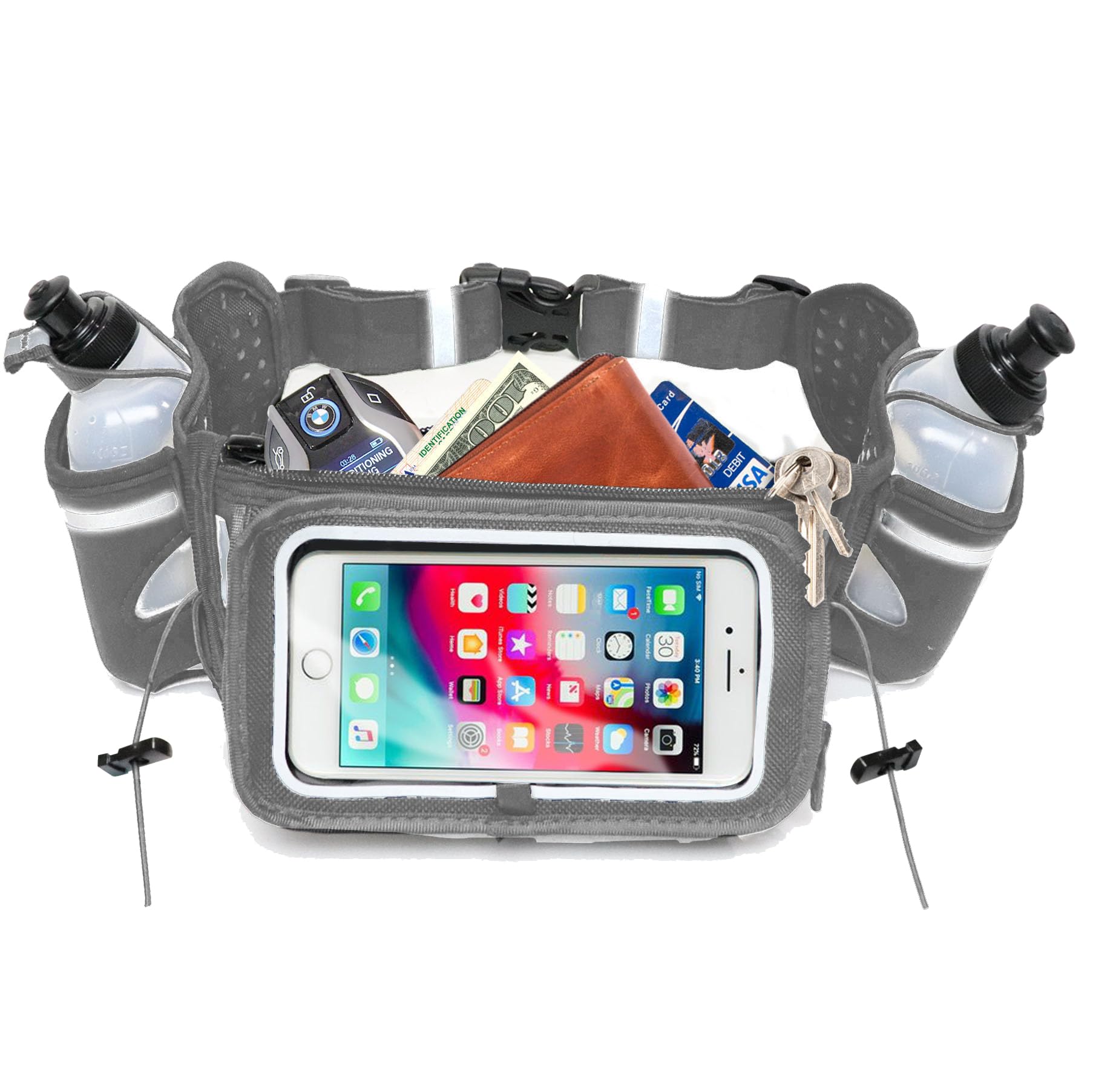
Staying put is the whole game with a running belt, and the Runtasty No.1 gets the fundamentals right. The two 10-ounce bottles sit in dedicated holsters, the band hugs low around the hips, and the phone pocket tilts up so you can glance at a screen without unzipping the whole belt. That combination is what makes it the easiest belt here to recommend for everyday running.

The storage layout is the other reason we kept reaching for it. A phone, keys, and a few gels disappear into separate compartments, and the touchscreen-ready cover means you can check a pace or a message without stopping. Twenty ounces is a sensible default for an hour of training, though on a hot day or a long run you should plan a refill stop rather than expect it to last the whole way.

We also like that the weight stays close to the body; the bottles ride low enough that they do not turn a relaxed run into a shuffle. The phone sleeve is the detail we use most, because it keeps the screen away from keys and lets you swipe through a playlist at a traffic light. That is the kind of small convenience that makes a belt worth wearing every day.

Bottom line: For most runners, the Runtasty No.1 is the hydration belt we recommend first: it stays put, carries 20 ounces, and keeps a phone reachable.

#6

Number-one Running Belt

Number-one Running Belt

Short runs

Our Score 8.8/10
Check Price

Worth Noting

  • Fit can be inconsistent around the waist
Phone Fit
Fits iPhones
Waist Fit
Adjustable
Bottle Capacity
2 x 175 ml
Water Resistance
Waterproof
Read the full review

Two 175 ml bottles are the defining compromise of the Number-one belt. That is roughly 12 ounces total, enough for a short run or a warm-up, but not the belt you pack for a hot half marathon. The upside is a light, low-profile belt that does not feel like a hydration pack.

The center pouch is roomier than the bottle size suggests, with three compartments that hold a phone, keys, and a snack without everything tangling together. The wide band and click buckle are easy to live with, and the waterproof shell is a nice buffer against sweat and rain. We found it comfortable on shorter efforts, where the small bottles are not a burden.

We see it as a short-run specialist, not an all-purpose hydration belt. The small bottles are the main trade-off, and the belt is best treated as a supplement to a larger pack rather than a replacement. If your runs are usually under an hour and you want to carry less, it makes sense. The click buckle is the detail that makes it easy to put on and take off without readjusting, and the three compartments keep a phone from sliding around with keys.

Bottom line: The Number-one belt is a light option for short runs, with two small bottles and a roomy center pouch.

#7

PYFK Running Belt

PYFK Running Belt

Wide waists

Our Score 8.6/10
Check Price

Worth Noting

  • Elastic and stitching can wear with use
Waist Fit
25-60 in
Main Pocket
7 in
Bottle Capacity
2 x 10 oz
Water Resistance
Waterproof
Read the full review

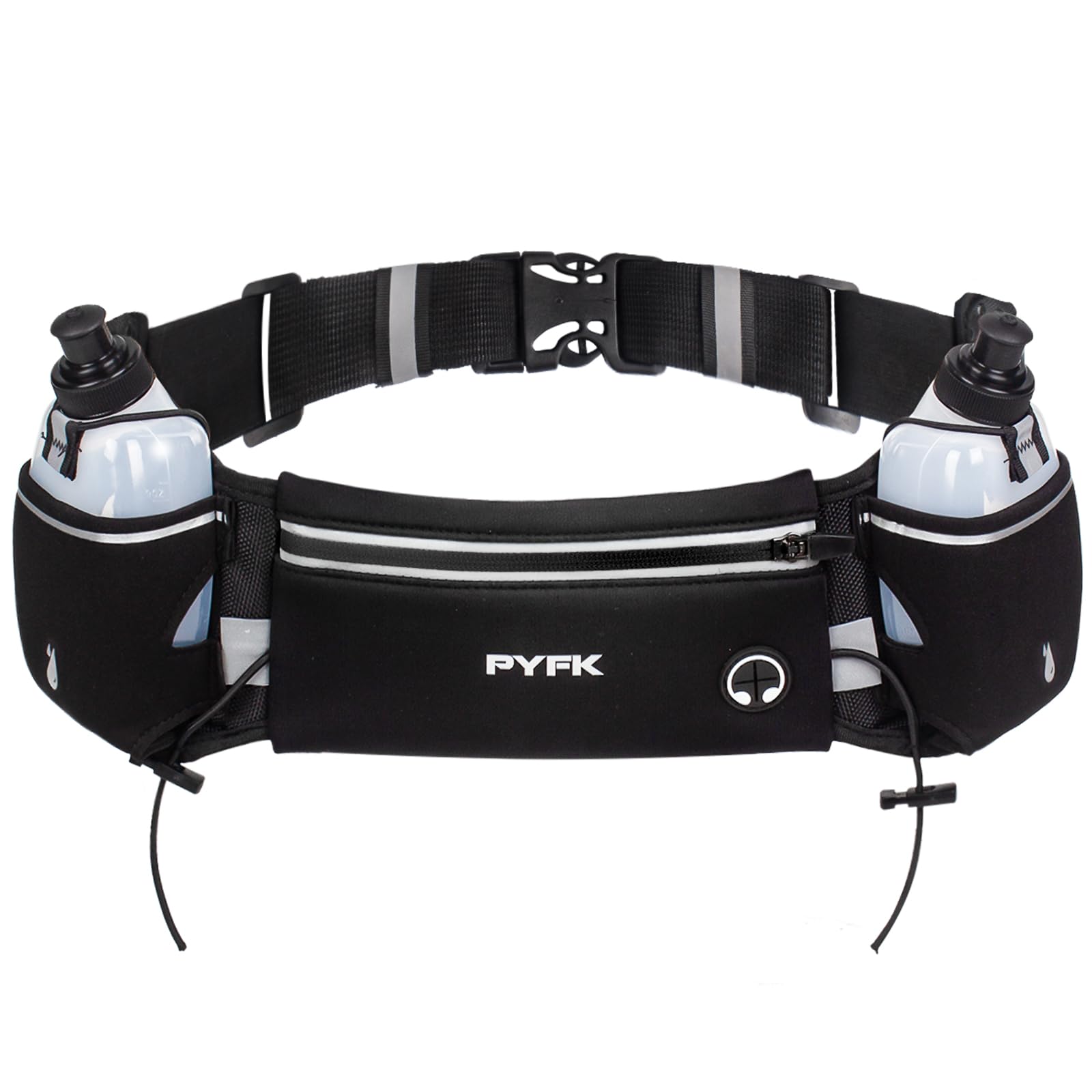
A 25-to-60-inch waist range is the widest in this group, and it is the first reason the PYFK is in this guide. The belt is built for runners who have trouble finding a band that closes comfortably, and the two 10-ounce bottles give it enough capacity for a normal training run.

The rest of the package is practical: a 7-inch main pocket for a big phone, reflective straps for early or late runs, and a waterproof shell that shrugs off drizzle. The silica-gel grip inside the band is a nice detail because it gives the belt something to hold onto when your shirt is damp.

The fit is the caveat. The wide range does not guarantee a perfect fit; the belt can stay snug on some waists and still shift on others, and the bottles sit far enough forward that some runners catch them with their arms. If you are between sizes, treat the range as a starting point and check the belt with a full load before a long run. For a runner who has struggled with tight bands, that adjustability is still the main draw.

We rank it as the belt to try when standard belts are too tight, not as the universal pick. That is a narrower role, but it is a useful one: a 60-inch strap is rare in this group, and the 7-inch pocket is the detail that makes it feel less like a compromise.

Bottom line: The PYFK belt is the one to try if most belts cut into your waist: it adjusts from 25 to 60 inches and carries two 10-ounce bottles.

#8

Simptech Running Belt

Simptech Running Belt

Casual runs

Our Score 8.6/10
Check Price

Worth Noting

  • Waist range tops out at 41 in
Pockets
3 zippered
Waist Fit
23-41 in
Bottle Holder
750 ml / 25 oz
Carry Options
5 ways
Read the full review

The foldable bottle holder is the trick that makes the Simptech more versatile than a standard running belt. It unfolds to take a 750 ml bottle and flattens when you are not carrying water, so the same belt works for a short run, a dog walk, or a trip to the store. The five carry modes, including crossbody and chest carry, are not a gimmick if you want one bag to do several jobs.

We like it best as an everyday belt rather than a race-day belt. The three zip pockets keep a phone, keys, and a gel separate, and the middle pocket fits phones up to 6.5 inches with an Otterbox case. The water-resistant nylon is a sensible choice for sweat and light rain, and the separate compartments mean you are not digging past a phone to find a key.

The holder is built around a 750 ml bottle, so check that your bottle fits before you rely on it for a long run. The belt is also better suited to casual paces than to a hard tempo; with a full bottle, the weight is noticeable in a way that a two-bottle race belt hides better. The phone pocket is the part we use most, because it keeps a big phone separate from keys and gels.

Bottom line: The Simptech belt is the casual-run pick: a foldable bottle holder, three zip pockets, and enough carry options for errands as well as jogs.

How We Tested the Best Running Hydration Belts

We started by pulling together roughly 50 belts sold by running specialty brands and larger outdoor retailers, then narrowed that list on the specifications that separate a usable belt from a fussy one: bottle size and closure type, how many pockets there are and how deep they run, the strap's adjustment range, and whether the whole thing can go in a washing machine. Price factored in, but only as a sanity check — a belt that costs twice as much still has to sit still. Fourteen made the cut, and each one logged four months of real running.

Every belt went out on the same set of runs: easy weekday 5Ks, a weekend long run of 10 to 20 miles, one rainy morning, and at least one trail session with a phone and two gels packed in. I loaded each to its stated capacity and ran a mile of strides to see how much it bounced, then checked whether the straps had crept or the buckle had rotated off-center. For sizing, I measured each strap's full adjustment range and wore the belt over a thin tee, over a rain shell, and against bare skin to watch for rubbing.

Leak testing was blunt: I filled every bottle to the line, turned it upside down, squeezed it, then left the loaded belt in a gym bag for a day to see what seeped out. Ease of use got checked mid-run — refilling a flask one-handed, fishing a gel out of a rear pocket without breaking stride, tightening a strap while moving. Durability came last, through repeated washes, seam and zipper-pull inspections, and a hard look at whether the elastic had gone soft.

How to Choose Running Hydration Belts

Put Fit and Stability First

A belt that slides or bounces will ruin a run faster than a small bottle will. Look for a band that sits low on the hips or snug around the waist, with a stated range that includes your measurement and enough adjustment to tighten after you start. We prioritize a no-bounce fit over extra pockets because storage cannot make up for a belt you keep hiking up. If you are between sizes, choose the range that puts you near the middle rather than at the last notch.

Match Water Capacity to the Run

Most running hydration belts carry between 12 and 20 ounces across one or two bottles. A 12-ounce setup suits short efforts and races with aid stations; 16 to 20 ounces covers an hour of training for many runners, while a holder that takes a 750 ml bottle is better for walkers and hikers. We treat bottle volume as a range to match to your longest unsupported run, not a score. If you sweat heavily or run hot, plan a refill rather than buying more capacity than you want to carry.

Decide Whether Bottles Come Included

Belts that include bottles are ready from the box: the holsters are sized to the bottle, and the caps are part of the system. Holder-only designs let you use a bottle you already trust and can be more versatile off the run, but you need to check that your bottle fits the sleeve and does not sit too high. We prefer included bottles for race-day simplicity and a holder-only design when the belt doubles as a walking or travel pack. The Simptech belt is the holder-only example here; the Fitletic Hydra 16 is the included-bottle one.

Check Pockets, Phones, and Wear Points

A dedicated phone sleeve protects the screen and keeps a large phone from sliding around with keys. Look for a pocket sized for your case, a separate spot for cards or gels, and zippers that are easy to work with one hand. Before you commit, inspect the holster stitching, strap attachment, and bottle caps; those are the parts that wear first. Reflective trim is a small bonus for early or late runs, but fit and secure carry matter more.

Frequently Asked Questions

Final Verdict

The Runtasty No.1 is the belt we recommend first because it balances a secure no-bounce fit with 20 ounces of water, a reachable phone pocket, and enough room for keys and gels. If you want to spend less, the AiRunTech covers the same two-bottle layout and race-day details, with a lighter build to keep an eye on. For a race-specific hip fit, the Fitletic Hydra 16 is the alternative. If standard belts are too tight, try the PYFK first.