Accessories

Best Running Headlamps of 2026

The scariest part of a predawn run shouldn't be the stretch of unlit path ahead of you. A running headlamp fixes that—it keeps your hands free, puts light where you're looking, and makes you visible to drivers without turning your stride into a juggling act. But brightness alone doesn't make a good one. I've learned that a well-shaped beam at a sane output beats a harsh spotlight that washes out roots and drains the battery in forty minutes. Over the past four months, we've run with 14 headlamps, from featherweight road models to burlier trail lamps.

The differences showed up in small places: straps that stayed put when I tightened a ponytail, buttons I could find with gloves on, and battery indicators that didn't lie at mile eight. We paid attention to adjustability, because a lamp that won't tilt or fit over a cap is a lamp you'll leave home. We also weighed the trade-off between a bigger battery and a lighter lamp—you feel every extra ounce after an hour. The picks below are the ones we kept reaching for, whether the run was a quick neighborhood loop or a wet, muddy trail.

#1

Klarus HM1

Top Pick
Klarus HM1

All-around running

Our Score 9.4/10
Check Price

Worth Noting

Weight
3 oz
Runtime
70 hours (low)
Max Output
440 lumens
Water Resistance
IPX6
Read the full review

The Klarus HM1 pairs 440 lumens with a body that weighs about 3 ounces. That is enough light for a road run or a moderate trail after dark, and it avoids the front-heavy feel of the high-output lamps here. The head tilts through 60 degrees so you can aim the beam down the path, and the motion sensor lets you switch modes without finding a button with cold hands.

Runtime is the part that matters over a full season. Klarus lists 70 hours on low and 8 hours on medium, with a 2.5-hour recharge, so a daily runner can top it up once or twice a week rather than every night. IPX6 sealing and a 2-meter drop rating make it the most weather-ready pick here, going beyond the IPX4 splash protection of the budget lights. The default medium start and three-second delay off are small conveniences you notice when you are wearing gloves.

The HM1 earns the top spot because it gets the running essentials right without asking you to choose between brightness, weight, and battery life. It is neither the cheapest nor the most powerful lamp in this group, and it does not try to be. For most runners that restraint is the point: a secure, bright, weatherproof light that is easy to live with, backed by a two-year warranty. If your routes are technical and you need a spot beam that reaches much farther, the Coast is the better tool. For everyday road and trail miles, it is the one we put first.

Bottom line: Our top pick for most runners: a light, bright, weatherproof lamp with enough runtime for everyday road and trail miles.
#2

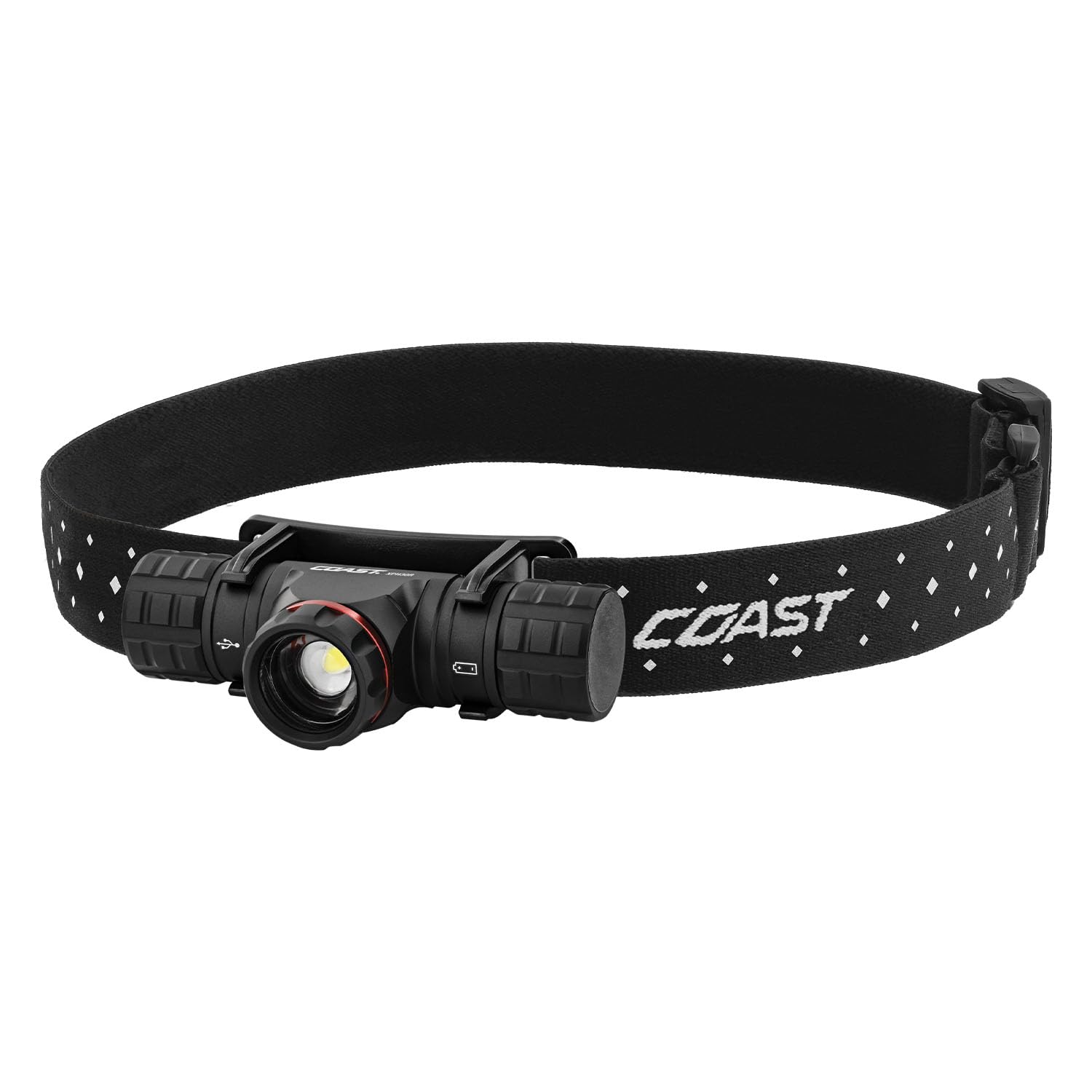
Coast XPH30R

Coast XPH30R

Technical trails

Our Score 9.4/10
Check Price

Worth Noting

  • Heaviest pick here at 4.37 ounces
  • Lifetime warranty excludes battery and charging gear
Weight
4.37 oz
Max Output
1200 lumens
Water Resistance
IP54
High-mode Runtime
6.75 hours
Read the full review

A twist of the Coast XPH30R's bezel shifts the beam from a wide flood to a tight spot, which is the reason it earns a place for technical trails. At 1200 lumens on turbo and 500 on high, it reaches farther than any other light in this group, and the focus ring lets you shape that reach instead of accepting a fixed pattern. We like that for descents, rooty singletrack, and any route where a pool of near light is not enough.

The body is aluminum, and it detaches from the bracket to work as a magnetic handheld light. That makes it more useful than a running-only lamp around a car, a tent, or a repair. IP54 sealing covers dust and splashes, the body is rated for a 1-meter drop, and the lifetime warranty is the strongest coverage here. USB-C charging keeps it simple between runs.

This is a specialist rather than an everyday pick. The twist focus and 1200-lumen turbo are for seeing detail at distance, not for flooding a bike path. If your night runs are mostly pavement, the Klarus is the easier all-rounder. If you need to see the next switchback, the Coast is the one for the job.

Bottom line: We choose the XPH30R for technical trails, where the twist-focus reach and tough magnetic body earn their place.

#3

Energizer Vision HD+ PRO 2-Pack

Energizer Vision HD+ PRO 2-Pack

Budget road running

Our Score 9.4/10
Check Price

Worth Noting

  • No rechargeable battery; recurring AAA cost
Battery
3 AAA per lamp (included)
Runtime
35 hours
Max Output
260 lumens
Water Resistance
IPX4
Read the full review

The appeal of the Energizer Vision HD+ PRO is getting two 260-lumen headlamps in one box. The pair makes sense for a runner who wants one lamp in the gear bin and one in the car, or for a household that shares lights. Each has an 80-meter beam, high, spot, and wide modes, stepless dimming from 10% to 100%, and a 35-hour runtime from three AAA cells. Batteries are included, so it works out of the box.

This is our budget pick because the dimming is more useful than the headline output suggests. Turning a 260-lumen lamp down to a low setting keeps it from blinding oncoming traffic and stretches the cells on a familiar route. The simple three-mode control is easy to find by feel, and IPX4 covers rain and road spray. It is not a trail light, and the beam is better at lighting the path ahead than reaching across a valley.

The case for the Energizer is simplicity rather than sophistication. There is no charging schedule to remember and no battery to baby; when the light dims, you swap cells. That makes it a sensible glove-box or travel lamp as well as a runner's spare. For a dedicated everyday runner, the rechargeable Klarus is the better long-term pick, but the Energizer pair is hard to beat as a low-cost kit.

Bottom line: The budget answer we like for simple road runs: two dimmable lamps and AAA batteries in the box.

#4

Energizer PRO-360

Energizer PRO-360

Long night runs

Our Score 9.4/10
Check Price

Worth Noting

  • No USB charging; relies on three AAA cells
Weight
3.52 oz
Battery
3 AAA (included)
Runtime
50 hours
Max Output
360 lumens
Read the full review

The Energizer PRO-360's headline is its 50-hour runtime, but the red and green modes are what make it useful after dark. We think that combination makes it the simplest long-night option in this group: no charging cable to remember, just a set of AAA cells and a light that can shift to a low, less blinding color around camp or at an aid station.

At 360 lumens it throws an 85-meter beam, and VisionGuard ramps the output up gradually rather than hitting your eyes with full brightness. The high, low, wide, wide-low, green, and red modes cover more situations than most runners need, but the extra choice costs little in weight. Three AAA batteries are included, and IPX4 sealing handles rain and splashes. The 50-hour number is a best-case runtime, not what you get at full output.

This is the light for a runner who wants a low mode that can run all night and does not want another charging routine. It is not as compact as the Klarus, and it does not have the Coast's focus, but it is easy to live with and easy to replace. We see it as the dependable battery-powered alternative for long, cold nights when charging is one more thing to worry about.

Bottom line: Our pick for long nights: red/green modes, a 50-hour low-runtime claim, and easy AAA swaps without a charging routine.

#5

SLONIK 1000 Lumen

SLONIK 1000 Lumen

Bright commutes

Our Score 9.2/10
Check Price

Worth Noting

  • Runtime is listed at four hours
  • Plastic strap bracket is a weak point
Weight
4 oz
Runtime
4 hours
Max Output
1000 lumens
Water Resistance
IPX4
Read the full review

A 1000-lumen aluminum headlamp at a midrange price is the SLONIK's pitch, and the metal body is the first thing that separates it from the plastic lights here. The main lamp swivels 90 degrees and detaches from the band, so it can be used as a handheld light or clipped to a pack. Six brightness levels and three modes give you more control than the single-button budget lamps.

We think it earns a place for short, bright outings. The 1000-lumen maximum is enough to turn a dark commute into daylight for a few seconds at a time, and the lower levels are the ones you will actually run with. USB-C charging is convenient, and the aluminum housing feels more substantial than the ABS bodies of the cheaper picks. The single large button is easy to find with gloves.

This is a bright specialist rather than the most versatile lamp here. For a commute where you want maximum light in short bursts, it is a strong value; for a long night out, the battery-powered Energizer is the more sensible choice. If your route is short and you want a light that feels like a tool rather than a toy, the SLONIK makes sense.

Bottom line: We like it for short, bright commutes and trail loops where maximum output matters more than all-night runtime.

#6

GearLight S500 2-Pack

GearLight S500 2-Pack

Backup and casual

Our Score 9.2/10
Check Price

Worth Noting

  • Uses three AAA batteries per lamp, not included
  • Strap durability is the weak point
Weight
3 oz (with batteries)
Battery
3 AAA per lamp (not included)
Runtime
10 hours
Max Output
200 lumens
Read the full review

The GearLight S500 two-pack is less a dedicated running light than a pair of inexpensive headlamps you can leave in a car, pack, or garage. That is not a criticism so much as a description: at 200 lumens, it is built for close and medium-range tasks, not for picking out a technical trail at speed.

Each lamp weighs about 3 ounces with batteries, tilts through 45 degrees, and has seven modes including white, strobe, and red. The adjustable band is washable, and the 10-hour runtime comes from three AAA cells. The simple controls are easy to learn, and the red mode is handy for preserving night vision.

For running, the beam is best on pavement, a lit path, or a familiar loop where you need to see the next few feet and be seen. It does not have the reach or the weather sealing of the better running lights here. The two-pack makes more sense as a household or emergency kit than as a single runner's primary lamp.

We see it as the glove-box answer rather than the light we reach for on a serious night run. If you want one lamp for occasional jogs, dog walks, and power outages, the pair is useful. If you are training after dark several times a week, the Klarus or the Energizer is the better investment.

Bottom line: We see this two-pack as casual-run and emergency backup, not as a serious trail light.

#7

Lepro Rechargeable 300

Lepro Rechargeable 300

Budget rechargeable

Our Score 9.0/10
Check Price

Worth Noting

  • Battery can stop holding a charge over time
Weight
2.86 oz
Runtime
30 hours
Max Output
300 lumens
Water Resistance
IPX4
Read the full review

The Lepro rechargeable headlamp is the cheapest way into USB-C charging in this group, and that is most of its appeal. It weighs 2.86 ounces, tilts through 45 degrees, and puts out up to 300 lumens with white and red modes. For a low-cost light, the feature set is sensible: high, low, strobe, red steady, and red flash.

The 30-hour runtime is a low-mode figure, and you will get far less on high, but the light is easy to top up from a phone charger or laptop. IPX4 covers rain and splashes, and a 500-foot beam is more reach than a road runner needs. The red mode is useful for map checks and camp without wrecking night vision. The band adjusts easily and the lamp is light enough to forget you have it on.

We like it as the budget rechargeable for casual road runs and as a second light in a pack. It does not pretend to be a trail specialist, and for a first rechargeable or a spare, it is an easy yes. If you want better weather sealing and a more proven battery, the Klarus is the step up.

Bottom line: We recommend this budget rechargeable for casual road runs and spare-light duty, with USB-C charging and a useful red mode.

How We Tested the Best Running Headlamps

We started by scanning runner forums, outdoor-gear reviews, and manufacturer spec sheets, then narrowed the field by beam type, weight, strap design, battery claims, and price. We ended up with 14 headlamps and ran with each one for four months—on predawn road loops, after-work trail runs, and a few rainy long runs when I deliberately left the charger at home. Every lamp went on at least three runs a week, and we rotated them so no model got only easy weather.

Brightness was judged on unlit pavement and root-covered trail, not just the lumen number: I noted whether the low setting was enough to see cracks, whether the hotspot tunneled my vision, and whether the beam held steady as the battery drained. To check adjustability, we tilted each lamp up and down mid-run, loosened and tightened straps with gloves on, and wore them over a thin cap and a ponytail. Weight got a simple test—20 minutes of running, then a shake test—and we marked any lamp that bounced or left a pressure point. Battery life was timed on the highest usable setting, with a mid-run check of how honest the indicator was. Durability meant drops onto pavement, rain, and stuffing them uncased into a gym bag. We also compared what each lamp delivered for its price, since reliability and performance matter more than a flashy spec.

How to Choose a Running Headlamp

Match the beam to the route

For road running, 200 to 400 lumens is the useful range: enough to read the pavement and be seen without overwhelming your eyes or oncoming traffic. Trail running rewards more reach, but extra brightness usually adds weight and drains batteries faster. A wide beam helps you spot roots and curbs near your feet; a tighter spot reaches farther down the trail.

We like the Klarus HM1's 440-lumen beam as an all-round compromise, while the Coast XPH30R's twist focus is the specialist choice for technical descents. If your route is mostly lit streets or a familiar loop, a 200-lumen lamp such as the GearLight can be enough. Do not buy the highest lumen number alone; buy the beam shape your route asks for.

Prioritize weight and a stable band

At running pace, a lamp that shifts is more distracting than a few lumens lost. Self-contained running lights generally land between 3 and 4.5 ounces; the Klarus is about 3 ounces and the Coast is 4.37. A wide elastic band and a lamp head that sits close to your forehead reduce bounce.

Try the band with the hat, headband, or buff you actually run in, then tighten it until the lamp is snug without pinching. Check that the tilt hinge stays where you put it and that the battery weight does not pull the front down. If you have long hair, make sure the strap can be adjusted without catching.

Understand runtime and battery style

Runtime is not one number. The Klarus lists 70 hours on low but 8 hours on medium; the Coast lists 6.75 hours on high. Plan with the mode you will actually use, not the longest quoted figure. High output and cold weather both eat into runtime.

Rechargeable lights save on cells and usually top up in a couple of hours, but an AAA lamp can be back in service with a swap. For a daily runner, rechargeable is simpler; for a car kit, a multi-day trip, or a household shared light, disposable batteries are easier to manage. Carry spare cells if you choose AAA.

Weather sealing and controls matter

IPX4 handles rain and splashes, which is enough for most road running. IPX6 withstands powerful jets and is the better choice for exposed trail runs. No rating makes a lamp safe to swim with, so do not treat a high IP number as permission to submerge it.

Controls matter with cold hands. A single large button, a motion sensor, or a dimming function you can find without looking keeps you moving. The Coast's twist focus is easy to operate with gloves; the Klarus's gesture sensor keeps your hand off the button. We prefer a light that starts on a usable medium rather than blasting turbo every time.

Frequently Asked Questions

Final Verdict

Start with the Klarus HM1. At about 3 ounces it is light enough to stay put, bright enough for road and moderate trail running, and sealed to IPX6, with runtime that covers several runs between charges. That combination makes it the easiest recommendation for most runners.

Choose the Coast XPH30R if your routes are slower and more technical and you need a twist-focus beam with real reach; accept the extra weight. For a simple battery-powered kit, the Energizer Vision HD+ PRO two-pack is the budget alternative.