Accessories

Best Hydration Vests of 2026

A hydration vest should disappear on your back, not turn a familiar loop into a wrestling match with a bouncing bottle. What most shoppers need is enough water, food, and layers for the day’s plan without fabric swallowing your shoulders or a gel hiding in a pocket you cannot reach while moving. The right vest keeps the essentials close, stable, and accessible, then stays out of the way once you start moving.

My team and I have spent the past seven months testing 12 hydration vests on trail runs, road runs, and long weekend hikes, from quick after-work outings to six-hour days above treeline. The differences come down to fit and stability first, storage that makes sense second, and the unglamorous details — seams, zippers, whether a flask leaks into your phone pocket, and whether the materials and hardware justify the cost. Capacity you cannot access while moving is just extra weight. The picks below are the ones that earned their place.

#1

MOKURA Running Vest

Top Pick
MOKURA Running Vest

Hot summer runs

Our Score 9.4/10
Check Price

Worth Noting

  • Comes with one 500 ml flask only
Weight
9.6 oz
Pockets
5
Chest Straps
3
Flask Volume
500 ml
Read the full review

At 9.6 ounces this is the lightest full vest here, and that is the whole argument. On a hot afternoon you notice a vest's weight long before you notice its pocket count, and we kept forgetting this one was on, which is the best thing you can say about running kit.

The storage is the surprise. Five pockets on something this light, including a sweatproof phone holder on a retractable coiled lanyard, is a small feature that turns out to matter when you want to glance at a message without unclipping a chest strap.

Water is a single 500 ml soft flask with an elastic cinch that compresses it as you drink, so it stops sloshing around. That is the right call for an hour of running and the wrong one for a self-supported half, so treat it as a race vest for events with aid stations.

Three chest straps and stretch waist panels hold it steady, and the reflective accents front and back do the visibility work on evening runs.

Bottom line: We like it for hot, fast runs where every ounce counts and a single flask is enough.

#2

Criuage Hydration Vest

Criuage Hydration Vest

Running and hiking

Our Score 9.0/10
Check Price

Worth Noting

  • Heaviest pack in this set at 750 g
Weight
1.65 lb
Pockets
8
Pack Capacity
5 liters
Bladder Volume
2 liters
Read the full review

Two litres is the number that separates this vest from most of the ones here. With the bladder full it covers the long run you would otherwise have to route past a water fountain, and the 5 litres of cargo behind it swallows a shell, a few gels and a phone without turning into a lump between your shoulder blades. Water plus space is the combination that matters most in this category, and this pack gets both right.

Eight pockets do the organising: four across the front where you can reach them at a shuffle, four at the back, including a double compartment for the layer you take off ten minutes in. The chest and shoulder straps pull the load in tight against your back rather than hoisting it up on your shoulders, which is what stops a full bladder from swinging.

Weight is the trade. This is the heaviest pack here, so we steer racers toward the lighter vests in this guide and keep this one for training days and hikes where the extra litre is worth more than the extra grams. Set the harness before you fill the bladder, too: two litres will drag a loose fit down your back, and the shoulder straps take an outing or two to dial in.

Where it earns its keep is the second hour, when a small bottle has run dry and a daypack would be sliding off one shoulder.

Bottom line: We suggest this one if you want a single vest for long training runs and full days on the trail, with the water and cargo to head out without a plan.

#3

SWIFTVEST Running Vest

SWIFTVEST Running Vest

Fast road runs

Our Score 9.0/10
Check Price

Worth Noting

  • 500 ml flask is short-run sized
Sizes
3
Weight
10.1 oz
Pockets
6
Flask Volume
500 ml
Read the full review

Six pockets and a single 500 ml flask put this on the other side of the line from the reservoir packs. It is built for the runner whose phone, keys, gels and headphones all need a home: 285 g, a soft neoprene harness that sits close instead of flapping, and reflective detailing for the ends of the day.

We ended up treating it as the everyday vest of the group. The zipped front pocket is the reason, because your phone rides where you can reach it without unclipping anything, and the waterproofing means a shower does not end the run. It is snug, though: a big phone in a thick case just fits, so try your own case before race day.

Water is the honest limit, and it is one you can work around. There is room for a second flask in the bottle pocket, and this is a vest for routes where a tap or a shop is never far away. For 5K to half marathon training, that covers most days.

It comes in three sizes rather than the one-size-fits-most approach, and the fit holds steady when you pick the pace up. If you have been running with a phone in your hand, this is the simplest fix here.

Bottom line: We hand this to runners who want their phone, keys and gels as sorted as their water: light, stable and easy to live with.

#4

Salomon Agile 12 Set

Salomon Agile 12 Set

All-day trail

Our Score 9.0/10
Check Price

Worth Noting

  • The most expensive vest in this set
Weight
13.8 oz
Pockets
3
Extra Carry
Trekking poles and helmet
Included Flasks
500 ml
Read the full review

This is the expensive one, and the price is the first thing to deal with. What it buys is a harness rather than a bag: a lightweight bib with open 3D mesh, front storage for flasks and gels, and a three-point attachment that links the shoulder straps to a flexible hip belt.

The load carrying is the point. Trekking poles and a helmet each have a home, so the same vest covers a fast trail run and a technical hike, and the flasks in the set sit up front where you can drink without breaking stride. For a pack that carries that much, 390 g is light.

We think it earns the money if you are out for hours rather than minutes. The cheaper vests here hold water and a phone beautifully; what they do not do is carry poles and a shell all day without the load starting to shift, and that is the gap this one fills.

It is also the least fussy to live with: front storage, a couple of compartments, and nothing to fiddle with when you are tired and the light is going.

Bottom line: We recommend it for long days in the hills when you are carrying poles or a helmet as well as water.

#5

Katroiy Running Vest

Katroiy Running Vest

A first vest

Our Score 9.0/10
Check Price

Worth Noting

  • Single 500 ml flask
  • Simple mesh build with minimal structure
Weight
7.05 oz
Flask Volume
500 ml
Stated Fit Limit
300 lb
Read the full review

The claim that stands out is the fit: the shoulder straps adjust to suit a stated 300 lb, which is a wider range than most of the vests here offer, and it is the reason we point bigger runners here first.

What you get for the money is a genuinely usable first vest. The 500 ml collapsible flask sits in an elastic front pocket, a chest buckle stops the front panel swinging, and reflective webbing across the chest does the same job as the expensive vests' trim. At 200 g it is the lightest thing in this group.

The shape of the thing tells you what it is for: one flask, a set of soft front pockets and a simple mesh body. That makes it an hour-on-the-road vest or a fast park loop rather than a mountain day, which is fine if that is the running you do.

When it arrives, fill the flask and jog on the spot. If the bottle rocks around in its pocket, tighten the chest strap before you take it outside, because that one check is the difference between a vest you wear and one that stays in the cupboard.

Bottom line: Our pick for a first vest and for bigger runners: it fits a wider range of bodies than anything else in this group.

#6

Azarxis 5L Hydration Vest

Azarxis 5L Hydration Vest

Long trail days

Our Score 9.0/10
Check Price

Worth Noting

  • 1.5 litre bladder holds less than the 2 L packs here
Weight
12 oz
Pockets
9
Pack Capacity
5 liters
Bladder Volume
1.5 liters
Read the full review

The rose red is what got our attention first, and it is a welcome change from a category that mostly ships black. What holds the attention is the layout: nine pockets, a 5 litre body and a 1.5 litre bladder in a pack that weighs 340 g.

It is a trail vest rather than a race vest. The rear compartment and mesh shoulder straps are built for a few hours out, the drop pocket takes a phone, and the elastic cord across the front lets you stuff a shell without stopping.

The bladder is the compromise. At 1.5 litres it holds less than the two-litre packs here, and the bite valve is the first thing to test: fill it, drink from it at home, and swap in a two-litre bladder if the flow feels weak.

Chest and waist straps both adjust, and the whole thing sits close once they are set. For long trail days where you want water, snacks and a layer without a daypack, it does the job.

Bottom line: We point trail runners here when they want a light, roomy vest for a few hours out and a bit of colour.

#7

Zelvot Race Vest

Zelvot Race Vest

Marathon race day

Our Score 8.8/10
Check Price

Worth Noting

  • Runs small; order by chest measurement
Weight
12.3 oz
Pockets
9
Chest Straps
3
Flask Volume
500 ml
Read the full review

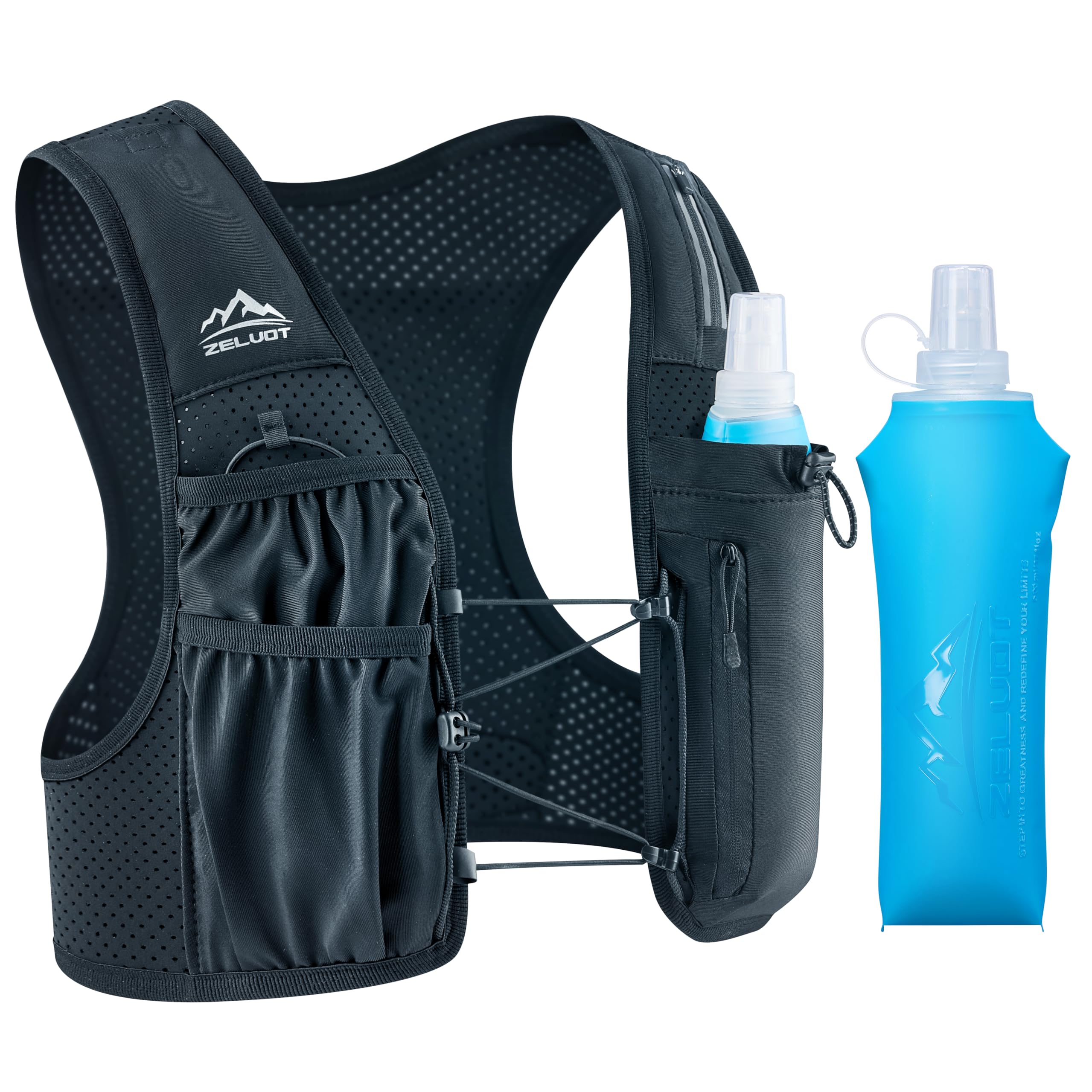
Two soft-flask pockets is the detail that sells this one. The 500 ml flask in the box fills one; add a second and you have a litre of water up front, which is a different proposition from a vest that carries a bottle and nothing else.

At pace this is the most planted vest in the group. Three chest straps pull the front panel flat against your sternum, and the nine pockets spread gels, a phone and keys across the front instead of stacking them into one lump. The rear zip pocket is a proper pocket, big enough for a shell, rather than a token sleeve.

The neoprene has enough stretch to sit close without chafing, and the venting does its job on warm days. Where it stops is the self-supported long run: a litre of water is a race-day amount, and for anything much beyond twenty miles one of the two-litre packs here is the better call.

Bottom line: For race day and fast training runs, this is the vest we choose, with nine pockets, two flask slots and a fit that stays flat.

#8

Zelvot Hydration Backpack

Zelvot Hydration Backpack

Rugged day hikes

Our Score 8.8/10
Check Price

Worth Noting

  • 0.65 kg is heavy for a running vest
Fabric
900D Oxford
Weight
1.43 lb
Front Pockets
3 zippered
Bladder Volume
2 liters
Read the full review

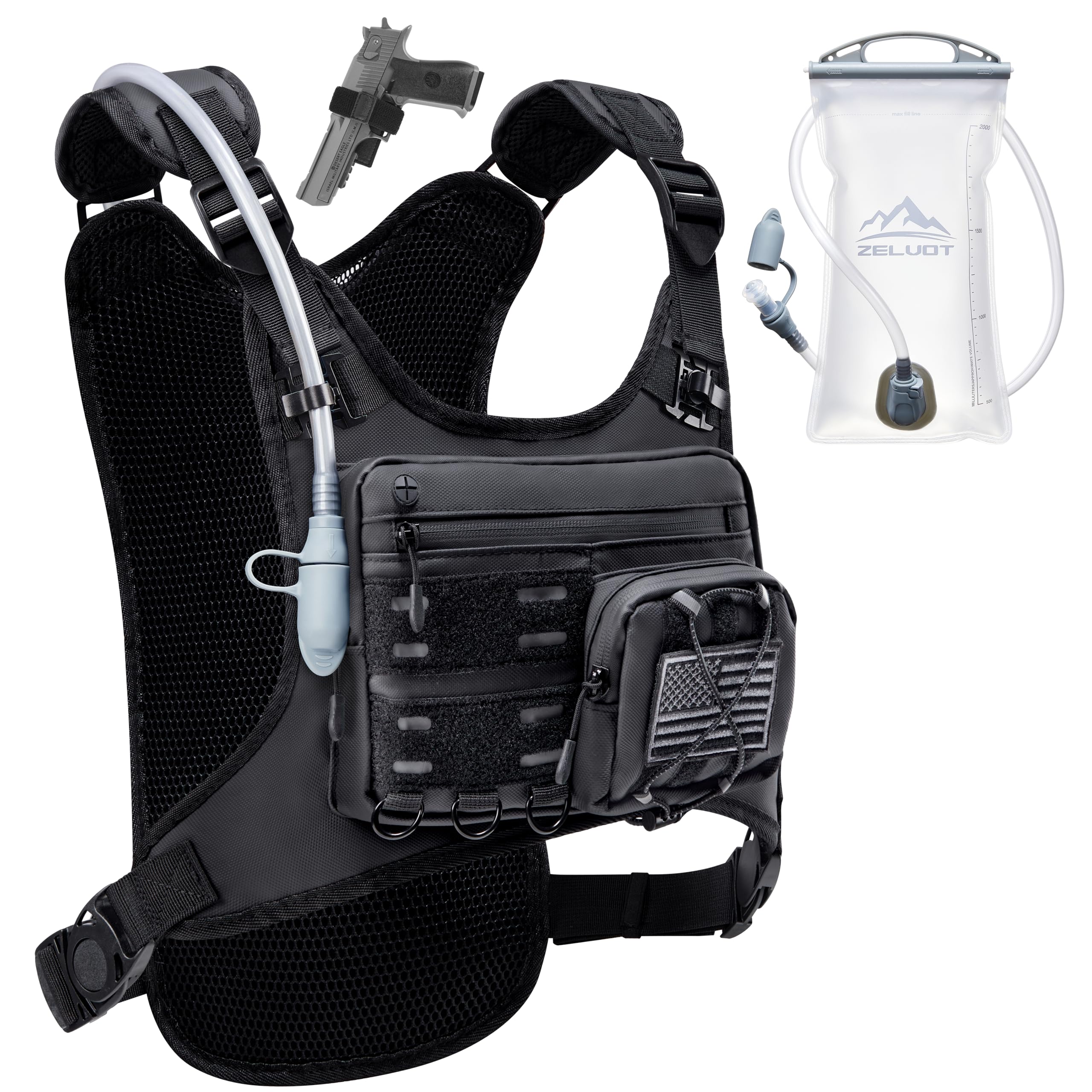
Nine hundred denier Oxford fabric across the front is the giveaway: this is the tough one. The three front pockets are zipped, waterproof and made to shrug off scratches, which is what you want on a vest that gets dragged through hedges, strapped to a bike or worn for hiking rather than racing.

Water comes from a 2 litre bladder with a high-flow bite valve, and both the shoulder straps and the waist belt adjust, so the load can be split between chest and hips instead of hanging off your shoulders.

We rate it for the rough stuff and not for the clock. At 0.65 kg it is heavier than the race vests here, and the shoulder adjusters can slide out of their buckles while you are putting it on, which is annoying at a cold start line and harmless once the straps are set and tightened.

Where it makes sense is a commute, a wet hike, or a day when your gear needs more protection than a mesh vest offers. This is a pack with a vest harness rather than a race vest, and it does that job well.

Bottom line: For commuting, wet-weather hiking and gear that needs protecting, we think this tough two-litre pack is the practical answer.

#9

Maelstrom Hydration Backpack

Maelstrom Hydration Backpack

Cycling and hikes

Our Score 8.8/10
Check Price

Worth Noting

  • Strap clips can slip while you tighten them
Weight
1.1 lb
Pockets
4
Bladder Volume
2 liters
Chest Strap Range
22.4–61 inches
Read the full review

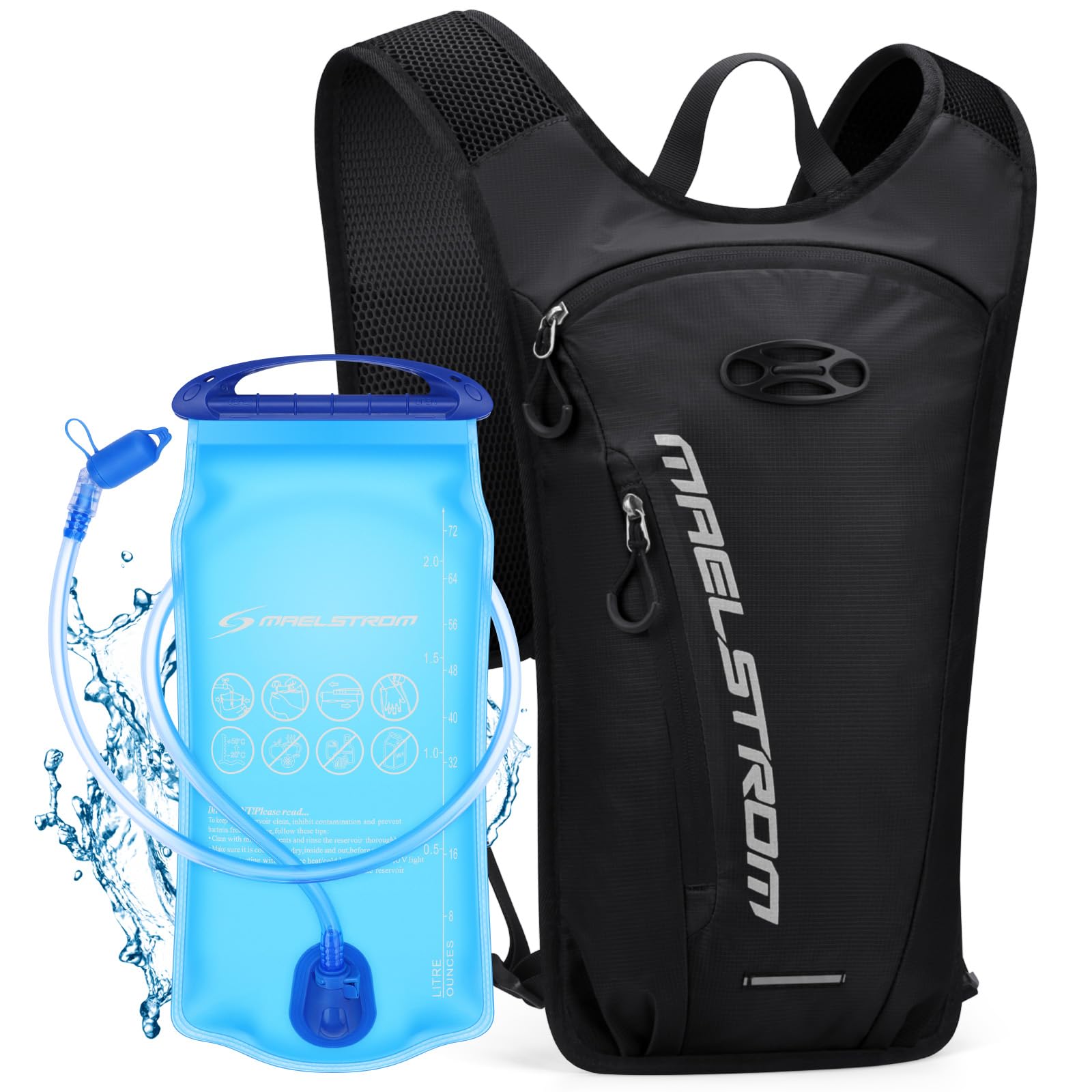
The thing to know before you buy is the bite valve. With a full bladder, bending right over to tie a lace or pick up a dog bowl can send water down your back. Closing the valve first solves it in two seconds, but it is the sort of detail a spec sheet never mentions.

Otherwise there is a lot of pack here for the money: two litres of bladder, four storage pockets, a lined sleeve for the reservoir and external clips that hold a cycling helmet. That is why it turns up on bikes and at festivals as often as on trails.

We think it is the best value of the bigger packs, as long as you are not running hard. The chest straps span a stated 22.4 to 61 inches, so they fit a wide range of bodies, and the load sits close once everything is set. It is a hiking and commuting pack that happens to run.

Bottom line: This is our value pick for hikers and commuters who want two litres and helmet clips without spending much.

How We Tested Hydration Vests

We started by scanning specs and reviews for vests with capacities from minimal race packs to 12-liter day packs, filtering out anything with limited size adjustment, fragile hardware, or a pocket layout that made the basics hard to reach. That left 12 vests, which we used over seven months on weekday road runs, local trail runs, and long weekend hikes. I wore some; other testers on my team wore the rest, rotating packs across different torso lengths and chest sizes so no single body type drove the results.

On every outing, we loaded each vest with two soft flasks, a phone, keys, two gels, and a light shell, then noted what bounced, what rubbed, and what we could reach without stopping. We tightened and loosened sternum straps mid-climb, ran downhill sections faster than was comfortable, and checked whether the vest rode up or shifted when we turned to look at the view. For storage, we paid attention to whether snacks stayed dry, whether a jacket could be stuffed away one-handed, and whether the pockets made sense in the order we actually needed things.

Back at the car, we filled every flask and bladder to its marked capacity, sealed it, shook it, and turned it upside down for an hour, then checked seams, zippers, and the fabric around the phone sleeve for moisture. We washed the vests repeatedly, stuffed them past their comfort zone, and looked for fraying at the shoulders, stretched mesh, and zippers that caught. Value came down to whether the materials, hardware, and usable storage held up after all that — not just how many liters the label claimed.

How to Choose Hydration Vests

Match Water Capacity to Your Longest Run

Start with the longest run you actually do, not the longest you plan to do. A 500 ml soft flask is an hour of easy running or a race with aid stations; 1.5 to 2 litres is a self-supported morning. Buying two litres for park loops means carrying weight you do not need and cleaning a bladder you barely used.

The middle ground is a vest with two flask slots. The Zelvot race vest takes a second 500 ml flask up front, which doubles the water without adding a reservoir, and it is the arrangement we suggest for anyone training through a marathon block.

Fit Is Decided at the Chest, Not by T-shirt Size

Measure around your chest, under the arms, and buy from that number. Several vests here run small, and a harness stretched to its last inch will chafe long before it bounces. Three chest straps give more usable adjustment than two and make more difference to stability than a padded back panel does.

If you are between sizes on a vest that runs small, go up. A vest that is slightly loose can be cinched; one that is already at maximum adjustment cannot.

Bounce Is a Harness Problem, Not a Tightness Problem

A vest that moves is usually a vest whose load is not anchored. Look for a harness that pulls the load against your back rather than hanging it from your shoulders: a waist belt or hip link, wide shoulder straps, and chest straps you can set at different heights. The Salomon's three-point attachment is the most elaborate version here; the Criuage's adjustable shoulder, chest and waist straps do much of the same work for less money.

Overtightening is the common mistake. The vest should feel close, not compressive, and you should still be able to take a full breath at pace.

Bladder or Flasks, and Where They Leak

Bladders hold more and let you drink without stopping. Flasks are easier to fill at a tap, easier to clean and let you see how much is left. Neither is better in the abstract, and plenty of runners end up with one of each.

What matters is the connections. The hose where it meets the bladder, the cap, and the bite valve are where water escapes. Fill the whole system and invert it over a sink before your first long run, and check the hose anchor holds once the bladder is full.

Pockets, Weight and What You Actually Carry

Empty weights in this group run from 200 g to 750 g, and every gram is a trade against how the pack carries a load. Pockets earn their place only if you can reach them while moving: a zipped phone pocket on the chest beats three rear compartments you have to unclip for.

Buy cargo room for the layer you will actually carry, not for the day you might. A 5 litre vest you fill once and then leave at home is worse than a 3 litre one you wear three times a week.

Frequently Asked Questions

Final Verdict

If you want one vest and no further research, buy the Criuage. Two litres plus five litres of cargo covers a half marathon and a full day on the hill, and the harness handles the weight once you have set it properly.

Change the brief and the answer changes. The SWIFTVEST suits road miles where refills are easy and pockets matter more, the Zelvot race vest is the one for a start line, and the Salomon earns its price when poles and a helmet come along.