Accessories

Best Gymnastics Bars of 2026

A gymnastics bar looks simple—two uprights, a padded bar, and a kid ready to hang—until it shifts. A shimmy during a cast or a wobble on a kip tells you whether the frame is secure. The right bar gives kids a safe place to build strength and gives parents one less reason to hover.

Over six months, my team and I assembled and lived with 12 gymnastics bars, from foldable beginner models to larger training bars. We adjusted heights for kids and teens, timed assembly, folded each for storage, and watched frame movement during hangs, casts, and kips. The best were well built, sturdy enough to trust, adjustable enough to grow with a child, enjoyable enough that testers kept returning, and a good value for the use they got.

One thing I've learned: a height setting only counts if it locks firmly. A tall bar that wobbles is worse than a lower one that stays planted. The picks below held up to daily family use, with the trade-offs that matter spelled out.

#1

Safly Fun Gymnastics Bar

Top Pick
Safly Fun Gymnastics Bar

Most families

Our Score 9.6/10
Check Price

Worth Noting

  • 51-inch top is the ceiling for a tall preteen
  • Costs more than the bare folding bars
Folded Size
17 in
Height Range
35"–51"
Height Settings
5
Weight Capacity
145 lb
Read the full review

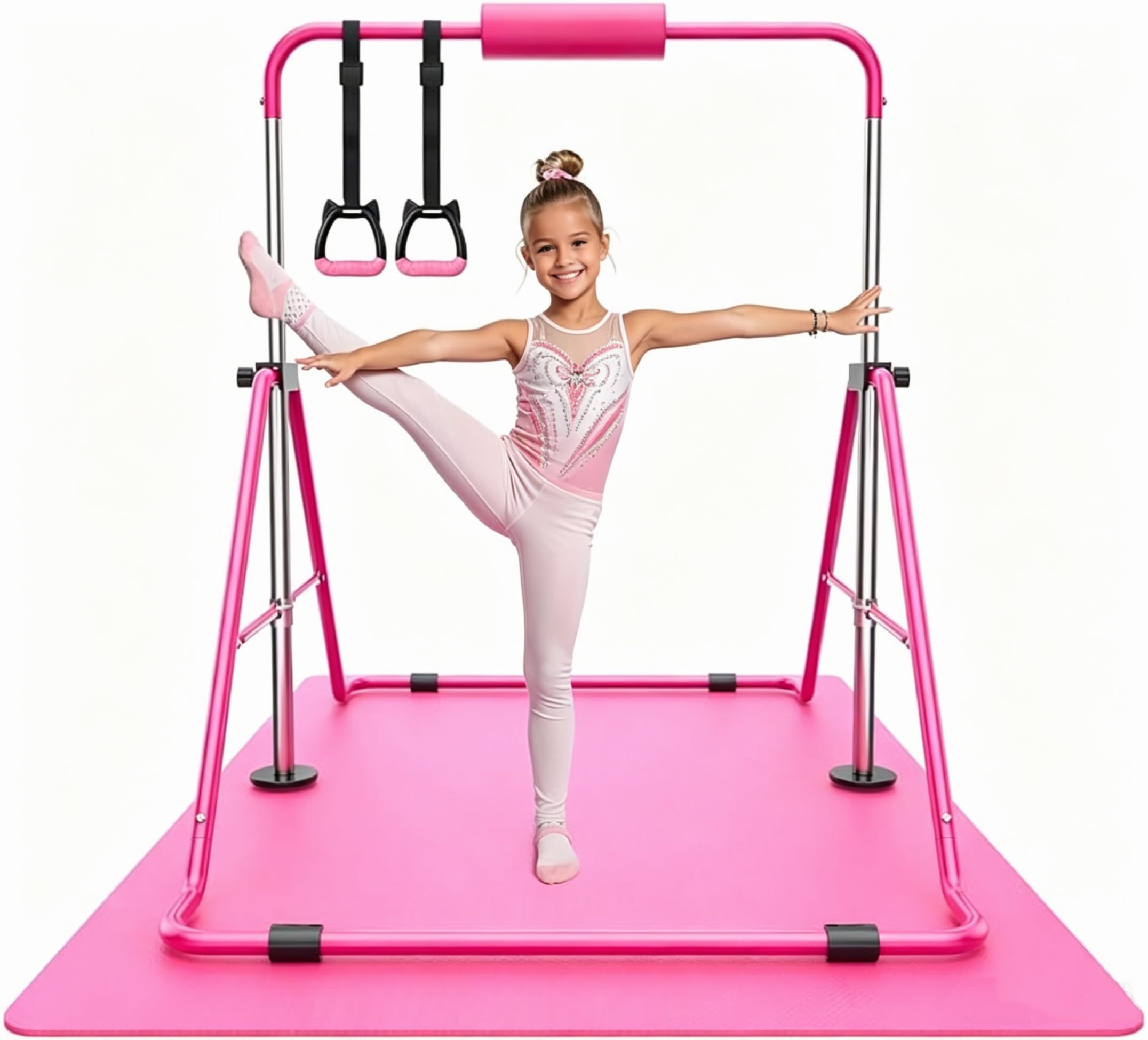
A landing mat ships in the box with this bar, and that single inclusion is why we hand it to most families first. A bar and a mat are usually two purchases, sized and paid for separately, and the mat is the half people postpone. Safly Fun puts both in one order, and the bar itself runs through five heights from 35 to 51 inches.

We recommend it first because there is no weak spot to warn you about. The frame holds steady under a swinging kid, the height pins line up on both sides, and assembly is a short job with clear directions that one adult can finish while a birthday breakfast is still on the table. The rail, the bolts and the folding hinge all feel like more bar than the money suggests.

The fold is what sells it to anyone without a gym room. It collapses from a full 57-inch bar to a 17-inch bundle, which is the difference between equipment that lives in the playroom and equipment that gets tucked behind the couch. The cushioned bar pad earns its place too: it is what a kid's hips and stomach meet during hip circles and front support.

Two things to weigh. The top setting is 51 inches, so a tall 11-year-old is already at the ceiling of what it offers, and the set costs more than the bare folding bars here — you're paying for the mat and pad as much as the frame. For a household with kids somewhere between 3 and 10, neither is a real obstacle.

Bottom line: We recommend it as the default family bar: a mat, a pad, five heights to 51 inches and a fold small enough to clear the floor, all in one order.
#2

Sportsroyals Gymnastics Bar

Sportsroyals Gymnastics Bar

Young kids

Our Score 9.6/10
Check Price

Worth Noting

  • 140-pound limit keeps it to kids
Frame
2 mm steel
In The Box
Bar, mat, pad, rings
Weight Capacity
140 lb
Read the full review

Every edge on this frame is rounded and the bar wears a thick cushioned pad — small details that matter on equipment a kid hangs from bare-handed. The mat that comes with it is PVC, waterproof and, the part parents notice, doesn't need days of airing out before it goes into a bedroom.

The frame is 2 mm steel rated to 140 pounds, with non-slip pads under the feet, and it folds compactly enough to lean against a wall between sessions. The rings detach, so they come off for solo bar work and go back on when friends are over. It is the shared-sibling bar of this group: steady enough that a 10-year-old and a 4-year-old can use it on the same afternoon.

Where it earns its place is as one order that ends the shopping: bar, mat, pad and rings, with nothing left to size up separately. We recommend it for a 4-to-10-year-old whose parents want the whole setup to arrive at once. The 140-pound rating is the boundary — it is a kids' bar, and the older siblings in the house will need one of the taller frames here.

Bottom line: We like it as the one-order setup for a 4-to-10-year-old: a waterproof mat, a padded bar and detachable rings, with a 140-pound ceiling.

#3

Tepemccu Gymnastics Bar

Tepemccu Gymnastics Bar

Young beginners

Our Score 9.4/10
Check Price

Worth Noting

  • 50.8-inch top suits kids up to about 8
In The Box
Bar, pad, rings
Height Range
34.8"–50.8"
Height Settings
5
Weight Capacity
140 lb
Read the full review

Rings and a bar pad come with this one, which is more than most bars in its price range include, and the pair turns a bare frame into a small playground on day one. The five settings run 34.8, 39.2, 42.3, 46.8 and 50.8 inches, the frame is rated to 140 pounds, and the maker aims it at ages 3 to 8.

Assembly is the easy part: the frame goes together with hand tools, and the pin-and-hole height changes are simple enough to teach a 7-year-old. Folded, it is slim enough to stand in a closet or slide behind a door, which is what makes it realistic in an apartment or a shared playroom.

Our reservation is the hardware. Screws work loose with steady use, and a bar that felt solid in March can feel loose by summer if nobody looks. Ten minutes with a wrench every few weeks, plus a glance at the joints after a sleepover full of kids, keeps it tight, and at this price we think that is a fair trade. Buy it for a 4-to-7-year-old who is just starting; if the gymnast is already close to 51 inches, step up to a taller frame.

Bottom line: We send preschoolers here: rings, a pad, five heights and the lowest kit price of our full-kit picks, as long as you'll tighten the bolts now and then.

#4

DOBESTS Gymnastics Bar

DOBESTS Gymnastics Bar

Budget headroom

Our Score 9.4/10
Check Price

Worth Noting

  • 51-inch top rules out teens
  • Age guidance stops at 7 despite the rating
Height Range
35"–51"
Height Settings
5
Weight Capacity
220 lb
Read the full review

A 220-pound rating on a folding bar that costs about what the 140-pound bars cost is why this one stays on our list. The five heights run 35, 39, 43, 47 and 51 inches on a pin lock, the base is the usual triangle with four rubber rings, and it folds like everything else in its class.

We treat the 220 as headroom rather than an invitation. The maker's own age guidance stops at 7, and 51 inches is the same ceiling as the budget bars, so this is a bar for a growing kid plus a friend, not for a parent's kip. What the money buys is real: nothing else in the folding group carries a higher rating, assembly is a hand-tools job, and the pin lock is easier to work than most.

Bottom line: We treat it as a middle option: 220 pounds of headroom, five heights and a fold-flat frame, though 51 inches is still the ceiling.

#5

Z Athletic Expandable Kip Bar

Z Athletic Expandable Kip Bar

Teens and adults

Our Score 9.2/10
Check Price

Worth Noting

  • 63 pounds, and it stays where you put it
  • The most expensive bar in this guide
Warranty
2 years
Item Weight
63 lb
Height Range
36"–58"
Height Settings
9
Read the full review

Pick this bar up and the 63 pounds explain the money. Z Athletic builds it from steel legs with welded supports and a fiberglass core rail, and the rail is the part that matters: it has some flex, it won't splinter the way a bare tube can, and it holds its line under a kip instead of bowing.

Nine settings run from 36 to 58 inches, which is the range that counts. Low enough for a 6-year-old's glide swings, high enough for a 13-year-old training kips at close to the height she jumps from at the gym. The locking pin seats positively and stays seated, but the change itself takes real force — plan on an adult doing it.

Assembly is deliberately short: fewer than 10 bolts and a wrench in the box. Expect a little movement when the bar is worked hard on a smooth floor. The rubber feet hold a mat far better than they hold polished hardwood, and the first week of daily use is when to go around and re-check every bolt.

It is the most expensive bar in this guide and it earns that for one buyer: the family whose gymnast has outgrown a 51-inch folding bar but isn't heading to a club. What the money buys is height, weight and a rail that behaves like the one at practice, backed by a two-year warranty that is longer than most here.

Bottom line: We hand this to the family whose gymnast has outgrown a folding bar: 58 inches of height, a fiberglass rail and a 63-pound frame that behaves like gym equipment.

#6

FC FUNCHEER Gymnastics Bar

FC FUNCHEER Gymnastics Bar

Adult-level training

Our Score 9.2/10
Check Price

Worth Noting

  • Starts at 45 inches, so young kids can't use it
  • Instructions are thin for a frame this size
Base Length
5 ft 10 in
Height Range
45"–71"
Height Settings
13
Weight Capacity
500 lb
Read the full review

The lowest this bar goes is 45 inches, which leaves out the preschool crowd entirely — and that limitation is the whole point. From there it climbs to 71 inches in 13 steps with a 500-pound capacity, and it is the only pick here that a teenager, and then an adult, can train on without the frame complaining. We keep it in the guide for exactly that household.

The base is what makes the rating believable: a 5-foot-10 footprint, six rubber-capped feet, six triangular braces with side extensions, and no steel tubing in the landing area, so a missed swing meets the floor rather than a crossbar. The rail is fiberglass under a beech cover, the same construction idea as a competition bar, and the reason it feels different from the padded steel tubes on the folding models.

Two things to know before you order. At the tallest settings the post has more give in it, so keep the big swings lower until the bolts have settled and the feet are seated. And nothing about this folds: a frame this size is a piece of furniture you make room for, not something you tuck away between sessions.

Bottom line: This is our teen-and-adult pick: 71 inches of height, a 500-pound rating and a clear landing area, given the floor space to leave it standing.

#7

FBSPORT Gymnastics Bar

FBSPORT Gymnastics Bar

Tight budgets

Our Score 9.2/10
Check Price

Worth Noting

  • Caps at 140 pounds and 51 inches
Height Range
35"–51"
Height Settings
4
Weight Capacity
140 lb
Read the full review

This is the least expensive bar in the guide, and the safety hardware is not what got trimmed: a six-point base with industrial rubber end caps and a dual locking pin at every height.

What you get is four settings between 35 and 51 inches, a 140-pound rating and a frame that folds flat — enough bar for a 5-to-9-year-old working glides, casts and front support. Budget for a mat underneath, because that is the first thing to add.

One check on setup day: run the bar to its highest notch before the return window closes. A few of these have topped out short of the advertised 51 inches, which matters if your gymnast is already close to the top of the range.

We recommend it when the budget is the deciding factor and the gymnast is small. If you need a bar that reaches teen height, or you want the mat in the box, the Tepemccu and the Safly Fun cost more and cover both.

Bottom line: We keep it for tight budgets and small gymnasts: four heights, a dual lock and a folding frame, as long as 51 inches is tall enough.

#8

MARFULA Kip Bar

MARFULA Kip Bar

Older kids, teens

Our Score 9.0/10
Check Price

Worth Noting

  • Doesn't fold away; storage takes partial disassembly
Warranty
10 years
Height Range
36"–60"
Base Footprint
5 ft by 4 ft
Height Settings
13
Read the full review

Set this beside the folding bars and the difference is the footprint: a 5-foot bar on a 4-foot-wide base, six triangular braces, three cross connections between the legs and six points on the floor. That is a lot of steel aimed at one problem — keeping the bar still while a kid swings hard on it.

Thirteen settings between 36 and 60 inches land within a couple of inches of our teen pick for a good deal less money, and the 10-year warranty is the longest here by a wide margin. We recommend it to a family with a corner that can stay a training corner, because this is not a bar you put away every evening.

Be honest about the trade. The directions are the weakest part of the package, so work from the pictures and give yourself an hour. Two checks on day one: set both pins to the same notch and sight along the bar, since mismatched holes show up as a bar that sits half an inch out of level, and take it slow through the first hip circles — on a slick floor the frame can slide an inch, which a sandbag across the back brace or a rubber tile underneath takes care of.

Bottom line: We point families with a dedicated training corner here: 60 inches of height, 13 levels and a base that stays put, for far less money than our teen pick.

How We Chose and Tested Gymnastics Bars

We started by researching the bars shoppers actually compare: folding kip bars, expandable models, and larger horizontal bars with wider bases. We filtered for clear height ranges, believable weight limits, sturdy-looking joints and hardware, and footprints that could work in a playroom, basement, or garage. Then we brought in 12 bars and tested them for six months.

The bars lived where families would put them—playrooms, basements, and a backyard—and kids from preschool age through teenagers used them for hangs, casts, front supports, and kips. We assembled each one from the box, timing how long one adult needed and noting whether the instructions matched the hardware. We also changed every height setting with one adult and, separately, with a child standing nearby, checking whether pins lined up cleanly and the bar locked without wobble at each position. Folded size and footprint got measured with a tape, then we tried storing each bar in a closet corner and along a wall.

For stability, we watched the base and uprights during hard swings and kips, then nudged the top corners to see how much the frame shifted on carpet and hard floor. For durability, we inspected welds, hinges, bolts, and bar pads weekly, looking for loosening, squeaks, padding wear, and finish scratches. We tracked which bars kids chose without prompting, since enjoyment shows up in repeat use, and judged value by hardware, pad coverage, and how many height settings felt secure rather than by the number on the box.

How to Choose a Gymnastics Bar

Buy the Height Range You'll Need in Two Years

Home bars fall into three rough ranges: about 35 to 51 inches for ages 3 to 8, roughly 36 to 60 inches for older kids and young teens, and 45 to 71 inches for teens and adults. The trap is the phrase "5-height adjustable," which sounds generous and says nothing about the ceiling. A bar topping out at 51 inches is a bar your gymnast outgrows somewhere around age 9 or 10, and then you shop again.

If two children share it, buy to the taller one and use the lower settings for the smaller. If a parent wants to demonstrate a kip, buy in the next range up — the whole family will use it more.

Weight Ratings Are About the Adult Who Tests It

Most folding bars here are rated 140 to 150 pounds, which is plenty for a 70-pound kid mid-swing and not much more. The moment a parent climbs on to show a mount, or a teenager starts adding power, you want the 220-pound-and-up group. The DOBESTS carries that rating at the budget end; the welded training bars sit well above it.

There is no halfway version of this. A bar either carries the person standing on it or it doesn't, and the frame that flexes under an adult is the frame that fails under a teenager.

Stability Is a Base Question

Bar height gets the attention; the floor gets the load. Count the contacts and the triangles. The folding bars here use four floor contacts and a triangle per side. The training bars use six rubber-capped feet, six triangular braces and a cross connection or two — and that is the difference you feel when a kip goes slightly wrong.

Surface matters as much as bracing. Rubber caps bite into a mat or a firm rug and slide on polished hardwood, so a bar that creeps usually needs a mat under its whole footprint rather than a tighter bolt.

What Folding Really Buys You

Folding is the feature most buyers assume they need, and it varies widely. Our top pick collapses from a full 57-inch bar to a 17-inch bundle in seconds and slides behind a couch. The heavy training bars come apart at the pins instead, and one of them is built as a fixed frame with no fold at all.

If the bar lives in a shared room, folding is worth paying for. If it has a dedicated corner, skip the folding premium and put the money into the base and the height range.

Mats, Pads and Rings: What's Worth Adding

A mat is the one accessory worth insisting on, and it should be at least as wide as the bar's landing area so a missed swing finds padding rather than floor. A bar pad is a comfort item — it's what hips and stomach meet during hip circles and front support — and most of these bars include one.

Rings are a bonus, not a reason to pick a bar: they're fun for swings and hangs, but the gymnastics work happens on the rail. When a set includes a decent mat, that inclusion is often worth more than the savings on a cheaper bare bar plus a mat bought separately.

Frequently Asked Questions

Final Verdict

Buy the Safly Fun bar unless something specific in your house says otherwise. It is the only pick that arrives with the mat, the pad and five heights covering a child from about 3 to 11, and it folds to 17 inches when the living room needs to be a living room again.

Change one requirement and the answer changes. If the gymnast is already 10 or 11, or an adult wants a turn, go straight to the Z Athletic at 58 inches or the FC FUNCHEER at 71. If the whole setup has to cost as little as possible, the Tepemccu brings rings and a pad for less, provided you'll check the bolts now and then.