Accessories

Best Gymnastics Mats of 2026

The first thing you notice about a flimsy gymnastics mat is the floor underneath it—and the second is usually the mat sliding out from under you. A good one gives you a stable, cushioned landing for tumbling, stretching, core work, and kids burning energy in the living room, without turning your spare room into a permanent gym. Thickness matters, but density and surface grip matter just as much; a soft mat that bottoms out is worse than a firm one that stays put.

Over the past eight months, my team and I tested 12 mats, from folding panels with carrying handles to inflatable air tracks. We folded and unfolded them, hauled them up stairs, and left the inflatables inflated for days to see which held air. We paid attention to the unglamorous stuff: whether panels lined up, how much space they ate in a closet, and whether edges stayed flat when connected with hook-and-loop strips. Some were great for gymnastics and less great for stretching—the picks below are organized around those differences.

#1

We Sell Mats 4 x 8 Folding Mat

Top Pick
We Sell Mats 4 x 8 Folding Mat

Home tumbling space

Our Score 9.6/10
Check Price

Worth Noting

  • 14 lb and four panels to move
  • Hook side grabs carpet
Cover
Vinyl
Weight
14 lb
Open Size
96"L x 48"W x 2"Th
Read the full review

Four by eight feet is the number that changes a basement. There is room for a cartwheel that travels, a round-off into a back handspring, and a parent sitting at the edge without getting kicked, and the 2-inch cross-linked foam is firm enough that a landing feels like a landing rather than a bounce. For a family past the beginner stage, this is the mat that turns a spare room into something a gymnast can use every day.

It folds into four panels with handles at the ends, and at 14 pounds the carry is a two-handed job you do once a day at most. We treat it as a semi-permanent floor: unroll it, leave it down, walk around it. If you need something a child can put away alone after school, this is not that mat.

The hook-and-loop edges are worth understanding before you order. They join a second mat into a longer or wider floor and they hold this one against creeping, but the hook side grabs a rug and can be annoying on carpet, so flip that edge or keep it off the pile. On a bare floor the vinyl stays put well enough for tumbling, and a damp cloth brings it back looking new after a chalky session.

Bottom line: Buy this when the mat gets a room of its own: 4 x 8 feet of firm 2-inch foam that makes cartwheels and short passes possible at home.

#2

BalanceFrom Folding Mat

BalanceFrom Folding Mat

First home mat

Our Score 9.4/10
Check Price

Worth Noting

  • 2-ft width rules out running tumbling
Cover
Double-sided vinyl
Panels
3
Weight
3 lb
Open Size
6 ft. x 2 ft. x 2 in.
Read the full review

Carrying it across a room with a coffee in the other hand is what sold us on this mat. Three pounds, one handle, and the folded stack is small enough to stand behind a door, which is the whole reason a folding mat beats a rolled one for home practice. The foam underneath is dense rather than soft: a knee, a wrist, or a landing meets resistance and then support instead of sinking through.

That combination is why it is our pick for most homes. Two inches is the right depth for tumbling basics, enough to take the sting out of a fall and firm enough that a handstand doesn't wobble, and the 6-foot length covers rolls, bridges, and the long cartwheel phase. It is also the least expensive of the 2-inch mats here, which matters when the person using it might lose interest by spring.

The 2-foot width is the honest limit. This is a practice mat, not a tumbling strip, and a running pass doesn't fit no matter how many times a kid tries it. The hook-and-loop edges are the answer we give families: buy a second mat and join them into a 6-by-4 surface once the cartwheels turn into back handsprings. Between sessions, the double-sided vinyl wipes down with a damp cloth and the stitched binding has stayed tight through daily folding and unfolding.

Bottom line: The mat we hand most families first: 2 inches of firm foam, 3 pounds with a carry handle, and a fold that disappears into a closet.

#3

RitFit 3 x 6 Folding Mat

RitFit 3 x 6 Folding Mat

Wider adult practice

Our Score 9.4/10
Check Price

Worth Noting

  • 10.6 lb is a two-hand carry
  • 6-ft length rules out running passes
Cover
PU leather
Weight
10.6 lb
Open Size
3 x 6 ft
Thickness
2 inches
Read the full review

Two-foot mats are the standard here, and the first time you roll over on one you find out why the extra foot matters. At 3 by 6, this one gives you room to turn over mid-stretch without a shoulder finding the floor, and it still folds into a stack that slides under a bed.

Weight is where the width shows up. At 10.6 pounds it is a two-hand carry rather than the one-finger lift of our top pick, so it is the mat you set out for a session instead of the one you grab for five minutes. For daily use on a bedroom floor, that is a fair trade, and the nylon handles are sewn in wide enough to actually take a hand.

The foam layering is the part we appreciate most. RitFit builds the pad from three densities rather than one slab, and the result is a surface that supports your hands in a plank, gives a little at the hip, and doesn't flatten into the floor after a few months of use. This is the mat we point adults to for home practice. The PU leather cover settles it for floorwork in shorts: softer against bare skin than the vinyl on the other picks, and still a wipe-clean surface.

Bottom line: The folding mat for adults who find 2 feet cramped: 3 feet of width and 2 inches of firm tri-density foam under a wipe-clean PU cover.

#4

ProsourceFit Tri-Fold Mat

ProsourceFit Tri-Fold Mat

Adult floor practice

Our Score 9.4/10
Check Price

Worth Noting

  • Thin for landings and tumbling
Fold
Tri-fold
Cover
Vinyl
Weight
4.2 lb
Open Size
72"L x 24"W x 1.5"Th
Read the full review

One and a half inches is thinner than every other folding mat here, and that is the point. On hardwood this reads as a firm, stable surface, where you plant a hand and it stays planted, which is what you want for planks, bridges, and the slow floorwork that a soft 2-inch mat makes harder by letting your wrists sink.

We reach for this one when the session is adult exercise rather than gymnastics. The EPE foam holds its density instead of packing down at the knees, and the tri-fold opens to a full 72 by 24 inches and then folds into a compact stack with two handles. It is the firmest surface in this group short of the floor itself, and that is a recommendation, not a complaint.

Where it runs out is anything airborne. A 1.5-inch mat won't absorb a hard landing, and the 2-foot width is the same practice footprint as the rest of the small mats here, so a kid working on handsprings needs more foam and more floor. It travels well at 4.2 pounds, and the vinyl wipes clean after a sweaty session, which is more than a hotel carpet will do for you.

Bottom line: For planks, stretching, and floorwork rather than landings: 1.5 inches of dense foam that keeps hands and knees close to a hard floor.

#5

CAP Barbell Folding Mat

CAP Barbell Folding Mat

Families with kids

Our Score 9.4/10
Check Price

Worth Noting

  • Firm surface, not a plush play mat
Edges
Hook-and-loop
Weight
4.1 lb
Handles
Built-in nylon
Open Size
72"L x 24"W x 2"Th
Read the full review

If the mat is going to sit on a playroom floor with a toddler crawling over it, the material claim is the reason to look here. CAP states the foam is made without ten phthalates, lead, and mercury. We can't audit a factory from a product page, but between two mats that look and feel about the same, a stated formulation is worth weighing, and for a household with young kids it is the difference between this one and our top pick.

Otherwise it is the familiar 6-by-2 shape: 2 inches of dense foam, a vinyl surface that wipes clean, built-in handles, and hook-and-loop edges for joining a second mat. The foam runs firm, closer to a gym panel than a play mat, so it takes a knee and a handstand well and feels a little unforgiving if you sit on it to read.

At 4.1 pounds it is light enough that a kid can drag it out and set it up alone, which is the underrated part of any mat a child uses daily. The folded stack stands upright against a wall with the handles out, so it doesn't need shelf space. What it won't do is anything a 6-foot mat can't: no running passes, and two of them joined still give you 4 feet of width rather than 8.

Bottom line: A 6 x 2 x 2-inch folding mat whose maker states the foam is free of ten phthalates, lead, and mercury: the tiebreaker for a playroom floor.

#6

Polar Aurora 4 x 10 Folding Mat

Polar Aurora 4 x 10 Folding Mat

Long tumbling runs

Our Score 9.4/10
Check Price

Worth Noting

  • 17.6 lb and four panels to move
  • Fold-line seams are the wear point
Cover
PU leather
Panels
4
Weight
17.6 lb
Open Size
115"L x 47"W x 2"Th
Read the full review

Seventeen and a half pounds of folded foam tells you what this mat is: not a mat you pull out and put away. It arrives in four panels with handles at each end, and getting it across a room is a two-hand, hips-into-it job. Plan on a wall it can lean against or a space under a bed frame before you order.

What the weight buys is length. Ten feet by four is the longest surface here, and it is what a back-handspring series or a tumbling line actually needs: enough runway that a kid isn't resetting the mat between attempts. If your gymnast is working on connected skills rather than single ones, this is the mat that supports them.

The 2-inch EPE core is firm and quiet underfoot, and the PU leather cover wipes clean with a damp cloth. Fold it the same way each time, keep it off concrete and out of direct sun, and it holds its shape through a season of practice.

No other mat here covers as much floor for the money, and for connected skills that is the whole decision. The caveat sits along the four fold lines, which is where a cover this size ages first, so check the seams when the box arrives and keep heavy things off the creases when it is stored.

Bottom line: The most floor in this group: 4 x 10 feet of 2-inch foam for back-handspring series, provided you can leave it set up against a wall.

#7

FBSPORT Inflatable Air Mat

FBSPORT Inflatable Air Mat

Bouncy tumbling drills

Our Score 9.4/10
Check Price

Worth Noting

  • Loses pressure between sessions
  • Not a crash mat for new skills
Included
Electric air pump
Material
1000D PVC tarpaulin
Inflation
Under 1 minute
Inflated Size
118"L x 39"W x 3.9"Th
Read the full review

The pump is the first thing you'll notice. Ten feet of track fills in under a minute, deflates just as quickly, and rolls into a shape that fits in a car trunk, so the mat can live in a closet and still be ready before a kid loses interest. The electric pump is included, which is not true of every air track at this price.

An air track behaves differently from foam, and that is why we keep one in the list. The surface returns some of the energy of a landing, so a back walkover or a cartwheel has a little lift to it and repeated drills are less punishing than the same drill on a firm panel. At 39 inches wide and nearly 4 inches thick it is also far more landing area than a 2-foot folding mat.

Pressure is the trade. Air tracks lose a little over days, so topping off becomes part of the routine: a minute with the pump before practice, more if the edges feel soft. We think the rebound is worth it, because nothing else here makes practice feel this much like a gym floor. Just don't mistake it for a crash mat. For a first handspring, foam and a spotter are still the safer pair, and this is the mat for the repetitions between lessons.

Bottom line: The inflatable we recommend for bounce: a ten-foot track that goes up in about a minute, rolls into a bag, and needs a pressure check before practice.

#8

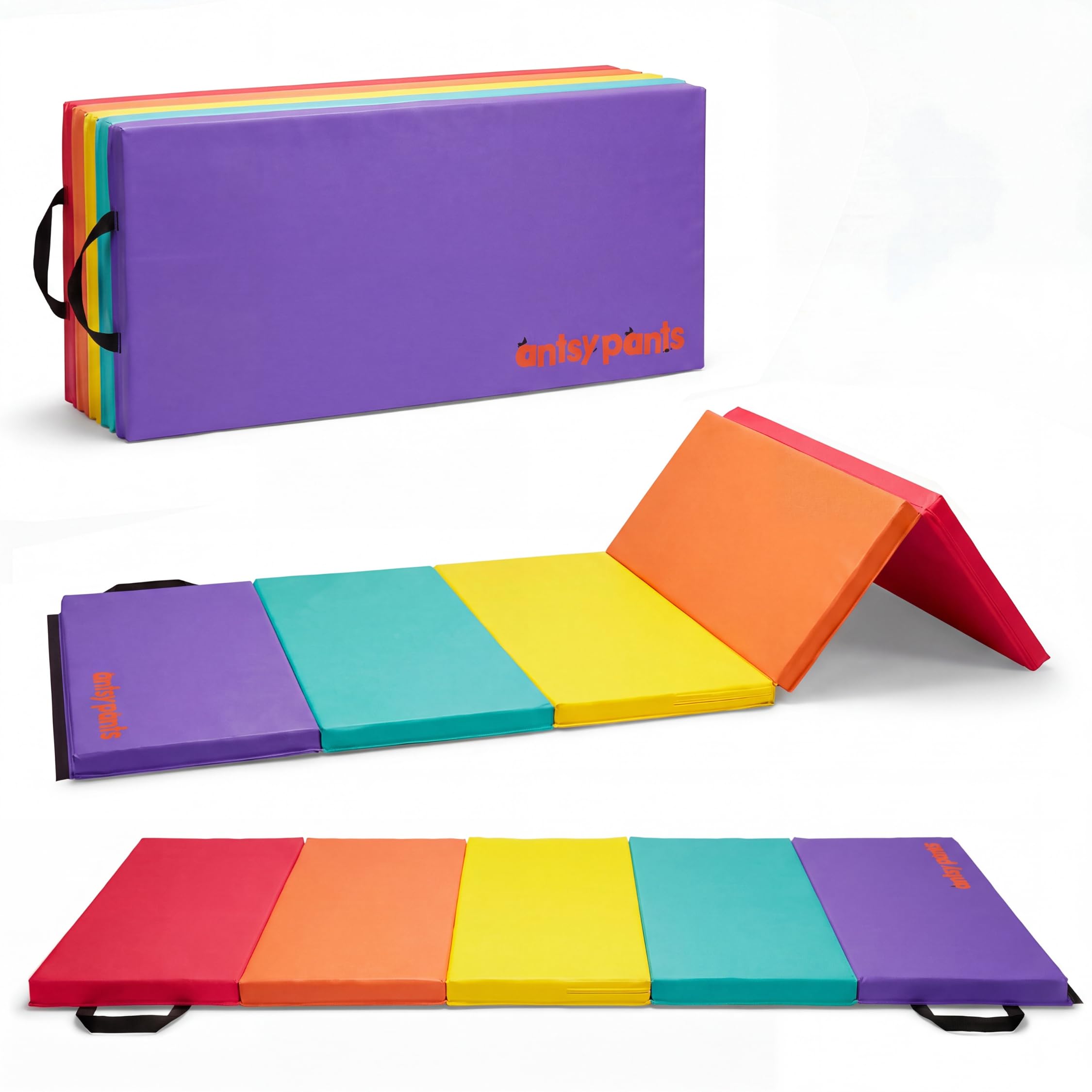
Antsy Pants Tumbling Mat

Antsy Pants Tumbling Mat

Young kids' play

Our Score 9.4/10
Check Price

Worth Noting

  • Slides on hardwood
  • Too thin for older kids' landings
Fold
Tri-fold
Edges
Hook-and-loop
Weight
4 lb
Open Size
77"L x 30"W x 1"Th
Read the full review

This one is built for the four-to-eight set. An inch of foam is plenty under a somersault, a forward roll, or a tumble off a couch cushion, and the 77-by-30-inch surface is sized for a small body rather than an adult's stride.

At 4 pounds it is the mat a kid can own: carry it out, unfold it, practice, fold it back. The colors are bright, the cover wipes down, and the tri-fold with its grip handle turns cleanup into a one-piece job instead of a wrestling match.

On a wood floor it slides. The hook-and-loop ends are for joining another mat or a beam, not for gripping a floor, so put it on a rug or accept that it drifts an inch every few minutes of cartwheels.

Where this makes sense is a household where the gymnast is small and the mat has to disappear into a playroom. Past the cartwheel stage it stops being enough, since a bigger kid feels the floor through an inch of foam on landings, and our top pick gives you twice the thickness and a longer surface for less money. What it has that the bigger mats don't is a size a five-year-old can handle alone.

Bottom line: A playroom mat rather than a training mat: an inch of foam, 77 by 30 inches, light enough that a small child carries it out alone.

#9

VOFiTNY Inflatable Air Mat

VOFiTNY Inflatable Air Mat

Cheer and tumbling

Our Score 9.2/10
Check Price

Worth Noting

  • Needs air topped off between sessions
  • Too short for running tumbling
Valve
Double protection
Included
Pump and carry bag
Material
600D multi-layer PVC
Inflated Size
118"L x 39"W x 4"Th
Read the full review

Every inflatable here asks the same thing of you, and this one is no exception: it holds pressure for a session and softens over days, so a minute with the pump becomes part of the routine. If that is a dealbreaker, buy foam.

Everything else about it is solid. The 600D multi-layer PVC is heavier material than the price suggests, the valve uses a double-protection design to slow the leak you are always fighting, and the whole thing is built like a track rather than a pool float.

Four inches of thickness is the number that matters for tumbling. It is enough air that a landing sinks and returns instead of hitting bottom, which puts the mat closer to a floor exercise strip than a backyard bouncer, and the 39-inch width is generous for one performer and tight for two.

Ten feet of length covers a round-off and a standing pass. It does not cover running tumbling, and no amount of pressure changes that, so a 13- or 16-foot track is the answer if that is the skill on the schedule.

For a cheerleader or a kid drilling the same skill nightly, this is the easiest inflatable here to live with: deflate, roll, bag, hallway. The bag takes the rolled track, the grip handles make a one-person carry possible, and it goes back in the closet instead of taking over the living room.

Bottom line: A ten-foot air track with a 4-inch deck that holds up well, provided you are willing to top off the air before most sessions.

How We Chose and Tested Gymnastics Mats

We began by researching the category—folding mats, tri-fold mats, and inflatable air tracks—and narrowed the field by available sizes, thickness, surface texture, carrying handles, and price. We ended up with 12 mats and used them for eight months in the places they'd actually live: a living room floor for stretching and kids' tumbling, a basement workout corner for core and MMA-style drills, and a garage for bigger tumbling sessions. We folded and unfolded each mat solo, carried it by its handles up a flight of stairs, and noted whether it stayed folded or flopped open. We also checked how much floor space each size covered and whether it stored upright in a closet.

To judge thickness and cushioning, we knelt, rolled, and landed on each mat, then compared how much give it had under hands and knees and whether we could feel the floor through it. For foldability, we timed setup and pack-down and watched whether hinges pinched or panels lined up flat. We connected edge-to-edge hook-and-loop strips where available and tugged to see if seams separated during tumbling. For durability, we looked for surface scuffs, seam stress, and foam compression after repeated use. Inflatable models got pumped up, left inflated for several days, and checked for pressure loss and even rebound; we also timed inflation and deflation and tested how small they packed. Suitability came last: which mats felt stable for gymnastics, which were better for yoga and stretching, and which were easy enough for kids to set up.

How to Choose a Gymnastics Mat

Match the Foam to the Skill

An inch of foam is playroom padding, which is fine under a four-year-old's forward roll and useless under a nine-year-old's back handspring. Two inches of dense foam is the home-practice standard: enough to take the edge off a landing without turning a handstand into a balancing act. An inch and a half of firm foam suits adults doing planks and stretching, where a soft surface makes wrists and knees work harder than the floor would.

The trap is assuming thicker is always better. A soft surface under a plank costs you stability, and the mat you sink into is not the mat that teaches control. Buy for the skill being practiced this month, not the one on the poster.

Width and Length Decide What You Can Practice

Six feet by two feet is the size most folding mats come in, and it covers rolls, bridges, handstands against a wall, and cartwheels that don't travel. Tumbling that covers ground needs more: four by eight is the smallest surface that fits a round-off into a back handspring, and four by ten gives a short series somewhere to land. A three-by-six mat adds a foot of width for an adult lying down.

Measure the wall before you shop, not the room. A mat that has to be folded away after every session gets used less than one that stays out, and the difference between a 6-foot and a 10-foot mat is usually a piece of furniture, not a budget.

Folding, Weight, and Where It Lives

Folding mats here run from 3 to 17.6 pounds, and that range decides who can move the thing. Under five pounds, a child can carry it by the handle and put it away alone, which is most of the battle in a house where practice happens on a Tuesday night. Above ten pounds, treat the mat as furniture: it goes down and it stays down.

Check the folded footprint as carefully as the open one. A 2-foot-wide mat folds into a stack around 2 by 2 feet, which is closet-sized; a 4-by-10 folds into something closer to a mattress pad and needs a wall or a bed frame to slide under.

Foam Mats vs. Inflatable Air Tracks

Foam is stable, silent, and needs nothing from you. An air track gives rebound, stores smaller, and asks for air. Choose foam for landings, balance work, and anything a beginner is learning, where a firm surface teaches control; choose air when the skill is already there and the point is repetition, because the mat returns energy and takes less out of young joints.

Inflatables lose pressure over days. That is ownership rather than a fault, and it costs a minute with the pump before practice. What it should not cost you is caution: air is not a crash mat, and first attempts at inverted skills belong on foam with a spotter.

Surfaces, Grip, and Joining Mats

Vinyl is the standard cover: it wipes clean, resists tears, and can be slick on tile. PU leather feels softer against skin and grips slightly better. Either way, a mat on a smooth floor will creep, so a rug or a grippy underlay does more than any texture claim on the listing.

Hook-and-loop edges are worth having if you might buy a second mat later: two 6-by-2 panels joined along the long edge make a 6-by-4 floor, which is a real upgrade for a growing gymnast. Watch the hook side on carpet, where it grabs the pile and holds on.

Frequently Asked Questions

Final Verdict

If you are buying one mat for a kid practicing at home, buy the BalanceFrom. Two inches of firm foam, three pounds, a handle, and the lowest price in this group make it the mat that gets unfolded on a weeknight and folded away before dinner, which is the only test that matters in the first year.

If the mat has a room of its own, the We Sell Mats 4 x 8 turns that room into a usable practice floor. If the skills are already there and the goal is repetition, the FBSPORT air track is the one worth inflating.