Accessories

Best Battle Ropes of 2026

A battle rope is a simple tool: anchor one end, grab the other, and try to make the rope behave. The right one turns a garage bay or a strip of driveway into a conditioning station without a rack of machines. The wrong one lets you down in small ways—a sheath that fuzzes, handles that slip, a coil that stays kinked. Over the past six months, my team and I anchored 12 different ropes in garages, driveways, and backyards to see which ones held up.

The first thing I noticed is that the weight on the label is only half the story: a stiff 2-inch rope can feel heavier than a 1.5-inch rope that moves. Assembly matters more than it should—uncoiling, attaching handles, setting the anchor—because a rope that takes 20 minutes to set up rarely gets used. I also check the sheath at the anchor point after every few sessions, since that's where most ropes fail first. The picks below are the ones that held their shape, didn't shred, and felt worth the money.

#1

Perantlb Battle Rope

Top Pick
Perantlb Battle Rope

Garage gyms

Our Score 9.6/10
Check Price

Worth Noting

  • No 2-inch diameter option
Length
30, 40 or 50 feet
Sleeve
Wear-resistant nylon
Weight
7.94 kg (17.5 lb)
Diameter
1.5 inches
Read the full review

A battle rope gives out in two places: where it grinds against the anchor, and where it slaps the floor. Perantlb's 1.5-inch rope answers both — a wear-resistant nylon sleeve runs its full working length, and the anchor strap kit is in the box rather than on your shopping list.

That's why we recommend it ahead of everything else here. Thirty feet of 1.5-inch poly dacron, listed at 7.94 kg — about seventeen and a half pounds — has enough mass for heavy waves without the sluggishness of a 2-inch rope, and it's the length that suits a garage bay: fold it at the anchor and you need roughly fifteen feet of clear floor. The same line comes in 40 and 50 feet if you have the run.

The handles are 8.66 inches of heat-shrink over a PVC core, on the generous side of the ropes here and long enough that your back hand isn't crowding your front one when you change grip. The supplied wall anchors are the part to check before you drill: they suit a stud, and on brick or block you'll want your own lag bolts. That's a five-minute errand, not a reason to look elsewhere.

One boundary worth naming: this line is 1.5-inch only, so if you want the heavier drag of a 2-inch rope, POWER GUIDANCE and Brobantle both sell one. Otherwise, order the length your floor can take — thirty feet covers most garages — and let the sleeve handle the concrete.

Bottom line: The rope we tell most people to buy: a sleeved 1.5-inch 30-footer with the anchor strap in the box, at midrange money.

#2

POWER GUIDANCE Battle Rope

POWER GUIDANCE Battle Rope

Concrete floors

Our Score 9.6/10
Check Price

Worth Noting

  • Shortest handles here at 7.5 inches
  • Highest price of any rope in this set
Length
30, 40 or 50 feet
Sleeve
Double-layer nylon
Diameter
1.5 or 2 inches
Warranty
2 years
Read the full review

Two layers of nylon cover the working length of this rope, and the anchor strap that ships with it is half again as wide as a standard strap. On a rubber gym floor that's overkill. On a garage slab it's the difference between a rope that lasts and a rope that fuzzes.

The rest of the build matches that intent: 100% polyester three-strand construction, heat-shrink handles, a full anchor strap kit with mounting hardware, and a choice of 1.5- or 2-inch diameter across 30, 40 and 50 feet. It also carries a two-year manufacturer warranty, which is a reassuring thing to see on a tool you're going to drag across concrete.

For our money this is the rope to buy if it's going to live outdoors and get used several times a week; the extra cover and the wider strap are exactly where the money should go. Two things to know going in. The handles are 7.5 inches, the shortest here, so if you like to slide your grip around mid-set the Yes4All is the friendlier rope. And a 30-foot rope runs out of travel fast once you're throwing hard — if you have the floor, order the 40.

Bottom line: Buy this one if the rope lives on concrete: the double-layer cover and wider strap are worth the step up in price.

#3

Yes4All Battle Rope

Yes4All Battle Rope

Grip work

Our Score 9.6/10
Check Price

Worth Noting

  • Anchor bracket needs timber or masonry
Length
30 feet
Weight
16 lb
Diameter
1.5 inches
Handle Length
10 inches
Read the full review

Ten inches of heat-shrink on each end is the longest handle in this set — two inches more than the Perantlb's and a good three more than POWER GUIDANCE's. If you've ever had a rope burn its way up your forearm during a lateral wave, that's the spec you care about.

The rest of the package is complete rather than clever: sixteen pounds of poly dacron, 1.5 inches by 30 feet, a nylon sleeve over the working length, and a steel anchor with a strap in the box. You can be working a few minutes after opening it, provided you have something solid to screw the bracket into.

Mounting height is worth settling before you drill. Chest height keeps the wave travelling along the floor instead of lifting the rope, and the bracket needs timber or masonry behind it — drywall alone will pull out the first time you throw hard.

Where this rope earns its place is grip. Longer handles give your hands somewhere to go when they start to slide, and the steel anchor plus a one-year warranty make the most complete hardware package at its price here. It's the pick for anyone whose hands give out before their shoulders do, and the 30-day return window makes it an easy one to try.

Bottom line: Buy it for the handles — ten inches of grip on each end, plus a steel anchor, for about the same money as our top pick.

#4

Just.smile Battle Rope

Just.smile Battle Rope

Tight budgets

Our Score 9.6/10
Check Price

Worth Noting

  • No anchor strap or mounting hardware
Cover
Cloth sleeve
Length
30 feet
Diameter
1.5 inches
Material
Polyester
Read the full review

Among the 1.5-inch ropes here with a cover over the working length, this is the least expensive: 30 feet of braided polyester with a cloth sleeve over the middle and a black-green-blue finish that won't disappear against a garage floor.

There's no anchor in the box — no strap, no bracket, no hardware — so plan on a kettlebell, a rack upright, or a wall mount before it arrives. That's a small errand, and it's the same one the Amazon Basics rope asks of you; neither of these is pretending to be an all-in kit.

On a mat or a smooth floor, this is a lot of rope for the money: covered for the working length, cut to the standard 30 feet, with nothing odd about the design. The cloth sleeve is the part to check after a few weeks, since it's where the savings show. Indoors on a mat, that's a fair trade.

Bottom line: A covered 1.5-inch rope for less than the midrange picks, best kept indoors on a mat.

#5

Amazon Basics Battle Rope

Amazon Basics Battle Rope

First home gym

Our Score 9.4/10
Check Price

Worth Noting

  • No anchor strap or mount included
Length
30 feet
Sleeve
600D Oxford
Weight
15.8 lb
Diameter
1.5 inches
Read the full review

The detail that sold us on the Amazon Basics rope is a small painted line: an orange-yellow stripe runs its whole length, so when you coil it back up you can see at a glance whether the rope has twisted. At 15.8 pounds and 30 feet of 1.5-inch Poly Dacron with a waterproof sleeve over the middle, it's also the value pick of this set.

That sleeve is 600D Oxford, a woven fabric rather than the denser nylon on the Perantlb and POWER GUIDANCE, and that's where the difference shows. This is the cover that wears first if you drag the rope over bare concrete; keep it on a mat or a smooth floor and the gap closes considerably. It's the honest trade for the price, and it's one you can manage.

There's no anchor in the box. A kettlebell, a rack upright, or a strap around a post all work, and plenty of people never install a wall mount at all — but budget for one if you want the rope fixed in place.

What's left is unremarkable in the right way. Nearly sixteen pounds is enough mass that a minute of waves feels like work, 1.5 inches is the diameter most home gyms settle on, and the heat-shrink caps keep the ends from unraveling. Thirty feet then coils onto a wall hook and stays out of the way, which is more than you can say for the rest of a home gym.

Bottom line: A budget rope that doesn't feel like one: waterproof sleeve, tracking line, and 15.8 pounds of honest Poly Dacron.

#6

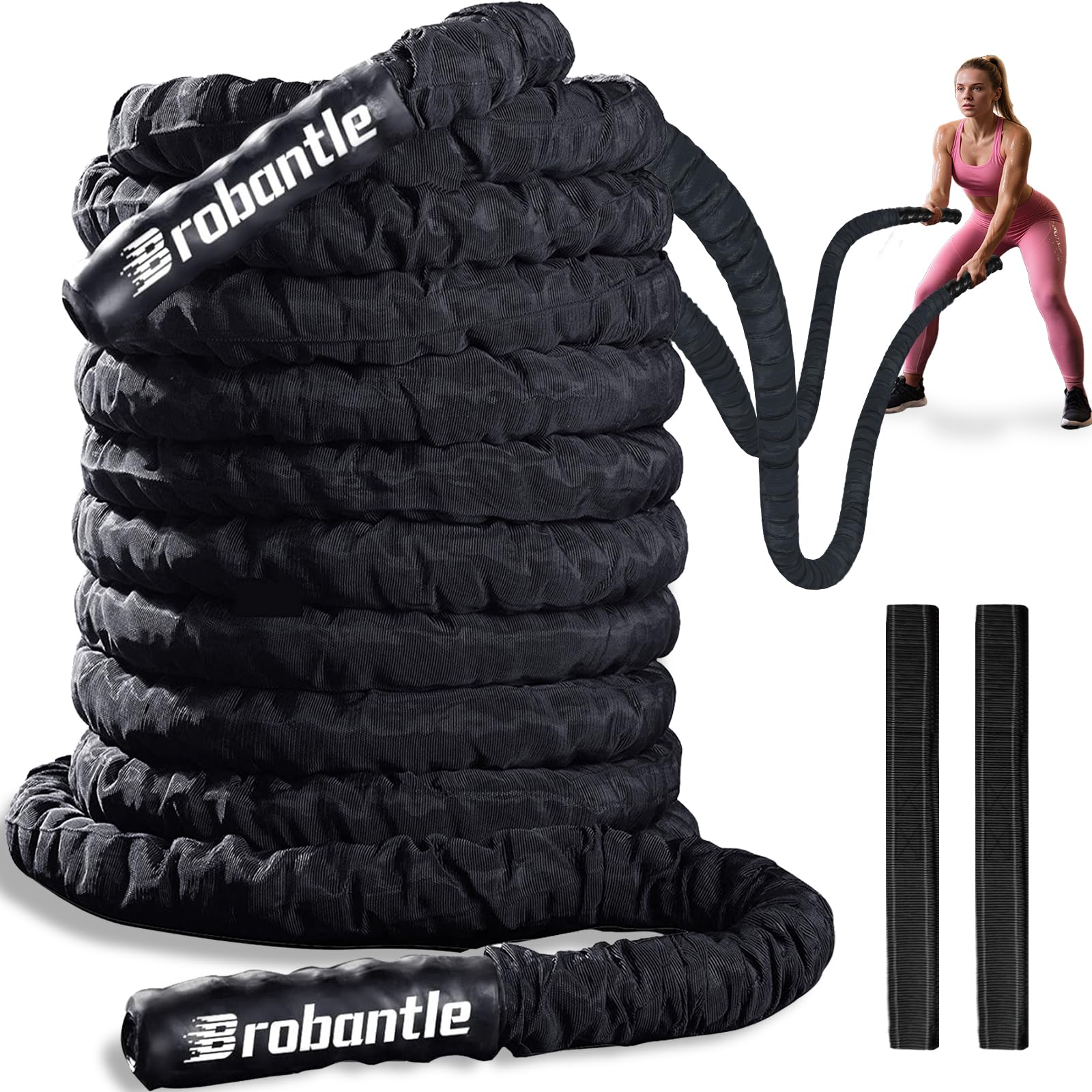
Brobantle Battle Rope

Brobantle Battle Rope

All-in-one kit

Our Score 9.4/10
Check Price

Worth Noting

  • Only available in 30-foot length
Cover
Nylon
Length
30 feet
Weight
14.5 lb
Diameter
1.26, 1.5 or 2 inches
Read the full review

Every rope in this line is 30 feet long, and it comes in three thicknesses: 1.26, 1.5 and 2 inches. That's a narrower range than it first appears — you choose how heavy the rope is, not how much floor it eats — so measure your space before you fall for the 2-inch version.

What arrives is more complete than most: a three-strand polyester filament core under a nylon cover, heat-shrink handles, an anchor strap, and a pair of gloves. The strap is the part that matters, because it means a rack upright or a post is enough to get started; the gloves are a nice courtesy for hands that aren't conditioned yet.

We like it as the kit that needs nothing added. The 1.5-inch, 30-foot version at 14.5 pounds is light enough for high-rep intervals and heavy enough to feel substantial, and the nylon cover is the same idea as the sleeves on our top picks. It isn't the rope for a big space or for someone chasing maximum drag, but as a single purchase that has you training the day it lands, it's the tidiest package here.

Bottom line: A complete kit in one box: covered rope, anchor strap, and gloves, all at a 30-foot length that suits tight rooms.

#7

Fitvids Battle Rope

Fitvids Battle Rope

Trying it out

Our Score 9.2/10
Check Price

Worth Noting

Length
30, 40 or 50 feet
Diameter
1.5 or 2 inches
Material
Polyester blend
Warranty
2 years
Read the full review

Fitvids makes the least expensive rope here, and it's the one we point people to when they aren't sure rope work will stick: 30 feet of 1.5-inch rope with heat-shrink ends, for roughly half what the midrange picks cost.

What you give up is the cover. There's no sleeve over the working length, so a concrete floor will abrade the rope where it slaps, and that's what turns a rope fuzzy over time. On a mat or a smooth floor the gap narrows a lot; on bare concrete you're borrowing time rather than buying it.

Everything else is straightforward: seven size options across 30, 40 and 50 feet in 1.5 or 2 inches, a two-year manufacturer warranty, and a rope that rolls up small enough to hang out of the way. If you already know you love rope work, spend more and get a sleeve. If you're curious, this is the least expensive way to find out.

Bottom line: The cheapest way to find out whether rope work sticks, provided you give it a mat rather than a slab.

#8

Keepark Battle Rope

Keepark Battle Rope

Intervals and speed

Our Score 9.2/10
Check Price

Worth Noting

  • Light 1-inch rope limits strength work
  • Costs more than heavier ropes here
Cover
Protective sleeve
Length
30 feet
Weight
7.5 lb
Diameter
1 inch
Read the full review

Seven and a half pounds is light for a battle rope, and that's the point of this one: a 1-inch, 30-foot rope with a protective cover over the middle and heat-shrink handles.

We think of it as the conditioning rope rather than the strength rope. A light rope moves fast, so you can hold a high turnover for a full interval without your shoulders quitting, which makes it a good fit for beginners, teenagers, and anyone using ropes as a finisher after lifting. What it won't give you is the heavy drag that makes a slam feel like a deadlift — a 1.5-inch rope at roughly twice the weight does that better.

Bottom line: The light rope for speed and intervals — good for beginners and teenagers, not for anyone chasing heavy drag.

How We Tested Battle Ropes

We started by gathering ropes from brands we've used and ones that kept surfacing in reviews, then filtered by diameter, length, claimed weight, sheath material, handle style, and whether an anchor strap was included. We ended up with 12 ropes, and each one lived with us for six months.

Setup was the first test. We timed each rope from box to first workout—uncoiling it, attaching handles where required, and anchoring it to a squat rack in the garage, a post in the backyard, or a trailer hitch. We noted whether instructions were clear, whether hardware came included, and whether the rope needed stretching before it would hang straight.

In workouts, we ran alternating waves, slams, spirals, and side-to-side patterns in 20-minute interval sessions, both solo and with a partner. We watched for kinks, flat spots, and whether the rope tracked smoothly through the anchor. We weighed each rope on a luggage scale to compare against the claimed weight, and noted whether a heavier rope slowed our tempo or made control harder. After each session, we checked the sheath at the anchor point and along the length for fraying, and inspected handle stitching and grip.

Value came down to wear versus price: a rope that fuzzed at the anchor in a month was not a bargain. We also judged functionality—whether the rope worked for different movements, whether handles stayed secure, and whether it coiled up for storage without a fight. The ropes that made the list still looked and performed like new after six months.

How to Choose Battle Ropes

Length follows your floor, not your ambitions

A battle rope folds at the anchor, so a 30-footer needs roughly 15 feet of clear floor in front of it: half its length for the working side, plus room to stand back. A 40 needs about 20 feet, a 50 about 25. Most garages and spare rooms land on 30 feet, which is why every rope here comes in that length.

If you're between sizes, go shorter. A long rope in a short room means you're fighting the wall on every throw, and the extra weight doesn't make up for it.

How much drag do you actually want?

Diameter changes the feel more than any other number. A 1-inch rope such as the Keepark is listed at 7.5 pounds and moves fast, which suits intervals and beginners. At 1.5 inches you're generally in the 14-to-17-pound range at 30 feet, the sweet spot for most home gyms. Two inches is a strength tool — twenty seconds and your shoulders are done.

For a single rope, we suggest 1.5 inches. You can slow a light rope down, but you can't speed up a heavy one once your form starts to go.

The sleeve is the upgrade that matters

Ropes fail at the anchor and where they meet the floor, which makes a protective sleeve the most useful upgrade in the category. On bare concrete an uncovered rope abrades visibly within months; on a rubber mat or a smooth floor the difference is much smaller.

Our rule: if the only space you have is a garage slab, pay for the sleeve. If you're working on a mat or a wood floor, save the money and spend it on rope instead.

Anchoring: what ships in the box

Some ropes arrive with a strap and bracket, others with nothing. Both are fine as long as you know which you're buying. A strap looped around a rack upright, a structural post, or a heavy kettlebell needs no drilling and moves when you do; a wall bracket is permanent and has to go into timber or masonry, never drywall alone.

Chest height is the useful default. It keeps the wave travelling along the floor instead of lifting the rope on every throw.

Handles, storage, and the small stuff

Handles run from 7.5 to 10 inches in this set, and longer is easier on the hands: you can shift your grip instead of holding one spot while it burns. Storage is simpler than the size suggests — 30 feet of 1.5-inch rope coils into a loop that hangs on a hook.

A rope left in a heap in the corner is the one that gets stepped on, kinked, and eventually ignored.

Frequently Asked Questions

Final Verdict

For most home gyms the Perantlb is the rope to buy: 1.5 inches by 30 feet, a nylon sleeve down the working length, and the anchor strap in the box, for less than the premium picks charge for the rope alone. It covers the two places a battle rope actually fails, which is the whole argument.

If the rope is going to live outdoors on concrete and get used several times a week, step up to the POWER GUIDANCE for the double-layer cover, wider strap, and two-year warranty. And if you're still unsure rope work is for you, the Fitvids is cheap enough to be an experiment rather than a commitment — as long as you give it a mat.