Yoga & Mobility

Best Yoga Mats of 2026

Downward dog is where most yoga mats give themselves away. You plant your palms, shift your hips back, and feel your hands creep forward an inch — or your back foot slide out from under you entirely. I've owned mats that were plush and mats that were grippy, and almost never the same one; the good ones stay put under a sweaty hand, cushion knees and wrists without turning tree pose into a balance drill, and stay light enough that carrying them to class isn't a chore.

Since early spring, my team and I have spent six months on 12 mats, from thin travel styles to thick cushioned ones, and the gaps between them showed up fast. One thing I didn't expect: nearly every mat arrives slicker than it will be a month later, so a mat that fails its first sweat test isn't automatically out. The picks below earned their place on grip, comfort, and how well they held their shape and their value after months of steady use rather than one pleasant unrolling.

#1

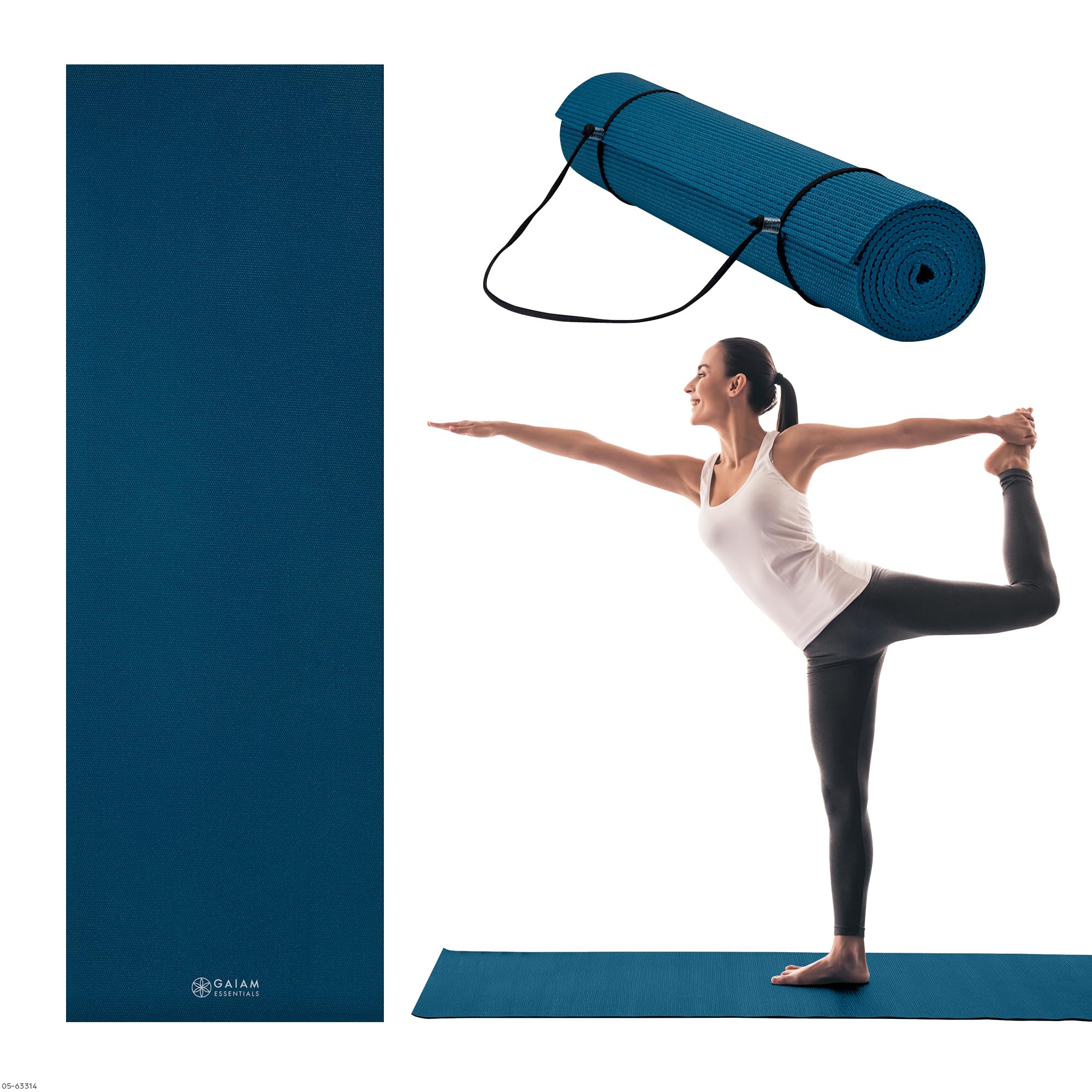
Gaiam Premium 6mm Print Mat

Top Pick
Gaiam Premium 6mm Print Mat

All-round yoga

Our Score 9.4/10
Check Price

Worth Noting

  • Slips once hands and feet get sweaty
Size
68" x 24"
Weight
3.1 lb
Material
6P-free PVC
Thickness
6mm
Read the full review

Six millimeters is the number that makes this mat work, and it's the figure that matters most. That's enough foam that our knees and wrists stopped complaining during lunges and table top, and little enough that we could still feel the floor underneath a standing balance — the thing every extra-thick mat here gives up. Add a textured surface with a slight tack to it and you have the mat we unroll by default.

The materials back it up. It's 6P-free PVC, made without the phthalates that turn up in cheaper foam, and Gaiam covers it with a lifetime warranty — nothing else on this list comes with that. At 3.1 pounds it isn't the mat you'll want to carry across a city, but it rolls tight, stays rolled, and the prints are the reason people end up leaving it out instead of putting it away.

Two things to know before you order. It arrives with the chemical smell PVC mats have; give it the two to three days of airing out the listing asks for before you judge it. And the grip is a dry-practice grip — once hands get damp it starts to slip, which puts hot yoga and heavy sweaters outside what this mat is for. A towel over the top handles it, and that's true of most of the mats here.

Bottom line: This is the mat we recommend to most people: 6mm of cushioning that still lets you balance, a grippy dry surface, and a lifetime warranty.

#2

BalanceFrom 1-Inch Exercise Mat

BalanceFrom 1-Inch Exercise Mat

Sore knees

Our Score 9.4/10
Check Price

Worth Noting

  • Too unstable for standing balance poses
  • NBR foam tears with rough handling
Size
71" x 24"
Material
NBR foam
Thickness
1 inch
Read the full review

If your knees decide which workouts you do, start here. BalanceFrom takes the half-inch idea up to a full inch of high-density NBR, and the extra depth is the entire point: it turns a tile or concrete floor into something you can kneel on.

It changes what's available to you. Kneeling work, hip openers, crunches, and a long savasana stop being a negotiation with your spine, and the textured waterproof surface wipes down in seconds. At 71 by 24 inches it's a little longer than a standard mat, and it rolls up with a reinforced nylon strap that comes in the box.

What you give up is any pretense of standing balance. An inch of foam is a mattress, not a mat — tree pose and warrior three go mushy, and this isn't the mat for a flow class. It's also a bulky roll that eats shelf space, and the foam will tear if you drag it across a rough floor. For Pilates, stretching, rehab work, and anyone whose joints are the limiting factor, all of that is the price of the cushion, and it's worth paying.

Bottom line: Buy this if kneeling on a hard floor is the thing stopping you from exercising; an inch of foam makes floor work comfortable again.

#3

NewMe Fitness Printed Pose Mat

NewMe Fitness Printed Pose Mat

Printed pose guide

Our Score 9.4/10
Check Price

Worth Noting

  • Goes slick once hands sweat
  • Thin under sore knees
Size
68" x 24"
Weight
2.6 lb
Material
PVC
Thickness
5mm
Read the full review

Seventy illustrated poses printed straight onto the mat sounds like a gimmick until you've tried to follow a video with your phone face-down on the floor. The poses are placed where you can catch them mid-flow, and the dark background makes them legible from standing.

Under the printing it's a 68 by 24 inch PVC mat at 5mm and 2.6 pounds, made without BPA, latex, or phthalates. That's the middle of the range here — thinner than the half-inch and one-inch foam mats — and it's firm rather than plush, which is the right feel for balance work.

Grip is where it gives ground. The surface is textured but it isn't a sticky mat, and once hands get damp it goes slick; a towel over the top handles it, but don't buy this expecting the tack of the Gaiam. And 5mm is modest under a sore knee — the printed prompts don't change that.

As a teaching tool, though, it's the most useful mat in this group for someone starting from nothing. The poses are a prompt you can't misplace, and after a few months you'll know them whether you meant to learn them or not.

Bottom line: Worth it if you learn from the mat itself: 70 printed poses are a prompt you can't misplace, though the grip won't carry a sweaty class.

#4

CAMBIVO Extra Long Wide Mat

CAMBIVO Extra Long Wide Mat

Tall yogis

Our Score 9.2/10
Check Price

Worth Noting

  • Bulky to store and to carry to class
  • Slick once hands and feet get sweaty
Size
84" x 30"
Weight
5 lb
Material
PVC
Thickness
6mm
Read the full review

Eighty-four inches by thirty isn't really a yoga mat; it's a floor you can roll up. Set beside a standard 68 by 24, it's 16 inches longer and 6 inches wider, which is the difference between a pose fitting inside the mat and your hand landing on the hardwood next to it. For anyone over about six feet, that's the whole purchase.

The rest of it is competent rather than fancy. The 6mm PVC has a textured top for traction and a honeycomb underside that grips carpet and wood better than a flat bottom does, and at 5 pounds it's heavier than a standard mat but manageable with the strap that comes with it. We also like it for the non-yoga use: it's wide enough that a bodyweight session or a barre workout stays on the mat instead of drifting onto the rug.

The trade-offs are honest. A mat this size is awkward to store, awkward on a crowded studio floor, and the surface goes slick once hands are sweaty — a towel is part of the kit. Cushioning is modest at 6mm spread across that much area, so if joint comfort is what you're after, the BalanceFrom is the better call. If your problem is that you don't fit on a mat, this solves it and nothing else here does.

Bottom line: For anyone who has never quite fit on a mat, this one ends the problem — 84 by 30 inches of grippy, cushioned surface.

#5

Gaiam Essentials 6mm Mat

Gaiam Essentials 6mm Mat

Everyday practice

Our Score 9.2/10
Check Price

Worth Noting

  • Firmer and heavier than the foam mats here
  • No print finishes or lifetime warranty
Size
72" x 24"
Weight
3.5 lb
Thickness
6mm
Read the full review

No print, no lifetime warranty, and a slightly heavier roll: this is the plain version of the 6mm Gaiam mat, and for a lot of people it's the smarter buy. The surface has the same textured tack as the pricier one, and the price lands closer to the budget end of this group.

Seventy-two inches is the detail we keep coming back to. That's four inches more mat than the standard 68, which is the difference between your hands staying on in downward dog and sliding off the front edge. At 3.5 pounds with a cinch strap it carries to class without complaint. The 6mm of dense cushioning is firm rather than spongy — exactly what you want under a standing pose, and less than you want under a bony knee, so it's the wrong pick if kneeling is the part that hurts.

Bottom line: Our top pick's plain sibling: four extra inches of mat, a firm 6mm surface, and a lower price for anyone who doesn't need the print.

#6

Amazon Basics Extra Thick Mat

Amazon Basics Extra Thick Mat

Hard floors

Our Score 9.2/10
Check Price

Worth Noting

  • Porous foam collects lint and tears
  • Unstable for standing balance poses
Size
73.2" x 24.3"
Weight
2.2 lb
Material
NBR foam
Thickness
0.5 inch
Read the full review

The carrying strap is promised in the product name, and it doesn't always make it into the box — so check yours before you need to carry the mat anywhere. That's the one piece of housekeeping that comes with this one.

What you're buying is 73.2 by 24.3 inches of half-inch NBR foam, a couple of inches longer than most standard mats. It's the same soft, cushy family as the Fitvids: forgiving over tile or concrete, kind to elbows and sit bones, and it springs back into shape after a session.

It's the porous, open-cell kind of foam, which means it grabs lint, dust, and pet hair and holds on to them. It needed a wipe-down more often than the denser mats here, and it will tear if you catch it with a toenail or drag it across a rough floor. It's also too soft to stand on: balance poses wander, and this isn't the mat for a flow class.

Where it earns its spot is as the second mat — the one that lives rolled up behind a door for stretching in front of the TV, a home strength session, or a bit of floor work after a run. It's inexpensive, it's comfortable on a hard floor, and it doesn't ask you to look after it.

Bottom line: A cheap, genuinely comfortable mat for stretching and floor work — as long as you're not standing on it and the strap is in the box.

#7

Fitvids 1/2-Inch Exercise Mat

Fitvids 1/2-Inch Exercise Mat

Budget floor work

Our Score 9.0/10
Check Price

Worth Noting

  • Wobbles under standing balance poses
  • Porous foam marks easily and holds dust
Size
71" x 24"
Weight
2.91 lb
Material
NBR foam
Thickness
1/2 inch
Read the full review

This is the cheapest full-size mat in the group, and it's the one we hand to someone who wants something for home workouts and isn't ready to spend on a yoga mat yet. The half-inch NBR foam is genuinely plush — elbows, knees, and sit bones all get a break on a tile floor — and 71 inches covers most adults head to toe with room to spare.

What we noticed after a few sessions is what the thickness costs. Standing balances get vague on half an inch of soft foam, and the surface has a slight stretch to it: press into downward dog and the mat creeps forward under your hands. For stretching, planks, crunches, and a home Pilates session it's excellent. For a flow class it's the wrong tool, and no price makes up for that.

The foam is the porous kind, so it collects lint and dust and marks if you catch it with a toenail. It wipes clean with soap and water and has held its shape, but don't expect it to keep looking new. Stored in a closet and unrolled three times a week, none of that will bother you.

Bottom line: We reach for this one when budget is the deciding factor and the workout is floor-based — a half-inch of plush foam at the lowest price here.

#8

YOGATI Alignment Yoga Mat

YOGATI Alignment Yoga Mat

First-time practice

Our Score 9.0/10
Check Price

Worth Noting

  • Thin under knees and spine
  • Grip is mid-pack once hands sweat
Size
72" x 24"
Weight
1.81 lb
Material
TPE
Thickness
0.24 inch
Read the full review

The etched lines down the middle of this mat are a small feature that turns out to be the reason to buy it. They mark where your palms and heels belong, which is exactly the feedback a video can't give you when your phone is face-down on the floor, and they're subtle enough that you stop noticing them once the shapes are in your body.

Underneath the lines it's a 72 by 24 inch TPE mat at about a quarter-inch thick. At 820 grams it's the lightest thing here by a wide margin — carrying it to class is a non-issue, and the shoulder harness comes with it. TPE is also the material to look at if the smell of a new PVC mat puts you off; this is the pick least likely to greet you with a chemical odor.

Two limits worth knowing. At 0.24 inches it's thin, and a bony knee or a sensitive spine will find the floor through it — this is a mat built for balance and portability, not cushioning. And the grip is mid-pack here: fine dry, fair once hands get damp. As a first mat, or the one that lives in a tote bag, it earns its place.

Bottom line: The mat we point beginners toward, because the printed lines teach placement in a way a video on the floor can't.

How We Tested 12 Yoga Mats Over Six Months

We started by gathering every mat with a real following and cross-checking its stated thickness, material, weight, and price against what owners actually said about it, dropping anything that turned up repeatedly in complaints about peeling tops, chemical smell, or straps that snapped. That left 12 mats, which I've lived with for six months. They moved between a hot studio class, a hardwood living room floor, and a carpeted basement, and two colleagues who practice at different intensities used them alongside me.

Grip got tested wet and dry. I spritzed my palms and feet before every flow and watched how far my hands crept forward in downward dog by the third round of sun salutations, then ran the same sequence with dry hands on a freshly unrolled mat. For thickness and comfort, I measured each one with calipers at three points, held long kneeling lunges to see where my knees landed, and noted which mats let my standing foot slide in tree pose and which stayed quiet through a ten-minute savasana.

Portability was a kitchen-scale job: I weighed every mat, rolled and strapped it the way I would on a class day, and carried it on a fifteen-minute walk. I also marked which mats came with a strap that actually held and which ones dumped the roll on the sidewalk. Odor got a sniff an hour out of the wrapper, again on day three, and once more after a week, and two mats still smelled like a tire by then. At the six-month mark I checked for flaking, permanent handprints pressed into the top layer, and compressed edges, then set that wear against what each mat cost.

How to Choose a Yoga Mat

Start With Grip, Because It's What Fails First

Every mat here feels fine on day one. What separates them is what happens ten minutes into a practice, when your hands get damp. Dense, closed-cell surfaces like the PVC on the Gaiam mats hold their tack far longer than the porous NBR foam on the thick exercise mats, which soaks up sweat and starts to slide. If you sweat heavily or practice in a heated room, plan on a thin towel over the top of whatever you buy — it's cheaper than replacing a mat that's gone slick.

Test it before you commit: dampen your palms, press them into the mat in a downward dog, and see whether they creep. If they creep dry, they'll creep worse in class. Wipe the mat down every few sessions, too — body oil and dust are what turn a grippy surface into a slippery one.

Thickness Is a Trade-Off, Not a Score

Four to six millimeters is the range where a mat still lets you feel the floor underneath you, and feeling the floor is what balance runs on. That's where our top pick and the Gaiam Essentials sit. Half an inch of NBR foam is the right call when your practice is mostly floor work — planks, stretching, Pilates, physical therapy — and a full inch, like the BalanceFrom, is for joints that need the floor to stop being the enemy.

Push past six millimeters and you pay for the cushion with your balance; tree pose on an inch of foam is a wobbly business. If you want cushion for kneeling and stability for standing, two cheap mats beat one bad compromise.

Match Length and Width to Your Body

Sixty-eight inches by 24 is the standard, and it's too short for plenty of adults — lie down on it and your heels or fingertips end up on the floor. Seventy-one to 72 inches covers most people around six feet, and 84 by 30, which is the CAMBIVO, is for anyone taller or broader who is tired of their hand landing off the mat in a lunge. Width matters more than people expect in a wide-legged forward fold.

Measure the floor you actually have before ordering. An 84-inch mat is a different proposition in a hallway than in a studio.

Foam Type, Odor, and What Comes in the Box

NBR foam is soft, inexpensive, and the least durable material here: it tears, it holds lint, and it compresses where you stand. PVC is denser, grips better dry, and lasts longer, but it's heavier and it smells for the first few days — the listings ask for two to three days of airing out, and that's worth doing before you form an opinion. TPE is the lightest option and the least likely to greet you with a chemical smell.

Whichever you choose, check the box for the strap. A couple of these mats are sold with one and turn up without it, and a rolled mat is awkward to carry under your arm.

Frequently Asked Questions

Final Verdict

We keep coming back to the Gaiam Premium 6mm. It gets the two things that matter right at once: enough cushion that your knees stop complaining, and little enough that you can still stand on one leg without wobbling. The lifetime warranty and a print you actually want to leave out are the bonus.

If your practice is floor work rather than standing poses, or your joints are the reason you're shopping, the BalanceFrom's full inch of foam is the better tool — and the Fitvids covers most of that ground for less.