Yoga & Mobility

Best Hot Yoga Mats of 2026

Twenty minutes into a 105-degree class, your hands get slick, your feet start to slide, and the mat underneath you becomes the whole story. A hot yoga mat has one job the rest of the year doesn't ask of it: grip that holds when both you and the surface are soaked. The right one keeps your hands planted through a long downward dog, cushions knees and wrists without making balance poses wobbly, and survives a wipe-down three times a week. We've spent six months putting 12 mats through that.

Grip is where buyers get surprised: a mat that feels tacky in a dry living room can turn glassy the moment sweat pools on it, and thickness doesn't fix that — 6 millimeters feels wonderful in pigeon pose but leaves standing balances wobbling. Odor matters too, since new rubber and PVC can off-gas for a week or more, and so does size if your hands keep finding the floor. Pale colors show every sweat print, which is worth knowing before you buy. The picks below were built for hot classes first; the rest is easy.

#1

Plyopic Ultra Grip PRO

Top Pick
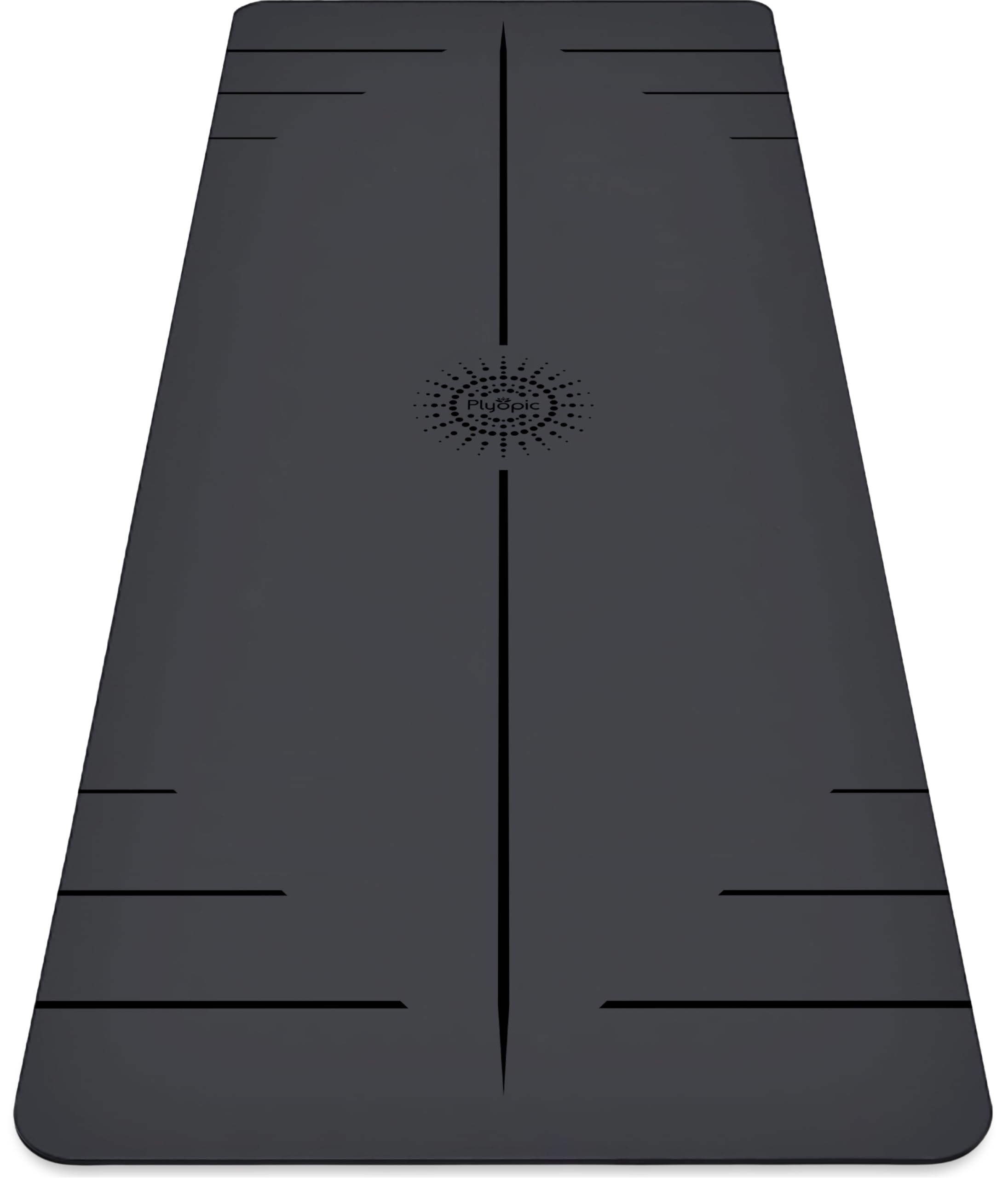
Plyopic Ultra Grip PRO

Maximum wet grip

Our Score 9.2/10
Check Price

Worth Noting

  • Heavy at 2.4 kg to carry to class
  • Firm 0.17-inch surface under knees
Size
72 x 26 in
Weight
5.29 lb
Surface
Eco-PU on natural rubber
Thickness
0.17 in
Read the full review

This is the most expensive mat in the group, and the one sold almost entirely on grip. An eco-PU surface is bonded to a natural rubber base, and the combination stays tacky whether your hands are dry or dripping; the difference shows up in standing balances, where a slipping hand normally costs you the pose. It has the surest wet grip of anything here, and our own sessions did not contradict that.

PoseMap is the second argument: printed reference points for hands and feet, so you can check your symmetry at a glance instead of guessing whether your stance has drifted an inch to the left. It earns its keep in a crowded class where nobody is coming over to adjust you.

What you pay for all of that is cushioning and carry weight. The rubber is dense and only 0.17 inch thick, so knees feel the floor in camel or a long low lunge, and at 2.4 kg this is the heaviest mat here, one for a studio locker rather than a walk to class three times a week. There is a rubber smell for the first few days that fades; the grip is the part that stays.

Bottom line: The mat we point to when grip is the only thing that matters: the surest wet surface here, with alignment lines and a weight that keeps it at one studio.
#2

Plyopic All In One Yoga Mat

Plyopic All In One Yoga Mat

Towel-free hot classes

Our Score 9.2/10
Check Price

Worth Noting

  • Only 3.5 mm of cushioning
Base
Dense natural rubber
Surface
Sweat-grip mat/towel top
Thickness
3.5 mm
Certification
SGS certified
Read the full review

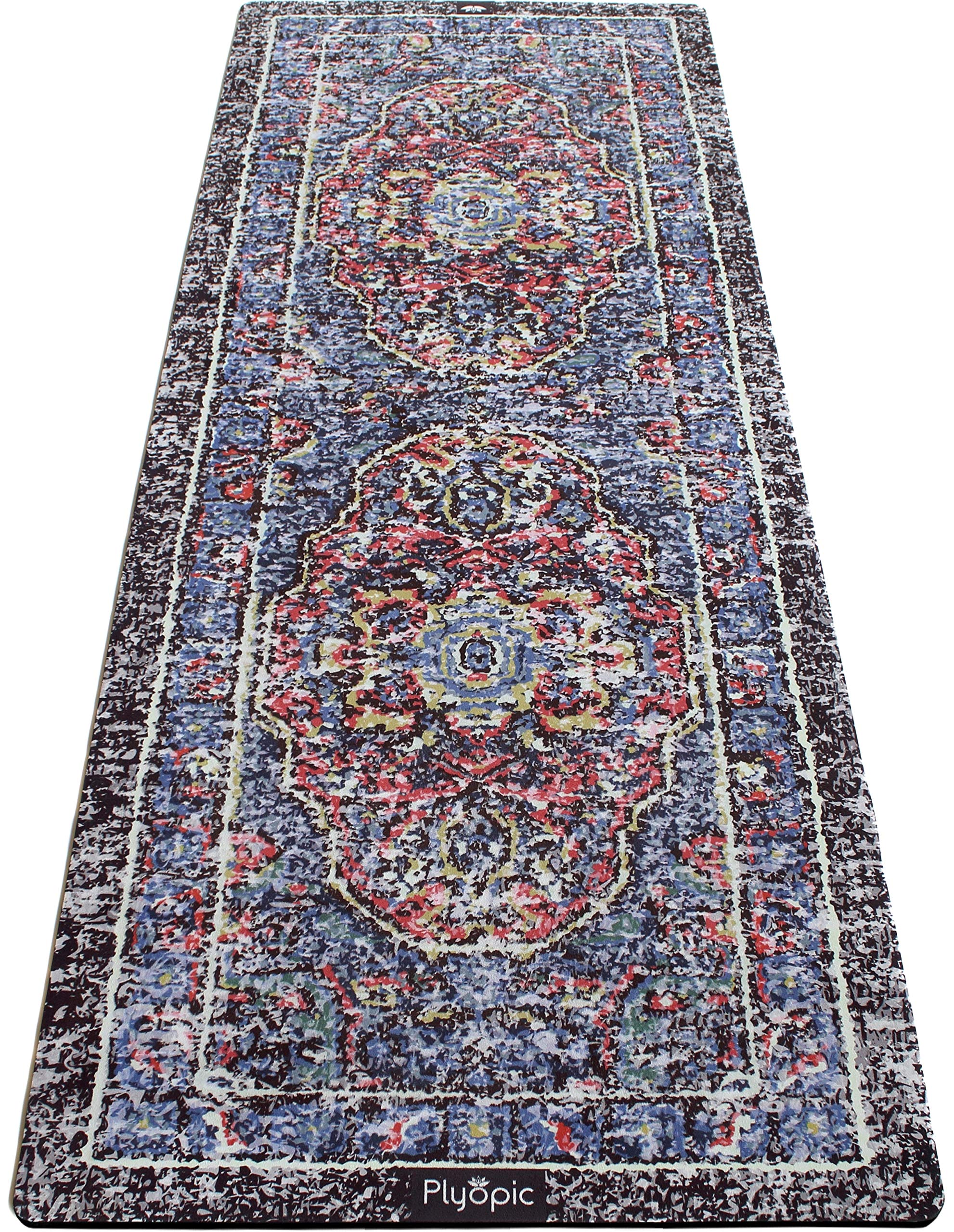
Every hot class has someone at the back rearranging a mat and a towel between poses. This one is built for that person: the top is a sweat-grip surface sold as a mat-and-towel hybrid rather than a plain foam, and the base is 3.5 mm of dense natural rubber that holds the mat flat under a lunging foot. Plyopic designs it to be flipped for a second surface, the limited-edition prints mean it does not look like everyone else's blue mat, and we like that more than we expected to.

Cushioning is the trade, and we felt it in a long pigeon. A 3.5 mm rubber base is firm underfoot, excellent in balance poses and thin enough that a kneeling sequence sends you looking for a folded blanket. If your practice is heavy on floor work, the 6 mm Heathyoga is the softer ride; if it is heavy on sweat, this is the design that anticipates it.

Bottom line: A sweat-grip mat that does the job of the towel you have been laying over your old one, on a dense rubber base: thin, flippable, and made for wet classes.

#3

balancea Suede and TPE Mat

balancea Suede and TPE Mat

Light travel mat

Our Score 9.0/10
Check Price

Worth Noting

  • 24-inch width is tight for wide stances
Size
72 x 24 in
Weight
1.65 lb
Surface
Suede over TPE
Thickness
5 mm
Read the full review

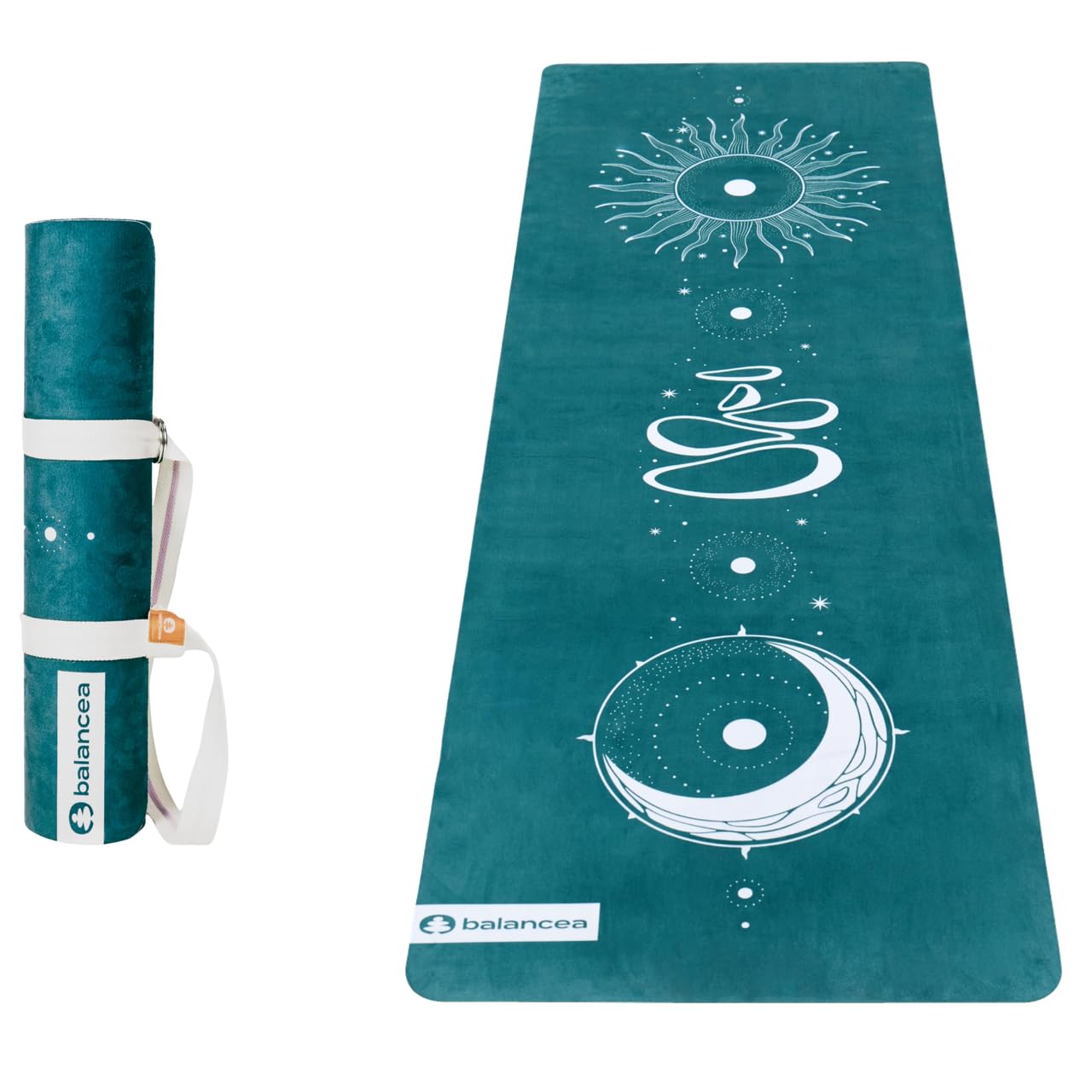
The finish sells it first: a printed suede top over a TPE base, with a symmetric graphic that helps you line hands and feet up without thinking about it, and it looks better than anything else in this group. It is also light in a way the others are not, at 750 g, roughly a third of what the Plyopic Ultra Grip PRO weighs, so it goes in a tote with a bottle and a towel and you forget it is there.

Suede is a different bargain from PU or TPE. It needs a little moisture to grip, so it is slick for the opening poses of a cool class and locked in once you warm up, and that single variable explains why two people can describe the same mat so differently. In a warm room it comes into its own, and a splash of water across the surface before a cooler session gets it there faster.

We like it for travel, warm classes, and anyone who wants a mat that does not look like gym equipment. The width is the thing to check: 24 inches is narrower than the 26-inch mats above, which you will notice in a wide warrior two, and the suede rewards a warm room over a cold one.

Bottom line: A suede-topped mat that grips better as you warm up and slides when it is bone dry, light enough at 750 g to be the one that leaves the house.

#4

Heathyoga Yoga Mat

Heathyoga Yoga Mat

Cushioned floor work

Our Score 9.0/10
Check Price

Worth Noting

  • Slides once sweat reaches the surface
Size
72 x 26 in
Weight
2.8 lb
Surface
Double-sided TPE
Thickness
6 mm
Read the full review

Six millimeters changes what a mat is for. This one is cushioning first: the TPE is soft enough that a long kneeling sequence stops being a negotiation with your knees, and the alignment system, hand and foot markings printed across the surface, is genuinely useful when you are learning where your feet belong in warrior one. It is 72 by 26 inches, so there is room to work, and 2.8 lb moves around the house without effort.

The double-layer construction is the detail we appreciated most. TPE mats often stretch out under a lunge; the bonded layers here hold their shape, and the surface has a slight texture that stops your feet from skating when they are dry. It is hand wash only, and a new mat carries a faint chemical smell for the first week, so unroll it in a spare room for a day or two before class.

Despite the hot yoga billing, this is the mat we keep for unheated flows, Pilates, and floor work; the heated room is a different job. What it does well, padding under knees, a printed grid for where your hands go, and enough width to work in, is exactly what a long home practice needs.

Bottom line: Six millimeters of TPE with alignment lines printed across the surface: the mat we reach for when knees need padding and the room is not heated.

#5

IUGA Pro Non Slip Yoga Mat

IUGA Pro Non Slip Yoga Mat

Sweaty heated classes

Our Score 8.8/10
Check Price

Worth Noting

  • Top surface can wear and peel with heavy use
  • Hand wash only; sweat sours if it sits
Size
72 x 26 in
Weight
2.5 lb
Surface
PU top, textured base
Thickness
5 mm
Read the full review

Polyurethane is the whole argument for this mat. A foam or TPE surface lets sweat sit on top until your hands skate across it; the PU layer here takes moisture in and keeps enough bite underneath to hold a downward dog late in a hot flow. The rest of the package is sensible rather than showy: 72 by 26 inches gives you room to step wide, 5 mm is enough padding for kneeling poses without the balance wobble of a 6 mm foam mat, and 2.5 lb rides on a shoulder without complaint.

Of everything here, this is the mat we point most people toward, because it removes the thing hot yoga is worst at: the small correction you make when a hand starts to go. An anti-tear mesh layer between the PU and the base keeps it from stretching out under repeated lunges, and the texture is fine enough that it does not print a pattern on your forearms. The Plyopic Ultra Grip PRO adds alignment lines and a firmer surface, but it weighs more than twice as much and costs noticeably more.

Wear is the honest caveat. The PU top is the working surface, and mats built this way can develop worn spots and start to peel in the middle after months of near-daily practice. Hand wash it with mild detergent rather than letting sweat sit, and treat it as a mat with a working life rather than a decade-long purchase.

Bottom line: If your hands are the first thing to fail in a heated class, this is the mat we hand you: the PU top drinks sweat instead of pooling it, and it stays put.

#6

Gaiam Dry-Grip Yoga Mat

Gaiam Dry-Grip Yoga Mat

Very sweaty hands

Our Score 8.4/10
Check Price

Worth Noting

  • Topcoat can peel and separate with heavy washing
  • 68-inch length is short for taller practitioners
Size
68 x 24 in
Weight
4.8 lb
Surface
Moisture-wicking PVC
Thickness
0.2 in
Read the full review

Gaiam's answer to sweat is not absorption, it is wicking: a topcoat that moves moisture off the surface so your hands keep contact. That is a different mechanism from the PU mats above, and for some people it is the better one, because the grip holds through a class even when the mat is visibly damp. At 68 by 24 inches it is the shortest mat here, 0.2 inch thick, and 4.8 lb is enough that you notice it on the walk to the studio.

We rate it as the specialist of this group. It solves one problem, sweating, more directly than the cushioned mats do, and it asks you to give up length and longevity in return. If your practice is unheated and your palms stay dry, this is money spent on a topcoat you do not need. If you have watched your own handprints slide across a mat in a heated room, it earns its place.

Treat the coating as the wear item it is. Wash it by hand with mild detergent, dry it flat, and do not leave it rolled up damp in a car, where heat and moisture do the most damage. The PVC base underneath will outlast the surface by a long way.

Bottom line: For hands that soak through everything else, the moisture-wicking topcoat here keeps traction where foam mats give up, in a shorter, heavier package.

How We Sweat-Tested 12 Hot Yoga Mats

We built the shortlist from specs first: material (natural rubber, PVC, and the newer closed-cell foams), thickness, weight, whether a mat came in more than one length, and price. Anything thinner than 4 millimeters got cut, because a hot class puts you on your knees often enough that a 3-millimeter travel mat stops being a kindness, and so did anything priced like a piece of furniture. That left 12 mats, which we used for six months.

Testing happened where these mats actually live: twice-weekly 105-degree studio classes, a home practice in a carpeted spare room with a space heater running, and a handful of muggy summer sessions on a back deck. For grip, I held downward dog for a full minute and noted whether my hands crept toward the front edge, then repeated it with a towel and without one. For cushioning and comfort, I stayed in camel, pigeon, and child's pose long enough to feel exactly where pressure landed on knees and wrists, and watched whether thicker mats made standing balances feel unstable — 6 millimeters was about where several started to squirm.

We unrolled every mat in a closed room and smelled it at hour one, day two, and day seven to track off-gassing, since a mat that reeks for a week is a mat you start avoiding. Durability was judged by eye after every tenth class: curling corners, peeling surfaces, stretched-out edges. We measured the usable surface of each one and tried rolling it back into its own carrier, which told us more about size than the listed dimensions did. Color was judged practically — light mats showed sweat rings and floor grit after two classes, and one pale gray mat never fully came clean. Value came down to cost per class before wear showed up.

How to Choose Hot Yoga Mats

Match the surface to how much you sweat

There are three surface families here, and they fail differently. Polyurethane, as on the IUGA Pro, absorbs moisture and keeps texture under your hands. Suede, as on the balancea, grips once it is damp and slides when it is bone dry. Closed-cell TPE, as on the Heathyoga, is cushioned and easy to wipe but lets sweat sit on top, where it turns slick. If your hands are wet ten minutes into a warm class, buy PU or suede; if your practice is mostly unheated, a TPE mat's comfort is the better trade.

Watch the label trap. Plenty of mats are titled hot yoga because the phrase sells, while the surface is the same foam everyone else sells. Judge the material, not the title.

Thickness is a stability trade

No thickness is simply better. A 3.5 mm rubber base like the Plyopic All In One is firm and stable in balances but unforgiving under a knee. Six millimeters of TPE like the Heathyoga protects joints and wobbles slightly in a one-legged pose. The 5 mm PU mats split the difference, which is why they suit the widest range of practices.

For a heated class we prefer thin and dense, with a folded blanket nearby for long kneeling work, because balance poses are where a squishy mat costs you.

What wears out, and how fast

On a coated mat, the top layer is the part doing the work and the part that fails. Sweat, salt, and repeated washing break down the bond to the base, and peeling or separation is the usual end. Single-material rubber and TPE surfaces keep their structure longer but can still erode where hands and feet land most often.

Wash by hand with mild detergent, dry flat and completely, and never roll a damp mat. A mat that stays wet is where the smell starts, and heat plus moisture is what finishes a topcoat off.

Length, width, and the walk to class

Sixty-eight inches is enough for most people; 72 gives taller practitioners room, and 26 inches of width matters more than you would think for wide stances and broad shoulders. Weight decides whether the mat actually leaves the house: 750 g rides in a tote, 2.5 lb sits comfortably on a shoulder, and 2.4 kg is a mat that stays at the studio.

Choose the weight for the trip you actually make. The best surface in this group is no use if you leave it in the car because it is heavy.

Frequently Asked Questions

Final Verdict

Start with the IUGA Pro Non Slip. For most people walking into a heated class, its PU surface is the difference between fighting your hands for an hour and forgetting about them, and it does that with a size, a weight, and a price that make it an easy everyday mat.

If grip is everything and the mat lives at one studio, the Plyopic Ultra Grip PRO is the upgrade worth carrying less often. If what you actually need is cushioning for unheated practice and floor work, skip both and take the Heathyoga.