Yoga & Mobility

Best Thick Yoga Mats of 2026

Thick yoga mats promise the one thing a thin travel mat can't: knees that don't complain in camel pose and a spine that isn't angry during savasana on a hardwood floor. But thickness is where this category gets tricky. Past a certain point, extra foam buys you comfort at the cost of balance, and a mat that squishes under your palms in downward dog turns every standing pose into a negotiation with gravity. The right one cushions your joints without letting you sink, and that difference is often what decides whether a practice sticks.

I've practiced on everything from a hotel towel to a borrowed studio mat, and my team and I have now spent six months with 12 thick mats. The first thing I'd tell a friend shopping this category: the millimeter number on the label is marketing, not destiny. Density matters more than depth — a firm 6mm mat can feel more supportive than a spongy 10mm one, and a dense mat also holds its shape when you're balancing on one leg. Below, the ones that held up to daily use, plus a few that looked good unrolled and disappointed by week three.

#1

BalanceFrom 1-Inch Mat

Top Pick
BalanceFrom 1-Inch Mat

Joint support

Our Score 9.4/10
Check Price

Worth Noting

  • Too soft for confident standing balance
  • Foam can tear or indent
Surface
Textured, waterproof
Material
NBR foam
Thickness
1 in
Dimensions
71 x 24 in
Read the full review

The BalanceFrom mat is what we reach for when the goal is pressure relief, not a traditional yoga feel. Its 1-inch NBR foam has a soft, almost memory-foam give that makes floor work, stretching, and long holds on a hard floor feel dramatically less punishing. At 71 by 24 inches, it gives you room to move without feeling confined.

That inch is a real trade-off. Standing poses feel vague because the foam compresses underfoot, so we do not choose it for a balance-heavy flow. But for Pilates, core work, knee-sensitive stretching, and anyone who has been avoiding the floor because of hip or knee pain, it earns its place. The textured, waterproof surface wipes clean, and the nylon strap makes it manageable to store.

Bottom line: When the priority is pressure relief on a hard floor, we reach for the BalanceFrom 1-inch mat; its cushioning is the most generous here.

#2

NewMe Fitness Pose Mat

NewMe Fitness Pose Mat

Guided beginners

Our Score 9.4/10
Check Price

Worth Noting

  • Only 5 mm of cushioning
  • Can be slick when hands sweat
Material
PVC
Thickness
5 mm
Dimensions
68 x 24 in
Printed Poses
70 poses
Read the full review

The NewMe mat is a teaching tool as much as a mat. Seventy illustrated poses are printed directly on the surface, so you can glance down for a reminder instead of stopping to check a screen. That is a genuinely useful feature for beginners building a home practice, and the 68 by 24 inch surface is a standard, manageable size.

The mat is 5 mm thick, which is thicker than a bare studio mat but not in the same cushioning class as the half-inch and 10 mm picks here. The PVC surface has a mild initial odor and a texture that some hands and feet will find slick once they sweat. We see it as a starter mat for guided practice, not a mat for sore joints or hot yoga.

The printed poses can also be visually busy under your hands, and the 5 mm foam will not protect knees the way a plusher mat does. But if you are learning sequences and want the reminders right under you, the NewMe earns its place. The pose illustrations are clear enough to follow at a glance, which is more than we can say for a lot of instruction cards.

Bottom line: Beginners who want a pose guide printed under their hands are the right buyers for the NewMe mat; we do not recommend it for anyone shopping primarily for cushion.

#3

CAP Barbell 1/2-Inch Mat

CAP Barbell 1/2-Inch Mat

Budget cushioning

Our Score 9.2/10
Check Price

Worth Noting

  • Shorter 68-inch length
  • Foam can tear with rough use
Weight
2.16 lb
Material
NBR foam
Thickness
0.5 in
Dimensions
68 x 24 in
Read the full review

A budget thick mat has one job: cushion the joints without feeling like a pool toy. The CAP Barbell mat gets that right with a half-inch of high-density NBR foam, a textured surface, and a simple strap. At 68 by 24 inches, it is shorter than the Fitvids and BalanceFrom mats, which matters if you are tall or like to spread out.

The foam has enough give for knees and elbows in planks, sit-ups, and stretching, and it stays put on a dry floor better than many soft mats we tried. The strap is basic but works, and the surface wipes clean. This is the no-drama choice: nothing fancy, just a solid half-inch mat.

The catch is durability. The foam can tear or scuff if you drag it or catch a toenail, and the shorter length leaves less margin for taller bodies. For a budget mat, though, those are reasonable trade-offs. We happily keep one by a weight bench or in a home workout corner.

Bottom line: The CAP Barbell mat earns our budget recommendation with a simple half-inch cushion and a surface that stays put on dry floors.

#4

CAMBIVO Extra Long Wide Mat

CAMBIVO Extra Long Wide Mat

Tall and wide

Our Score 9.2/10
Check Price

Worth Noting

  • Heavy and bulky to transport
  • Can get slick when sweaty
Weight
5 lb
Material
PVC
Thickness
6 mm
Dimensions
84 x 30 in
Read the full review

The first thing you notice about the CAMBIVO mat is not the foam but the footprint. At 84 by 30 inches, it gives tall and wide-bodied users room that a standard 68- or 71-inch mat simply does not. If your heels hang off the end in reclining poses or your elbows keep sliding onto the floor during floor work, that extra surface is the feature that matters.

The 6 mm PVC surface is denser than the soft NBR mats here, with a textured top and a honeycomb bottom that grips smooth floors. We like it for stretching, bodyweight work, and anyone who wants a mat to grow into rather than a starter mat. It is not the plushest option for sore knees, though, and the size makes it a bulky thing to carry.

Grip is the other caveat. The surface holds well when dry, but sweat can make hands and feet slide, so it is not our first choice for hot yoga. The included strap helps with transport, but this is a mat you leave in one room more often than you sling over a shoulder.

Bottom line: Tall or wide users get the most usable floor space here from the CAMBIVO's 84-by-30-inch surface, and that is why we keep it in the roundup.

#5

Fitvids 1/2-Inch Yoga Mat

Fitvids 1/2-Inch Yoga Mat

All-around yoga

Our Score 9.0/10
Check Price

Worth Noting

  • Grip can turn slick with sweat
  • Foam can tear with rough handling
Material
NBR foam
Thickness
0.5 in
Dimensions
71 x 24 in
Carrying Strap
Included
Read the full review

Half an inch is the number we keep coming back to for a thick yoga mat. The Fitvids mat uses that thickness in high-density NBR foam, which is enough to take the sting out of a hardwood floor under knees, hips, and elbows without turning standing poses into a balance drill. At 71 by 24 inches, it also gives taller users more room than the common 68-inch mats here. We recommend it first because it covers the widest range of the way people actually use a thick mat: yoga, Pilates, stretching, and floor work.

The surface is textured on both sides and wipes clean, and the included strap makes it easy to roll and carry. Grip is the part to watch. On a dry floor it feels secure, but sweaty hands and feet can slide, so a towel or a stickier top layer matters for hot sessions. The foam is also soft enough that a nail or a rough drag can leave a mark; roll it instead of folding it, and keep it away from sharp edges.

Bottom line: For most shoppers, the Fitvids 1/2-inch mat is the thick mat we point to first: it cushions joints without making standing poses feel unstable.

#6

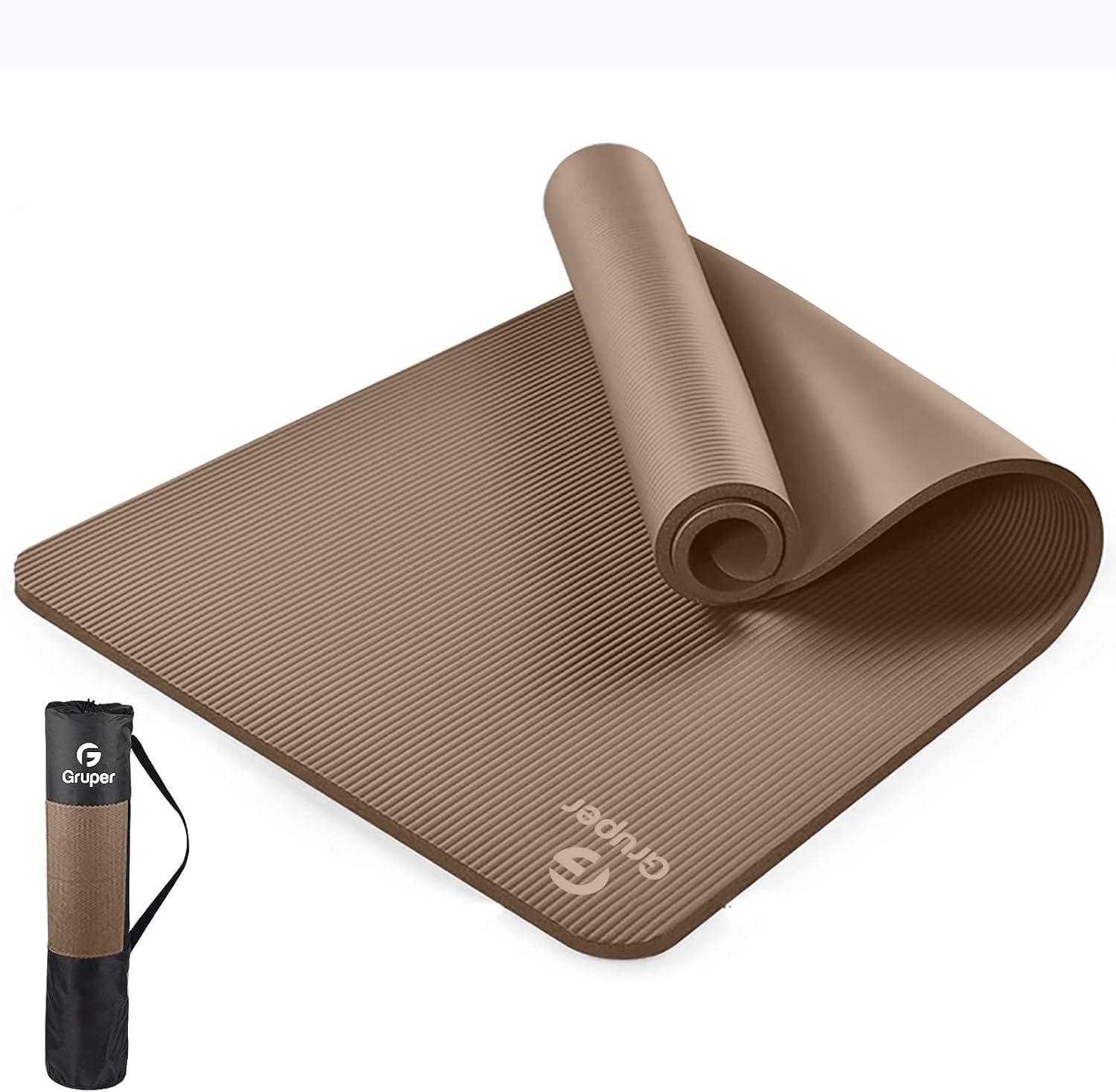
Gruper 10mm Yoga Mat

Gruper 10mm Yoga Mat

Plush floor work

Our Score 9.0/10
Check Price

Worth Noting

  • Too soft for stable standing poses
  • Foam can tear or indent
Material
NBR foam
Carry Bag
Included
Thickness
10 mm
Dimensions
72 x 24 in
Read the full review

The Gruper mat is the one we reach for when the session is more about comfort than precision. Its 10 mm NBR foam has a soft, pillowy feel that takes pressure off knees, wrists, and elbows during planks, stretching, and long floor sequences. At 72 by 24 inches, it is a little longer than the standard mats here, and the included carry bag and strap make it easy to store or take to class.

The trade-off is stability. A mat this soft compresses underfoot, so standing balance poses feel less planted than they do on a half-inch mat. It is not the mat we choose for a balance-heavy flow. But for restorative yoga, Pilates, stretching, and home workouts where joint comfort comes first, the plushness is the point.

Durability is the other thing to watch. The foam can tear or indent if you drag it or catch it on a rough edge, and the soft surface holds marks more than a denser mat. Keep it rolled in the bag, trim your nails, and it should hold up for the kind of low-impact work it is best at.

Bottom line: The Gruper 10 mm is the plush option we choose for joint-friendly floor work; it is the softest ride here, but not the mat for balance-heavy yoga.

#7

YOGATI Alignment Yoga Mat

YOGATI Alignment Yoga Mat

Alignment practice

Our Score 9.0/10
Check Price

Worth Noting

  • Only 6 mm of cushioning
  • Can get slick with sweaty hands
Material
TPE
Thickness
6 mm
Dimensions
72 x 24 in
Alignment Lines
Center markings
Read the full review

The alignment markings are what make the YOGATI worth a look. Laser-etched lines run down the center of the mat, giving beginners a visual check for hand and foot placement without propping up a phone. At 6 mm and 72 by 24 inches, it is a mid-weight mat rather than a plush one, but the TPE surface feels denser than the soft NBR foams here.

We like it for alignment-focused beginners and anyone who wants a lighter mat to carry to class. The included shoulder harness is simple, the two-tone surface wipes clean, and the mat rolls tightly. The cushioning is enough for knees in tabletop and seated poses, but it is not the mat we reach for when joint pressure is the main problem.

Grip is mixed. It holds on dry floors, but sweaty hands can slide, and the 6 mm foam can curl at the edges if it is stored tightly. Those are real caveats, but for the price and the built-in guidance, it is a useful teaching mat.

Bottom line: We like the YOGATI for beginners who want alignment guidance in a lighter mat; it is not the plushest thick mat here, but the center lines are genuinely useful.

How We Chose and Tested the Best Thick Yoga Mats

We started by narrowing the field to mats between roughly 5mm and 12mm thick, then filtered by material, since PVC, TPE, natural rubber, and cork all behave differently underfoot. We ruled out anything sold without a carry strap, anything that came in only one length, and anything priced far above what the material justified, which left us with 12 mats to live with for six months.

Testing happened where mats actually get used. I did 6 a.m. flows on the living room rug before work, took mats to sweaty evening vinyasa classes, and used them for restorative floor work at night. I measured each one with calipers at the center and along the edges, then again after a month, because cheap foam compresses where your hands and feet land. We watched whether knees and wrists felt supported in lunges and tabletop, and whether the surface got slippery once hands got damp — I tested grip both dry and after spritzing my palms.

Stability got its own pass: tree pose, warrior three, and one-legged transitions, noting whether edges curled, whether feet sank far enough to shift my balance, and whether the mat slid on hardwood and carpet alike. To check durability, we lived on these daily and let the usual abuse happen — keys dropped on them, bag straps dragged across them, and roughly six months of sun salutations. We checked for flaking, stretching, and permanent dents in the high-traffic zones. Portability came down to weighing each mat, rolling it into its strap, and actually carrying it on a twenty-minute walk to class.

How to Choose Thick Yoga Mats

Thickness Is a Trade-Off, Not a Score

A half-inch mat is the sweet spot for most yoga and floor workouts. It has enough foam to soften knees and hips on a hard floor, but it still feels firm underfoot in a lunge or warrior pose. A 1-inch mat is better for floor work, stretching, and pressure relief; it is too soft for confident standing balance. A 6 to 10 mm mat gives a plusher feel than a standard mat without the full mattress effect. Choose the thickness around the poses you do most, not the biggest number on the listing.

Grip Has a Dry-Floor Version and a Sweaty-Hands Version

Most thick mats grip well enough when your hands and feet are dry. The difference shows up when you sweat. Soft NBR foam can turn slick, while denser PVC and TPE surfaces hold better for some people; neither is universal. If you do hot yoga or sweat heavily, plan on a towel or a stickier top layer, and test the mat with damp hands before a class. A textured surface helps, but the word non-slip on its own does not tell you how the mat behaves once it is wet.

Length and Width Are the Most Overlooked Specs

Thickness gets the attention, but size is what determines whether you can use the mat comfortably. A standard 68 by 24 inch mat works for many people, while 71 or 72 inches gives taller users more room in reclining poses. If you are tall, wide-bodied, or like to spread out for floor work, an 84 by 30 inch mat can be worth the extra bulk. Check the rolled size too, because a longer, wider mat is harder to store and carry.

Durability, Odor, and Care

Thick foam is soft by design, and soft foam is more prone to tearing, indentations, and scuffs than a dense thin mat. Keep your nails trimmed, roll the mat instead of folding it, and store it away from sharp edges and direct sun. New NBR and PVC mats often have a chemical smell; unroll them in a ventilated room for a few days before the first class. Wipe with a damp cloth and mild soap, then air dry. A carry strap or bag helps storage, but it will not protect the foam from rough handling.

Frequently Asked Questions

Final Verdict

For most people, the Fitvids 1/2-inch mat is the one we recommend. It has enough cushion to protect knees, hips, and elbows on a hard floor, but it stays firm enough for standing poses, and the 71-inch length gives taller users more room than a standard mat. If your practice is mostly floor-based, the BalanceFrom 1-inch mat is the better cushioning tool; if you are tall or wide, the CAMBIVO's 84-by-30-inch surface is worth the extra bulk.