Yoga & Mobility

Best Pilates Sliders of 2026

Pilates sliders look like glorified coasters, but the wrong pair will either stick like gum on a hot day or shoot across the room mid-lunge. The right ones turn a living-room floor into a low-impact studio: they let you glide through mountain climbers, hamstring curls, and side lunges without wrecking your knees or your flooring. For anyone building a home Pilates routine, they’re the cheapest way to add instability and core work without a reformer—and small enough to toss in a gym bag. I’ve tried them on carpet that grabbed, hardwood that felt like ice.

Over the past four months, we put 16 pairs through home workouts, studio sessions, and travel mornings, judging them on how smoothly they slid, how well they gripped, how they held up, and whether they worked on the floors people actually have. The best ones made the moves feel controlled, not chaotic, while the ones that didn’t are a reminder that a low price isn’t a bargain if you’re fighting the slider. Below are the pairs that earned a spot in my bag.

#1

BODi Strength Slides

Top Pick
BODi Strength Slides

Keeping feet on

Our Score 9.4/10
Check Price

Worth Noting

  • Fabric covers wear through first
  • Premium price against flat discs
Diameter
Extra wide
Includes
Two slides and two booties
Surfaces
Hardwood, carpet, concrete
Read the full review

The rim is the tell. These discs are wider than anything else here and the edges curve up, so a whole foot — or both sets of toes on one disc — sits inside the curve instead of hanging over an edge. If your feet have ever skated off a flat slider halfway through a reverse lunge, that shape is worth the money, and it's why we hand these to anyone with bigger feet or a fast, sweaty workout.

Two fabric booties come in the box and are meant to be worn for extra grip. The pair is rated for hardwood, carpet and concrete, which is broader coverage than most here and means one set works in the garage as well as the living room. Where they stop is Berber carpet and rubber gym flooring — both surfaces grab the disc and kill the glide.

The width has a cost beyond the price: at the widest diameter here, they take more drawer space and more clear floor around you than a 7-inch disc. We didn't mind, because the same width is what keeps a heel planted through a mountain climber, and that's the whole point of buying this pair over a flat one.

Bottom line: The fix for slipping feet: a wider, rimmed disc that keeps a whole foot on, with booties in the box and a price to match the extra material.

#2

Mr. Pen Core Sliders

Mr. Pen Core Sliders

Tight budgets

Our Score 9.2/10
Check Price

Worth Noting

Diameter
7 in
Material
ABS plastic
Surfaces
Carpet, hardwood, tile
Read the full review

The cheapest pair here, and the honest question is what that actually costs you. Not much, as it turns out: two 7-inch discs, a plastic face for carpet and turf and a softer face for hardwood and tile, in a blue that's easy to spot at the bottom of a bag. For a first pair, or a second pair to leave at the office or a parent's house, we think that's the smart buy.

What you give up is refinement, not function. These are the plainest discs in the set — two discs and nothing else to sort through — and they're light enough that you'll forget they're in the bag until you need them. The ABS shell has no laminated layer to lift at the edge, which is the failure we see most often on discs with a bonded face.

Two things stood out in use: they're light enough that a hand doesn't tire during a long set of plank work, and the flat profile sits under a heel without a wobble. Nothing about them feels like the cheapest thing in a category. They just get out of the way and slide.

Bottom line: Two discs, both floor types, and the smallest outlay here — the pair to buy when you're not yet sure sliders will stick.

#3

Synergee Core Sliders

Synergee Core Sliders

Best overall

Our Score 9.0/10
Check Price

Worth Noting

  • Socked feet can slip on the slick face
Diameter
7 in
Includes
Printed exercise manual
Material
PVC
Surfaces
Dual-sided for carpet and hard floors
Read the full review

Flip one over and it goes from the living-room rug to the wood floor in the hallway, and that one-second flip is most of why we keep a pair next to the mat. Each disc is 7 inches across, wide enough for a whole hand or a whole foot, with two different faces so you match the disc to the surface instead of the other way around. Two come in the pack, which is the number you actually need.

This is the pair we point people to first, and the reason is unglamorous: it covers both floor types and it costs about as little as anything here, so trying sliders stops being something you have to research. Nothing about the size or the finish feels like a corner was cut to hit that price. Ours get used barefoot on rug and in socks on hardwood, and the edges have held their shape through both.

The discs are jet black and plain, so they vanish under the sofa instead of announcing themselves the way a neon pair does, and a printed exercise manual comes in the pack — a small thing that's the difference between two discs and a routine on day one. Wipe the faces after a session on carpet and they stay slick; grit is what turns a slider into a brake.

Bottom line: Our default pick: two 7-inch discs that handle carpet and hardwood, at a price that makes trying sliders a small decision rather than a project.

#4

Gaiam Core Sliding Discs

Gaiam Core Sliding Discs

Higher weight limits

Our Score 9.0/10
Check Price

Worth Noting

  • Foam side drags on low-pile rugs
Weight
4.96 oz
Material
PVC and EVA foam
Surfaces
Dual-sided for carpet and hard floors
Maximum Weight
400 lb
Read the full review

Four hundred pounds is the highest weight rating in this set, and for a lot of people that number settles the choice before anything else gets discussed. The discs are dual-sided — a foam face for hardwood and a slicker face for carpet — and they come as a pair in grey and black, thin enough to stack in a drawer.

On wood and smooth floors the foam side glides predictably, which is where these are at their best. On a low-pile rug or a thin exercise mat the foam drags, and you end up working harder to move than you meant to. Flip to the slick side for carpet and the drag goes away, though so does some of the control.

We keep a pair in the rotation because the rating and the build suit heavier users and anyone who wants a disc that feels substantial rather than flimsy. The foam face is also the friendlier surface for kneeling work, where bare plastic gets uncomfortable fast. At roughly the middle of what this set costs, they're the sensible step up from the cheapest discs here.

Bottom line: The pair for heavier users and anyone who wants a generous weight rating: foam on one side for wood, slick on the other for carpet.

#5

ZILLEEN Exercise Sliders

ZILLEEN Exercise Sliders

Packing and travel

Our Score 9.0/10
Check Price

Worth Noting

  • Slide can stick under a heavier user
Weight
2.89 oz
Diameter
6.9 in
Surfaces
ABS side for carpet, EVA foam side for hard floors
Read the full review

Under three ounces each and just under seven inches across, these are the pair that ends up in the side pocket of a bag rather than in a drawer at home. Nothing about them is precious, which is exactly what you want in something you'll throw in a carry-on and use in a hotel room with a carpet you've never met before.

The two faces are easy to tell apart by touch: ABS plastic for carpet and cloth surfaces, EVA foam for hardwood, laminate and tile. That sounds like a small thing until you're mid-workout trying to remember which side goes down, and it's the reason a beginner can pick these up and be sliding correctly within a minute.

For travel and for a first pair, these are what we hand people. The slide is smooth on low carpet and on wood, it turns sticky for a heavier user pressing straight down into plush pile, and the cost sits barely above the cheapest pair here — which makes them the low-risk way to find out whether sliders suit you at all.

Bottom line: Light, cheap and clearly two-sided: the pair to pack in a bag, and the low-risk way to find out whether sliders fit your routine.

#6

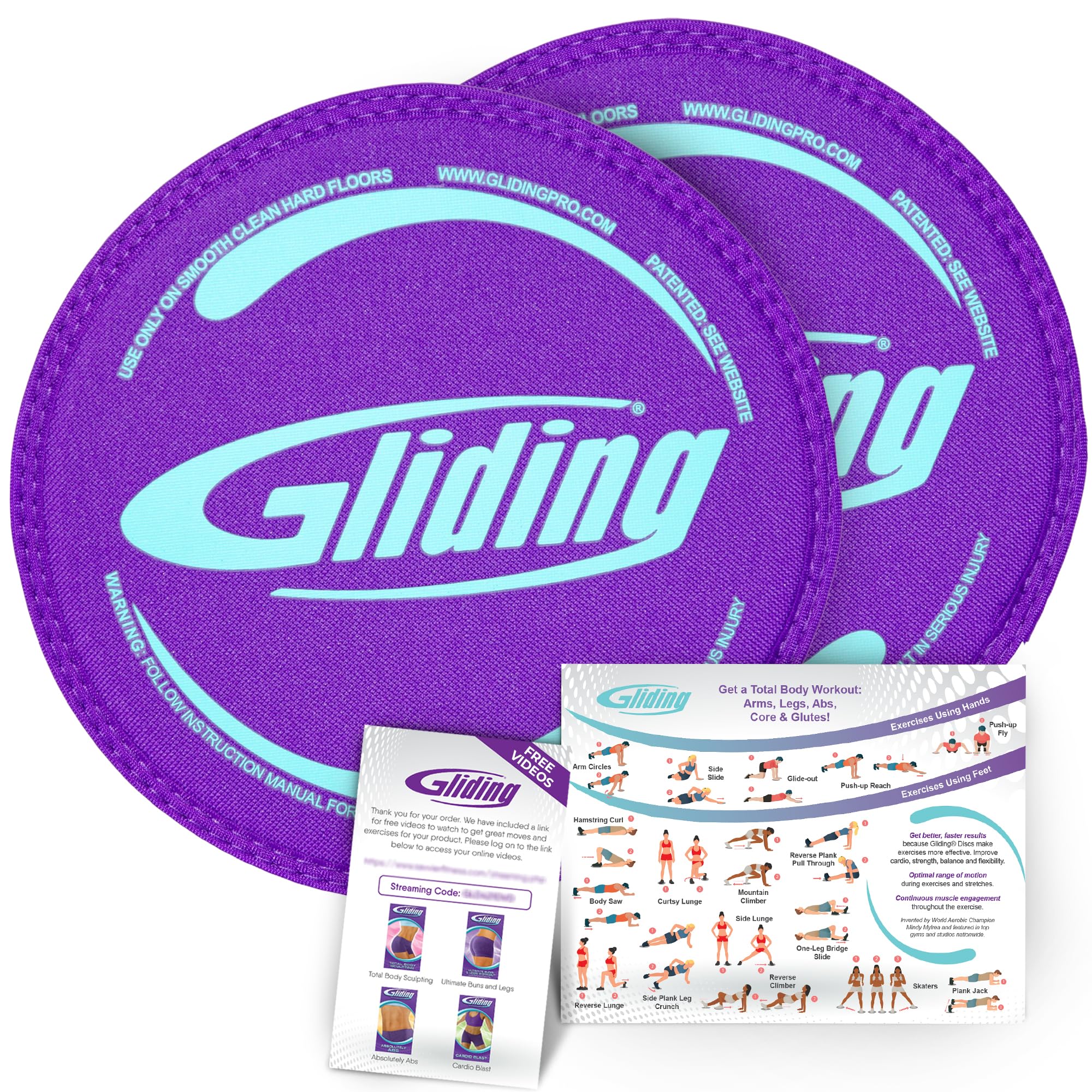
Gliding 9-Inch Sliders

Gliding 9-Inch Sliders

Hard floors

Our Score 9.0/10
Check Price

Worth Noting

Weight
5 oz
Diameter
9 in
Includes
Four streaming workouts
Surfaces
Hardwood and tile
Read the full review

There's no carpet side on this pair — they're built for hardwood and tile, and that one fact decides whether they belong in your house. If your workout space is a wood floor or a tiled basement, the 9-inch nylon disc is the closest thing here to what a studio uses: wide enough for a whole foot, with a surface that keeps gliding over tile with ridges in it.

Nine inches is the largest diameter in this set, shared only with the Tumbl Trak pair, and the extra size is the difference between a heel that stays put and one that keeps finding the edge. In a pilates or barre routine, where the movement is slow and controlled, that stability matters more than raw slide speed.

Four streaming video workouts come with the pair, which is more structure than most discs here offer, and they pack flat enough that a gym bag doesn't notice them. Nylon rather than the usual ABS is the unusual choice, and it's part of why these read as studio equipment rather than gym-floor hardware.

So: the pair for a hard floor and a slow, controlled routine. If you need one set that covers a carpeted bedroom and a tiled kitchen, buy a dual-sided disc instead — these will fight you on pile, and no amount of technique fixes a surface mismatch.

Bottom line: For a wood or tile floor, the closest thing here to a studio disc: 9 inches wide, light in the bag, with four workouts included.

#7

Tumbl Trak Sliders

Tumbl Trak Sliders

Carpet workouts

Our Score 9.0/10
Check Price

Worth Noting

  • Can pop and whistle during use
  • Plastic shell can crack under load
Top
Padded
Weight
8 oz
Diameter
9 in
Surfaces
Carpet
Read the full review

Convex underneath, padded on top, and shaped to ride over pile rather than dig into it. The curve is what lets these travel across a carpet in any direction without catching an edge, and the 9-inch surface is big enough for a whole foot or a forearm.

That padding is why these turn up in rehab routines as much as in conditioning. Kneeling or resting an elbow on a hard plastic disc is the part that hurts after a few sets, and the foam top takes that away, which makes long mountain-climber and plank sequences far more tolerable.

The trade-offs come with the design. The extra size that makes them comfortable under a knee is the same size some find clumsy for hand work, the plastic shell can crack under heavy use, and they've been known to pop and whistle as they move.

For a carpeted home gym, a physical-therapy routine on rugs, or anyone who wants padding under a knee, these earn their price. On a wood floor they're the wrong tool entirely, and the padding doesn't change that.

Bottom line: For carpet, a padded, curved disc that's easier on knees and elbows than flat plastic — worth the premium if you'll use it often.

#8

Elite Sportz Core Sliders

Elite Sportz Core Sliders

With shoes on

Our Score 8.8/10
Check Price

Worth Noting

  • Bogs down on thick, plush carpet
Weight
6.4 oz
Diameter
7.09 in
Warranty
Lifetime
Maximum Weight
300 lb
Read the full review

Shoes on, on a carpeted basement floor: that's the setup where these discs make the most sense, and it's a real one, because plenty of people don't want to take their trainers off between sets. The plastic face slides under a sole without grabbing, and the 7.09-inch diameter leaves enough room that a larger shoe doesn't hang over the edge.

What tips these above the other cheap pairs for us is the combination of a 300-pound rating and a lifetime warranty on something this simple. A disc is a piece of plastic, so a maker offering to stand behind it indefinitely is saying something about how it's made. They also work on padded gym mats, which is where a lot of people actually end up doing plank work.

They pack flat and weigh little, so they live in a gym bag without being noticed until you need them. The surface list is the usual one — carpet, hardwood, padded mats — and it's worth knowing that a thick, plush carpet is where the glide gives out first, on these as on almost everything else here.

Bottom line: Slide them under your shoes on a carpeted floor and forget about them — the pair we point to for shoe-on sessions, backed by a lifetime warranty.

How We Chose and Tested the Best Pilates Sliders

We started by pulling together sliders from brands we kept seeing in Pilates forums, studio equipment lists, and customer reviews, then narrowed the field by material, size, construction quality, price, and the floor types each pair claimed to handle. We ended up with 16 pairs, from budget discs to slightly nicer sets, and used them for four months.

Testing happened where sliders actually get used: my living room carpet, a hardwood floor, a tile bathroom, and a studio mat, plus a few hotel rooms while traveling. I did the same short sequence on each pair—mountain climbers, hamstring curls, side lunges, and plank knee tucks—and noted whether they glided evenly, caught on carpet fibers, or slid out from under my hands, and whether the exercise felt stable or wobbly. I also checked how much surface area each one gave under my palms and feet, whether the edges dug in, and how easy it was to flip them for different floors.

After each session, I wiped them down and checked for scuffs, cracking, fraying, and warping; by the end of four months, some looked barely used and others had flat spots. I compared that wear against how they felt in use and what they cost, because a slider that needs replacing in a season isn’t a value no matter the sticker price. The pairs that made the final cut were the ones that stayed smooth, stayed put when I needed them to, and worked on more than one floor.

How to Choose Pilates Sliders

Match the disc to the floor you actually train on

A dual-sided disc puts a slick face down on carpet and a foam or felt face down on hardwood, tile and laminate, which is why most pairs here list both. That's the right buy if you move between a rug in one room and a wood floor in another. If you always train in the same spot, a single-surface pair glides better than a compromise: the Gliding discs are built for hardwood and tile, and the Tumbl Trak pair is built for carpet.

Two floors defeat almost everything. Rubber gym flooring grabs plastic, and deep plush pile swallows a disc that works fine on low-pile carpet. Before you order, push a paper plate across the spot where you plan to work out — if the plate won't travel, the disc won't either.

Size, rims and keeping your foot planted

Seven inches is the working standard and suits most hands and feet. Nine inches gives noticeably more room, which matters if you wear a large shoe or work barefoot with sweaty feet. Shape matters as much as width: a rimmed or dished disc, like the BODi slides, catches a heel that would otherwise skate off a flat one.

If your feet keep sliding off, technique fixes more than equipment does. Press down through the middle of the disc rather than the edge, and slow the movement until the slide is controlled — a fast, sloppy rep is where feet leave the surface.

Weight ratings and what actually wears out

Ratings here run from 300 to 400 pounds and plenty of discs publish none at all, so check before buying if you're on the heavier side or plan to load a disc with a knee or elbow. The sliding face is what fails first: laminated foam and fabric layers can peel away, and a thin plastic shell can crack under repeated pressure.

Construction tells you most of it before you buy. A single molded piece of ABS or PVC has nothing to delaminate, while a disc with a bonded foam or fabric face has one more layer that can lift at the edge.

What comes in the pack

You need two discs, and every pair here supplies them. Beyond that, the extras separate the options: the BODi set adds fabric booties, the Gliding pair includes four streaming workouts, and several cheaper pairs ship with a printed exercise sheet. None of it is essential, but guidance earns its keep if you've never used sliders before.

Frequently Asked Questions

Final Verdict

One pair covers it for most people: the Synergee discs handle carpet and hardwood, the 7-inch face suits hands and feet, and the price makes the whole experiment almost free. That's the recommendation for a reader who just wants sliders to work wherever they unroll a mat.

Two reasons to go elsewhere. If your feet keep sliding off flat discs, the BODi slides are wider with a rim that holds a foot, and the booties come with them. If your training space is hardwood and you want the studio feel, the Gliding 9-inch pair glides there better than a compromise disc — just don't buy it expecting to use it on carpet.