Yoga & Mobility

Best Pilates Balls of 2026

A nine-inch pilates ball is just a pocket of air that refuses to hold its shape, and that's the point — your deep core and hip stabilizers have to do the stabilizing. That only works if the ball is firm and stays firm through a set. A soft one lets you lean on it instead of working against it, and a slick one shoots out from under your lower back mid-rep.

I've used these in barre classes where every ball was half-deflated by the second exercise, and at home, where mine spent more time under my desk as a lumbar prop than in an actual workout. Over three months, my team inflated 16 of them, and the differences came down to how easily they blew up, how they gripped a bare floor, and whether the thing was actually nine inches across.

Size is the spec nobody double-checks: the number on the box is closer to a range than a promise. A ball that runs large won't sit right between your knees, and one that runs small is useless under your lower back. The picks below held air, held their shape, and earned their small price.

#1

THERABAND Mini Ball

Top Pick
THERABAND Mini Ball

Guided PT routines

Our Score 9.2/10
Check Price

Worth Noting

  • Plug can be fiddly to seat fully
  • Firmness can fade between sessions
Surface
Textured
Diameter
9 inches
Included
Ball, inflation tube, instruction booklet
Material
PVC
Read the full review

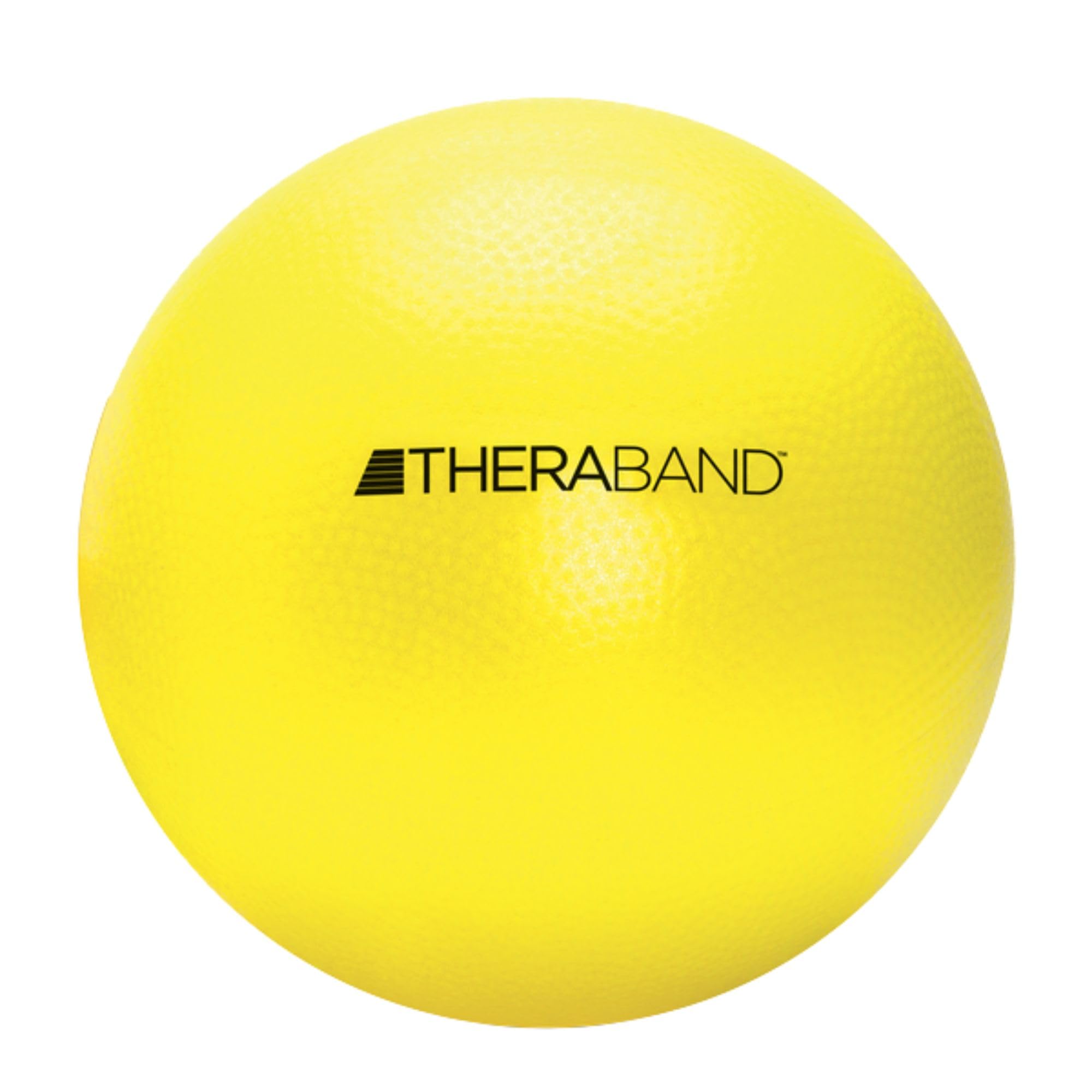
A small ball is only as useful as the exercises you bring to it, and Theraband packages a printed booklet with its 9-inch Mini Ball. That booklet is the first thing we noticed, because it turns a simple prop into a guided session for abs, hips, shoulders, and posture. The ball itself is anti-burst PVC with a slightly textured surface that is meant to stay put against a wall or floor.

The 9-inch size is right for between-the-knees squeezes and under-the-lower-back crunches, and the ball is designed to remain elastic and squishy even when fully inflated. That softness is a plus for neck and posture work, where a firmer ball can feel like a tennis ball against the spine. The included tube inflates by breath, so there is no pump to lose.

We were struck by how much the booklet changes the ownership experience for someone following a PT handout or building a low-impact routine. The trade-off is the higher price than the basic balls here, but the printed program and textured feel are what the extra money buys. It is the one we choose when structure matters more than a spare plug.

Bottom line: We reach for Theraband when a printed exercise booklet and a textured surface matter as much as the ball itself.
#2

ProBody Pilates Ball

ProBody Pilates Ball

Core and PT

Our Score 9.0/10
Check Price

Worth Noting

  • Can need periodic top-offs after inflation
Weight
3.2 oz
Diameter
9 inches
Included
Ball, two straws, extra plug, instructions
Material
PVC
Read the full review

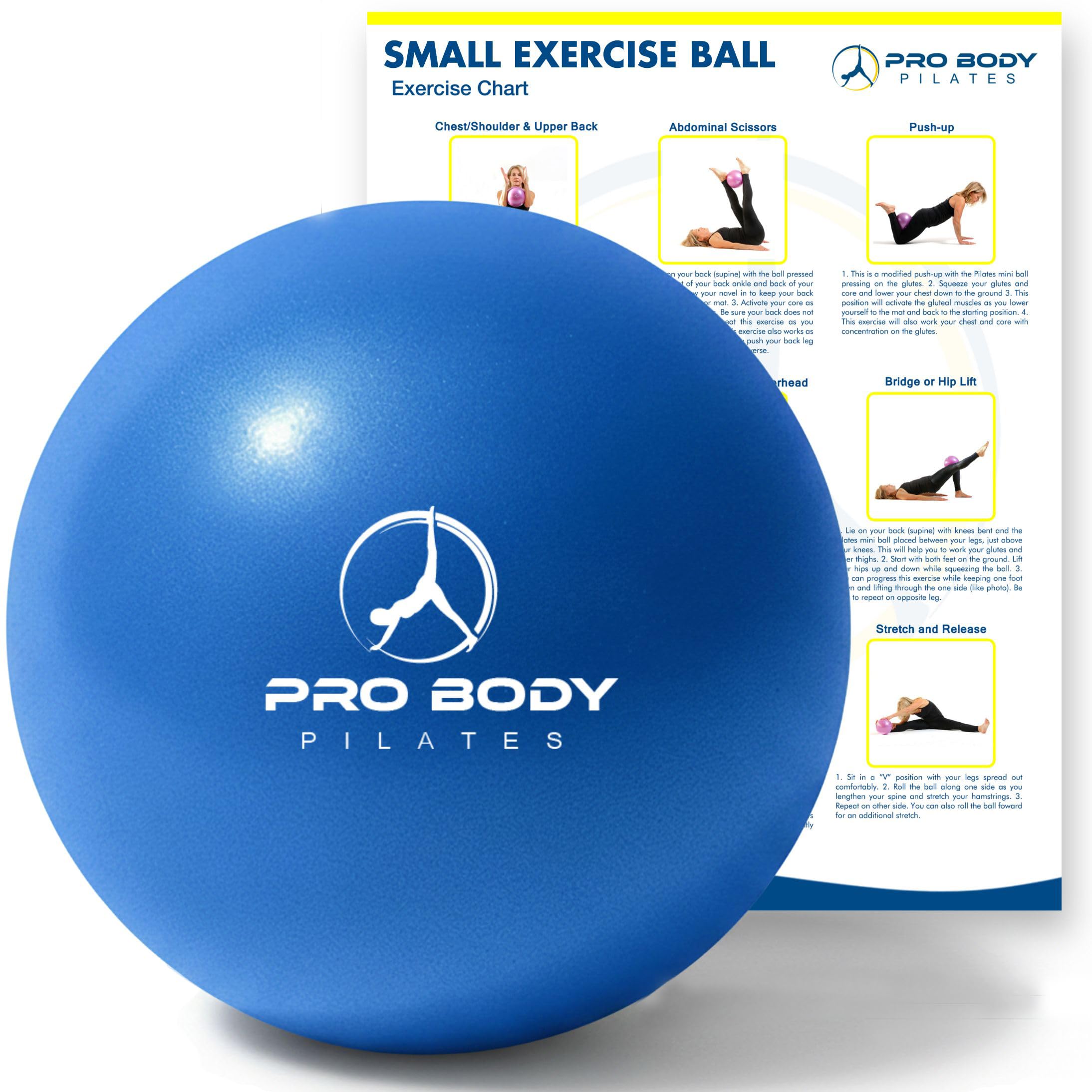
Nine inches is the size we look for first in a small Pilates ball, and ProBody keeps the rest of the package simple: anti-burst PVC, a latex-free build, and two inflation straws plus an extra plug. That last detail matters more than it sounds. A misplaced plug turns a useful ball into a drawer ornament, and having a spare removes the small panic of losing one.

We recommend this one as the default because it sits in the middle of the category rather than chasing a gimmick. The 9-inch diameter is the familiar between-the-knees size for core squeezes, glute bridges, and postpartum or PT exercises, and a firm-but-yielding feel suits holds of 10 to 30 seconds better than a rock-hard ball. At 3.2 ounces, it disappears into a tote or suitcase.

The included instruction sheet gives you a starting point, though we think of it as a nudge rather than a full program. Inflation by straw takes a few breaths, and the ball is easy to deflate when you want to travel with it. We also appreciate that the PVC is latex-free, which is a useful detail for anyone sensitive to latex.

ProBody is not the plushest or most textured ball here; that is the trade for a straightforward build and a kit that covers the basics. The Theraband adds a printed program and a more textured feel; ProBody keeps the essentials and the lower price.

Bottom line: We recommend ProBody first for a simple 9-inch ball that covers core, barre, and PT without making you pay for extras.

#3

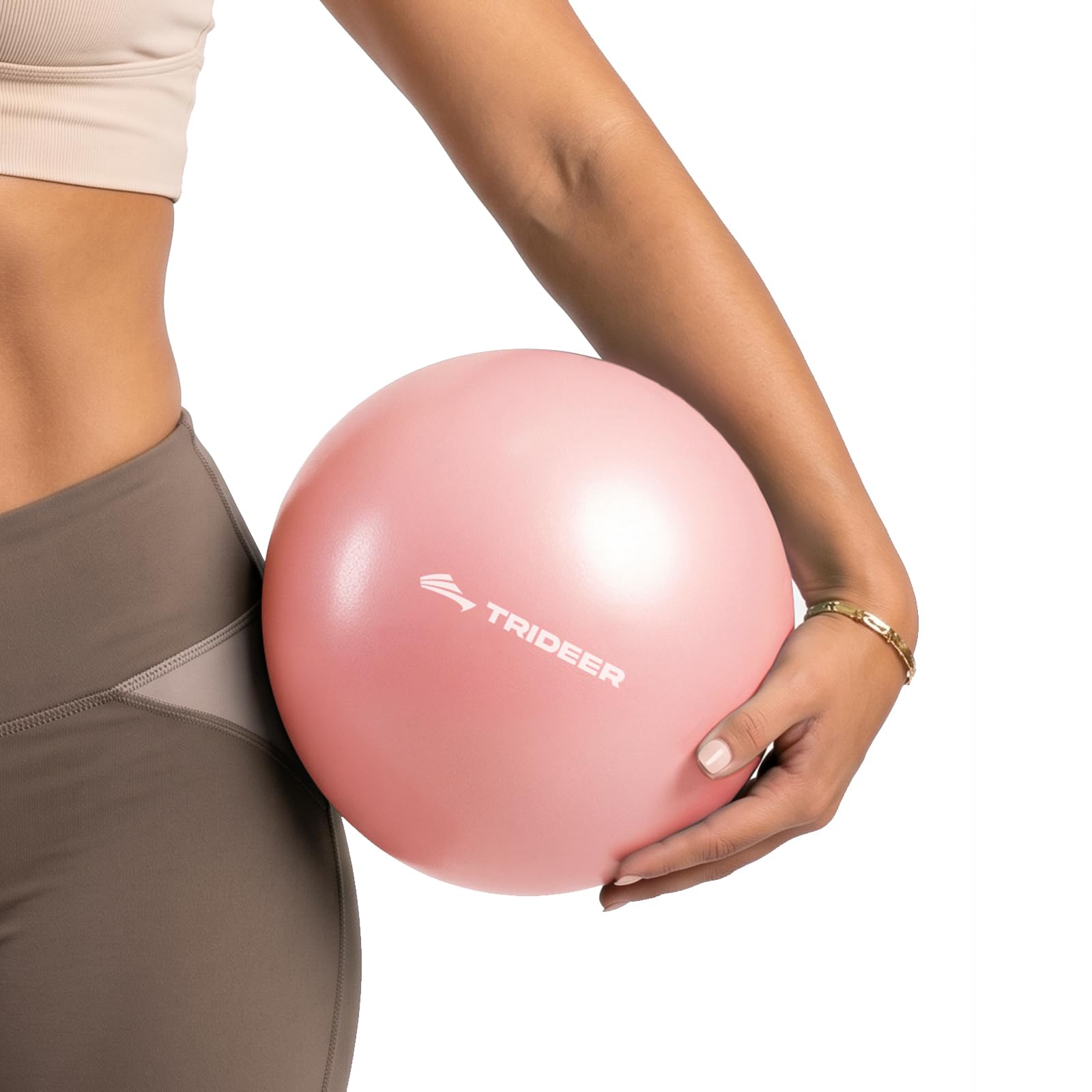
Trideer Pilates Ball

Trideer Pilates Ball

Barre and mat

Our Score 9.0/10
Check Price

Worth Noting

  • Sticky surface can mark furniture
  • No pump included in the kit
Weight
5 oz
Diameter
9 inches
Included
Ball, two plugs, two straws, plug remover
Material
PVC
Read the full review

Trideer is upfront about the first week: the PVC may feel softer and need more air before it settles. We appreciate that honesty, because it explains the main adjustment before it becomes a surprise. Once inflated, the 9-inch ball has a soft, slightly grippy surface that feels more forgiving against the inner thighs than a slick, hard ball.

At 5 ounces, it is light enough to carry to a class and still substantial enough to feel like a real piece of equipment. The kit includes two straws, two plugs, and a plug remover, which is more than most basic balls offer. We were glad to see the plug remover in particular; it makes deflating for travel less of a fingernail exercise.

The trade-off is size: fully inflated, it can feel larger than the studio ball you are used to, so start with less air and add more only if you need firmness. For barre, mat Pilates, and between-the-knees work, the soft surface is comfortable. We also think the one-year warranty is reassuring for a ball that is likely to see floor time.

Bottom line: Trideer's soft, grippy PVC makes it our pick for barre and mat work where a little give feels better than a hard ball.

#4

Slim Panda Pilates Ball

Slim Panda Pilates Ball

Desk lumbar support

Our Score 9.0/10
Check Price

Worth Noting

  • Not a substitute for a desk chair
Diameter
9 inches
Included
Ball, steel straw, plug, guide
Material
PVC
Warranty
1 year
Read the full review

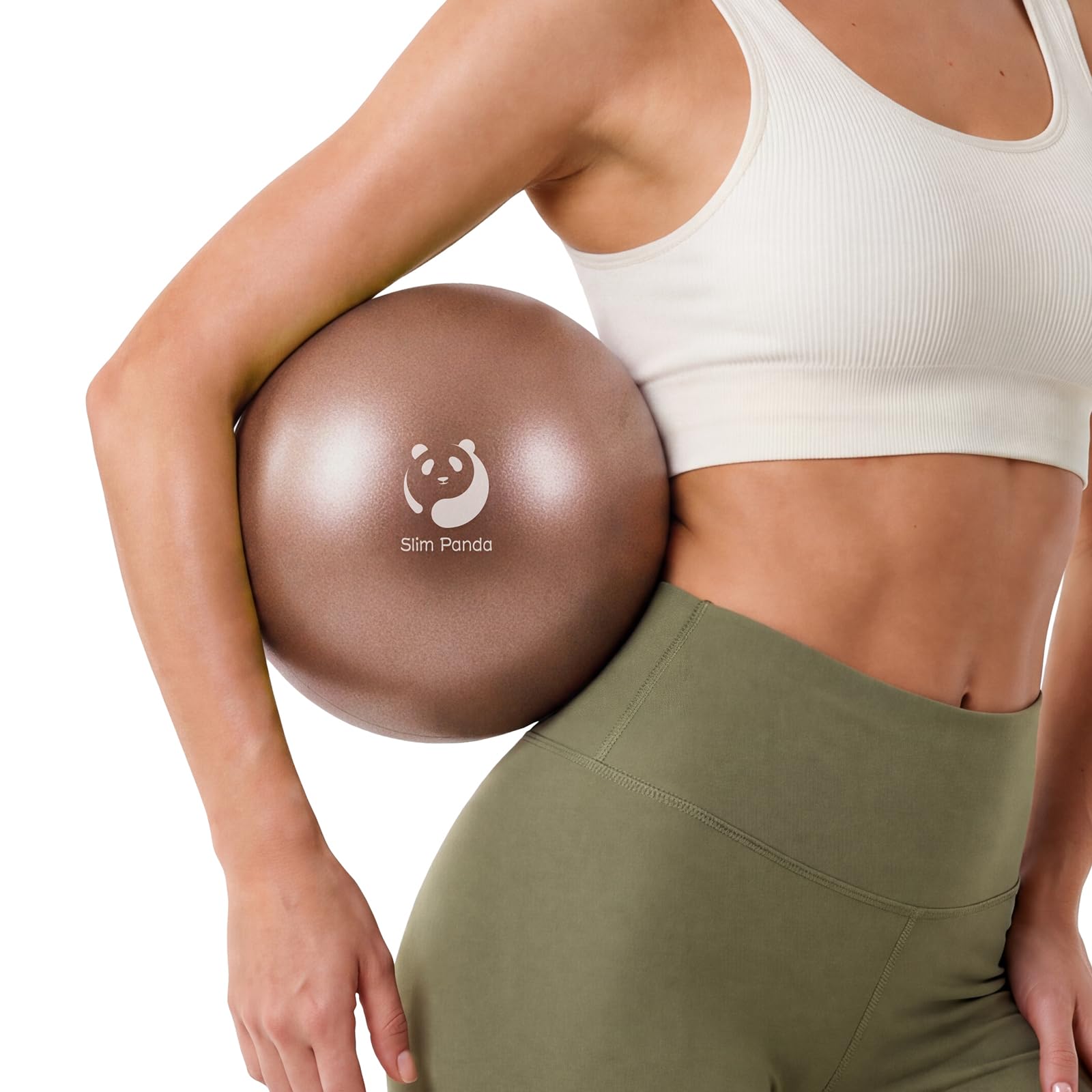
The desk-posture idea is what sets Slim Panda apart. A 9-inch ball tucked behind the lower back can encourage a more upright seat without turning your office chair into a full active-sitting setup, and the champagne gold finish looks less like gym equipment than most balls here. The PVC is thick, non-slip, and designed for everyday training loads.

We think that dual role is genuinely useful: the same ball that supports a few minutes of desk posture work can be pulled onto a mat for crunches, bridges, or barre leg work. Inflation is by a stainless steel straw, which feels sturdier in the hand than the plastic straws included with some rivals. The kit also includes an air plug and a printed guide, and the ball comes with a one-year warranty.

The catch is maintenance. The instructions suggest resting the ball for about a day after inflation, and PVC balls can lose air between sessions, so check firmness before you rely on it for a workout. Those are reasonable trade-offs for a ball that looks good enough to leave out.

Bottom line: Slim Panda is the small ball we choose when it needs to do double duty as a desk lumbar prop and a mat workout tool.

#5

APEXUP Pilates Ball

APEXUP Pilates Ball

Grip-focused work

Our Score 9.0/10
Check Price

Worth Noting

  • No pump included in the kit
Grip
Honeycomb texture
Diameter
9 inches
Material
PVC
Inflation
Two straws
Read the full review

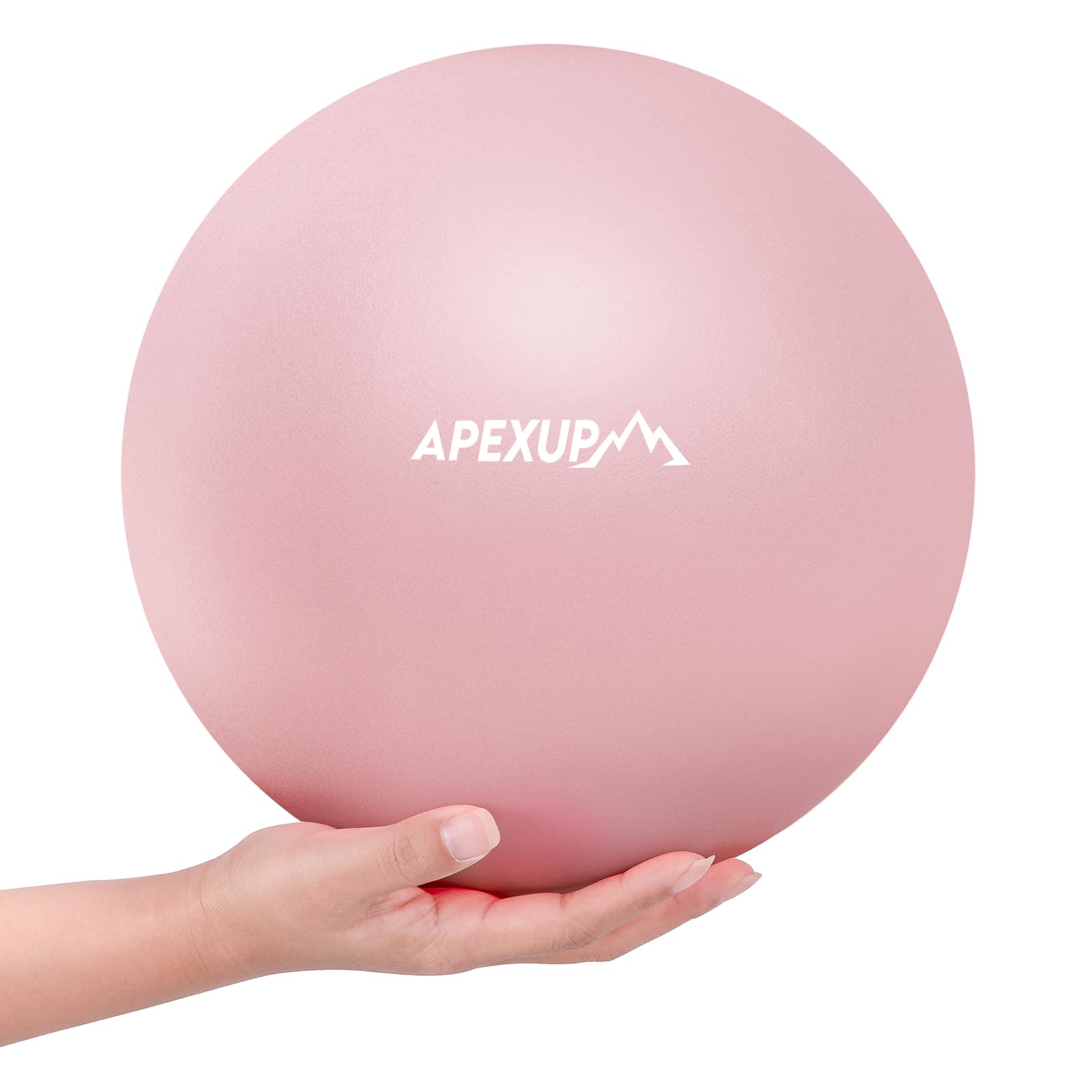
Honeycomb texture sounds like a small detail until you are holding a plank with one hand on the ball or pressing it between your knees. The pattern on the APEXUP gives the PVC a more tactile surface than a smooth ball, and we like that extra bite for balance and core work. It is still a 9-inch ball, so the size is familiar, not a new skill to learn.

The PVC is described as eco-friendly, non-toxic, and odorless, and the ball inflates with two included straws. We appreciate that the plug is a standard push-in style rather than a recessed valve that needs a special tool. The ball is light enough to move from mat to floor without a second thought.

Where it falls behind our top pick is long-term evidence; APEXUP has a shorter history in our rotation and a simpler package. But if grip is the thing that makes you reach for a ball during a workout, this is the one we hand over first. It is a specialist, not the default.

Bottom line: APEXUP is our grip pick, with a honeycomb texture that keeps a 9-inch ball steadier under hands and feet.

#6

Bender Ball

Bender Ball

Follow-along workouts

Our Score 9.0/10
Check Price

Worth Noting

  • Premium price for a basic PVC ball
Weight
3.8 oz
Diameter
9 inches
Included
Ball, printed instructions, streaming videos
Material
PVC
Read the full review

The streaming workout library is the reason to look at the Bender Ball. Instead of handing you a ball and a one-page sheet, Bender includes printed instructions and access to follow-along videos, which is useful if you are new to small-ball work or want a structured core session. The ball itself is a 9-inch anti-burst PVC model with a grippy, non-slip surface.

It weighs less than 6 ounces, so it is easy to carry in a gym bag, and the maker rates it to support up to 300 pounds. The 8-to-9-inch diameter is in the same range as the other picks, and the non-slip surface is designed to work on a mat or floor. We were glad for the compact package on travel days, though the video access is the feature that separates it from a plain ball.

The stopper needs to be seated with care, and if it is not fully in, the ball softens between sessions. That is the one detail we check before a workout. Otherwise, the videos are the real product here; the ball is the delivery system.

Bottom line: Bender Ball is worth the premium when you want a ready-made video program with your 9-inch ball.

#7

kisnbld Pilates Ball (2-Pack)

kisnbld Pilates Ball (2-Pack)

Home and gym

Our Score 8.8/10
Check Price

Worth Noting

  • Two balls may be more than a solo user needs
  • No pump included in the kit
Diameter
9 inches
Included
Two balls, four straws, four plugs, two pullers
Material
PVC
Read the full review

The two-ball pack is the first thing to understand about kisnbld. You get two 9-inch PVC balls, four straws, four plugs, and two plug pullers, which is more hardware than most single-ball listings. That makes it a sensible choice for a household that wants one ball upstairs and one in a gym bag, or for a small studio that needs a spare on hand.

The balls are described as anti-burst and non-slip, with a PVC surface that is meant to hold its shape on a hard floor. We like the plug puller because deflating a small ball can otherwise be a fingernail test. The 9-inch size is right for between-the-knees work and under-the-back support, and the light weight makes the spare easy to store.

The trade-off is that a two-pack does not solve the usual PVC maintenance. The balls can lose air between sessions, and the surface can feel tacky if it picks up dust. Neither issue is unusual for this category, but it means you should check firmness before a workout rather than assuming the ball is ready.

We rank this as an also-consider rather than a top pick because the ball itself is not notably softer, grippier, or more supportive than the singles here. What it does well is remove the single-point-of-failure problem: if one ball goes missing or soft, the second is already there. The second ball is the feature; the rest is standard PVC.

Bottom line: kisnbld is the practical two-ball set for keeping one at home and one in a bag as a ready spare.

How We Chose and Tested the Best Pilates Balls

We started with the best-selling and best-reviewed nine-inch balls on the major retail sites, then cut anything that didn't name an anti-burst material or include some way to inflate it. That left 16 balls, which we inflated and lived with for three months.

Each one got inflated the way the maker intended — straw, hand pump, whatever came in the box — and we timed how long it took one person to go from flat to round, since a fussy inflator is often the difference between a ball that gets used and one that stays in the closet. We measured the diameter with a tape at 24 hours and again at a week, and noted the plastic smell right out of the package.

Air retention was checked weekly by pressing a thumb into each ball and re-taping its diameter, and the ones that went spongy got written down. For durability, we sat on them, squeezed them between our knees for 30-second holds, and pressed them into a wall for wall sits, then looked for bulging seams, creases, and tacky spots.

Real life covered the rest: 20 minutes of barre videos on a living room rug, hamstring bridges on hardwood, and long stretches under a desk as lumbar support. We tracked which balls skidded and which gripped, which stayed comfortable under a lower back for an hour, and whether the printed instructions or follow-along videos added anything. With 16 balls at nearly the same price, value came down to which ones were still firm and round in month three.

How to Choose a Pilates Ball

Match the Ball to the Work

A 9-inch ball is the common starting point for between-the-knees squeezes, under-the-lower-back crunches, and barre holds. Inflate it until it holds its shape under a firm squeeze but still gives a little; a ball pumped rock hard feels larger and is harder to keep between the knees. If you mainly want neck or hand support, a softer, slightly underinflated ball is more comfortable. Check the inflated diameter before a workout, not just the size on the box, because the same ball grows as you add air.

Expect to Top It Off

PVC is slightly porous, so most small balls lose a little air over time, especially in the first week. That is normal maintenance, not a defect by itself. Inflate to the firmness you want, seat the plug fully, and check the ball before each session; if it will not hold firmness overnight, return it rather than fighting the valve. A spare plug and two straws are worth having because the plug is the usual failure point. We treat a ball that needs a top-off every few days differently from one that goes flat during a set.

Choose the Surface You Can Grip

Textured PVC gives bare legs and hands something to hold onto during barre, bridges, and wall work. Smooth balls can feel slick once you start to sweat, while a tacky surface can pick up lint or leave a mark on wood furniture. Store a sticky ball on a mat or in a bag rather than on a finished table. Firmness matters too: a softer ball is kinder under the lower back or neck, while a firmer ball gives more resistance between the knees. We prefer a little give for PT-style work and a firmer feel for strength sets.

Pay for Guidance, Not Gadgets

A plain 9-inch PVC ball does the core job. The extra money goes toward a printed exercise booklet, streaming videos, a better inflation kit, or a warranty. That can be worth it if you are starting from scratch or following a PT handout; it is not worth it if you already know the moves. We look for a ball that lists its included straws and plugs clearly, because a missing plug makes the whole purchase useless. Buy the simplest ball that matches your routine, then spend more only on the support you will actually use.

Frequently Asked Questions

Final Verdict

The ProBody is the small ball we recommend first because it gets the essentials right: a 9-inch size that fits adult between-knees work, a light PVC body, and a kit with spare straws and a plug. It is the simplest path to core, barre, and PT sessions without paying for programming you may not use.

If you want a printed routine and a more textured feel, the Theraband is the upgrade. Choose the Trideer for a softer, grippier surface, or the APEXUP if grip is the priority. The ProBody remains the default for most homes.