Tech & Wearables

Best Pedometers of 2026

A pedometer that overcounts is worse than no pedometer at all. You buy one to find out whether you're actually getting your 8,000 steps, and a number inflated by swinging arms or a jostled set of keys is just a confidence trick with a clip on it. What a good one gives you is quieter: a small, honest figure you can glance at mid-walk and believe.

The frustrating part is how wildly the cheap ones disagree about what a pedometer even is — some are one-button pebbles, others want an app and your height before they'll show a number. I've worn one or another around my own neighborhood for years, and over the past three months my team lived with 14 of them, clipped to waistbands and dropped in bags alongside keys. The feature nobody mentions until it bites them is the reset button, easy to brush against and hard to forgive. The picks below land in different places — a couple are almost aggressively simple, one is readable in full sun — but every one of them gave us a number we believed.

#1

StepLify CR-837

Top Pick
StepLify CR-837

Everyday walking

Our Score 8.8/10
Check Price

Worth Noting

  • Heavier than the pocket-size alternatives
Carry
Clip and lanyard
Power
USB rechargeable
Weight
1.69 oz
Display
1.3 inches
Read the full review

The USB-rechargeable, backlit design is what makes the StepLify CR-837 feel more considered than the average simple pedometer. There is no coin cell to hunt down, and the screen lights up for an evening walk. For a device that does one job, that combination is unusually thoughtful. We also like that the one-button operation does not hide a setup menu behind it.

The clip and lanyard cover the two carry methods most walkers use. We wore it on a waistband for the most consistent count and hung it from a collar when we wanted it out of the way. The screen wakes when you move and sleeps when you stop, so the charge is not leaking away while you sit. That auto behavior is the kind of detail you notice only when it is missing.

The 1.3-inch display is smaller than the big-screen picks here, but it is legible at a glance, and the 3D sensor gives this model one of the stronger accuracy stories in this group. It is not a training computer: steps only, no distance or calorie estimates, and no app to browse. That is the point. If you want a number to check after a walk, this is enough.

The trade-off is the battery. The CR-837 is rated at 12 weeks per charge, shorter than the year-long coin-cell life of the NESKLA and Beroziyesi. USB charging is easier than finding a CR2032, so we accept the routine, but it is a routine you have to remember. If you want to forget about power for a year, choose one of the coin-cell models instead.

Bottom line: We recommend the StepLify CR-837 for most walkers because it is a simple, backlit step counter that recharges over USB and carries easily by clip or lanyard.
#2

Beroziyesi Bero-P03

Beroziyesi Bero-P03

Casual daily walks

Our Score 8.2/10
Check Price

Worth Noting

  • Six-month warranty is the shortest here
  • Long-term reliability is inconsistent
Carry
Clip and lanyard
Weight
0.95 oz
Battery
6 to 12 months
Display
1.73 inches
Read the full review

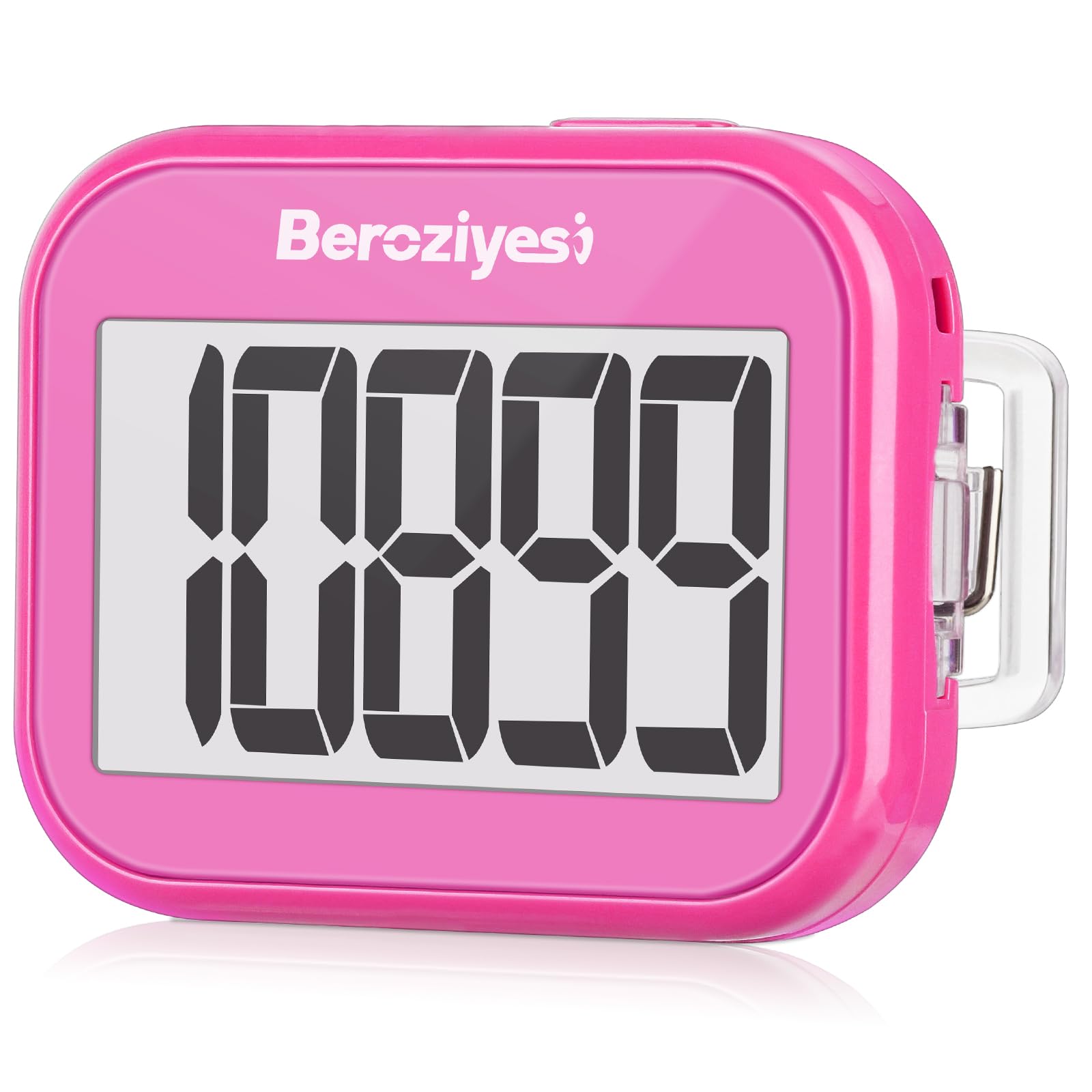
The Beroziyesi Bero-P03 is the budget pick we keep coming back to because it does the basic job without asking you to learn a menu. Hold the reset button, walk, and read the 1.73-inch display; there is no app, no Bluetooth, and no setup sequence to forget. That simplicity is not a small thing when the alternative is another device that wants a password. It is the kind of device you can hand to someone who has never used a fitness gadget.

We found the large screen and light 27-gram body a good match for older walkers or anyone who wants to check a count from the waist. The clip is strong enough for a waistband or pocket, and the lanyard gives you a neck-carry option. The CR2032 battery is rated for six to twelve months, with auto sleep to help. It counts up to 99,999 steps, so a multi-day total is not a problem. The reset is a hold, not a tap, which helps prevent accidental clears.

The compromise is accuracy: this is not the model we trust for a precise training log, and the count can drift. For a dog walker or a mall walker who wants a simple prompt to move, the big display and low fuss are the point. The current variant is pink, so check the color if that matters.

Bottom line: For a casual walker on a tight budget, we recommend the Beroziyesi Bero-P03 as a big-screen, one-button step counter.

#3

StepLify CR-707S

StepLify CR-707S

Belt-loop carry

Our Score 8.2/10
Check Price

Worth Noting

  • Smaller display than the large-screen picks
Carry
Built-in carabiner
Weight
1.2 oz
Battery
Up to 1 year
Display
1.2 inches
Read the full review

The StepLify CR-707S solves a small but real problem: the clip. Instead of a separate clip that can pop off, it has a built-in carabiner that hooks over a belt loop or bag strap. We like that for errands because there is no lanyard to untangle and no clip to lose. It is the one here that feels most like a set-and-forget tag.

It is still a one-job device: steps only, no app, and a reset you hold for a few seconds. The display is clear, and the 10-step error-prevention feature is a sensible touch—it waits for a continuous walk before it starts adding to the total. The 34-gram body is light enough to forget, and the battery is rated for up to a year. There is no programming, no unit selection, and no daily reset ritual unless you want one.

The carabiner is the reason to choose it over the CR-837, but it also makes the unit hang differently. If you want the most consistent count, clip it at the waist rather than let it swing from a bag. For a quick errand counter, the hook is the whole point.

Bottom line: The StepLify CR-707S is our choice when a carabiner is the only carry method you want to fuss with.

#4

NESKLA 838

NESKLA 838

Glasses-free reading

Our Score 8.0/10
Check Price

Worth Noting

  • Reset button can be bumped accidentally
  • Durability is inconsistent
Carry
Clip and lanyard
Weight
0.96 oz
Battery
Up to 12 months
Display
1.73 inches
Read the full review

A 1.73-inch LCD and a 27-gram body are the two facts that explain the NESKLA 838. The numbers are big enough to read from a waistband without stopping, and the unit disappears on a belt or lanyard. If you have ever given up on a pedometer because you needed glasses to check it, this is the one that makes the daily glance easy.

We like it as a simple, low-cost counter for someone who does not want to squint or fuss with an app. One button resets the count, and the CR2032 battery is rated for up to a year, with auto sleep and wake to stretch it. The case is plain plastic, but it feels fine for the job, and the clip is strong enough for a waistband. There is nothing to pair, charge, or sync, which is the appeal.

Accuracy is where we temper expectations. The 3D sensor is the same broad approach as the others, but this is not the model we reach for when a precise count matters more than a big display. Test it against a known 100-step walk before you build a daily goal around it. The included lanyard is the better choice if you check the screen often; the clip is fine for a waistband, but the lanyard keeps the display angled toward you.

Bottom line: We think the NESKLA 838 is the pick when you want the biggest numbers and the lightest body without paying much.

#5

Realalt 3DTriSport

Realalt 3DTriSport

Extra metrics

Our Score 8.0/10
Check Price

Worth Noting

  • More expensive than the simple picks
  • Setup takes more button presses than the simple picks
Battery
Up to 12 months
Display
1.7 inches
Tracking
Steps, distance, calories
Warranty
18 months
Read the full review

The Realalt 3DTriSport is the pick for someone who wants a step counter to do a little more than count steps. It adds distance, calories, and time, and it keeps a rolling record rather than showing only today's total. That makes it feel closer to a basic fitness computer than the one-button pedometers here, without crossing into app-and-subscription territory.

We appreciate that it still works without a phone or app, and the 1.7-inch display is readable. The included waist clip and lanyard cover the usual carry options, and the 18-month warranty is the longest here. The extra information is genuinely useful if you walk the same route and want to compare days, but it is not necessary if all you want is a step number.

One practical detail we minded is the clip: it is not as secure as the clips on the StepLify or NESKLA, so a lanyard or pocket may be safer for daily wear. The extra modes are genuinely useful if you walk the same route and want to compare days, but they are not necessary if all you want is a step number.

Accuracy is decent but not the strongest here, and the extra metrics are only as useful as the calibration. Treat the calorie number as a rough guide rather than a precise ledger. We like the idea of a pedometer that grows with your walking habit, but this one asks for more patience than the best simple counters.

Bottom line: We like the Realalt 3DTriSport for walkers who want distance and calorie estimates alongside steps, provided they can live with more setup.

#6

Jaxrium W807

Jaxrium W807

Hook-on carry

Our Score 8.0/10
Check Price

Worth Noting

  • Small 0.75-inch display
Carry
Clip and carabiner
Battery
Up to 1 year
Display
0.75 inches
Error Prevention
10 steps
Read the full review

The Jaxrium W807 leads with a 10-step error-prevention feature: it waits until you have taken ten continuous steps before it starts counting, then adds those first steps to the total. That is a smart way to cut down on jolts and fidgets being logged as walking. It is the kind of detail that matters more on a busy commute than on a quiet park loop.

We also like the dual carry: a detachable clip and a built-in carabiner, so you can hook it to a belt loop or bag without adding a lanyard. Setup is genuinely minimal—remove the battery tab and walk—and the CR2032 battery is rated for up to a year. The auto sleep and wake behavior is here too, so it is not running while it sits on a shelf. One button handles reset, so there is no combination to remember.

The count is not the most consistent in this group; it is fine for a rough daily total, not for a precise training log. It is not the one to rely on for interval training or a step-count competition. The carabiner is a useful alternative to the clip when you want to hook it to a bag, and the low profile makes it easy to keep as a spare.

Bottom line: We see the Jaxrium W807 as a tiny spare or bag hook for rough step totals, not a precision training tool.

How We Tested: 14 Pedometers, Three Months, a Lot of Walking

We started by gathering every pedometer we could find that was still widely sold and priced under about $40, then filtered by how each one is worn — clipped to a waistband, dropped in a pocket, hung from a lanyard — plus display size, and whether the thing could work at all without a phone app. Fourteen made the cut. Each went home with a tester for three months.

Accuracy got tested on a route we measured by hand at 1,000 steps. We counted aloud on the first pass, compared the pedometer's reading, and repeated that walk three times over the testing period with different people, including one tester with a notably bouncy gait. The treadmill got the same treatment at three miles an hour, and we noted every count that drifted by more than about 3 percent.

Setup we timed, from opening the box to a first reading, with no instructions allowed. Readability was checked by glancing down mid-walk in bright sun, at dusk, and through sunglasses. For size, we clipped each unit to a waistband, a bra strap, and the band of a running short, noting anything that slid off, dug in, or needed two hands to attach.

The reset button earned its own trial after one tester wiped a week of data with a bumped button — so each pedometer rode loose in a bag with keys and coins for a week to see whether it survived. Durability meant a waist-high drop onto pavement and three months of daily wear, and we judged value on what a unit actually did over that stretch rather than on the features printed on its box.

How to Choose Pedometers

Start With the Count, Not the Feature List

A simple pedometer counts steps from motion at the hip, so where you carry it affects the number. A waistband or belt gives the most consistent reading; a pocket can muffle steps, and a bag that swings can add noise. We look for a 3D sensor if you want to clip it in different positions, and we treat a 10-step start-up delay as a useful filter against fidgets—the StepLify CR-707S and Jaxrium W807 both use one. No cheap pedometer is a lab instrument, so test a new one against a known walk before you build a goal around it.

Choose a Carry Method You Will Repeat

Clip, lanyard, carabiner, or pocket: the right answer is the one that fits your clothes and routine. A clip is quick on a waistband but can pop off; a lanyard is secure around the neck but lets the unit swing; a carabiner is handy on a belt loop or bag but hangs less rigidly. We like the StepLify CR-707S and Jaxrium W807 for hook carry, while the NESKLA and StepLify CR-837 include clips and lanyards. If you wear dresses or soft waistbands, a lanyard or bag hook may be the practical choice.

Readability and Reset Are Daily Frictions

You will check the number far more often than you change a battery, so a display you can read at a glance is worth more than an extra mode. Large LCDs help in low light and without glasses, but backlighting is the feature that matters on evening walks; the StepLify CR-837 has it, while the NESKLA and Beroziyesi rely on big unlit numbers. Reset is the other daily touchpoint. A recessed or hold-to-reset button is less likely to be bumped than a simple press, especially if you track a week rather than a day.

Power and Setup: Match the Maintenance to Your Habits

Coin-cell pedometers usually run six to twelve months and ask nothing more than a battery change; USB-rechargeable models save that errand but add a charging routine. The StepLify CR-837 is rated at 12 weeks per charge, so it suits someone who already plugs in a phone or watch every night. Setup is the other hidden cost. A one-button model is ready almost immediately, while a multi-mode pedometer such as the Realalt 3DTriSport takes more presses to set units, time, and stride. If you will not read a manual, buy the simpler device.

Durability and Warranty: Budget for the Whole Life

Pedometers live on waistbands, in pockets, and at the bottom of bags, so the case, clip, and battery door all take abuse. A strong clip matters most if you wear it on clothing; a lanyard takes the strain off the clip. Warranty length is a useful tiebreaker because these are small electronics with few repairable parts: coverage here runs from six months on the Beroziyesi to 18 months on the Realalt. If you are hard on gear, choose the longer warranty and a carry method that keeps the unit from swinging.

Frequently Asked Questions

Final Verdict

Our default remains the StepLify CR-837. It gives most walkers the cleanest daily routine: one button, a backlit screen, USB charging, and a choice of clip or lanyard. The NESKLA 838 is the better choice if a large display matters most, and the Realalt 3DTriSport earns its higher price for walkers who want distance and calories as well as steps. If you mainly hook a counter to a belt loop and forget it, the StepLify CR-707S is the one to pick.