Strength & Weights

Best Weight Bench with Leg Extension of 2026

A weight bench with a leg extension sounds like the ideal two-for-one: press on Tuesday, train legs on Thursday, one footprint in the garage. The catch is that a lot of combo benches feel exactly like what they are — a bench with a station bolted to the end, flexing under load and parking the roller pads somewhere near your shins instead of your ankles. What a good one actually fixes is simpler than the box copy suggests: it lets you work quads, hamstrings, and your pressing lifts at home without buying two machines or driving to a gym.

I've assembled more of these in my own garage than I'd like to admit — the hardware bags, the bolts that don't match the diagram, the wobble that only shows up at rep eight. Over the past eight months, my team and I put 11 benches through their paces, and the pattern held: the ones that felt solid were the simple ones, not the ones with the longest feature list. One thing nobody tells a first-time buyer — the leg attachment's height range matters more than the weight rating printed on the box, because if the roller pads don't land at your ankles, you'll never use the thing. Here's what earned the floor space.

#1

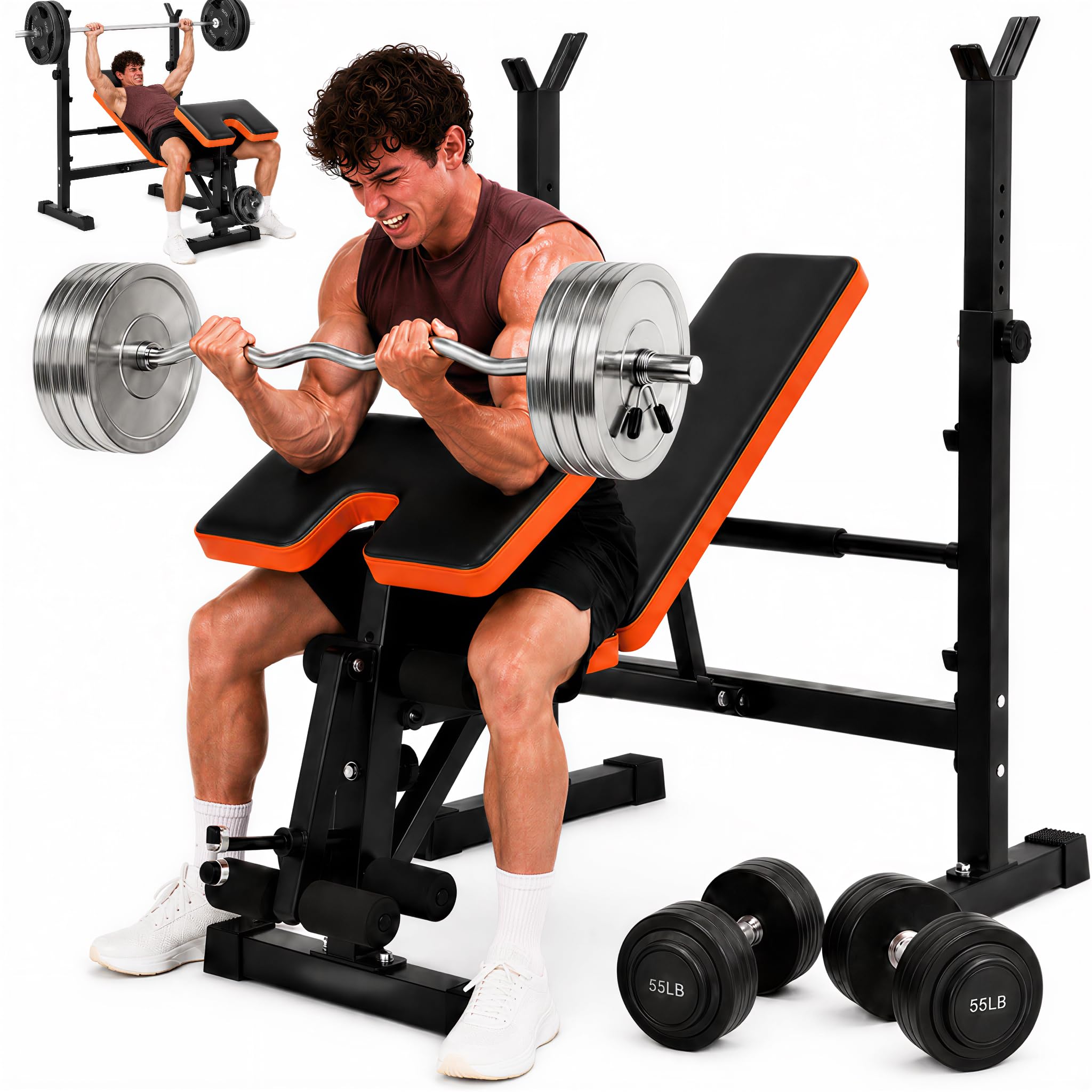
TYRSEN Foldable Weight Bench

Top Pick
TYRSEN Foldable Weight Bench

Compact spaces

Our Score 9.2/10
Check Price

Worth Noting

  • Narrow preacher pad that's fiddly to fit
  • Light frame for its claimed capacity
Bench Height
18 inches
Backrest Angles
7
Weight Capacity
900 lb
Preacher Settings
3
Read the full review

Eighteen inches is the number to start with. That's the height TYRSEN builds the WB-04's pad to, and it's roughly where a commercial flat bench sits, which is why the press feels familiar from the first set rather than after a week of fiddling with your setup.

Seven backrest angles, three preacher settings and a leg developer with a contoured anchor make it more adjustable than the price suggests. The anchor is the part we like: your legs sit against a shaped pad at the top of the movement instead of sliding along a straight crossbar, and on a light bench that's the difference between a controlled curl and a swing.

The preacher pad is where it falls down. It's narrower than the pads on the XDDIAS and the LSL6005, and fitting it is fiddly enough that you'll want to do it once and leave it on. For a bench that otherwise asks nothing of you, that's an annoying five minutes.

Nothing in the build looks like a shortcut: the steel is reinforced where the leg developer mounts, the fold is simple enough to use daily rather than once, and 900 pounds of rating on a 33-pound frame is ambitious in a way that makes us want to see one after a year of use. For a small room and a light-to-moderate lifter, it's a sensible buy; for a heavy pressing program, buy more frame.

Bottom line: A compact folding bench with a real 18-inch pressing height, seven backrest angles and a leg developer; buy it for a small room, not for a heavy squat or press program.
#2

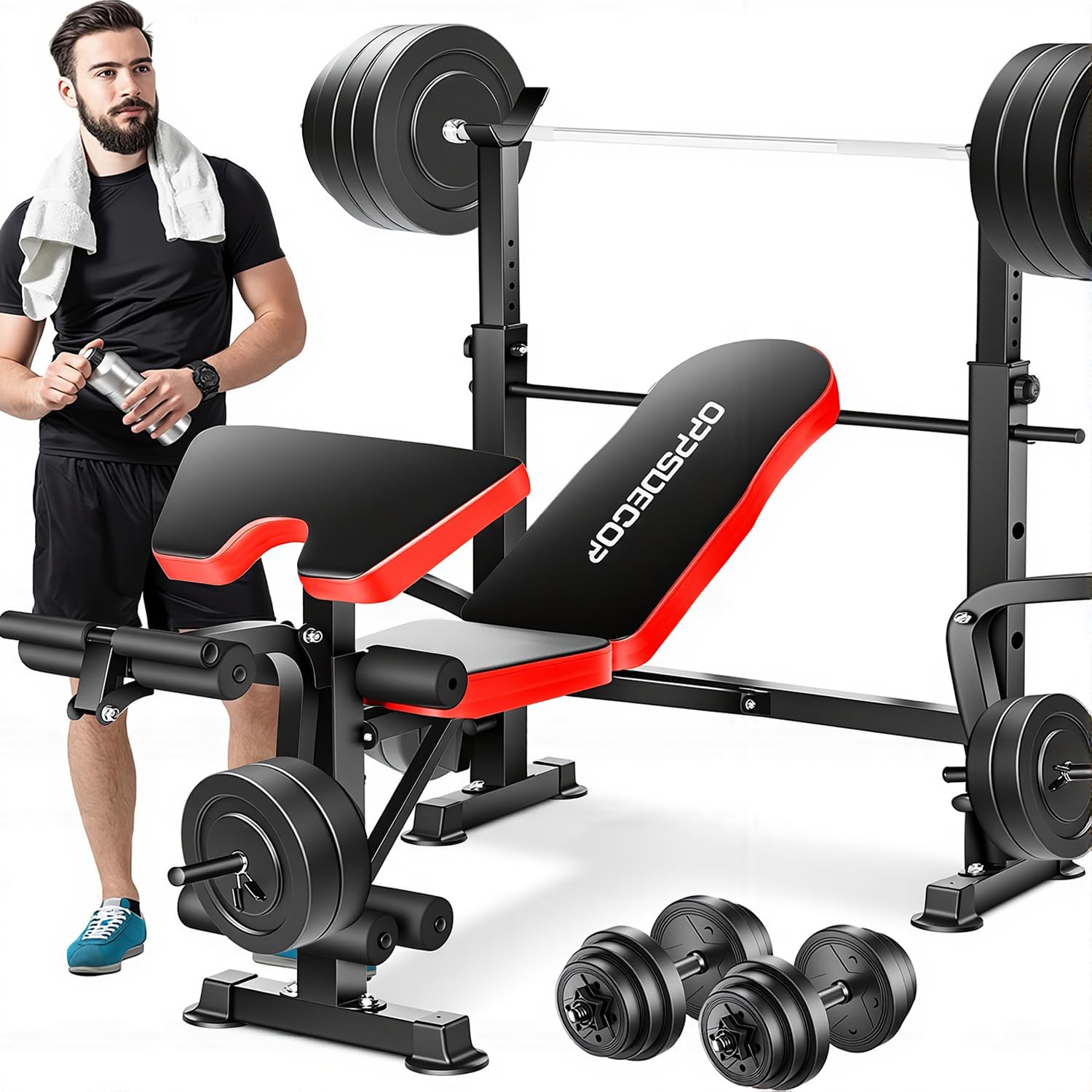
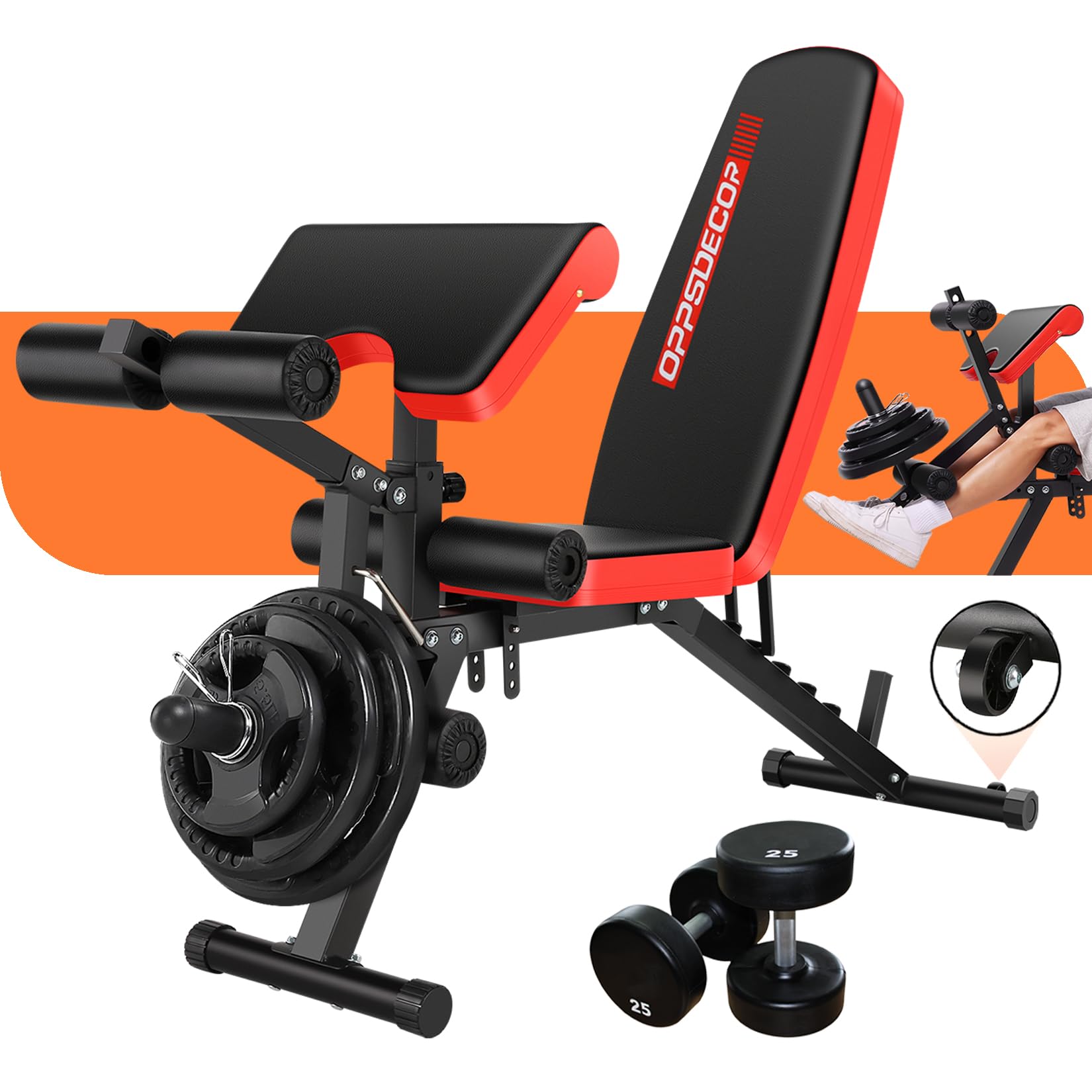
OPPSDECOR LSL6005 Bench

OPPSDECOR LSL6005 Bench

Most home gyms

Our Score 9.0/10
Check Price

Worth Noting

  • Backrest stops short of fully upright
Seat Positions
4
Weight Capacity
800 lb
Backrest Positions
7
Preacher Pad Width
17.7 inches
Read the full review

Four seat angles, seven backrest angles, a 17.7-inch preacher pad and a pin-loaded leg developer, all on an 800-pound frame: the LSL6005 is the most complete bench in this group, and it's the one we point most people to first. The detail that settled it for us is the seat. Being able to change the seat angle along with the backrest is what keeps your hips from sliding forward on a steep incline, and it's the adjustment most people never touch until their lower back tells them to.

It's also the easiest bench here to live with. There are wheels at one end and a handle at the other, so shifting it out of the way between sessions is a one-handed job, and the triangular base takes up the slack on a floor that isn't level. Assembly is the part buyers worry about and shouldn't: the hardware arrives bagged by step, so you're not sorting a coffee can of bolts before you start.

The leg developer is pinned rather than bolted, which means one pin changes it between extension and curl and you're not hunting for a wrench mid-session. Both movements feel properly loaded instead of bolted on as an afterthought, which is more than we can say for every attachment in this group. That matters, because the attachment is the whole reason you're buying this instead of a plain bench.

Two things we noticed. The preacher pad is a fit-and-remove piece rather than a permanent fixture, so an arm day means bolting it on; we left it off otherwise. And at six feet the foot end of the leg developer gets crowded — a chunky training shoe can foul the frame at the bottom of the movement, so check the setup if you're tall or lift in thick soles. For one bench that covers pressing, curls and legs without a second machine, this is where we start.

Bottom line: For most home gyms this is the bench to buy: independent seat and backrest adjustment, a preacher pad and a leg developer that both work, at a midrange price that doesn't feel like a compromise.

#3

XDDIAS Adjustable Weight Bench

XDDIAS Adjustable Weight Bench

Arms and pressing

Our Score 9.0/10
Check Price

Worth Noting

  • Light frame can shift under heavy incline work
  • Leg developer sits low for tall riders
Seat Levels
4
Backrest Levels
10
Weight Capacity
900 lb
Preacher Pad Width
17.5 inches
Read the full review

The adjustable headrest is the detail most people skip past on the way to the backrest numbers, and it's the one that makes the XDDIAS comfortable for a long session: it moves independently, so on a steep incline your neck isn't craned back over the top edge of the pad. We came away thinking of this as the upper-body bench of the group, and the 17.5-inch preacher pad is a real one rather than a token.

Ten backrest positions gives you fine control between flat and steep, and the seat has four of its own, so an incline for upper chest doesn't send your hips sliding down the pad. Both attachments come off with a pin, which sounds minor until you're doing dumbbell rows and the leg rollers are in the way. That's the detail we ended up appreciating most.

Two things to know. At 41.9 pounds it's light, and heavy incline pressing is where that shows: the frame can walk forward under a big load, so set it somewhere it can't slide. The leg developer also sits low, which suits most riders but crowds the arc for anyone over about six-two, and the round bars near the foot end catch the back of a training shoe at the bottom of the movement — train in socks or set your feet wider.

Neither of those undoes what the bench gets right. For pressing, rows, curls and moderate leg work it does everything a home gym needs in one footprint, and the arm work is where it earns its place on this list.

Bottom line: Buy it if your training is mostly pressing, rows and curls and you want a preacher pad plus a leg attachment without premium money; heavy leg work deserves a sturdier frame.

#4

Marcy SB-350 Utility Bench

Marcy SB-350 Utility Bench

Moderate loads

Our Score 8.8/10
Check Price

Worth Noting

  • Hamstring curl arc runs short
  • Not rated for heavy lifting
Item Weight
51 lb
Back Positions
6
Weight Capacity
600 lb
Assembled Dimensions
23"D x 64.5"W x 42"H
Read the full review

The two steepest backrest settings are where the SB-350 shows its age: the pad gets a little vague up there, and if your program is built around seated pressing at close to upright, this isn't the bench. Drop it to flat or the first few notches and it's a different piece of equipment — settled, quiet, and easy to press from.

At 51 pounds with a handle and a set of wheels, it's the bench you move with one hand, which is most of why these end up in spare rooms and garages rather than dedicated gyms. That lightness has a cost on a smooth floor: the feet can skate when you push back into a set, so put a mat under it before you blame your setup.

Six positions on a sawtooth ladder is a mechanism we still like. You lift the pad, drop it into the notch, and there's nothing small to lose. The leg developer is the reason to buy this one and the reason to think twice — extensions feel properly loaded, and the hamstring side is where it runs out.

Six hundred pounds is the rating, and as the loads climb the attachment is the part to watch. This is a bench for moderate work: dumbbells, a bar you can control, and the sort of training most people actually do at home. What it still does better than most is go together in an evening with one person and a socket set, without asking you to rearrange the room.

Bottom line: A light, easy-to-move bench that handles flat and shallow-incline pressing well and adds usable leg extensions; buy it for moderate loads and a small room.

#5

YOLEO 880 All-in-One Bench

YOLEO 880 All-in-One Bench

Small rooms

Our Score 8.8/10
Check Price

Worth Noting

  • Incline stops at 30 degrees
  • Compact pad and narrow rack
Weight Capacity
880 lb
Folded Dimensions
32"D x 17"W x 62"H
Backrest Positions
4
Read the full review

Folded down, the YOLEO measures 32 inches deep and 17 wide, which is roughly the floor space of a drying rack. In a bedroom, a sunroom, or half a garage, that's the difference between owning a bench and not owning one at all.

We like what the fold buys and we won't pretend it's free. At 50 pounds and a 62-inch folded height, this is a small bench in every dimension, and the compactness shows up where you'd expect: the pad is short under the shoulders, the rack that comes with it is narrow enough to crowd a wide grip, and a taller lifter will feel all of it.

The leg developer is the part that surprised us. It's a proper dual-function attachment with rollers you hook your ankles under, it folds with the rest of the frame instead of living as a separate piece, and it handles both extensions and curls at a load that suits the bench. On a set this compact we expected a token attachment and got a usable one.

Two limits to know. The backrest tops out at a 30-degree incline, so there's no steep incline and no upright seated work — if your program leans on shoulder pressing, look elsewhere. And settle the plate question before you order: the rack is sized around a shorter bar than a full Olympic setup, so check the sleeve diameter against your own plates. Everything else about it is a genuine all-in-one for less than most of the dedicated benches here.

Bottom line: Buy it when the bench has to disappear between sessions: it folds smaller than anything else here and still gives you a rack, a preacher pad and a working leg developer.

#6

OPPSDECOR 6-in-1 Bench Set

OPPSDECOR 6-in-1 Bench Set

Rack and bench

Our Score 8.8/10
Check Price

Worth Noting

  • Pad length is short for taller lifters
Weight Capacity
900 lb
Adjustment Positions
72
Assembled Dimensions
53"D x 31"W x 50"H
Read the full review

If you're shopping for a rack and a bench at the same time, this is where the search should end. The 6-in-1 puts a bench press station, squat uprights, a leg developer, a leg curl and a preacher pad on one folding frame, and it costs less than the premium bench here does on its own.

Sturdiness is where a folding all-in-one usually gives itself away. This one is built on a thickened alloy steel frame with a widened anti-tip base, rated to 900 pounds, and at around 69 pounds it sits still when you rack a bar. It isn't as refined as the LSL6005, but the extra frame weight shows up exactly where it should.

The compromise is size. Fifty-three inches of length and a 31-inch width is compact for something that has to double as a squat rack, and a taller lifter will feel the pad run out under the shoulders when lying back. If you're over six feet, sit on one before you buy.

The padding is the pleasant surprise — widened high-density foam under sweat-resistant PU leather, which matters more on a bench you sit on for a whole session than the spec sheet suggests. And the fold is genuine: this is a station that collapses back against a wall, which is the only way a rack and a bench share a garage with a car.

Bottom line: One frame that covers a bench press station, squat rack, preacher pad and leg developer, and folds when the car needs the garage; the pad is short for tall lifters.

#7

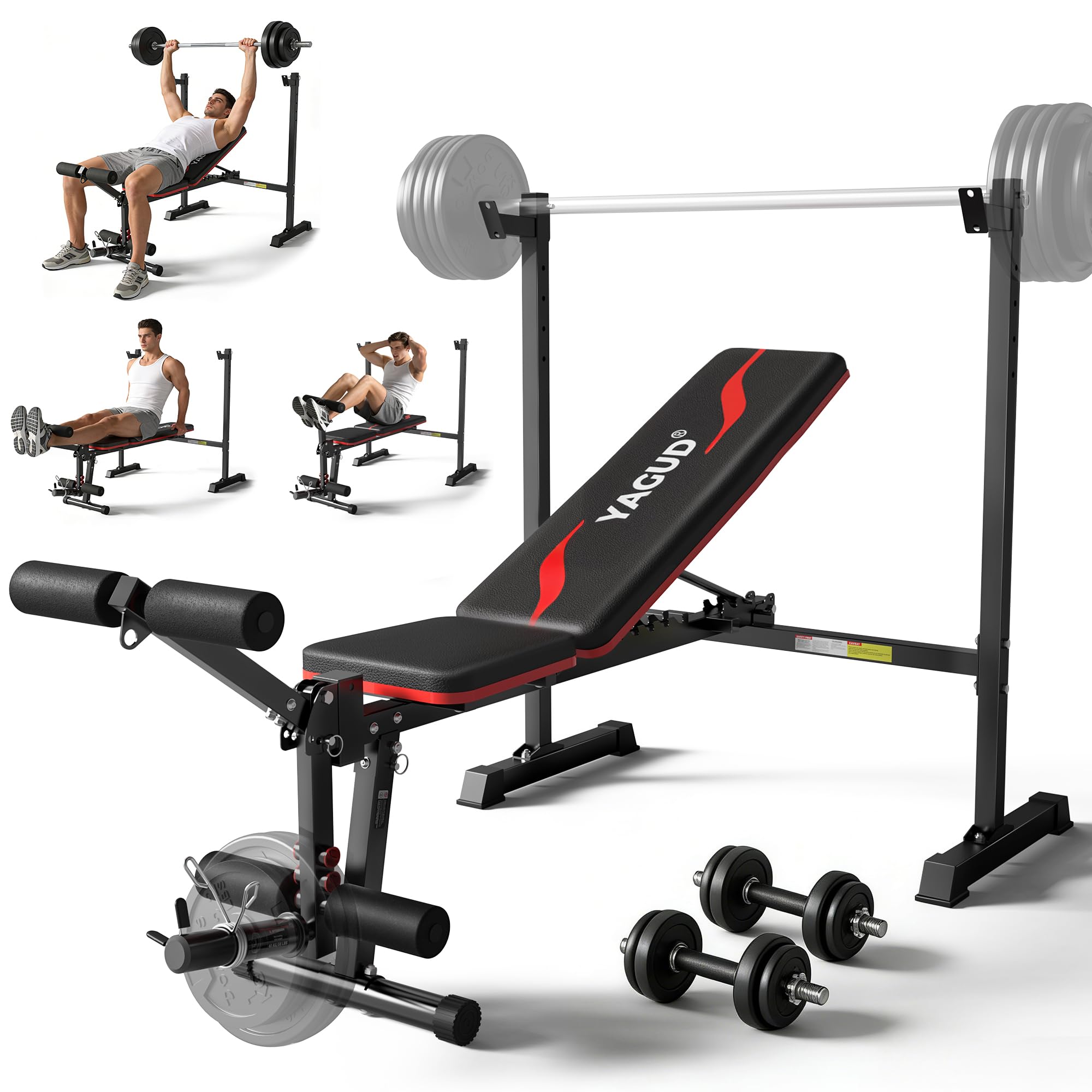
Yagud 10-in-1 Bench Set

Yagud 10-in-1 Bench Set

First setups

Our Score 8.8/10
Check Price

Worth Noting

  • Light 42-pound frame limits heavy loading
Item Weight
42 lb
Barbell Rack
Included, with safety catches
Backrest Positions
10
Read the full review

It's the least expensive bench here, and the spec list reads like a misprint: a 10-in-1 station with a barbell rack, safety bar catches, a dual-function leg developer, ten backrest positions and a frame that folds flat when you're done.

The safety catches are what we point to first. A rack without them asks you to trust a roll-out when a rep goes wrong; with a catch bar set at chest height, a solo bench press becomes something you can fail safely instead of something you survive. On a set at this end of the market, that's the feature worth having, and it's here.

Forty-two pounds of frame is the tell for everything else. This is a bench for dumbbells and moderate barbell work, and it's honest about it: the steel is light, the pad is thin, and the whole thing folds away against a wall. Nobody is going to mistake it for the Keppi, and at this price nobody should.

As a first setup, the arithmetic is hard to argue with: rack, catches, leg developer and ten backrest positions, all of it folding flat when the room goes back to being a room. Buy it to learn what you actually use, then spend the difference on the parts you outgrow.

Bottom line: The value pick: a fold-flat 10-in-1 with a barbell rack, safety catches and a leg developer for less than any other bench here, happiest with dumbbells and moderate bar work.

#8

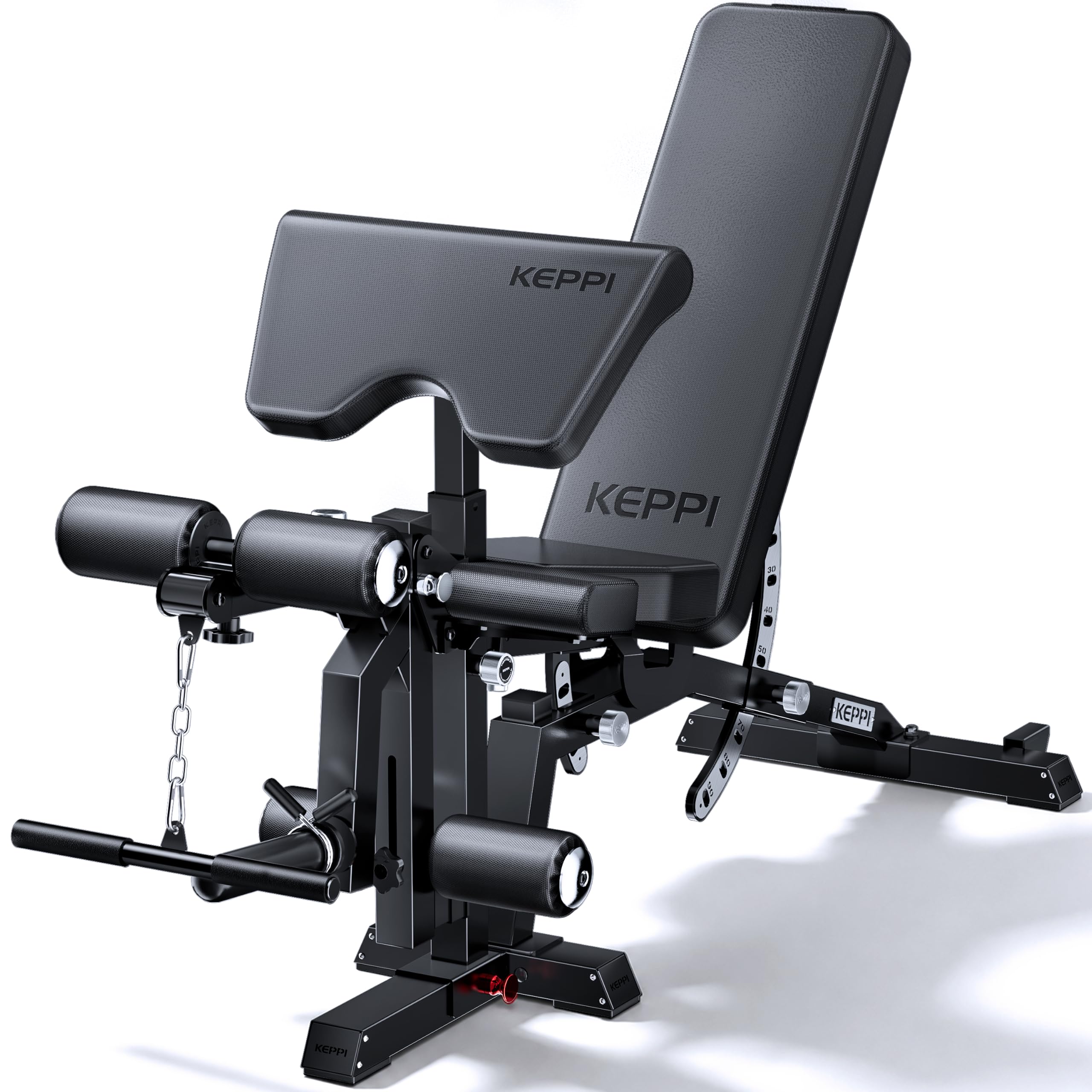
Keppi Bench3000 V2

Keppi Bench3000 V2

Heavy pressing

Our Score 8.6/10
Check Price

Worth Noting

  • Short leg-curl arc, tighter for tall lifters
  • Doesn't fold, so it needs permanent floor space
Frame Weight
93 lb
Seat Positions
3
Backrest Angles
12
Weight Capacity
1200 lb
Read the full review

Ninety-three pounds of 8- and 16-gauge steel is the short answer to why the Bench3000 V2 costs what it does. This is the only bench in the group that feels like it came off a commercial floor — the base is one rigid assembly, the pad stitching is clean, and nothing about it flexes when you set your shoulders.

Pressing is where it earns the money. Twelve backrest angles run from a 20-degree decline all the way to fully upright, the seat has three positions of its own, and the thigh pad on the leg developer is oversized enough to hold you down. If your training is barbell-led and you're a heavier lifter, this is the bench you stop thinking about.

The catch is the attachment the keyword is about. The leg developer is heavy and smooth, but the arc is short — most noticeably at the top of a hamstring curl — and it gets shorter as your legs get longer, so over six feet it's tighter still. For a bench at this price we expected the leg work to be the strong suit and it isn't.

It also doesn't fold, and at 93 pounds it isn't a bench you move for the vacuum. That's the trade: a piece of equipment that stays where you put it in a room you've given over to training. Assembly is the easy part — the hardware comes grouped by step and hand tools are enough.

Bottom line: The best-built bench here and the one we trust under a heavy bar, though the short leg-curl arc makes it a pressing bench with a leg attachment rather than a leg station.

How We Tested Weight Benches With Leg Extensions

We started by gathering every bench with a leg extension from brands we already trust for home gym gear, then filtered by frame material, stated weight capacity, footprint, and price, since those decide whether a bench fits someone's spare room and budget. That left 11 benches, which we bought at retail and built over eight months in garages, basements, and one very tight spare bedroom. Assembly came first, because it's where most of these lose people: we timed how long one person working alone needed to get from a box of parts to a finished bench, and noted whether the hardware was labeled clearly enough to skip the manual. While we had tools in hand, we checked welds at the frame joints and ran a thumb along every pad seam.

Each bench then went through a normal training week — pressing on Tuesday, leg extensions and curls on Thursday, plus the flat-to-incline shuffling that happens when you're actually working out rather than posing for a photo. We loaded the bar to within 50 pounds of each bench's stated capacity and watched the frame for side-to-side rock and the back pad for flex. We timed the switch from a flat press setup to the leg extension position and counted every pin pull along the way. For the attachment itself, we measured how high the roller pads sat off the floor and where the pivot landed relative to the knee, since pads that hit mid-shin instead of the ankle make the whole station useless.

We measured the footprint with the attachment on and off, and checked whether the bench rolled or had to be dragged clear, because most of these live in rooms that do double duty. Finally, we noted whether leg plates came in the box or had to be bought separately, and tracked what each bench actually sold for across the eight months so we could tell you where the money goes.

How to Choose the Right Weight Bench with Leg Extension

Fit the leg developer to your body first

You can't move where a leg developer's pivot sits, so the question is whether your knee lines up with it. Sit down, hook your ankles under the rollers, and check that the pad ends just above the top of your foot and that your knees sit level with the pivot point.

Then look at travel. A longer arc gives you more range at the top of a curl, and a short one is the most common complaint about budget frames. If you're over six feet, do this before you order rather than after the box arrives.

Adjustment quality beats adjustment count

Six positions that lock with a pin you can feel are worth more than twelve that rock under load. Two details matter more than the total: whether the backrest reaches 75 to 90 degrees for seated pressing, and whether the seat tilts along with the backrest on an incline, which is what stops your hips sliding forward.

The gap between settings matters too. A bench that jumps straight from flat to 30 degrees leaves you with nowhere to press for upper chest, however many notches it advertises further up the ladder.

Height, length and the room it lives in

A well-set-up bench puts the pressing surface around 17 to 18 inches off the floor, which keeps your feet flat and your shoulders just below the bar. A taller bench changes the angle of the press and makes it harder to stay tight, so it's worth measuring rather than assuming.

Pad length is the other half of the fit: a short pad is fine for flat work and noticeable on an incline. Then measure the floor. A dedicated bench runs about five feet long and doesn't fold; a folding all-in-one gives some of that back.

Match the frame to the load you actually move

Ratings on these benches run from 600 to 1,200 pounds, and the number to compare against is your body weight plus the loaded bar, not the plates on their own. Frame weight is the more honest guide to how a bench feels: a 45-pound frame moves easily and shifts under a heavy press, while a 90-pound frame stays where you put it.

If you press alone, a rack with safety catches is worth more than another 200 pounds of claimed capacity.

Preacher pads and the other attachments

A preacher pad earns its place if you curl seriously, but check two things: the width across the pad, which should land near 17 inches to support both arms without crowding, and how it attaches. A pad that has to be bolted on and off for every leg session is one you'll stop fitting.

The same test applies to the leg attachment itself. A pin you can pull is a feature; a pair of bolts is a chore you'll do once and then avoid.

Frequently Asked Questions

Final Verdict

Our pick is the OPPSDECOR LSL6005. It's the one bench here that pairs a genuinely independent seat adjustment with a preacher pad and a leg developer that both work, and it does it without premium money. If pressing is your priority and the leg work is secondary, the Keppi's frame is in another class. If the bench has to fold away between sessions, the YOLEO takes up the least floor of anything here.