Strength & Weights

Best Resistance Bands of 2026

A band that snaps mid-rep doesn't just ruin the set — it leaves a welt and a lingering suspicion about everything else in the drawer. The cheap ones fail predictably: latex goes tacky, the seam at the loop gives out, the printed resistance turns out to be a suggestion, or it rolls into a rope around your thighs. A good band fixes all of that in one motion: grab it, anchor it, and get the same tension on the hundredth rep as the first.

Over four months, my team and I put 16 sets through exactly that kind of use. What separated the keepers was rarely how many bands came in the bag. One thing nobody tells a first-time buyer: resistance ratings aren't standardized, so one brand's heavy is another's medium, and loop length — not resistance — is what usually makes a band feel wrong for your body. The picks below are the ones that earned a permanent spot.

#1

Vergali Fabric Bands

Top Pick
Vergali Fabric Bands

Legs and glutes

Our Score 9.6/10
Check Price

Worth Noting

  • No anchor or handles, so no pulling exercises
Included
Carry bag and guide
Material
Cotton-latex fabric
Band Size
13.6 x 3.15 in
Resistance Levels
4 levels, 14–60 lb
Read the full review

Bands that slide down your thighs turn a set of hip thrusts into a series of readjustments, and the Vergali loops are the ones here we stopped thinking about mid-set. The inner face carries a grip strip, the band is 3.15 inches wide, and the weave is cotton and latex rather than the bare rubber that grabs leg hair. For legs and glutes, this is the set we recommend first.

Four levels run from 14–25 lb up to 45–60 lb, and the resistance is printed on each band — a small thing we came to rely on, because it means you grab the right loop without matching a color to a chart you've already lost. The middle two bands overlap at the low end, so the step from medium to strong is gentler than the printed numbers suggest: a real progression without a cliff.

The comfort details hold. On bare skin or over leggings the wide band doesn't dig or pinch, and the set can go in the washing machine once it's sweaty. All four loops plus the carry bag come in a little over a pound, so they live in a gym bag without being noticed.

What they won't do is pull. There's no anchor and no handles, so rows, presses and pulldowns are out, and the WHATAFIT set covers that ground. The heaviest band, though, is the one we hand to anyone who announces that resistance bands are too easy.

Bottom line: For legs and glutes we recommend this set first: the loops stay where you put them, and the resistance is printed on each band.
#2

Tribe Lifting Fabric Bands

Tribe Lifting Fabric Bands

Heavy lower-body work

Our Score 9.4/10
Check Price

Worth Noting

  • Lightest band starts at 40 lb
Levels
5
Material
Polyester-latex weave
Band Size
12 x 2 in
Resistance
40–180 lb
Read the full review

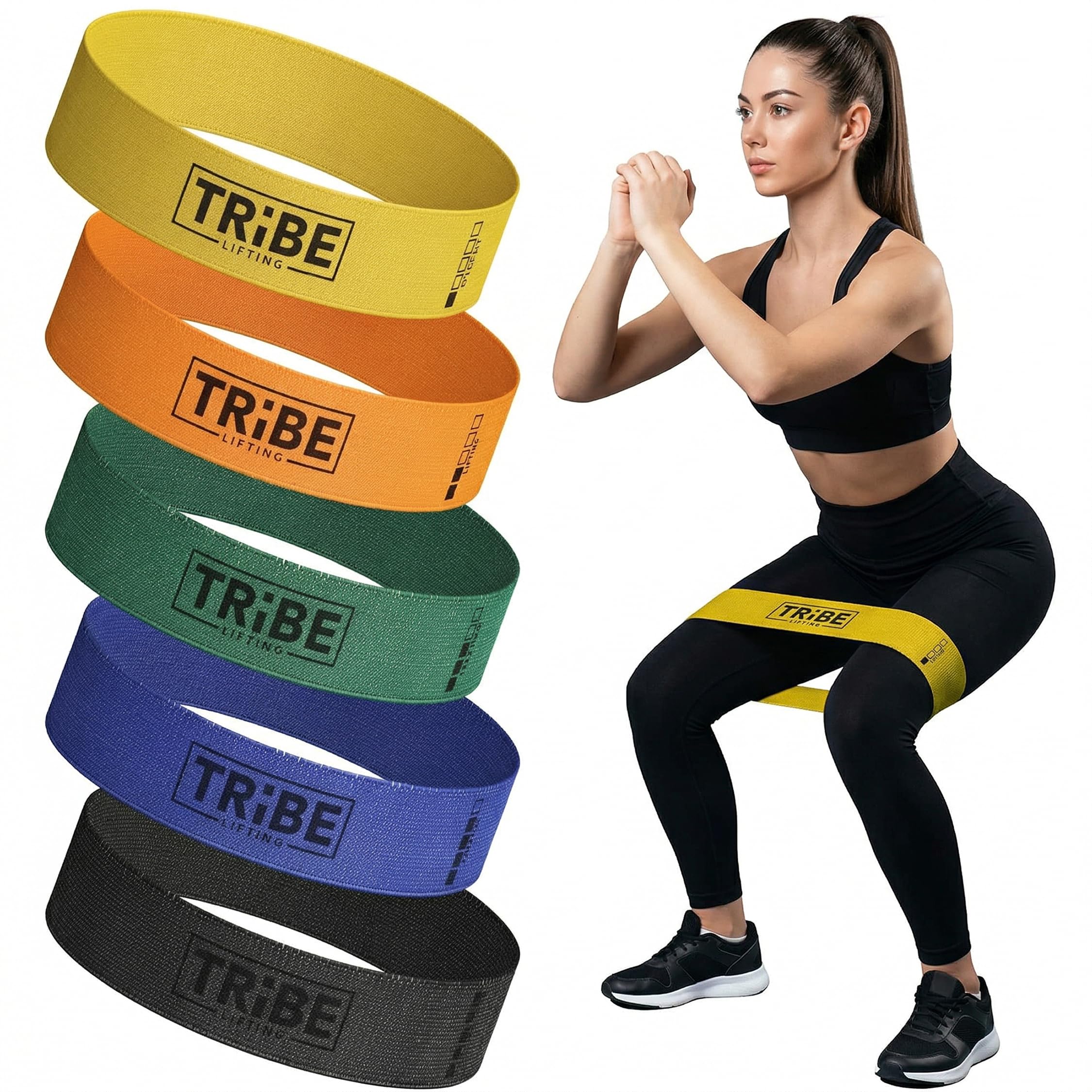
If the light loop in your current set has stopped feeling like anything, start here. Tribe Lifting's five fabric bands begin at 40 lb and run to 180 lb, which makes this the heaviest fabric set we cover and the one we reach for when the session is hip thrusts, lateral walks and heavy squats rather than a warm-up.

The bands are a woven polyester-latex blend, 2 inches wide, and they hold their position on bare legs without rolling or dragging at leg hair. Two inches is narrower than the Vergali loops, so the pressure sits in a tighter band across the thigh — the trade for a set that goes three times as heavy. Five levels in a package that weighs about seven ounces is a good ratio for a gym bag.

The floor is the catch. Forty pounds is a lot for a first band: a beginner will find it too much for warm-ups, and there's nothing gentle enough for shoulder or hip rehab. This is a set for someone who already trains and wants a band that keeps up, not a starter kit.

Bottom line: Our pick for anyone who has outgrown light bands: five fabric loops from 40 to 180 pounds that keep up with real lower-body loading.

#3

Renoj Fabric Bands

Renoj Fabric Bands

Budget leg work

Our Score 9.4/10
Check Price

Worth Noting

  • Three levels, with nothing heavier to move up to
Levels
3
Included
3 bands, carry bag
Material
Cotton and polyester
Band Width
3.15 in
Read the full review

Three bands, not five. The Renoj set keeps the wide fabric loop that grips bare skin and cuts the ladder down to three levels, which is the whole idea: fewer decisions, less to carry, and a set that still handles everyday leg work. The loops are a cotton-polyester weave about 3 inches wide, they don't roll or pinch, and the three bands plus a mesh carry bag weigh under a pound.

For a first set, or a second set that lives in a travel bag, that's enough. We recommend it to anyone who wants a loop around each leg for warm-ups, banded walks and light squats without paying for a ladder they never climb. It earns the budget fabric spot here rather than settling for it — though if you already know you'll want heavier work, the Tribe Lifting set is the one to buy first.

Bottom line: A sensible first fabric set: three grippy loops that cover everyday leg work for a modest outlay.

#4

WHATAFFIT Tube Set

WHATAFFIT Tube Set

Full-body workouts

Our Score 9.2/10
Check Price

Worth Noting

  • Tubes and clips wear faster than fabric loops
  • Two pounds of parts is more to pack than loops
Levels
5
Included
Handles, ankle straps, door anchor, bag
Warranty
2 years
Resistance
10–150 lb, stackable
Read the full review

A loop band can't do a row. That's the gap this set fills: two cushioned handles, two ankle straps and a door anchor turn five latex tubes into something close to a cable station you can zip into a bag. Rows, presses, curls, kickbacks, pulldowns and core work all become possible in a room with a door and a bit of floor.

The tubes are rated 10, 20, 30, 40 and 50 lb, and what we appreciate is that they add rather than replace — clip all five together and you're pulling against 150 lb, enough to keep pressing and rowing interesting for a long while. The connections are the part we looked at hardest: TPU collars, crimped brass ferrules, steel clips and reinforced webbing, all removable, so a handle comes off and an ankle strap goes on in seconds. The two-year warranty is the longest of any set here.

It is a kit rather than a loop, though. Two pounds of tubes, clips, straps and manual take up real space in a bag, and rigging the door anchor costs a minute at the start of a session instead of a second. If pressing and rowing are part of your week, that minute buys you a lot.

Bottom line: Buy this one if you want to row and press as well as squat — it's the most complete kit here, backed by the longest warranty.

#5

WSAKOUE Pull-Up Bands

WSAKOUE Pull-Up Bands

Assisted pull-ups

Our Score 9.2/10
Check Price

Worth Noting

  • Wear concentrates where the band crosses the bar
  • Natural latex, so not for latex-sensitive skin
Levels
5
Material
Natural latex
Band Size
82 x 2 in
Resistance
5–125 lb
Read the full review

Assisted pull-ups are the clearest job a band does: loop it over the bar, stand a knee or a foot in the bottom of it, and the hardest part of the rep gets lighter. This set is built for that — five continuous latex loops, 82 inches long and 2 inches wide, from a 5 lb band for warm-ups to a 125 lb band heavy enough for dips and banded squats.

Length is what makes bar work possible. At 82 inches there's enough band to go over a pull-up bar and still get a foot into the loop without standing on tiptoe; shorter loops force you to double them, which changes both the resistance and the angle you pull from. The set weighs just over two pounds with the bag, so it goes to the gym or the park without a second thought.

Where we're careful is wear. A band stretched over a steel bar takes more load at that contact point than anywhere else, and that's the spot to check for nicks before you load it. Rotating which side faces the bar between sessions spreads the strain and gets you more months out of the set. If latex is a problem for your skin, the LEEKEY loops do the same job without it.

Bottom line: The set we hand to anyone chasing a first pull-up: five long latex loops with a light band to start and a heavy one for dips.

#6

THERABAND Flat Bands

THERABAND Flat Bands

Rehab and warm-ups

Our Score 9.2/10
Check Price

Worth Noting

  • Rehab-level resistance only
Levels
3
Material
Non-latex synthetic rubber
Band Size
60 x 4 in
Resistance
3–6.7 lb
Read the full review

Three pounds is barely resistance, and that is exactly the point of this set. The three flat bands are rated 3–4.3, 3.7–5.5 and 4.6–6.7 lb, each 5 feet long and 4 inches wide, and together they weigh under two ounces — a set built for the shoulder rotations, ankle work and gentle rows that follow an injury or a long layoff.

Flat bands are the least glamorous format and the most flexible. You tie one into a loop, wrap it around a handle, hold an end in each hand or anchor it under a foot, and the 5-foot length gives you room to move through a full range instead of running out of band halfway. This is the non-latex version, synthetic rubber and TPE rather than natural latex, which is why the format turns up in clinics and in homes where latex is a problem. THERABAND sells both, so check the variant rather than the photo.

We keep a set like this for the small stuff: rotator cuff work, hip abduction, the warm-up before heavier band work. It's also what we point to when someone is starting a physical therapy protocol at home and needs the same three tensions the clinic used. If a workout rather than a rehab routine is the goal, the Vergali or WHATAFIT sets are the better buy.

Bottom line: What we recommend when the goal is a shoulder, a knee or a post-surgery protocol rather than a workout: three non-latex bands built for gentle, repeatable work.

#7

lianjindun Flat Bands

lianjindun Flat Bands

Stretching and rehab

Our Score 9.2/10
Check Price

Worth Noting

  • Top band is 20 lb
Levels
5
Material
TPE, latex-free
Band Size
60 x 6 in
Resistance
3–20 lb
Read the full review

Five feet long and six inches wide is a lot of flat band, and that size is the reason to pick this set over the clinic-style bands. The extra width spreads the load across your hands or your thigh instead of digging in, and the length means you can wrap it, tie it or loop it around a foot and still have room to move.

The five bands are TPE — latex-free, smooth and easy to wipe down — rated from 3 to 20 lb. Colors step from extra-light to heavy in small increments, so you can move up without changing the exercise entirely. The whole set weighs under a pound and folds into a drawer.

They're cut flat rather than looped, which makes them the most versatile format here and the least convenient: nothing holds them on your legs, so they're for holding, wrapping, tying and anchoring rather than banded walks. As a stretching and shoulder-work set, this is what we keep in a suitcase.

For Pilates, arm and shoulder work, stretching and travel, they're an easy recommendation: the range covers slow progression, they're latex-free, and they cost little enough that a second set in another room makes sense. If your plan is squats and hip thrusts, the fabric loops in this guide are the better tool.

Bottom line: For stretching and shoulder work we reach for these: five latex-free bands, wide and long enough to wrap comfortably.

#8

LEEKEY Pull-Up Bands

LEEKEY Pull-Up Bands

Latex-free pull-up help

Our Score 9.2/10
Check Price

Worth Noting

  • Starts at 15 lb
Levels
4
Included
4 bands, bag, guide
Material
Latex-free synthetic rubber
Resistance
15–125 lb
Read the full review

Latex-free is why this set earns a place. The four loops are layered synthetic rubber rather than natural latex, which matters if your skin reacts to latex or your gym has stopped allowing it, and it makes them the alternative to the WSAKOUE set rather than a duplicate of it.

The bands are rated 15–35, 25–65, 35–85 and 50–125 lb — overlapping ranges, so moving up a band doesn't mean jumping a canyon. The light end handles assisted pull-ups and dips for a beginner, and the green band is heavy enough to add real resistance to squats and push-ups.

Four bands rather than five, and a kit that folds into its own carry bag at under two pounds, so it lives in a gym bag without complaint. There's an exercise guide in the bag too, which is more use than it sounds when you're rigging a band over a bar for the first time and guessing at the setup.

For a latex-sensitive lifter who wants pull-up assistance and banded strength work, this is the obvious answer here, and the overlapping levels stay forgiving as you get stronger. Buy it for the bar; if you need something gentler for shoulders, the flat bands are where to look.

Bottom line: The latex-free choice for bar work: four loops that overlap enough to progress smoothly from assisted pull-ups to banded squats.

How We Tested Resistance Bands (and What Made Us Retire a Few)

We built the shortlist from sets that keep turning up in reviews, physical therapy clinics, and gym bags — latex loop bands, fabric loop bands, and long tube bands with handles — then filtered by what the listings actually told us. Bands that gave resistance in pounds rather than vague words, listed their length and width, and came with a replacement policy moved forward. That left 16 sets, which we used for four months.

Every set went into the same rotation: a living room floor on weekday mornings, a gym bag for rack work and pull-up assistance, a hotel room on work trips, and a short list of shoulder and hip exercises borrowed from a physical therapist. Each band got stretched to roughly double its resting length most days, and afterward we felt for tackiness, looked for nicks at the seam, and noted any band that started to cloud or discolor — the earliest warnings before a snap.

To compare resistance honestly, we hooked a luggage scale to each band and pulled it to a marked length, which exposed the labels that oversold a light band. Loop bands went to testers of different heights and thigh measurements to see whether they rolled, cut in, or slid down during lateral walks and glute bridges, and we flagged the sets where the lengths ran short for taller users or squat-rack anchoring. Door anchors got the roughest treatment: repeated pulls at an angle from a closed door, checking for slipping and for scuffs on the paint.

Value came down to whether a set's levels were far enough apart to be useful — plenty of kits include five bands that feel like three — and whether the wider bands held up to being stood on without curling at the edges. Everything on the list is still in the rotation.

How to Choose Resistance Bands

Match the format to the exercise

Fabric loops and short latex loops are leg and glute tools: they go around the thighs or ankles and load hip work. A tube set with handles and a door anchor is the only format here that does rows, presses and pulldowns. Long flat bands are for rehab, stretching and wrapping, and long heavy loops are for pull-up assistance and banded squats.

The trap is buying for the exercises a product photo suggests rather than the ones you'll do. Write down the three movements you'll perform most weeks; if two of them need a handle, buy a tube set, and the WHATAFIT kit is the one we point to.

Look at the range, not the number of bands

Five bands only help if they span a useful range. The Tribe Lifting set starts at 40 lb, which is a serious band and a poor warm-up; the THERABAND set stops under 7 lb, which is right for a shoulder and useless for a squat. You want a bottom band light enough for the first set of the day and a top band above what you can currently move.

Stacking matters too. Tubes add together — 10, 20 and 30 lb clipped on at once give you 60 lb — while loops are used one at a time. A set advertising 150 lb is describing all five tubes combined, not one band.

Staying put, and staying comfortable

A band that rolls down your thigh mid-set has failed at the job, which is why fabric loops dominate the leg-work picks here. Woven bands with a grip strip stay where you put them and don't pull leg hair; bare latex loops grip less and roll more, especially on bare skin. Width helps: the wide bands here run around 3 inches, the narrower ones 2.

If latex irritates your skin, look for TPE or synthetic rubber. The lianjindun flat bands and the LEEKEY loops are both latex-free, and the THERABAND set is the non-latex version.

Make a set last

Bands fail in predictable places: at the clip and collar on a tube set, and where a loop crosses a steel bar. Check those spots for nicks before you load a band, and retire it at the first tear rather than the first snap. Fabric loops generally outlast elastic, and the tube sets here carry warranties up to two years.

Keep them out of sunlight and away from heat, and don't leave a sweaty set knotted in a bag. That is the whole maintenance routine, and it separates a set that lasts a season from one that lasts several.

Frequently Asked Questions

Final Verdict

The Vergali set is the one we point most people to. For legs and glutes it stays where you put it, four printed levels take you from a warm-up to real load, and nothing about it needs setting up.

If your training includes rows, presses or pulldowns, buy the WHATAFIT tubes instead. That's the set that turns a room with a door into a gym, and its two-year warranty is the longest cover here on the part of a tube set that wears.