Strength & Weights

Best Olympic Weight Benches of 2026

A weight bench fails in one of two places: under a heavy set, or in the corner of a room you no longer use because it is too wide and too much trouble to adjust. I have had a bench scoot mid-press and have also bought one that turned a spare corner into a maze. The right Olympic bench fixes both problems: it feels planted when you load the bar, changes angles without a wrestling match, and still leaves enough floor space to rack the weight safely.

Over the past nine months, my team and I assembled and trained on seven Olympic weight benches in home gyms, from cramped basements to converted garages. Price did not reliably predict quality: some costly benches wobbled at the joints, while a few mid-priced ones felt sturdier than expected. Assembly ranged from a tidy hour with clear hardware to an afternoon of guessing. The keepers shared a planted feel, useful adjustability, and a footprint that made sense in a real home gym rather than a showroom.

#1

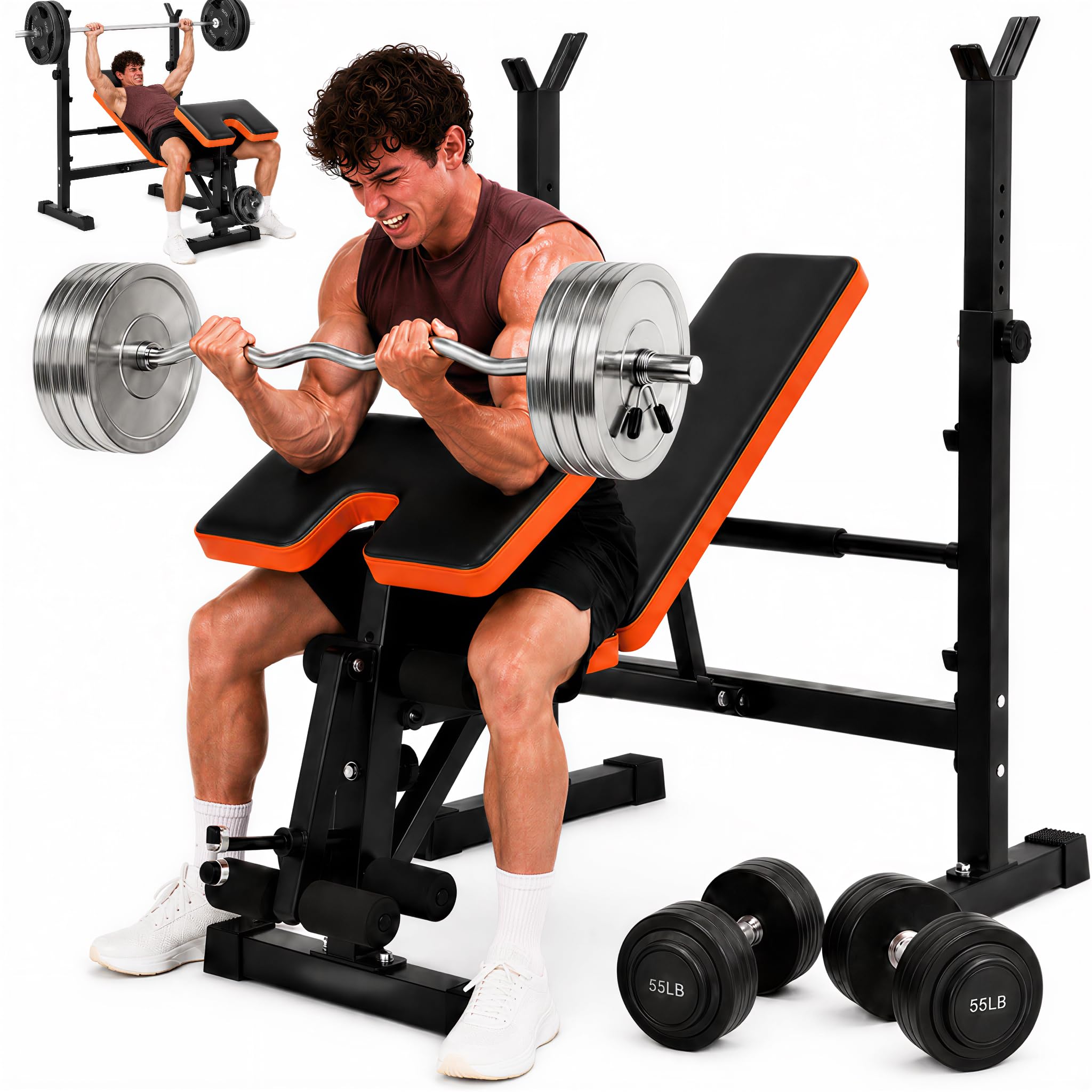
OUNUO Compact Six-in-One Bench

Top Pick
OUNUO Compact Six-in-One Bench

First home gyms

Our Score 9.2/10
Check Price

Worth Noting

  • Narrow holders suit shorter, narrower lifters
Back Pad
4 angle positions
Stations
Six-in-one
Assembled Size
53"D x 31"W x 50"H
Maximum Capacity
550 lb
Read the full review

If 40 inches of rack spacing is why the YOLEO tops this guide, the OUNUO shows what a much smaller budget buys: a frame 31 inches wide overall, which puts the bar holders close enough together that anyone much over 5 foot 9 ends up pressing with a narrow grip. That is the trade, and it is worth being blunt about up front.

Past that, there is more here than the footprint suggests. Six stations — leg press, preacher curl, squat rack, and an adjustable bench among them — fold into a corner, the back pad adjusts through four angles, and the whole thing is light enough to move without help. Assembly is straightforward: the hardware arrives organized, the instructions are clear, and one person can manage it without a second set of hands.

Five hundred and fifty pounds is the stated ceiling, near the bottom of this group, and the frame is genuinely compact at 53 inches deep and 31 wide. The narrowness that lets it fit beside a car is the same narrowness that limits the pressing — there is no version of this bench that gives you both.

Bottom line: The six-in-one for first home gyms: buy it when floor space is the constraint and a narrow grip suits how you press.
#2

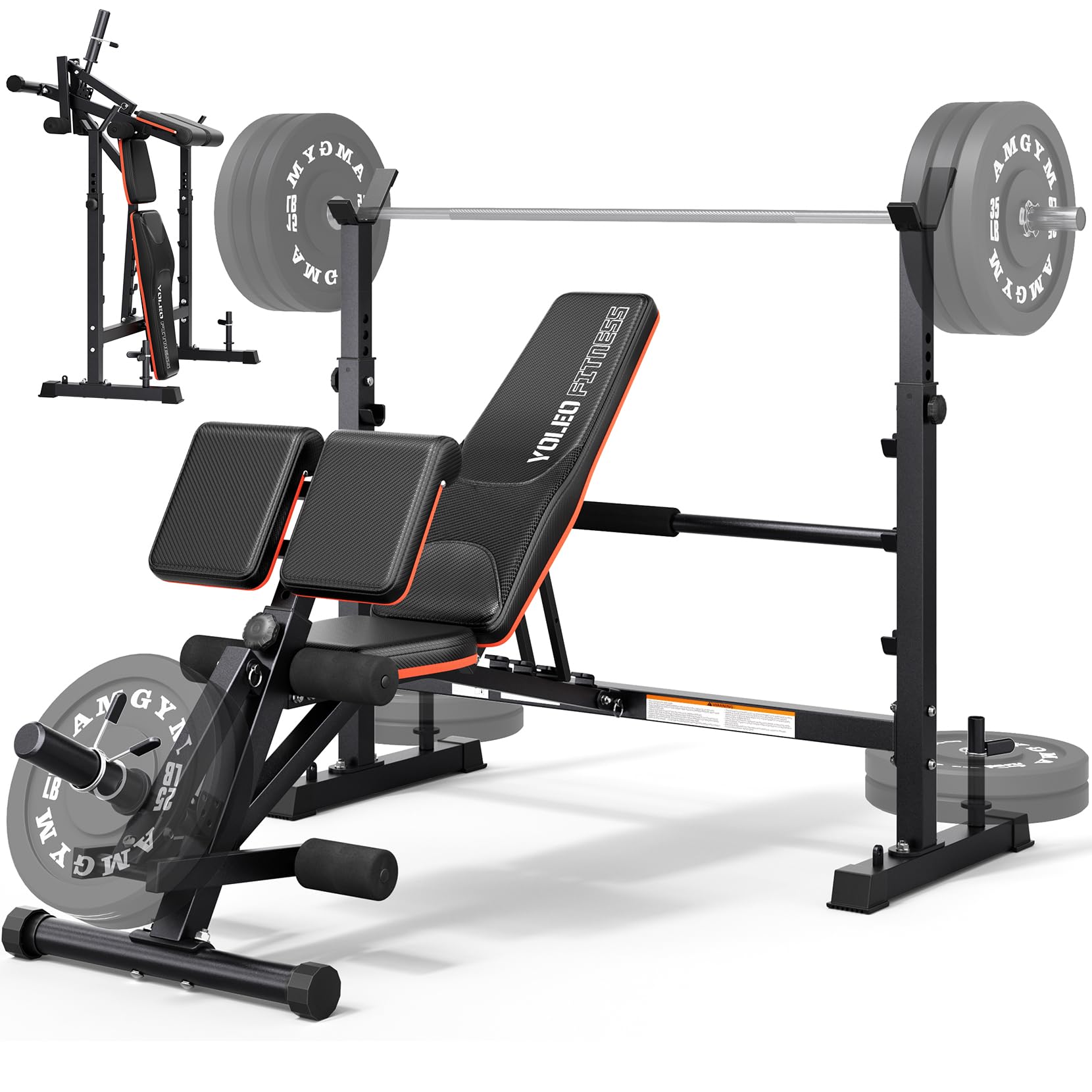
YOLEO Core 1+X 6-in-1

YOLEO Core 1+X 6-in-1

Home gym pressing

Our Score 9.0/10
Check Price

Worth Noting

  • Preacher pad sits low for tall lifters
Bar Fit
6-7 ft Olympic bar
Assembled Size
65"D x 44"W x 51"H
Rack Inner Width
40 inches
Capacity By Station
660 lbs rack, 880 lbs bench, 330 lbs preacher
Read the full review

Forty inches. That is the gap between the rack uprights on this YOLEO, and it is the number that decided our top pick. On a 6- or 7-foot Olympic bar it leaves room to set your hands at a proper pressing width and still clear the posts, which turns re-racking a hard set from a fumble into one motion. The compact folding frames here are 31 to 39 inches across their entire width, so their posts sit closer together than this.

The capacity claim needs unpacking, because YOLEO sums it into one 1,870-pound headline. The numbers that matter are separate: 660 pounds for the rack, 880 for the bench pad, 330 for the preacher pad. No single part is rated for the total — but each figure is generous for a home gym, and 660 pounds of rack capacity is a long way past most working sets.

At 68 pounds it is heavy enough not to skate when you drive your heels into the floor and light enough for one person to fold and stand against the wall, which is why the fold is more than a bullet point on this one. The six stations are where the compromises live: the preacher pad sits low, so taller lifters work through a short range, and the leg developer is fine rather than good. If preacher curls are a priority for you, a dedicated pad is worth the floor space.

What earns it the top spot is that it gets all three things that decide this purchase right at once: room to press, ratings you will not outgrow, and a frame that goes away when you are done. The 44-inch width clears a standard garage bay, and the pop pins seat positively, so you know the pad is locked before you lie back on it.

Bottom line: Our top pick: 40 inches of rack spacing, generous per-station ratings, and a frame that folds make this the bench most home gyms should start with.

#3

Marcy MD-857 Olympic Bench

Marcy MD-857 Olympic Bench

Plate storage setup

Our Score 9.0/10
Check Price

Worth Noting

  • 600-pound stated capacity is the lowest here
  • Leg extension arc is short for tall lifters
Storage
Weight plate posts and Olympic sleeves
Assembled Size
47"D x 80"W x 61"H
Product Weight
103 lb
Maximum Capacity
600 lb
Read the full review

A hundred and three pounds is a lot of bench, and the Marcy is the heaviest frame in this guide. You feel it in the way it settles onto the floor and stays there. But the feature that got it onto this page is the pair of weight-plate posts and Olympic sleeves on the back of the frame — the only place in this group where your plates live on the bench instead of on the concrete beside it.

The seat slides on a track so you can line the pad gap up with your shoulders instead of working around it, and the dual-function leg developer pivots near the knee with a lockout for abdominal work. The seat shifts a little as you slide on and off it — not during a set, but enough that you notice.

Six hundred pounds is the stated ceiling, and it is the lowest here, so this is the pick for the lifter building a station rather than chasing a number: a bar, a set of plates, somewhere sensible to rack them, and pressing in the low two-hundreds for the next few years. It also carries a two-year limited warranty, which is a real commitment rather than a marketing line. Move it once with two people and leave it where it lands; at this weight it is furniture, not something you will rearrange on a Sunday.

Bottom line: Buy the Marcy if you want plate storage, a preacher pad, and a two-year warranty on the heaviest frame here, and you will stay under 600 pounds.

#4

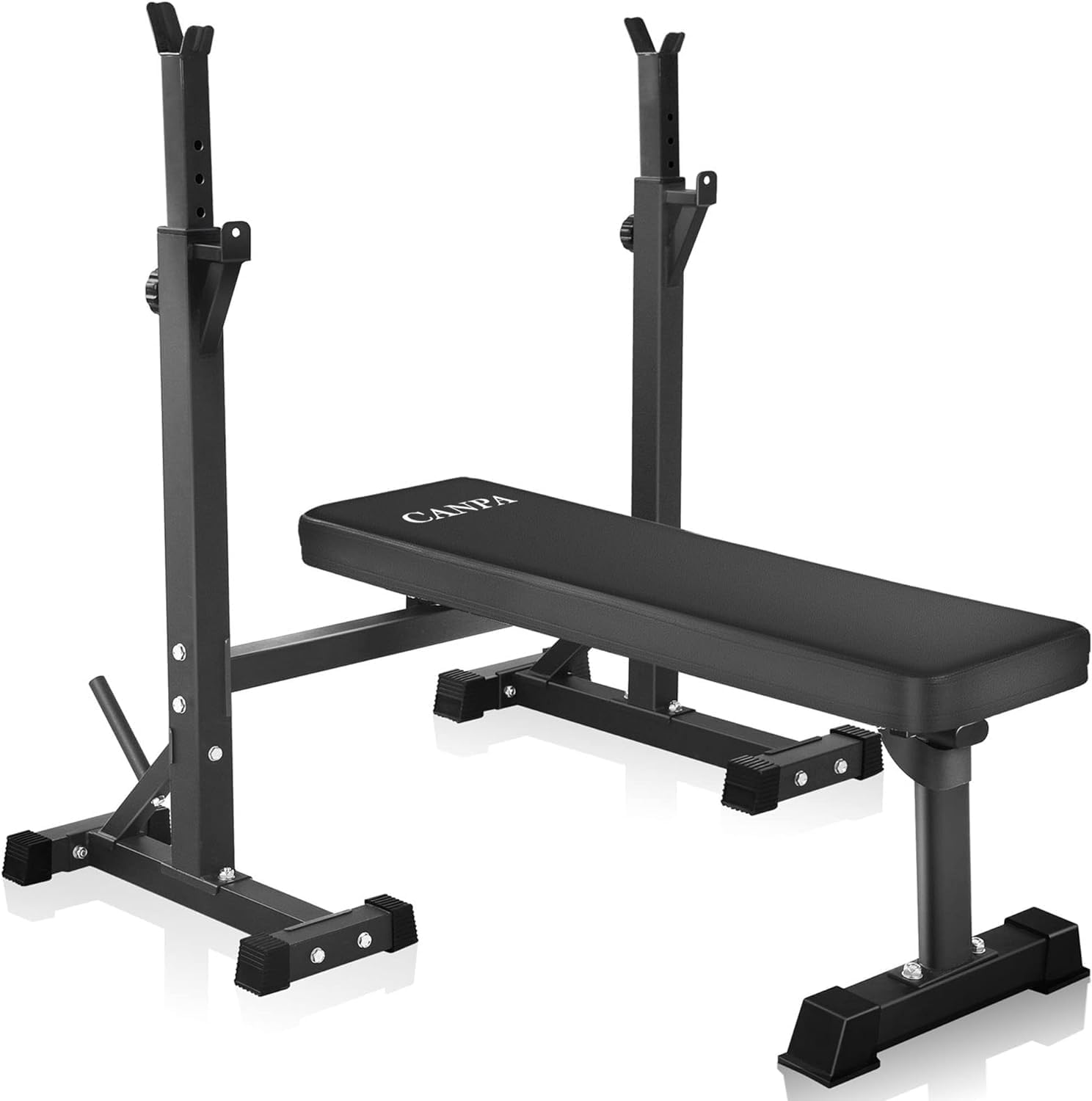
CANPA Olympic Bench with Squat Rack

CANPA Olympic Bench with Squat Rack

Small spaces

Our Score 9.0/10
Check Price

Worth Noting

  • Back pad is flat only, no incline
  • Narrow 38.8-inch frame pinches a wide grip
Back Pad
Flat only
Assembled Size
43.3"D x 38.8"W x 46.9"H
Product Weight
46 lb
Maximum Capacity
500 lb
Read the full review

Twenty kilos and change — 20.87 kilograms on the spec sheet — is light enough to lift with one hand, and this bench is built around that fact. It folds flat, stands on its end against a wall, and when it is put away you would not know a rack was in the room. If your garage has to be a garage the rest of the week, that is the whole argument.

As a pressing station it is honest rather than luxurious. The 2x2-inch steel H-base sits solid under the 500 pounds it is rated for, and the six rack-height settings let two people of different sizes share it without tools — a small thing that matters more than it sounds in a household with one bench. We also appreciate that the fold does not depend on removing anything first.

What you give up is adjustment and width. The back pad is flat only, with no incline or decline, and the frame is 38.8 inches wide overall, which puts the posts closer together than on the YOLEO. Broad-shouldered lifters on a 7-foot bar will find their grip pinched; with a 5- or 6-foot bar it is a non-issue, and the money you save buys the mat you will want underneath it.

Bottom line: The folding flat-press station for tight spaces: buy it if you use a short bar and want the bench against the wall between sessions.

#5

YOLEO 880 lb All-in-One Bench

YOLEO 880 lb All-in-One Bench

Tight rooms

Our Score 8.8/10
Check Price

Worth Noting

  • Rack fits 5-6 ft bars, not 7-footers
  • Leg developer is short for tall users
Bar Fit
5-6 ft Olympic bar
Back Pad
4 positions, -10° to 30°
Folded Size
32"D x 17"W x 62"H
Maximum Capacity
880 lb
Read the full review

Folded, this bench stands 62 inches tall and 17 inches wide — roughly the footprint of an ironing board leaning in a closet — and that is the reason it is here. It is the budget all-in-one of the group: rack, four-position back pad, preacher pad, and leg developer on one frame, at the bottom of this guide's price range.

It is also the smallest bench we would recommend, and YOLEO does not hide it: the rack is sized for a 5-6 foot Olympic bar rather than a 7-footer, and the frame is 33 inches across, so a wide grip puts your hands outside the posts. The back pad covers four positions from a slight decline to a 30-degree incline — think of it as a flat bench that tilts rather than a true adjustable. The leg attachment is short, too, and taller lifters will be folding up to fit.

Eight hundred and eighty pounds is the stated maximum, less than half the Core 1+X, and that is the honest trade for the fold and the price. What it does well is the everyday job: a place to press, tilt, and curl in a room that goes back to being a living room, with hardware labeled by assembly step so one person can put it up. Seventeen inches wide is narrower than most closet doors, and it stands upright without a lean.

Bottom line: A genuinely foldable budget all-in-one for small rooms and short bars; the fold is what you are paying for, and it earns it.

#6

MAIDOMA Folding Bench Set

MAIDOMA Folding Bench Set

Casual lifters

Our Score 8.8/10
Check Price

Worth Noting

  • 750-pound stated capacity is modest
  • Bar rack is narrow for a wide grip
Back Pad
4 positions, incline to decline
Assembled Size
63"D x 54"W x 37"H
Product Weight
44.3 lb
Maximum Capacity
750 lb
Read the full review

This is the least expensive bench here, and the 20.1-kilogram frame tells you where the money went. It is light enough to shift with one hand and stiff enough for the loads it is rated for, but the leg curl pad hangs close to the floor — tall lifters get an arc closer to a knee raise than a leg curl.

Two numbers on the listing disagree: the title advertises 1,500 pounds while the specification panel says 750. Plan around 750, which is enough for a beginner working with a 5- or 6-foot bar and standard plates, and not much more. Four backrest positions cover flat, incline, and decline, and the adjustment pins are the pull-and-drop kind, so changing the angle between sets is quick.

Where it lands for us is the shallow end of the market done properly: a real pad, a leg developer, and a fold for the least money here. Pull the locking pin, fold it in one motion, and it is in the corner — which is the difference between a bench that gets used and one that becomes a coat rack. What it is not is a bench you will still be pressing on at 300 pounds.

Bottom line: The budget entry: a folding bench with real pad adjustment and a leg developer, sized for a teenager or a casual lifter rather than a heavy presser.

#7

OPPSDECOR 900 lb Bench Set

OPPSDECOR 900 lb Bench Set

Full-body stations

Our Score 8.6/10
Check Price

Worth Noting

  • Bar holder too narrow for a wide grip
Back Pad
4 levels
Assembled Size
63"D x 50"W x 65"H
Product Weight
68.8 lb
Maximum Capacity
900 lb
Read the full review

The butterfly arms come off. That sounds minor until you have pressed under a pair of chest-fly arms that stay put — OPPSDECOR made them detachable, so the bench path is clear when you want it clear, and it is the most thoughtful piece of design on the frame.

There is a lot bolted to that frame: squat rack, preacher pad, leg developer, T-handle, four backrest levels and six rack heights, plus a fold that is one motion rather than a sequence. Folded, it is roughly 17 inches deep and 30 wide, which is closet-sized for a station this busy, and at 31.2 kilograms it still sits solidly for its weight.

The bar holder is the catch. The posts sit close enough together that a wide grip puts your hands outside them, and you end up pressing narrower than you want on a 7-foot bar. Measure your grip against the post spacing before you order; if you are broad-shouldered, the YOLEO's 40 inches is the better answer.

Nine hundred pounds of stated capacity, more stations than anything else in this guide, and a fold that gets used — that is a fair swap for a narrower grip, and it is why this one stays on the list. Plan an evening and a second pair of hands for the first assembly, because it ships flat in a lot of pieces.

Bottom line: Nine hundred pounds and more attachments than anything else here — buy it if you will use the stations and your grip fits between the posts.

How We Tested Olympic Weight Benches at Home

We started with a shortlist of 19 benches sold for home gyms, then narrowed it by frame material, stated weight capacity, footprint, and whether the pad height worked with standard racks. Seven made the cut. Over nine months, we assembled each one, checked the hardware against the instructions, and noted missing or vague steps, loose bolts after tightening, and how long solo setup actually took.

Each bench lived in a home gym for at least a month of regular training: flat pressing, seated rows, step-ups, and the clumsy business of sliding a loaded bar back onto the rack. We approached each maker's claimed capacity in stages, watched for frame flex, foot lift, and pad compression, then rechecked every bolt after the first heavy week. We also measured the pad width and the stance width at the feet, because a narrow bench has to fit between rack uprights without feeling like a balance beam.

Adjustability got its own workout. On incline benches, we changed angles between sets with sweaty hands and noted whether pins engaged cleanly or the pad shifted under load. We also kept a fixed flat bench in the mix to judge what you give up without an incline option: less setup fuss and often a more rigid feel, but no incline pressing. Finally, we compared what each bench asked in assembly time and floor space against its price, because value here is not just the sticker, it is whether the bench earns its footprint for years.

How to Choose an Olympic Weight Bench

Start With the Space Between the Uprights

Hand position is the first thing to check, and it is the figure listings bury. Most lifters press with their hands somewhere around 28 to 32 inches apart, wider for bench specialists, so the rack posts need to sit outside that with room to spare. A full-length Olympic bar wants roughly 40 inches of clearance to feel natural.

The compact folding benches here are 31 to 39 inches across their entire frame, which puts their posts tighter than that. The YOLEO Core 1+X, at 40 inches inside a 44-inch frame, is the most generous of our picks. The trap: a listing that boasts a "wide frame" is often measuring the leg developer or the plate posts, not the space your hands go.

Read the Capacity Numbers One Station at a Time

A single headline total is an addition problem, not a rating. The useful figures are the ones attached to the part under load: the pad rating for your body weight, the rack rating for a loaded bar, the preacher pad rating if you use it. Our picks advertise totals from 500 to 900 pounds, and the gaps between them are real rather than marketing noise.

If you are pressing in the low two-hundreds and adding weight slowly, 500 pounds is years of headroom. If you lift with a partner, or you already move real weight, buy the higher rating and skip the folding frames. The Marcy's 600-pound ceiling is the one to weigh hardest, because it is also one of the pricier benches here.

Decide How Much Pad Adjustment You Will Actually Use

Flat pressing is most of what a home bench does, so flat-only is a legitimate choice rather than a compromise — the CANPA proves it. Incline earns its place if you work upper chest and shoulders; decline is the least-used setting on any bench and the one most oversold by feature lists.

Check the gap between the seat and the back pad as well. A wide gap digs into your lower back at the bottom of a press, and it is not something the specification panel tells you.

Measure Depth Before You Measure Anything Else

Depth is what surprises people. These benches run from 43 inches deep at the CANPA to 65 at the YOLEO Core, and the Marcy spreads to 80 inches wide once its rack and plate posts are counted. Depth decides whether you can walk past the bench; width decides whether it fits the wall you have in mind.

Folding helps more than it sounds. The YOLEO 880 stands 17 inches wide and 62 tall when folded, and the OPPSDECOR folds to roughly 17 by 30. Measure the height of the closet or shelf you plan to stand one in, not just the floor space.

Match the Rack to Your Bar and Plates

Bench stations are built around bar length: the YOLEO 880 is specced for a 5-6 foot Olympic bar, the Core 1+X for 6-7 foot. Put a 7-foot bar in a short rack and the plates end up where the uprights are, which is how people end up pressing with their hands squeezed together.

No bench here includes a bar or plates, so budget for both. The Marcy is built to take either 1-inch standard or 2-inch Olympic plates; check the sleeve diameter your plates need before you assume a set will fit.

Frequently Asked Questions

Final Verdict

For most home gyms, the YOLEO Core 1+X is the bench to buy. Forty inches between the uprights gives you a pressing position you do not have to fight for, the per-station ratings of 660, 880, and 330 pounds are generous enough to grow into, and it folds when the garage has to be a garage again.

Change one requirement and the answer changes. If storing plates on the frame and a two-year warranty matter more than a folding footprint, the Marcy is the better buy as long as you stay under its 600-pound ceiling. If the bench has to disappear against a wall between sessions, the CANPA does that better than anything else here.