Strength & Weights

Best Ab Benches of 2026

An ab bench is a deceptively simple thing: a padded decline, a pair of ankle rollers, and a frame that has to stay planted while you curl your torso against gravity. What separates a good one from a bad one rarely shows up in a product photo — you find out at the bottom of a set, when the whole thing slides an inch sideways or the rollers dig into your shins. The right bench pins your legs, supports your lower back, and lets your abs do the work instead of your neck.

We've spent the past eight months living with 12 of them, in a garage gym and the corner of a spare bedroom, doing decline crunches, reverse crunches, and leg raises. Two things surprised us: price barely predicted quality, and the gap between the back pad and the ankle rollers mattered more than any height range printed on the box. The picks below are the ones we kept coming back to — the rest quietly became furniture.

#1

Marcy Utility Slant Board SB-4606

Top Pick
Marcy Utility Slant Board SB-4606

Most home gyms

Our Score 9.0/10
Check Price

Worth Noting

  • 250-pound capacity, the lowest in this set
Storage
Folds flat on a locking pin
Backrest
Extra-long padded backrest with headrest
Weight Capacity
250 lb
Adjustable Positions
4 incline/decline positions
Read the full review

Four locked backrest angles, a padded headrest, and a frame that folds on a locking pin: that combination is why this is the slant board we recommend first. You can start close to flat and drop the angle as twenty clean sit-ups stop being a challenge, and the four foam-padded handles give your hands somewhere to go when you move into twists and side bends. The backrest is longer and wider than the budget boards here, which shows up at the shoulders — your upper back stays on the pad instead of hanging off the end.

The ankle bar adjusts for leg length, so a shorter user can lock their feet in without sliding down toward the headrest. What we noticed during assembly is that the hardware kit ships with an Allen key and nothing to hold the other side of the bolt, so a second wrench and a second pair of hands turn a fiddly job into a short one. The stated 250-pound limit is the lowest in this group; over that, look at the Finer Form or the Sunny instead.

Folding is the detail we keep coming back to. Pull the pin, the board drops flat, and it slides behind a door or into a closet, which is worth a lot when the living room doubles as the gym. The trade-off is a little movement under you at the steepest setting with full-range decline sit-ups; on carpet it settles, and on hardwood a mat under the frame takes most of it out.

Bottom line: The board we recommend to most people: four angles, a headrest, and a folding frame that clears the room, with a 250-pound limit that only rules out heavier users.
#2

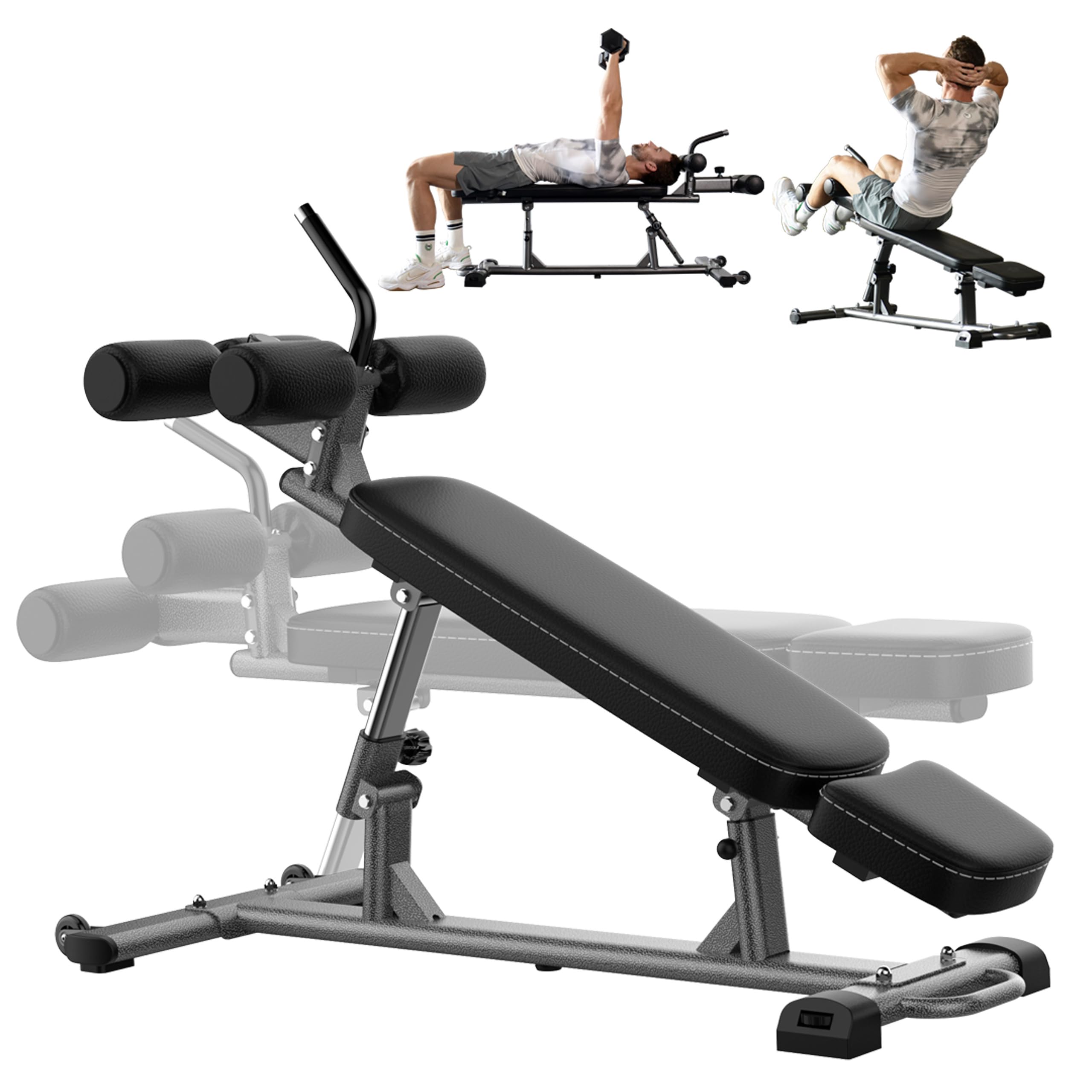
Finer Form Semi-Commercial Decline Bench

Finer Form Semi-Commercial Decline Bench

Loaded strength work

Our Score 8.8/10
Check Price

Worth Noting

  • Heavy at 44 pounds and doesn't fold
  • Can rock slightly at the top of a hard set
Mobility
Transport wheels and leveling pads
Positions
Flat and decline
Frame Weight
44 lb
Weight Capacity
1,100 pounds
Read the full review

Forty-four pounds is a lot of bench, and you feel it lifting the box. That mass buys something specific: a wide base, a heavy steel frame, and a 1,100-pound total rating that puts it in a different class from the folding boards here. It also does two jobs properly — a true flat position for dumbbell and barbell pressing, and a decline that holds you through weighted sit-ups and reverse crunches.

We think it's the right choice when core work shares a room with real strength training, because you're buying one bench instead of two. The extra-long, thick backboard is the part that convinced us: at six feet your head still rests on the pad in the decline position, which is exactly where the shorter boards here run out of room. Adjustable foot rollers take up leg-length differences, and the steel handle at the top end opens up reverse crunches and leg raises.

Mobility is better than the weight suggests — tip it onto the transport wheels and it rolls out of the way — but it doesn't fold, so it wants a permanent corner. On an uneven garage floor the frame can sit off-level, and the leveling pads under one end are there for exactly that; a couple of minutes with a wrench gets it flat.

Bottom line: Buy this one if the bench has to press as well as crunch — the 1,100-pound frame and long pad hold up, at the cost of 44 pounds and a permanent corner.

#3

LifePro SculptTrainer Roman Chair

LifePro SculptTrainer Roman Chair

Back extensions

Our Score 8.8/10
Check Price

Worth Noting

  • Height adjustment can leave the base crooked
Storage
Folds flat
Footprint
38.2 x 22.2 inches
Item Weight
19.8 lb
Weight Capacity
330 lb
Read the full review

Ankles under the padded rollers, hips free to hinge: this isn't a sit-up board, and that's exactly why it earns a place here. The SculptTrainer is a Roman chair in the classic sense — you anchor your feet, fold forward at the hip, and the work lands on glutes, hamstrings, and the lower back rather than the hip flexors that take over a steep decline crunch.

It folds flat in seconds, and 19.8 pounds is light enough to slide under a bed or stand in a closet, which matters in a room that has to be something else the rest of the day. The square-steel frame is rated to 330 pounds, the stabilizer base is wide, and the grip handles open up side bends, incline push-ups, and triceps dips. Set beside a folding slant board, it feels planted, and we appreciated that the folded footprint is small enough for a closet shelf.

This is the pick for the person whose lower back, not their six-pack, is the reason they're shopping — hip hinging is the one thing a decline sit-up bench can't give you. Where the design is least refined is the height adjustment: the pin positions and the base crossbars don't always line up square, so build it on a level floor and check the base sits flat before your first session.

Bottom line: For hip hinging rather than crunches, this is our pick: a Roman chair that folds flat, holds 330 pounds, and leaves your lower back stronger.

#4

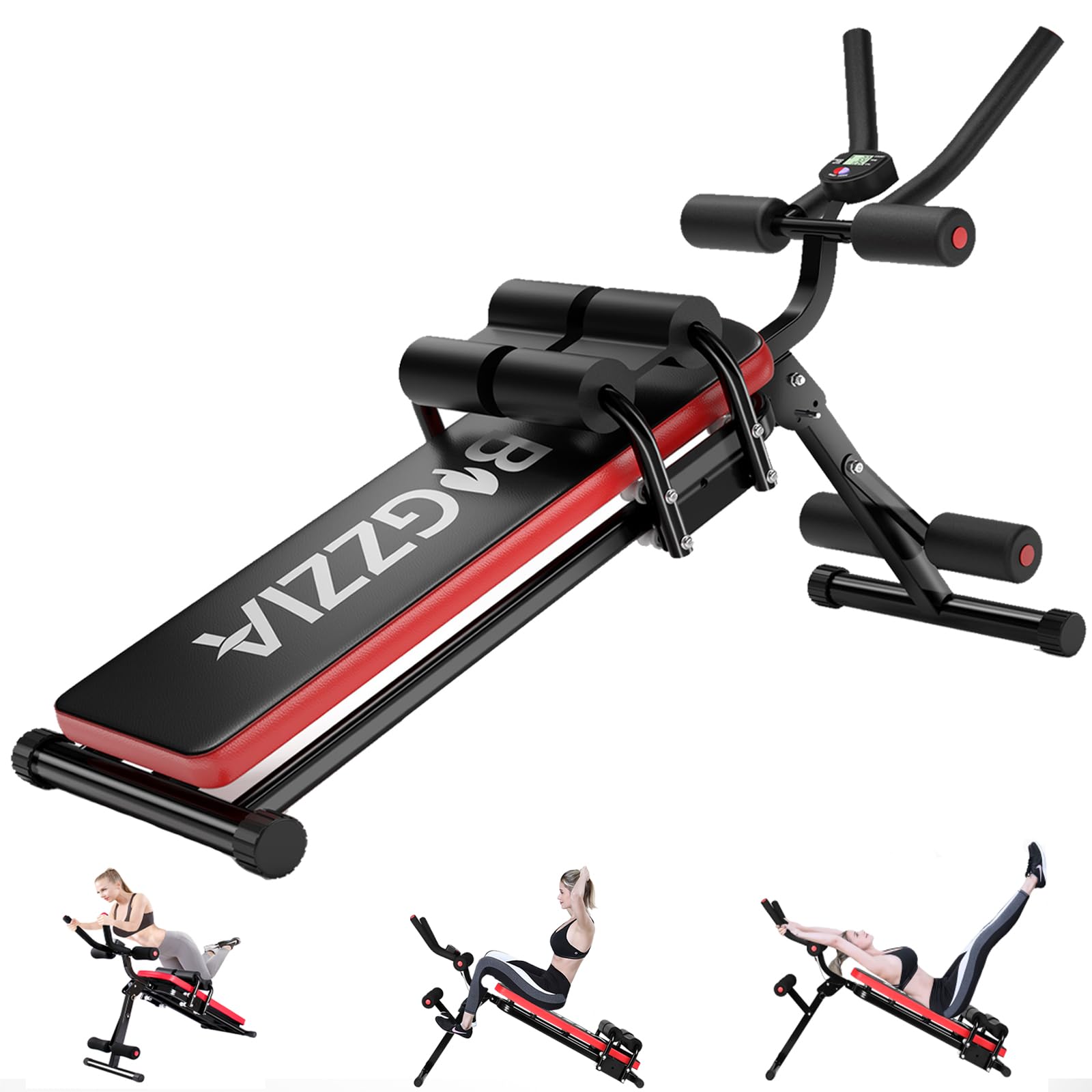
Bigzzia 5-in-1 Ab Machine

Bigzzia 5-in-1 Ab Machine

Small spaces

Our Score 8.8/10
Check Price

Worth Noting

  • Stiff, uneven drag on the sliding carriage
  • Low frame and short range for taller users
Storage
Folds with locking latch
Footprint
47.24 x 15.75 inches
Weight Capacity
330 lb
Resistance Levels
3
Read the full review

The glide is what you notice first. Drive the carriage up the rail and there's drag — a firm, sticky resistance rather than a smooth roll — and that's before you touch the three-hole plate under the handle that sets the difficulty. On a machine this compact the drag is partly the point: a lighter user gets a real workload out of a short range, and the resistance doesn't soften as you get fitter, you just move the pin.

Five functions in a footprint of 47 by 16 inches is the pitch, and most of it holds: sit-ups, push-ups, leg lifts, the glider, and a Roman-chair position, all folding on a latch for storage. The pad is thick, the armrests are foam, the rollers run quiet, and the 330-pound rating covers most users. What surprised us is how much fits into 16 inches of width.

It suits a small apartment and a short daily session more than a dedicated strength program. The resistance and the limited head movement make it a poor first purchase for someone starting from zero, and taller users will find the whole frame low and the range short. The instructions are printed small enough that the pictures are hard to follow, so budget an evening for the build rather than expecting a quick one.

Bottom line: Best for a small apartment: five exercises in one folding frame, provided you're short enough and ready for a stiff, demanding glide.

#5

Marcy Slant Board Sit Up Bench JD-1.2

Marcy Slant Board Sit Up Bench JD-1.2

Tight budgets

Our Score 8.6/10
Check Price

Worth Noting

  • Fixed incline with no angle adjustment
  • Narrow, short leg pads
Incline
Fixed, non-adjustable
Backboard
Extra-long padded board
Item Weight
19.1 lb
Weight Capacity
300 lb
Read the full review

The incline doesn't move. Once you've accepted that, the JD-1.2 makes a lot of sense as a first ab bench: a long padded board, foot anchors that keep you off the floor and take the strain off your hands, and a 300-pound rating — more capacity than the adjustable board we recommend, and the cheapest here.

Progression is the cost. A fixed board leaves you with reps, tempo, and a weight hugged to your chest, so if going steeper as you get stronger appeals to you, the adjustable Marcy is the better buy. We noticed the leg pads before anything else: they're narrow and short, and once you're much over 5'10" your knees sit past the padding and the rollers press in the wrong places. It doesn't fold either, so plan a wall to lean it against.

What it does deliver is steadiness. The powder-coated steel frame sits solid once you're on it, assembly takes minutes with the parts in the box, and the vinyl-covered pad wipes clean after a garage session — firm rather than plush, which is what you want under a sit-up rather than a nap.

Bottom line: The straight answer for a tight budget and a single angle: 300 pounds of capacity and a long padded board with nothing to adjust.

#6

Sunny Health & Fitness Multi-Function Roman Chair

Sunny Health & Fitness Multi-Function Roman Chair

Tall users

Our Score 8.4/10
Check Price

Worth Noting

  • Built tall, so shorter users can't reach the pads
  • Flex at the pad junction under heavier loads
Positions
Flat to decline
Item Weight
24.5 lb
Ankle Rollers
Adjustable
Weight Capacity
1,000 pounds
Read the full review

A 44.5-inch frame and a 35-inch height make this the biggest machine here, and that sizing is the whole story. If you're around 5'4", the ankle rollers sit far out in front of you and the pad doesn't meet your back where you want it — this is a bench built for people tall enough to use all of it.

Get the fit right and the case is strong: a 1,000-pound rating, an extendable frame, adjustable ankle rollers, and flat-to-decline positions that let one machine cover back extensions, decline sit-ups, Russian twists, and preacher curls. Of the multi-stations here, we think it's the one to buy for a tall lifter who wants a single piece of equipment rather than a bench plus a separate extension stand.

Assembly is where patience runs out. It arrives as 13 separate pieces, and the instructions are the weakest part of the package — the order for connecting the frame is the least clear part of it. Sort the hardware into piles first and it's an evening's job rather than a nightmare, and a second pair of hands helps at the pad junction. Give the bolts a re-torque after the first week of use.

Bottom line: A tall, heavy-rated multi-station for tall lifters; shorter users should look elsewhere, and the pad junction flexes under heavy use.

How We Tested 12 Ab Benches Over Eight Months

We started with a list of roughly 40 ab benches from major fitness retailers and cut it to 12 by reading specs and customer reviews, filtering out anything with a pattern of cracked welds, missing hardware, or a height limit that would rule out taller users. We also tracked what each one gave you for the money, since the cheapest and priciest models look nearly identical in photos. Every bench was bought at retail, so none arrived pre-assembled or tuned in our favor.

Assembly came first: we timed each build with one person working alone, noted where the instructions stopped matching the hardware in the box, and re-checked every bolt after a week of use. From there, each bench lived in real workouts three or four times a week — decline crunches, reverse crunches, leg raises, and the occasional set of dumbbell presses on the flat setting — split between a garage gym and a carpeted spare-room floor.

During sets we watched whether the frame flexed or walked across the floor at the bottom of a rep, and whether the back pad stayed firm through a full range of motion or bottomed out under a shoulder blade. We adjusted the ankle rollers for a five-foot-five tester and a six-foot-one tester to see where each bench pinched, and how much fiddling a mid-workout change actually took. Small construction details got written down too — vinyl seams, foam density, bolt size — because those are what a bench is worth a year in. Effectiveness was the honest measure: did the setup put the work in our abs rather than our hip flexors, and did we reach for it over a floor mat when we were tired?

How to Choose an Ab Bench

Start With the Movement You Want

Three designs sit under the ab bench label and they train different things. A slant or decline board anchors your feet and loads the abs through a crunch. A Roman chair frees your hips to hinge, putting the work on glutes, hamstrings, and the lower back. A flat-to-decline weight bench splits the difference when the same pad also has to handle pressing.

Pick the movement first — the Marcy SB-4606 for crunches, the LifePro for hip hinging, the Finer Form when the bench pulls double duty — and the rest of the shopping gets shorter. Buying for a movement you don't enjoy is how these end up folded in a closet.

Adjustable Angles Earn Their Keep

Progression is the reason to pay for adjustment. A fixed board leaves you with reps, tempo, and a weight hugged to your chest; three or four locked positions let you go steeper as the reps get easy, which is the cheapest progression in home training.

Range beats count. You want a setting close to flat for the first weeks and a top end steep enough to be genuinely hard. We rank a four-position board with a real flat start above one with six positions that all sit steep, and we check how the pin engages — a hinge with play in it feels loose under load no matter how many settings it lists.

Fit Is Height and Leg Length, Not Weight Rating

A generous capacity tells you the frame won't fold under you. It says nothing about whether your knees land on the pads. We put backboard length and ankle-roller adjustment ahead of capacity when matching a bench to a body.

If you're tall, a short pad leaves your head hanging and your knees past the padding — the Sunny is built for that body and the Marcy JD-1.2 plainly isn't. If you're short, a tall machine pushes the rollers so far out that you slide down the board. The trap is assuming more capacity means a better fit; the two are unrelated.

Rigidity, Base Width, and Real Floors

Every folding bench flexes somewhere, and full-range decline sit-ups are the movement that finds it. The give usually shows up at the hinge and the pad junction, and it's the trade you accept for a frame that stores flat.

What you can judge before ordering is the base: a wide footprint with feet at the corners resists the sideways twist a narrow frame develops, and a fixed frame is stiffer than a folding one at the same weight. If you train heavy or with added load, buy rigidity first and store the bench standing.

Storage, Footprint, and the Build

Folding is the feature people use most and think about last. A board that drops flat on a pin can live behind a door; a 44-pound semi-commercial bench needs a corner of its own, and wheels help you move it rather than store it.

Plan the build too. Hardware kits are often short a wrench or a second pair of hands, and multi-station machines arrive in a dozen pieces with thin instructions. Open the box somewhere you can leave the parts spread out, and sort the bolts by size before you start.

Frequently Asked Questions

Final Verdict

The Marcy SB-4606 is the ab bench we point most people to, and the reason is simple: four locked angles, a headrest, and a folding frame cover the beginner-to-intermediate arc without taking over a room.

If the same bench has to handle loaded pressing, the Finer Form semi-commercial is the upgrade, provided you can give 44 pounds of steel a permanent corner. And if the goal is a stronger lower back rather than a harder crunch, the LifePro Roman chair is the one to buy.