Strength & Weights

Best Leg Press Machines of 2026

A leg press solves a problem free weights can't: you get to load heavy and push hard without balancing a bar overhead or waiting on a spotter. It also eats more floor space than anything else in a home gym, and the wrong one makes itself known fast — a frame that shudders near the top of a rep, a foot plate too small for both feet, an afternoon surrendered to assembly.

We've had six of these set up in a garage gym for the past eight months, assembling, loading, and shifting them more times than I'd like to admit. The things that separate a good machine from a frustrating one rarely show up on the spec sheet: whether the sled glides at the bottom of the stroke, and whether you can shove it against the wall alone when you want the floor back. The picks below are the ones that held up.

#1

Eryntix 45° Leg Press Combo

Top Pick
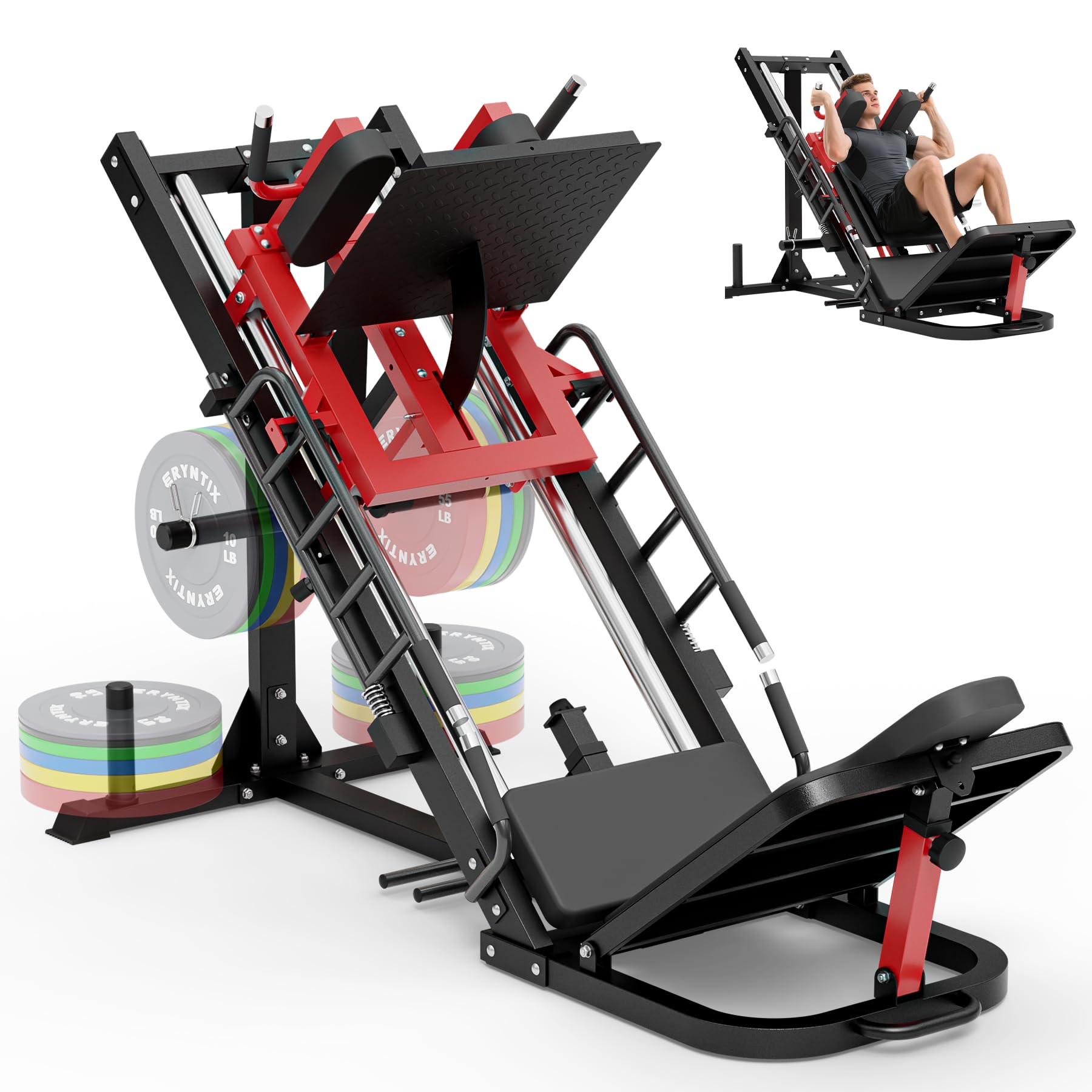
Eryntix 45° Leg Press Combo

Build quality

Our Score 9.6/10
Check Price

Worth Noting

  • 1,000-pound rating is the lowest of the premium combos
Max Load
1,000 lb
Warranty
2 years
Footprint
75.98"D x 38.19"W x 49.41"H
Safety Positions
4 dual-sided rail positions
Read the full review

Thirty-eight inches wide, under 50 inches tall, and 76 inches front to back: the Eryntix is the narrowest of the full-size 45-degree combos here, and that silhouette is most of the argument. It sits along a garage wall without elbowing the car out of the bay, which is more than we can say for the bigger frames on this page.

The build is where the money went. The main frame is 2mm Q235 steel on a wide triangle base, the sled rides on ball bearings instead of rollers, and the dual-sided rails give four safety positions. Plates load under the sled rather than on horns poking out the back, which keeps the working area tight and makes loading between sets a short reach rather than a walk around the machine.

What we can tell you after time on it: the frame is stiff, the glide is quiet, and the adjustments hold where you set them. What we can't tell you is how it ages. This is the least-established of the premium machines, so the two-year warranty is doing some of the persuading, and the 1,000-pound rating is the lowest of the three premium combos — if you press heavy, compare against the GMWD before you commit.

Assembly runs a couple of hours for one person and the tools come in the box. Build it where it will live: the triangle base is stable once it's down, and the instructions are good enough that one person can finish in an evening without help.

Bottom line: If you want the cleanest build in this group and a warranty that runs two years, this is the premium combo we point you to.

#2

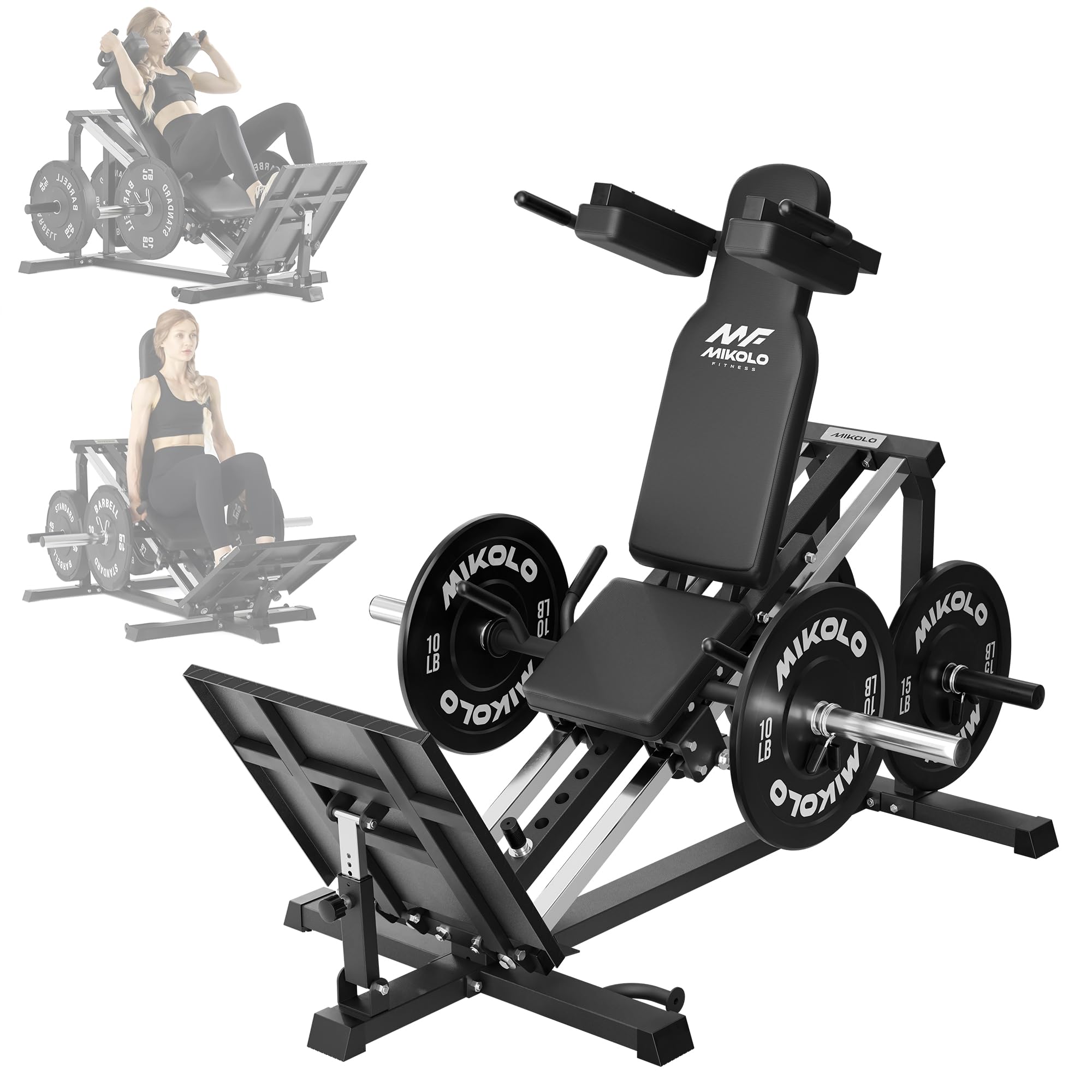
Mikolo LP05 Leg Press

Mikolo LP05 Leg Press

Press-only setups

Our Score 9.2/10
Check Price

Worth Noting

  • No hack-squat mode
  • Longest footprint here at 88 inches
Max Load
2,000 lb
Warranty
2 years
Footprint
88"D x 26"W x 55"H
Frame Weight
220 lb
Read the full review

Twenty-six inches wide is the number that makes the Mikolo LP05 interesting. That's narrower than an interior door, which means a 45-degree leg press can live in a corridor, a closet nook, or the strip of garage beside the car — places no combo machine on this list will go.

It's a press and only a press: no hack squat, no shoulder pads, nothing to convert. What the money buys instead is capacity and steel — a 2,000-pound rating, the highest here, an 11-gauge welded frame at 220 pounds, four band pegs with eight holes for accommodating resistance, and three starting heights so you can set the bottom of the movement where your hips want it.

If leg press is the lift you care about, this is the cleanest way to spend the money. There's no hack-squat mechanism to pay for and no second mode to go wrong, and the sled glides quietly on linear bearings. If you want to squat as well, it's the wrong machine, and that's a decision to make before you order rather than after the boxes arrive.

Assembly is manageable for one person, and it's narrow enough to build in place. One note: the weight-storage pegs aren't as stout as the rest of the frame, so keep them for the plates you're actually lifting rather than treating them as a rack.

Bottom line: Choose this when the leg press is the machine you care about: 26 inches wide, 2,000 pounds rated, and no hack squat to pay for.

#3

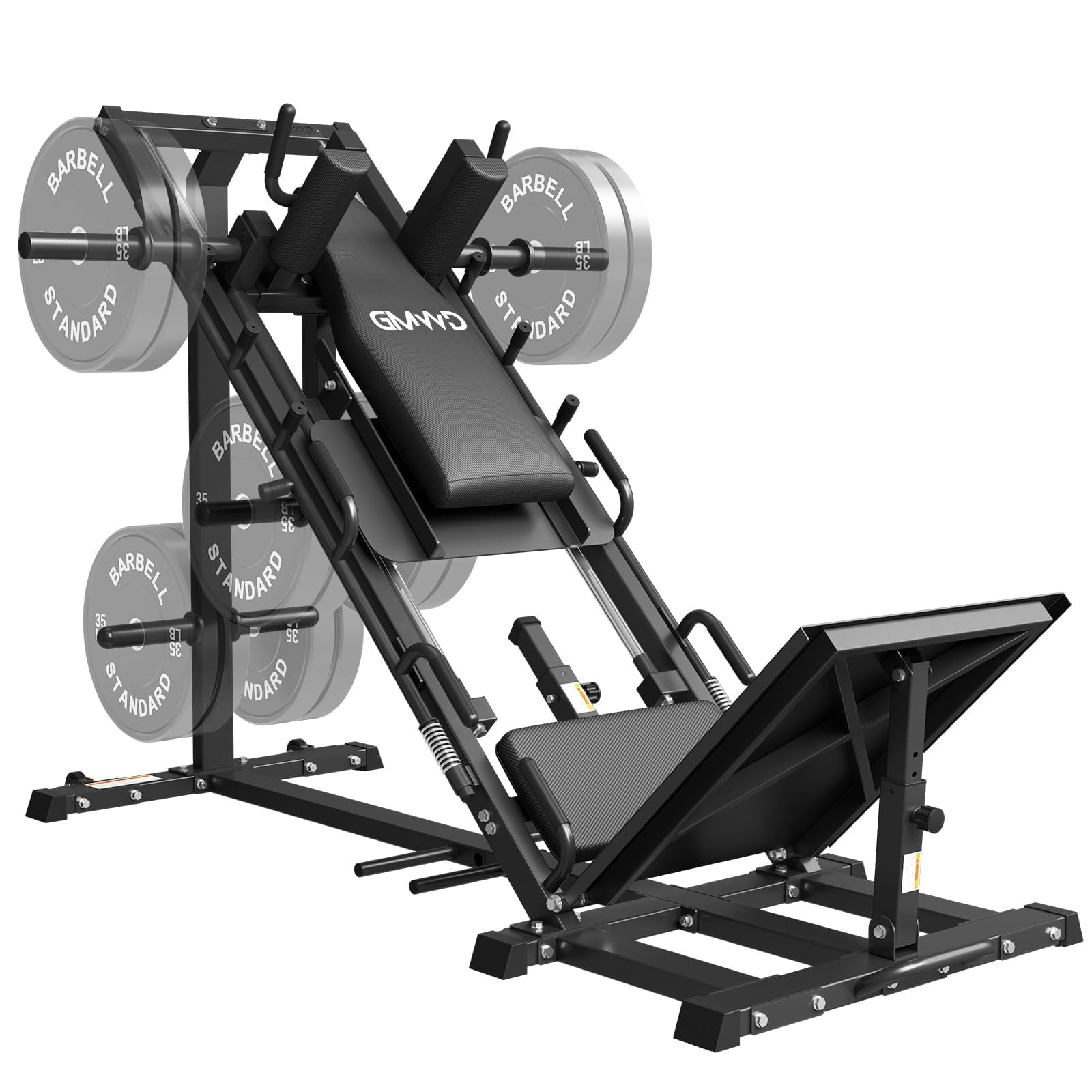
GMWD Leg Press Hack Squat Combo

GMWD Leg Press Hack Squat Combo

Serious home gyms

Our Score 9.0/10
Check Price

Worth Noting

  • Narrow hack-squat footplate limits stance width
  • Deep 84-inch footprint takes a dedicated space
Max Load
1,500 lb
Warranty
2 years
Footprint
84"D x 47"W x 56"H
Frame Weight
385 lb
Read the full review

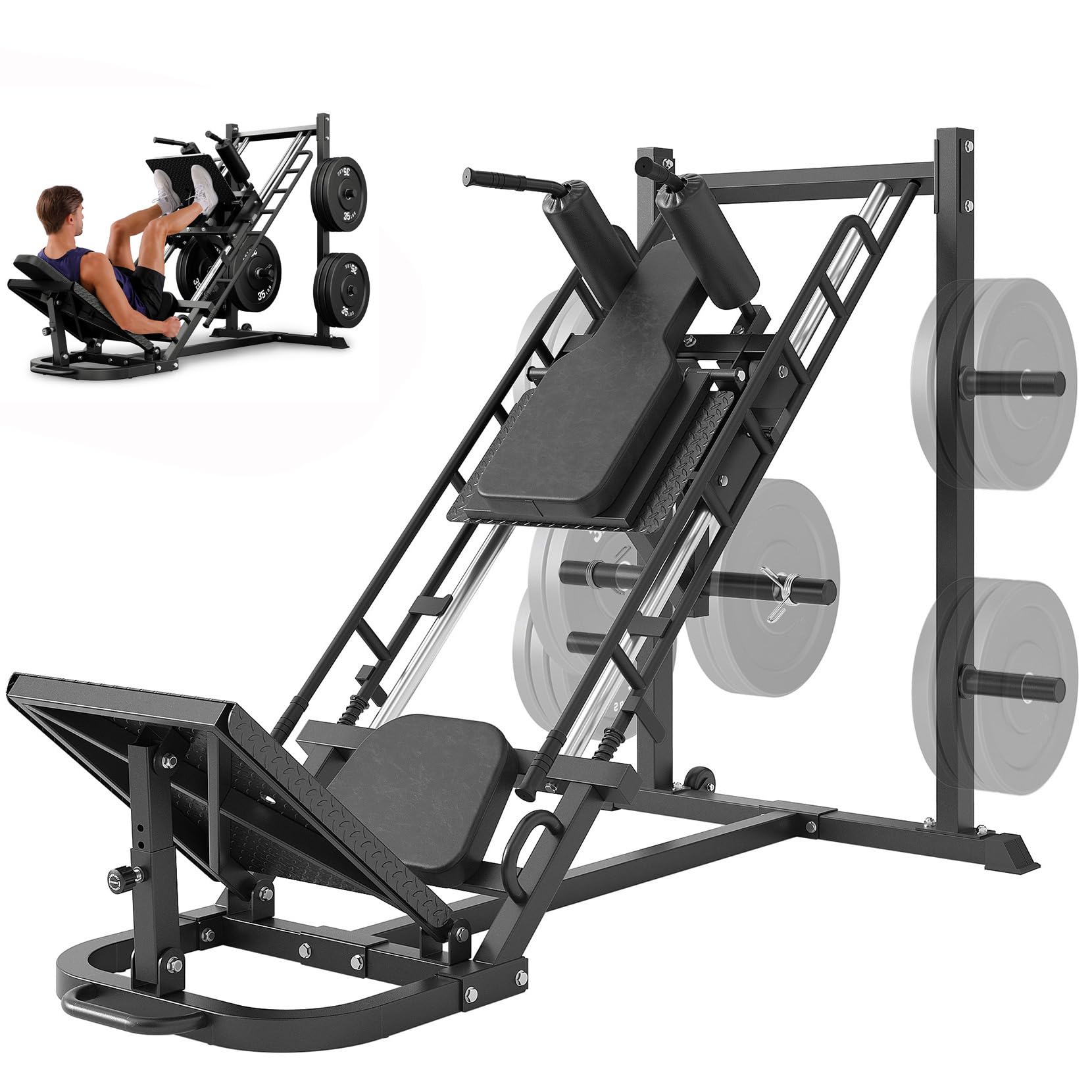
Three hundred eighty-five pounds is the number that decides this one. Frame weight is the least glamorous spec on any leg press and the one you feel every rep: a heavy frame doesn't shiver when the sled settles into the stops, doesn't creep across the floor under a lopsided load, and doesn't leave you wondering mid-set whether the machine will hold. The GMWD is the heaviest machine in this group by a wide margin, and it behaves like it.

We made it the top pick because it's the most complete 45-degree combo here. The frame is rated to 1,500 pounds, the sled runs on linear bearings rather than rollers, and the safety system is the best sorted in this group: dual-sided rails with three lockout positions plus a five-level limiter, so you can set the bottom of the press to your own depth and train alone without guessing. Converting between leg press and hack squat takes seconds, and after a couple of sessions we stopped thinking about it.

Two details worth knowing before you order. The upper weight-storage horns measure just under two inches, so a standard 2-inch barbell collar won't slide over them — use the horns for storage and a clamp on the sled. And the 1,500-pound figure is a frame rating, not a promise about how the sled behaves at the very top of that range; plan around the weight you actually press and neither point will bother you.

Set aside an afternoon and a second pair of hands for the shoulder-pad section. What you get for it is a two-year manufacturer warranty, on the machine that would be the most expensive and awkward of the lot to ship back. The pads are leather-wrapped and thick, which is the sort of thing you notice on the fourth set rather than the first.

Bottom line: Buy this one if your garage has the floor for it: the heaviest frame here, the highest capacity, and a combo that behaves like commercial equipment.

#4

Mikolo LP10 30° Combo

Mikolo LP10 30° Combo

Low ceilings

Our Score 9.0/10
Check Price

Worth Noting

  • 1,000-pound rating caps heavy pressing
Max Load
1,000 lb
Footprint
67"D x 52"W x 47"H
Sled Angle
30 degrees
Frame Weight
165 lb
Read the full review

Forty-seven inches tall. If your garage has a low bay, a beam across the middle, or a shelf the machine has to live under, that number decides the purchase before any other spec does, and it's why the Mikolo LP10 is on this list.

The 30-degree sled is the other half of the story. A shallower angle than the 45-degree standard changes how the press feels — more of a forward drive than a diagonal one — and it lets the machine stand shorter without folding you into it. Mikolo gives you seven backboard and foot-pedal positions, and the shoulder pad lifts off when you're pressing, which keeps that mode uncluttered.

The honest limit is capacity: 1,000 pounds is the ceiling, and this is a home machine rather than a commercial one. Nobody lining up five plates a side should be looking here. Fit is the other question — shorter lifters around 5'5" can find the hack-squat pads sitting a few inches off the shoulders, so check the pad height before you commit to squatting in it.

For a garage that already has a car in it, this is the combo we point to: 67 inches deep, 47 tall, and still capable of both lifts. It's the least intimidating machine here, and the one most likely to get used on a Tuesday night when the alternative is unloading a car first.

Bottom line: For a low ceiling or a shared garage bay, this is our answer: a 47-inch combo that still gives you a real hack squat and press.

#5

RitFit Leg Press Hack Squat Machine

RitFit Leg Press Hack Squat Machine

All-round training

Our Score 8.8/10
Check Price

Worth Noting

  • Footplate is narrow for a wide stance
  • Range of motion runs short for lifters over six feet
Angles
5 hack squat + 3 leg press
Max Load
1,200 lb
Warranty
1 year
Frame Weight
238 lb
Read the full review

Put the RitFit next to our top pick and the differences are honest ones: 300 pounds less rated capacity, a frame that weighs 238 pounds instead of 385, and about the same money. What you get back is the widest adjustment range here — five hack-squat angles and three leg-press settings — and a machine two people can shift without planning a morning around it. For a garage lifter who isn't loading four plates a side, that's the better trade.

Adjustability is where it earns its place. Five squat angles mean you can set a depth that suits your hips rather than picking between two positions and living with it, and the sled runs on linear bearings with a glide that stays smooth instead of developing the rattle roller systems pick up. It reads as a home machine rather than a commercial one, which is a compliment here: it doesn't dominate a room the way a 385-pound frame does.

Assembly is an afternoon with the illustrated steps, with one wrinkle — the shoulder pads need to go on at an angle and the manual doesn't say so clearly. Both boxes can arrive scuffed, so inspect them before the packaging goes out. The 1,200-pound rating is honest about what this machine is for: home training, at home weights, for a long time.

Bottom line: Our pick for most garages: nearly everything the top pick does for the same money, with more angle settings and a frame two people can move.

#6

Dripex Leg Press Hack Squat Combo

Dripex Leg Press Hack Squat Combo

Budget garages

Our Score 8.8/10
Check Price

Worth Noting

  • Footplate narrower than a wide stance wants
Max Load
1,200 lb
Warranty
1 year
Footprint
82.3"D x 42.9"W x 58.3"H
Frame Weight
103.6 lb
Read the full review

The Dripex is one of the two lowest-priced combos here, and it's the one that behaves like it knows it. A 1,200-pound rating, a diamond-pattern footplate that grips a training shoe, weight storage to keep plates off the floor, and transport wheels at the back so one person can tip it up and park it against the wall — that's a lot of machine for the money.

We like it for the garage lifter who trains alone a few times a week and needs the floor back the rest of the time. At 104 pounds it's the lightest of the full-size machines here, which is exactly why the wheels matter: nothing else in this group moves without a second person. It also means you don't get the nailed-down feel of a 385-pound frame, so take the rating seriously and keep your working weight inside it.

The hardware is where a budget machine usually lets you down, and the rollers and fittings are where we look hardest in the first month. Check them when the boxes land, before the packaging goes out, and re-check every bolt after the first week. Assembly runs a couple of hours at a relaxed pace with clear steps.

Bottom line: The budget combo we trust: 1,200 pounds of rated capacity and wheels that let one person put the floor back after training.

#7

Goimu Leg Press Hack Squat Combo

Goimu Leg Press Hack Squat Combo

Adjustability

Our Score 8.6/10
Check Price

Worth Noting

  • Wordless picture manual slows assembly
  • No warranty stated
Angles
5 hack squat + 3 leg press
Max Load
1,200 lb
Footprint
70"D x 42"W x 55.5"H
Plate Compatibility
2" plates
Read the full review

The assembly manual is pictures without words, and following it takes patience. That's the first thing to know about the Goimu, because a machine this size will take a couple of hours even with good instructions, and these aren't.

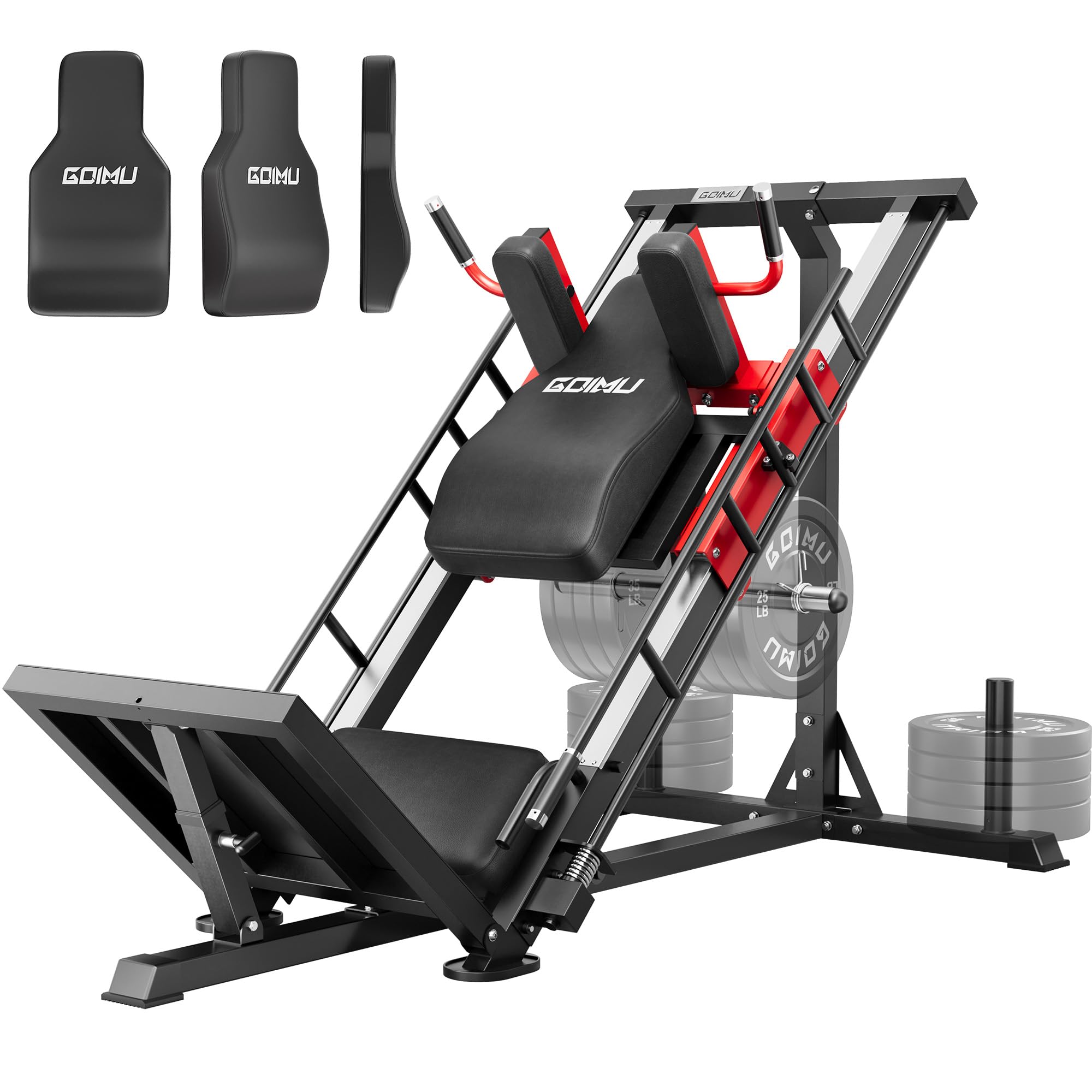
Get past the build and there's a well-equipped combo underneath: five hack-squat angles and three leg-press settings, a 1,200-pound rating, a carriage that takes 2-inch plates, thick shoulder and back pads, and a 70-by-42-inch footprint that's tighter than the big frames here.

The platform is the other sticking point. The starting position and the stop height can leave you short of a full range of motion, and at 5'8" the stops run out of depth before the hips do. Set them on day one before you load anything, and check the bottom position against your own depth rather than the manual's.

We kept it on the list because the adjustment range is worth the hassle for the right buyer — someone who has assembled gym equipment before and wants angle options without paying premium money. If a frustrating build would sour you on the machine, spend more on the RitFit and save yourself the evening.

Bottom line: A capable, adjustable combo at a fair price if you've built gym equipment before and don't need a warranty behind it.

#8

Soozier Vertical Leg Press

Soozier Vertical Leg Press

Small spaces

Our Score 8.4/10
Check Price

Worth Noting

  • 1-inch standard plates only, not Olympic
  • 286-pound plate limit caps progression
Footprint
50.4"W x 41.6"D x 53.7-61.5"H
Plate Load
286 lb
User Weight Limit
661 lb
Plate Compatibility
1" standard plates
Read the full review

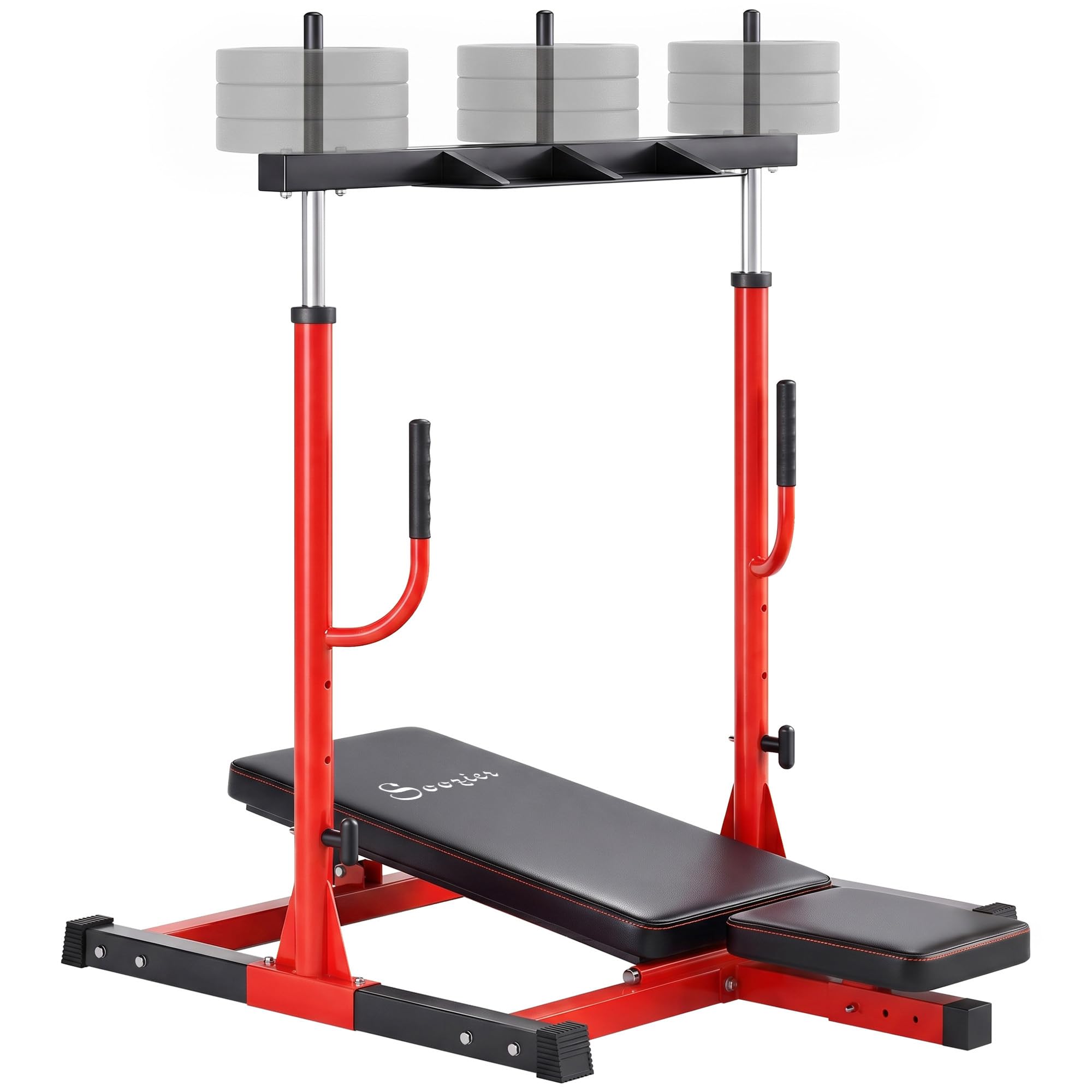
Two hundred eighty-six pounds of plate capacity, one-inch plates, a vertical sled and a 64-pound frame: the Soozier is a different animal from everything else here, and it's the machine we recommend most readily to someone with a corner to spare and a modest plate collection. It presses legs without loading the spine, costs the least here, and takes up the least room.

The vertical path is the difference you feel. Instead of pushing along a 45-degree diagonal, you press straight up from a supported position, which changes the line of force and, for some hips, the comfort. At 50 inches wide and 42 deep it tucks into places nothing else on this list will go, and at 64 pounds one person can shift it.

The limits are real. One-inch plates mean your Olympic set won't fit, 286 pounds caps what you can load, and the linear bearings are the part to watch — a bearing that fails turns a smooth press into a grind. For maintenance pressing in a spare room, none of that matters. For chasing a number, all of it does.

Bottom line: The cheapest way into a real leg press, as long as 286 pounds of plates is more than you'll ever load.

How We Chose and Tested Leg Press Machines

We started by pulling every home leg press we could find that published a real weight capacity, a listed footprint, and a frame spec more specific than "steel." That narrowed a crowded field to six machines, which we assembled and used in a garage gym over eight months, at roughly three leg sessions a week.

Assembly came first, because it's where most of these machines lose people. We unboxed and built each one alone, stopwatch running and nothing but the included instructions, noting where a diagram skipped a step, where the hardware bags weren't labeled, and where the sled genuinely needed a second set of hands. Then we measured each footprint with a tape and tried moving it solo across bare concrete and rubber mats to see whether the transport wheels did anything at all.

Under load, we worked up toward each machine's stated capacity and watched for frame flex, a sled that binds at the bottom of the stroke, and a foot plate too narrow or too short to shift stance between sets. Over the months we kept an eye on welds, powder coat at the contact points, and bolts that worked loose, and we weighed what each machine delivered against the rest of the group rather than against its price tag. Sturdiness and honest instructions, it turns out, are what you're really paying for.

How to Choose Leg Press Machines

Measure the floor and the ceiling first

The footprint numbers decide whether you keep the machine. The 45-degree combos here run 67 to 88 inches front to back and 26 to 52 inches across, and the tallest stand close to 58 inches. Compact in a listing means compact against other leg presses, not against a car: a 70-inch machine still needs a tape measure on the floor.

Mark the rectangle in tape, then stand in it and load a plate. Most of these load from the sides or the back, so leave room there. If the ceiling is low, favour the Mikolo LP10 at 47 inches over anything taller.

Decide between a combo and a press-only machine

The hack-squat mechanism is the reason combos cost what they do, and it earns its keep if the leg press is your main lower-body lift and you want quad work without a barbell on your back. It also adds a shoulder-pad fit question that matters more for shorter lifters.

If you already squat, a press-only machine like the Mikolo LP05 puts the money into steel and capacity instead: 2,000 pounds rated, 26 inches wide, nothing to convert. Our rule is simple — if you can't name the day you'll use the hack squat, don't pay for it.

Range of motion is the spec you can't look up

The number of start positions and lockout points decides whether the machine fits your body, and it's where a cheap combo gives itself away. Three or four positions are workable; five hack-squat angles is generous.

Two traps. Taller lifters, over six feet, can run out of depth before the stops run out of travel, so favour more positions. Shorter lifters around 5'5" can find the hack-squat pads sitting inches off the shoulders, which makes the squat feel loose. Check the footplate width as well — a narrow plate turns every press into a close stance.

Build it where it will live

Set aside an afternoon and, above roughly 150 pounds of machine, a second person. Frame weights here run from 64 pounds to 385, which is the difference between a machine you slide against a wall and one you site once and never move.

Warranty is worth reading before you buy: two years on the GMWD, the Eryntix and both Mikolos, one year on the RitFit and the Dripex, none stated for the Goimu. On something this heavy and this awkward to ship back, that isn't a small detail. Keep the packaging until you've checked every bolt.

Frequently Asked Questions

Final Verdict

The GMWD is the machine we want in our own garage, floor space permitting: 385 pounds of frame, a 1,500-pound rating, and a hack squat that converts without tools. It is the most machine here, and it behaves like it.

When the room is the constraint, the Mikolo LP10 answers it at 47 inches tall and 67 inches deep and still gives you both lifts. And if you only ever press, the LP05 puts the money into a 2,000-pound rating and a 26-inch width instead of a mechanism you won't touch.