Strength & Weights

Best Dumbbell Racks of 2026

A home gym usually starts with one pair of dumbbells and ends with a floor you can’t cross without tripping. The second and third pairs need a home—not a pile behind the bench or a lean against the wall. A dumbbell rack fixes that: it keeps the weight off the floor, puts the pair you need at arm’s reach, and turns a tripping hazard into something you can walk past.

I’ve learned that choosing one is less about the weight capacity on the box and more about how it behaves when you’re tired and racking a 50-pound pair with one hand. Over six months, we put 12 racks through daily use in a garage gym and a spare bedroom, and the differences showed up fast—some flexed at the joints when the heavy pairs went up top, some swallowed a whole set, and one smelled like a tire fire for a week. Assembly ranged from a ten-minute solo job to a two-person puzzle, and only a few felt worth the money. The picks below are the ones that stayed steady, went together without a fight, and earned their footprint.

#1

Marcy DBR-86 3-Tier Rack

Top Pick
Marcy DBR-86 3-Tier Rack

Most home gyms

Our Score 9.6/10
Check Price

Worth Noting

  • 24.75-inch depth stands well off the wall
Tiers
3
Footprint
24.75"D x 37"W x 33"H
Unit Weight
43 lb
Weight Capacity
1,000 pounds
Read the full review

The measurement that decides whether the Marcy DBR-86 suits your gym is not the 1,000-pound capacity. It is the length of the handle on your heaviest dumbbell. The three tiers are angled and generously sized, but the rails sit close enough that very short two- and three-pound neoprene pairs can slip between them, and the widest 50-pound heads sit snug rather than loose. Measure one handle and one head before you order.

Get that sorted and this is the rack we point most home gyms toward. Three angled shelves carry a stated 1,000 pounds, and a full run of hex pairs from 5 to 50 pounds comes to roughly 550, so there is room to grow rather than a ceiling to hit. Angling the shelves tips the handles toward you, which makes one-handed re-racking possible when the other hand is already full.

Building it is one of the simpler jobs in this group: the holes line up, the hardware is straightforward, and at 43 pounds the frame is light enough for one person to stand upright. Rubberized feet keep it from skating on a hard floor or marking it, and the powder-coated steel wipes down without drama.

Nothing here is fussy. No casters to lock, no adjusters to re-set, no tray to clear out — you build it once, load it, and it disappears into the routine, which is about the highest compliment we can pay a storage rack.

Bottom line: We recommend the Marcy DBR-86 for most home gyms: it carries a full hex set with capacity to spare, and the fit question is one measurement away from being a non-issue.
#2

Josmimic 4-Tier Rack

Josmimic 4-Tier Rack

Light dumbbells

Our Score 9.4/10
Check Price

Worth Noting

Tiers
4
Footprint
3.58"D x 12.99"W x 16.93"H
Unit Weight
7 lb
Weight Capacity
154.3 lb
Read the full review

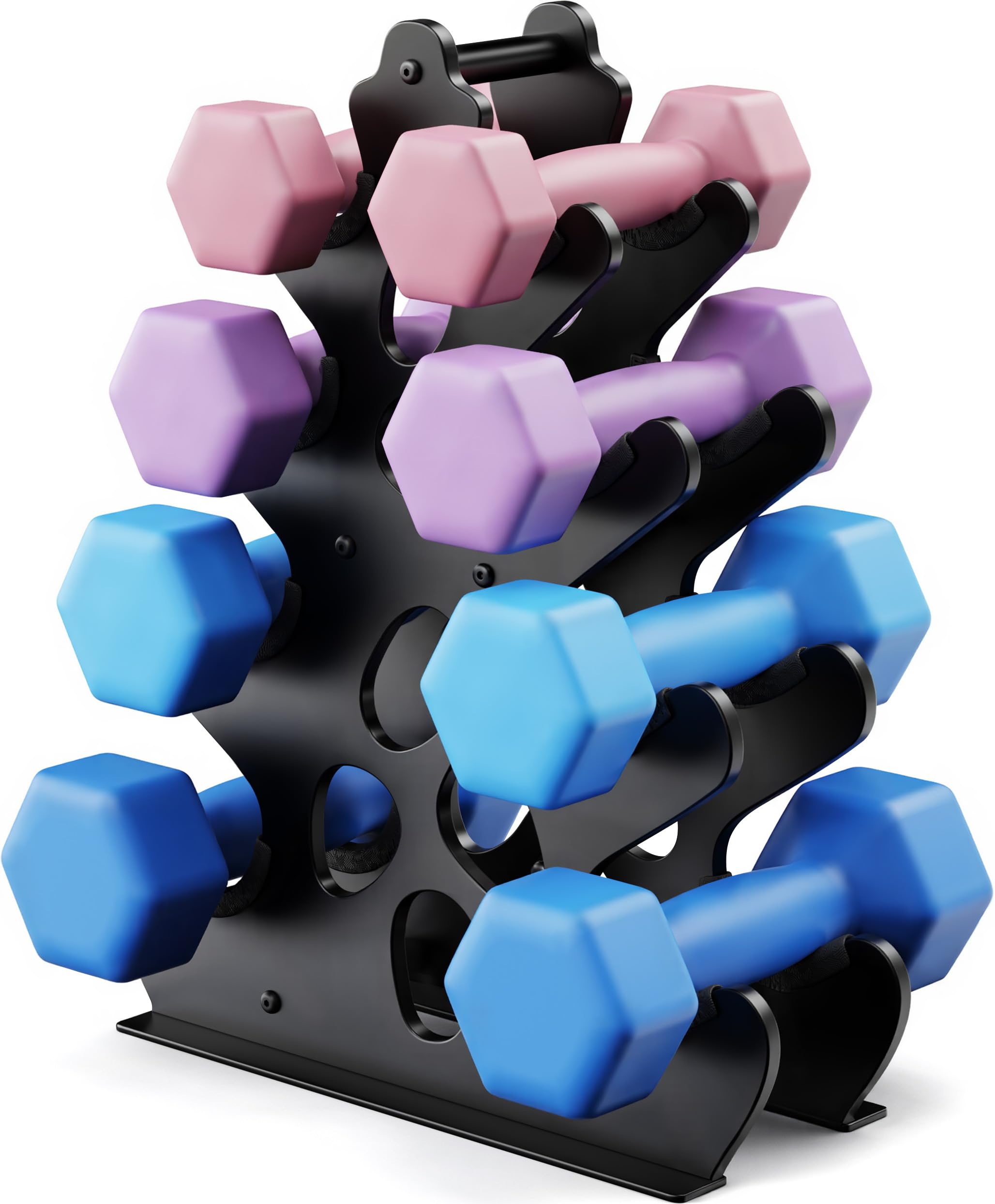
This is the rack for the corner of a bedroom, not the wall of a garage. The Josmimic four-tier is small, deliberately styled — the frame runs a coral-inspired A-shape rather than the usual black rectangle — and built for the light dumbbells that live next to a yoga mat.

Four tiers, a stated 70 kg capacity, and rubber-edged guards on the shelves that protect the dumbbell coating as well as the floor. At 7 pounds you can pick it up and carry it to wherever you are working out, and the powder-coated metal is treated to resist rust in a damp basement.

Assembly is minutes rather than an evening — the holes line up and the hardware is in the box — and the whole thing is small enough that it does not read as gym equipment in a living space. In an office or a spare room, that matters more than capacity.

We recommend it with the boundary spelled out: this holds small dumbbells, the 3s through the 15s, and nothing heavier. If that is your set, it is the neatest way here to get them off the floor. If you own 25s or plan to, the CAP A-frame costs more and takes heavier pairs.

Bottom line: Small dumbbells, small room, small budget: the Josmimic handles the light end of a set better than anything else here.

#3

YOLEO Adjustable Dumbbell Rack

YOLEO Adjustable Dumbbell Rack

Mixed dumbbell sets

Our Score 9.2/10
Check Price

Worth Noting

  • Taller and heavier than the compact racks here
Tiers
3
Footprint
19.7"D x 37.8"W x 36.6"H
Weight Capacity
1,100 pounds
Adjustable Bar Width
2" to 5.1"
Read the full review

Adjustable bars are what sold us on the YOLEO. Each of the three tiers has four screw holes and two width adjusters, so the gap between the rails runs from about 2 inches to 5.1 — a direct answer to the thing that makes people regret a rack, which is a set assembled from three brands that will not sit level on fixed rails.

The rest of the frame is stout: a welded triangular base, a stated 1,100-pound capacity, rubber end caps that protect the floor, and angled shelves. It is a taller, heavier rack than the A-frames here, so give it a wall rather than a corner, and keep a second wrench within reach — the adjusters and bolts want more leverage than the included tool gives you on its own.

If your dumbbells are one brand in one size family, the Marcy is the simpler buy and holds more per shelf. The YOLEO earns its place when the set is a hodgepodge, or when a kettlebell or two share the storage: set the bars wide, drop them in, and they sit flat instead of leaning.

Bottom line: If your dumbbells come from more than one brand, we think the YOLEO's adjustable bars are worth the extra fiddling at assembly time.

#4

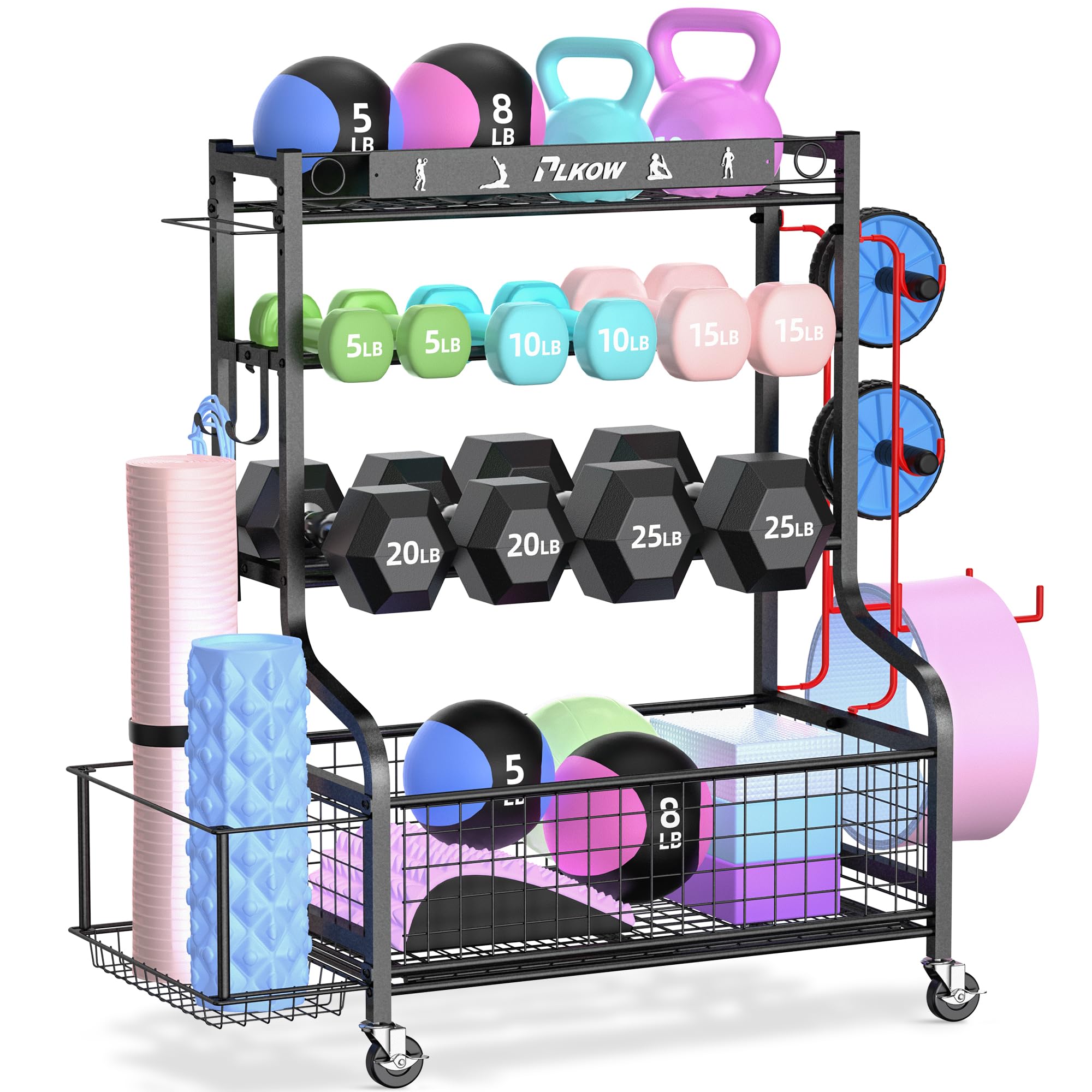
PLKOW Rack with Wheels and Hooks

PLKOW Rack with Wheels and Hooks

Apartment gyms

Our Score 9.2/10
Check Price

Worth Noting

  • 350-pound rating suits mid-weight sets only
Wheels
4, 2 lockable
Footprint
15.8"D x 41.5"W x 37"H
Extra Storage
Side basket and hooks
Weight Capacity
350 lb
Read the full review

Four casters, two of them lockable, are what make the PLKOW worth its floor space. A rack of dumbbells is furniture until you can push it to the mat and back, and this one turns storage into something you move instead of walk to.

It is a storage station first and a dumbbell rack second, which is the point. Three tiers take the weights while a side basket swallows a yoga mat and foam roller and the hooks take bands and towels. The frame runs 41.5 inches long and 15.8 inches deep, so it sits along a wall without eating the room.

If all you own is dumbbells, a plain rack buys more capacity for the same money. If your corner is a heap of mats, bands, a kettlebell and four pairs, this is the one product here that clears the whole heap at once.

Bottom line: The PLKOW is the pick when your gym gear has to move: locking casters, a shallow frame, and hooks for everything that is not a dumbbell.

#5

LIONSCOOL Rolling A-Frame Rack

LIONSCOOL Rolling A-Frame Rack

Rolling between rooms

Our Score 9.2/10
Check Price

Worth Noting

  • 300-pound rating limits it to mid-weight sets
Wheels
360-degree swivel casters
Footprint
18.39"D x 13.58"W x 35.98"H
Slot Spacing
3.8 inches
Weight Capacity
300 lb
Read the full review

The tray at the base is what separates the LIONSCOOL from the other A-frames here. Instead of a fifth pair of slots, the bottom of this rack is a flat shelf — somewhere a kettlebell, a couple of plates or a pair of odd-sized dumbbells can sit without rolling off the front.

Above the tray, the rungs sit 3.8 inches apart, which is enough room that a mid-weight head comes out without scraping your knuckles, and the whole frame rides on 360-degree casters so it moves when you want it to and stays when you lock it.

It stands 13.58 inches wide and 35.98 inches tall, narrow enough for the gap beside a doorway, and assembly is genuinely simple: the hardware comes in two bolt sizes, so there is no sorting through a pile of near-identical screws.

We like it most in a room that does double duty — a garage that is also a workshop, a spare room that becomes a gym for an hour a day. Roll it out, load it, lock the casters. It is the rack for a modest set that has to move; the PLKOW is the one for a whole pile of gear.

Bottom line: The LIONSCOOL earns its spot with a flat tray and locking casters, and it suits anyone whose weights have to move with them.

#6

CAP 3-Tier Dumbbell Rack, 51-Inch

CAP 3-Tier Dumbbell Rack, 51-Inch

Large collections

Our Score 9.0/10
Check Price

Worth Noting

  • Needs 51 inches of dedicated wall
Footprint
25.6"D x 51.57"W x 37.4"H
Unit Weight
45 lb
Shelf Length
51 inches per shelf
Weight Capacity
1,000 pounds
Read the full review

Fifty-one inches of shelf per tier is the whole argument for the CAP three-tier. Three of those shelves add up to more than 150 inches of storage, enough for a full run of hex dumbbells with the 7.5s and 12.5s left in — the rack you buy when you know you will keep adding pairs.

It carries a stated 1,000 pounds on a square steel frame, and the lower two shelves angle up toward you so the heavy pairs come out with one hand. Two things decide whether it behaves: build it where it will live, and leave the bolts loose until every tube is in and the frame sits flat. A rack tightened down out of square will rock no matter how many times you go back over it.

This is the pick for a garage or basement wall where the collection keeps growing. If your dumbbells stop at 25 pounds and live in a spare-room corner, the Marcy does the same job in less space. If you are adding a pair every few months, the extra shelf length is the difference between a tidy rack and a pile on the floor.

Bottom line: For a collection that has outgrown ordinary racks, the CAP three-tier is the pick, as long as you can give it a wall.

#7

Amazon Basics 3-Tier Adjustable Rack

Amazon Basics 3-Tier Adjustable Rack

Oversized dumbbells

Our Score 9.0/10
Check Price

Worth Noting

  • Tight clearance for the largest heads
Tiers
3
Footprint
19.09"D x 37.2"W x 31.1"H
Tier Spacing
Adjustable
Weight Capacity
1,000 pounds
Read the full review

Where the CAP rack spreads along the wall, the Amazon Basics version stacks up. It carries the same 1,000-pound rating and the same three tiers in 37.2 inches of width instead of 51, and the spacing between the shelves adjusts rather than being welded in place.

That adjustability is the reason to pick it. A fixed three-tier rack can leave you wedging a tall 40-pound head under a shelf sized for 25s; move the rails, open the gap, and a mixed set of mid-size pairs sits properly instead of resting on the one below.

Assembly is a dozen bolts and a short sitting, and the non-slip caps on the feet keep the frame from walking across a smooth floor — small things, but they are the difference between a rack you forget about and one you notice every session.

Bottom line: Our pick for a mixed set of bulky dumbbells in a room without much wall: adjustable shelves, 1,000 pounds, 37 inches wide.

#8

CAP A-Frame Dumbbell Rack

CAP A-Frame Dumbbell Rack

Tight budgets

Our Score 8.8/10
Check Price

Worth Noting

  • Rubber and paint smell out of the box
Footprint
13"D x 14.5"W x 26"H
Pairs Held
5
Unit Weight
9.9 lb
Weight Capacity
200 lb
Read the full review

The CAP A-frame is the least expensive way here to get a real dumbbell set off the floor, and it does not pretend otherwise: five angled slots, a stated 200-pound capacity, and a 14.5-inch-wide frame that drops into a corner.

For the 5s through 25s most people start with, five slots is the right number, and the A-frame leans the handles toward you so you grab and go. At just under 10 pounds it moves with one hand, and assembly is a few bolts and a hex key rather than an afternoon.

For a first set of five pairs, we recommend it, with one condition: it needs a hard, level floor. Deep carpet or a slab that slopes sets the A-frame rocking, and you feel it every time you drop a 25 back in. A plywood offcut under the feet fixes it. Nothing else here asks for that, which is the real cost of the low price.

Bottom line: The CAP A-frame is the cheapest sensible start for a first set of five, as long as it lands on a hard, level floor.

How We Tested 12 Dumbbell Racks in Real Home Gyms

We built the shortlist by scanning the usual shapes—compact A-frames, wall-mounted racks, and multi-tier rolling units—and ruling out anything with a vague weight rating or a footprint that wouldn’t fit a typical garage corner. From there, 12 racks came home with us and stayed in daily use for six months.

Each one lived in a real home gym: a concrete-floored garage or a carpeted spare room, loaded with pairs from 5 to 50 pounds. We racked weights after every set, sometimes one-handed and tired, and watched for rocking, flex, or a top-heavy lean when the heavier pairs went on the upper shelves. We also measured footprints, checked whether a rack blocked a walkway or fit under a window, and noted where each design wanted the weight placed—low and centered or high and precarious.

Assembly was timed solo, with a count of tools and a note whenever a step really needed two people. We checked welds, powder coat, and whether bolts stayed tight after repeated loading.

Capacity was counted in usable pairs, not the number on the box, and we paid attention to shelf spacing for wider hex heads. Odor got a sniff test right after unboxing and again a week later. Finally, we compared what each rack cost against how many pairs it held comfortably and how steady it felt when loaded.

How to Choose Dumbbell Racks

Start With Your Dumbbells, Not the Capacity Rating

A stated capacity tells you what the frame will carry, not whether your dumbbells will sit in it. What matters is the gap between the rails against the shape of what you drop in. A fixed A-frame slot is molded around a hex dumbbell handle, so a kettlebell rocks in it and a short, fat neoprene pair can slide straight through.

Measure the longest handle and the widest head in your set before you shop. If either number is unusual, buy a rack with adjustable bars or a flat tray rather than fixed slots — the adjustable ones here move from about 2 inches to 5 inches, which covers most of what a mixed set throws at them.

Count Pairs and Leave Headroom

Add up what you own now and what you expect to own in a year. A three-tier rack rated to 1,000 pounds carries a full 5-to-50-pound hex set with room left; a 200-pound A-frame is sized for five pairs in the 5-to-25 range.

We prioritize headroom over a perfect fit on day one — one rack with spare capacity beats replacing a too-small one in a year. Load the heaviest pairs on the lowest tier; a top-heavy rack is the one that rocks.

Depth Is the Number That Decides Placement

Width gets printed in bold; depth is what you walk into. A rack standing 25 inches off the wall juts into a walkway in a way a 16-inch one does not, and you need clear space in front of it to lift a 50 out without turning sideways.

Treat compact in a listing as small for its class, not small for your room. Check the depth and the space in front of it together, and decide whether the rack sits against a wall you pass or one you don't.

Stability Comes From the Floor and the Bolts

Two racks built from the same steel behave completely differently depending on how they went together. Build the rack where it will live, on the floor it will sit on, and leave the bolts finger-tight until every tube is in and the frame sits flat. Then snug everything down.

A rack tightened out of square rocks forever, and going back over the bolts does not rescue it. Rubber feet protect a hard floor and add grip; leveling feet, where a rack has them, take care of the rest.

Wheels, Trays and Hooks: Pay Only for What Moves

Mobility is worth real money in a room that does double duty and worth nothing in a dedicated gym corner. Casters usually come attached to a lower capacity rating, because the frame and the wheels both have to carry the load.

A flat tray at the bottom earns its place if kettlebells or plates share the storage; hooks and baskets are for the bands and towels that otherwise live on the floor. Buy the extras that match the clutter you actually have, not the clutter you plan to acquire.

Frequently Asked Questions

Final Verdict

Most home gyms should buy the Marcy DBR-86. It carries a full hex set with capacity to spare, goes together without drama, and asks only that you check your dumbbell handles against its rails before ordering.

If your set is a mix of brands, or kettlebells share the shelf, the YOLEO's adjustable bars solve a problem the Marcy cannot. And if the collection keeps growing along a garage wall, the 51-inch CAP three-tier holds more than anything else here.