Strength & Weights

Best Cable Machine Attachments of 2026

A cable machine is only as versatile as the handle clipped to it — the same stack that gives you a smooth lat pulldown can feel clumsy for face pulls if the attachment is the wrong shape. I spent years making do with the one tricep rope and a single D-handle at my gym, until I started building a small collection at home and realized how much difference a well-made, durable handle makes. The right attachment fixes grip comfort, keeps tension even on both sides, and lets you train around a cranky shoulder instead of aggravating it.

For the past four months, my team and I have cycled through 14 cable attachments — ropes, bars, handles, straps — on lat pulldowns, rows, pressdowns, and face pulls. We cared about whether the swivel turned without catching, whether the grip stayed comfortable through a high-rep set, and whether the attachment hung level when loaded. Some looked great in photos and felt vague in hand; the ones worth the money felt solid from the first rep and earned their place in the gym bag.

#1

Fitarc Double D Row Handle

Top Pick
Fitarc Double D Row Handle

Rows and pulldowns

Our Score 9.8/10
Check Price

Worth Noting

  • 400 lb capacity is the lowest here
Grip
Rubber
Swivel
360 degrees
Weight
1.9 lb
Stated Capacity
400 lb
Read the full review

The Fitarc is a double D: two parallel handles under a steel arch, 7.9 inches across and 1.9 pounds, with a rubber grip molded in a wavy pattern. The 360-degree eyelet at the top is the useful part — it lets the handle turn as your wrists rotate through a row instead of fighting them.

Neutral-grip rows are where we like it most. Palms face each other, elbows track close, and the pull stays even through the middle of the rep rather than drifting to your stronger side. It also handles lat pulldowns and landmine rows, which is a lot of ground for something that rides in a gym bag next to a water bottle.

The finish has held up, and the matte coating doesn't get slick the way bare chrome can once your hands are sweaty. Nothing about it feels premium — it's steel, rubber and a swivel — but nothing about it feels disposable either, and that's the right trade for an attachment you'll throw in a bag three times a week.

Bottom line: The row handle we recommend first: a neutral double-D grip and a 360-degree eyelet that follows your wrists instead of fighting them.

#2

Yes4All 3-Piece Cable Attachment Set

Yes4All 3-Piece Cable Attachment Set

Home gym starters

Our Score 9.6/10
Check Price

Worth Noting

  • No handle or ankle strap included
  • Rope runs through a fixed bracket, not a swivel
Warranty
1 year
Set Contents
27 in tricep rope, straight bar, V bar
Total Weight
10.3 lb
Stated Capacity
880 lb
Read the full review

Three attachments arrive in this box — a 27-inch tricep rope, a straight bar and a V bar — which is most of what a cable machine needs to stop feeling like a single exercise. We made it the top pick because it covers pressing, pulling and triceps work in one purchase, and because the steel feels heavier and better finished than we expected. There are 10.3 pounds of it here, and the straight bar alone lands in the hand like something off a commercial rack.

The straight bar does the most work. Its knurling is gentle enough for high-rep pushdowns bare-handed but still bites once your palms get damp, and the chrome has stayed clean through our sessions. The V bar is the sleeper of the three: the angled grip puts your elbows on a natural line for rows and lateral work, and the flat knobs at each end stop your hands sliding inward under load.

What you're really buying is headroom. The set is rated to 880 lb, well past what most home stacks produce, and every piece ends in the same standard clip, so it drops onto any pulley system without adapters. That's why we're comfortable recommending the same box to a beginner and to someone pulling heavy: nothing in it feels like the part that will let go.

Think of it as a starting point rather than a complete kit. If a rope and a straight bar are already on your rack, you're paying for duplicates, and the money is better spent on the single attachment you're missing. For everyone else, this is the shortest route from one pulley to a full upper-body session.

Bottom line: For anyone starting a cable setup, this is the set we point to: three well-finished attachments rated to 880 lb, with nothing that feels like a weak link.

#3

MANUEKLEAR 24-Inch 3-Grip Rope

MANUEKLEAR 24-Inch 3-Grip Rope

Triceps pushdowns

Our Score 9.6/10
Check Price

Worth Noting

  • Pricier than a plain 27-inch rope
Length
24 in
Weight
10.6 oz
Grip Positions
3
Handle Covering
Neoprene
Read the full review

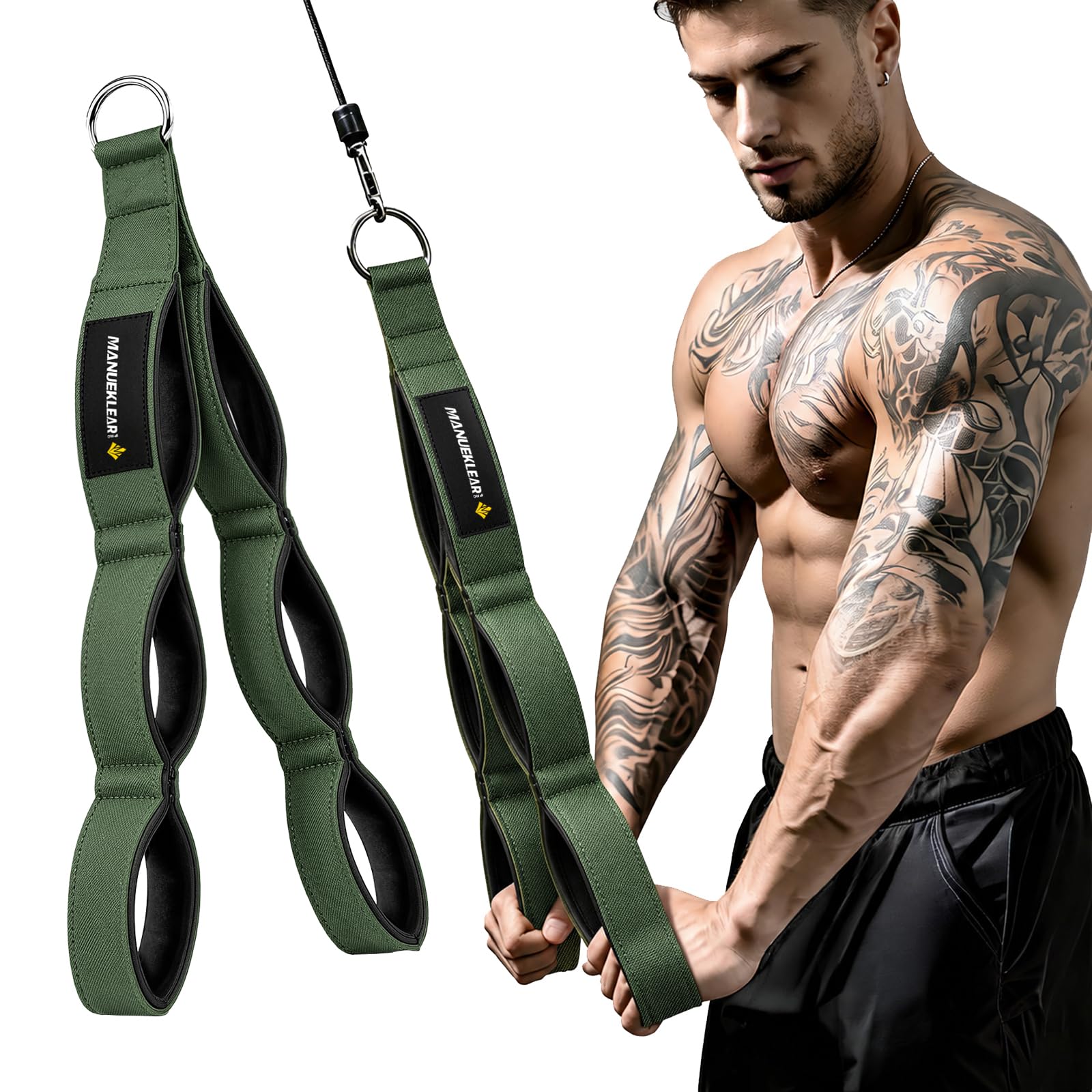
Three grip points sit at different heights on this attachment's 24-inch body, so you can hold it low, middle or high without unclipping. The handles are wrapped in neoprene, the body is nylon, and at 300 g it doesn't swing the cable around when you let go between sets.

Changing grip height changes the pull angle more than it sounds like it should. A low grip drives the movement behind you, a high grip brings it in front, and the long body lets you finish a pushdown further back than a standard rope allows. That extra range is the reason the attachment exists, and on triceps it's the difference between a squeeze at the bottom and a real stretch at the top.

The strap format is a genuine difference rather than a gimmick. A rope makes you squeeze two ends together for the whole set; here your hands press flat and your wrists stay neutral, which suits anyone whose elbows complain about a fixed grip. It does mean the feel is further from a classic rope than the photos suggest, so if you love that squeeze, keep a rope on the rack too.

This is the one we keep clipped on for triceps day. If your pushdowns have gone stale and you want a reason to add a set, the grips and the longer body give you one; if you just want a plain rope, the one in the Yes4All set does the job.

Bottom line: Our pick for anyone whose triceps work has gone stale: three grip heights and a long body that stretches the movement out further than a rope can.

#4

HPYGN Exercise Handles

HPYGN Exercise Handles

Replacing worn handles

Our Score 9.6/10
Check Price

Worth Noting

  • Foam grip is the first part to wear
Grip
Foam
Pack
2 handles
Material
Nylon
Read the full review

The handles that ship with most home cable systems are the first thing to give out, and swapping them is one of the cheapest upgrades in this guide. HPYGN's pair has a firm foam grip that fills the palm and stitching that feels sturdier than the originals; we stopped thinking about ours a set or two after clipping them in.

Size is what separates them from budget handles. These are closer to a commercial grip than the skinny ones on entry-level pulley sets, which makes pressing and rows feel more secure in the hand, and they work on bands and Pilates reformers as well as a cable stack. That range is why they earn their keep beyond a single machine.

Bottom line: Buy these the day a factory handle cracks: two firm foam grips that feel sturdier than the originals and work on cable stacks, bands and reformers.

#5

Gymreapers Ankle Straps

Gymreapers Ankle Straps

Leg day circuits

Our Score 9.6/10
Check Price

Worth Noting

  • Coating can peel with heavy use
Pack
Pair
Lining
Cotton
Hardware
Stainless steel rings
Material
Neoprene
Read the full review

Gymreapers sells these as a pair, and that's the whole argument: one strap on each ankle means you never have to move a strap between sides. The body is neoprene over a soft cotton lining, with stainless steel rings and a 10-inch cuff.

The pair saves the small interruption that breaks a rhythm — you finish your left-leg reps and the right strap is already waiting. On a kickback-and-abduction circuit that's worth more than it sounds. The lining is soft against the skin and the cuff is wide enough not to dig in, though the edge can rub over a long session, so wear them over socks.

Under load they stay put. The rings are separate from the cuff, so the clip rides at the top of the strap rather than dragging the whole thing sideways, and the padding holds its shape under a heavy stack instead of compressing into nothing.

Comfort, two clip points and a cuff that stays where you put it — for long glute sessions, that's the whole job. If you do three sets of kickbacks and move on, the DMoose single is the simpler buy.

Bottom line: For a leg day built on cables, this is the pair we hand people: two straps, two clip points, and no swapping between sides.

#6

Yes4All Single D Handle

Yes4All Single D Handle

Single-arm work

Our Score 9.6/10
Check Price

Worth Noting

  • Sold as one handle, not a pair
Grip
Textured chrome
Pack
Single
Material
Alloy steel
Handle Type
Closed D
Read the full review

The grip is knurled chrome over alloy steel, and the shape puts the load across your whole palm rather than into the middle of it. That's a small thing you notice by the twentieth rep of a triceps set, when a thinner or smoother handle starts to feel like a bar of soap.

The center is a rotating joint and it ships dry. A couple of drops of light oil and a few spins free it up, and after that it follows your wrist through curls and rows instead of dragging against it. That's a two-minute fix, and it's the difference between a handle you tolerate and one you reach for.

Rows, curls, triceps, anything where one hand pulls at a time and you want the load in line with your forearm — that's where it earns its keep. It's simple hardware done properly, and simple is what you want at the end of a cable.

Bottom line: A plain, solid D handle for single-arm work — we like the knurled chrome and the rotating center once it's been oiled.

#7

FITGIRL Ankle Strap

FITGIRL Ankle Strap

Budget glute work

Our Score 9.6/10
Check Price

Worth Noting

  • Closure wears before the strap body
Pack
Single
Color
Black mint
Padding
8 mm neoprene
Material
Neoprene
Read the full review

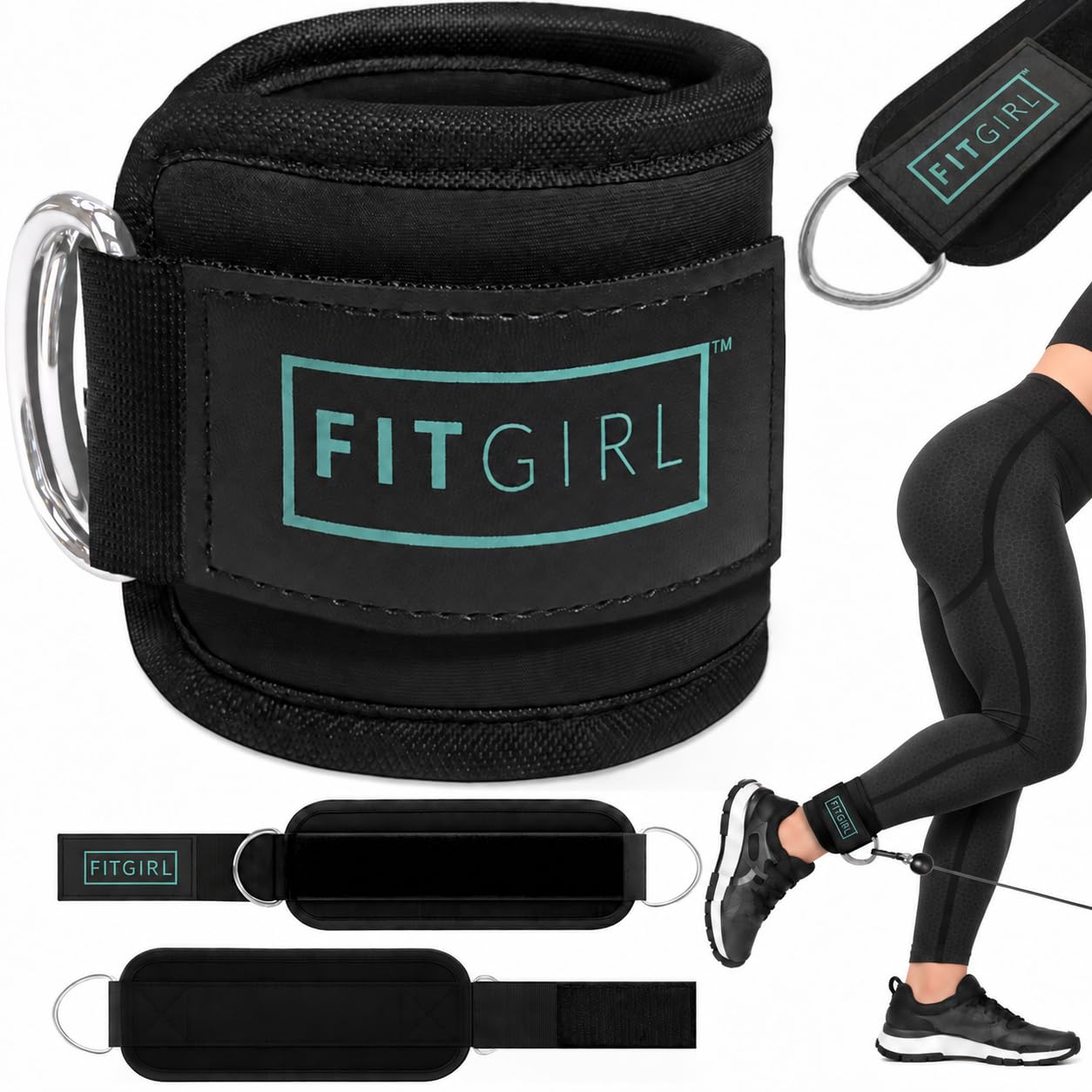
FITGIRL's strap is the one you notice first, and the colors are the point — this is the ankle strap people ask about across the gym floor. Underneath is a neoprene cuff with 8mm of padding, dual steel D-rings and a width that covers more of the ankle than either of the other straps here.

Padding is where it punches above its price. The cuff is soft, it doesn't bunch behind the heel, and the extra width keeps it from digging in during kickbacks. It also sits well on narrower ankles, which isn't true of every one-size cuff.

We point budget-first buyers here: it's the least expensive strap in this guide, the padding matches anything on the page, and it comes in colors you'll actually want on your ankle. For light-to-moderate cable work, that's enough.

Bottom line: The budget strap we point people to when padding and colors matter more than a closure built for years of heavy loading.

#8

DMoose Ankle Strap

DMoose Ankle Strap

Glute kickbacks

Our Score 9.4/10
Check Price

Worth Noting

  • No warranty stated
Pack
Single
Weight
4.23 oz
Padding
8 mm neoprene
Hardware
Dual D-rings
Read the full review

The cuff is the whole story with an ankle strap, and DMoose's is 8mm of neoprene around a 10-inch nylon body. That thickness spreads the pull across a wider patch of the ankle than thin webbing does, so kickbacks land on cushion rather than bone. At 120 g the strap disappears into a gym bag, and the twin D-rings give you two clip points instead of one.

We reach for this one on glute days precisely because of that second ring: the clip sits centered whichever side you hook, so the strap doesn't spin around your ankle mid-set. The closure holds through a full session without creeping, the padding doesn't bunch behind the heel, and it stays put during hip abductions as well as kickbacks.

It is, however, one strap. You'll unclip and move it between legs, which is a small annoyance on straight sets and a bigger one in a superset. The Gymreapers pair below exists for exactly that reason, and if your leg days run long, it's the better spend.

Bottom line: The ankle strap we reach for on glute days: thick padding, a closure that stays put and twin D-rings that keep the clip centered.

How We Tested Cable Machine Attachments

We started with a shortlist of more than 40 attachments sold for home and commercial cable machines, then filtered by clip compatibility, grip diameter, materials, and whether replacement parts were available. From that pool, we tested 14 pieces over four months — ropes, straight and curved bars, D-handles, ankle straps, and a few specialty handles — on a home functional trainer and a gym cable stack.

Each attachment went through the same weekly circuit: lat pulldowns, seated rows, triceps pressdowns, face pulls, and single-arm work, with some sets done bare-handed and some with lifting gloves. We clipped and unclipped them dozens of times, spun every swivel under light and heavy load, and noted whether movement felt smooth or caught halfway through a rep. For fit, we checked how cleanly each one connected to standard carabiners and cable ends, whether the grip suited different hand sizes, and whether straps cinched down without slack. Comfort got judged at the end of high-rep sets — hot spots, pinching, and grip fatigue mattered more than how a handle looked on the rack.

We also hung each piece from a carabiner and checked whether it sat level, measured from the center to each end, and loaded both sides to catch any pull to one side. Construction got a close look at welds, stitching, coating, and clip points, and we kept notes on fraying, rust, loosening swivels, and stretched straps as the months went on. To judge value, we asked whether the extra cost bought better hardware and cleaner finishing or just nicer packaging. And because no attachment suits every exercise, we scored suitability by movement: ropes for pressdowns and face pulls, bars for rows and pulldowns, handles and straps for unilateral work.

How to Choose Cable Machine Attachments

Start with the lifts you already do

Every attachment buys a specific movement: a rope for pushdowns and face pulls, a straight bar for curls and pressdowns, a V bar or row handle for pulling, a D handle for single-arm work, a strap for glutes and hamstrings. If you're starting from nothing, a set covers the most ground for the money, and the Yes4All combo handles rope-and-bar work in one box.

If your program is already built around legs, spend the whole budget on a good ankle strap instead. Buying three attachments you won't use is the most common way this purchase goes wrong.

Read the load rating, then look at the hardware

Ratings across these picks run from 400 lb on the Fitarc row handle to 880 lb on the Yes4All set, and every one of them is the maker's own figure rather than an independent certification. For a home stack, capacity is rarely the limit.

What fails first is the stitching, the clip and the swivel. Look at how the ring is attached, whether the stitching is doubled, and whether the carabiner feels like pot metal. A high rating on a weak clip buys you nothing.

Grip and padding where you load it

Handles come in knurled chrome, molded rubber and foam. Chrome bites hardest and lasts, rubber holds when your hands are wet, and foam is kindest on the palms but flattens first. If you train bare-handed and often, foam is a comfort purchase you'll repeat.

On ankle straps, thickness and width do the work. Eight millimeters of neoprene across a wide cuff spreads the pull; a narrow strap digs in on heavy kickbacks. Check the cuff width before the color.

Swivels, brackets and clips

A fixed bracket turns a rope into a lever that pulls harder on one side; a swivel eyelet lets the attachment follow your wrist. That's the practical difference between the rope in the Yes4All set, which runs through a fixed chrome bracket, and the Fitarc handle's 360-degree eyelet.

For pressing and rowing, the swivel is worth paying for. For pushdowns it matters less than the length of the attachment and the grip, which is why we still recommend the plain rope.

One or two, and what rides in your bag

Ankle straps come singly and in pairs. One is fine if you do three sets of kickbacks and move on; a pair stops the unclipping between legs that eats a superset. Packed weight matters if you carry your kit: the Fitarc handle is under 2 lb, the Yes4All set is over 10 lb, and a strap is lighter than either.

Buy for the bag you actually carry. A set that stays in the garage is a good set; a set you resent lugging is not.

Frequently Asked Questions

Final Verdict

Start with the Yes4All three-piece set. It's the fastest way to make a single pulley do real upper-body work, the steel is good enough that you'll stop thinking about upgrading, and nothing in the box feels like the weak link.

If your training is glute-and-leg focused, skip the set and put the budget into the DMoose strap instead, adding the Gymreapers pair when you want one on each ankle. For triceps and single-arm work, the MANUEKLEAR rope and the Fitarc row handle are the two that earn their space in a gym bag.