Strength & Weights

Best Barbells for Women of 2026

A barbell is a steel bar with a number attached to it, and that number — the shaft diameter — decides almost everything else. Twenty-eight or twenty-nine millimeters is the default, which is fine if the bar disappears into a big hand and miserable if it doesn't: too thick a shaft turns a hook grip into a pinch and makes every pull feel heavier than it actually is. Plenty of women spend their first years lifting around a bar that was never sized for them. The right one doesn't make lifting easy; it just stops being the thing you have to fight.

Over the past eight months, my team and I have lifted on 10 bars built with women in mind, from 25mm training bars to dual-marked 20-kilo bars that survive a real squat program. Here's what nobody tells you first: a lighter bar isn't automatically a beginner's bar, and the stated weight rating is rarely what fails first — the finish, the knurling, and the sleeve spin go long before the steel does. We watched all three closely. What follows is what we'd genuinely put in our own racks.

#1

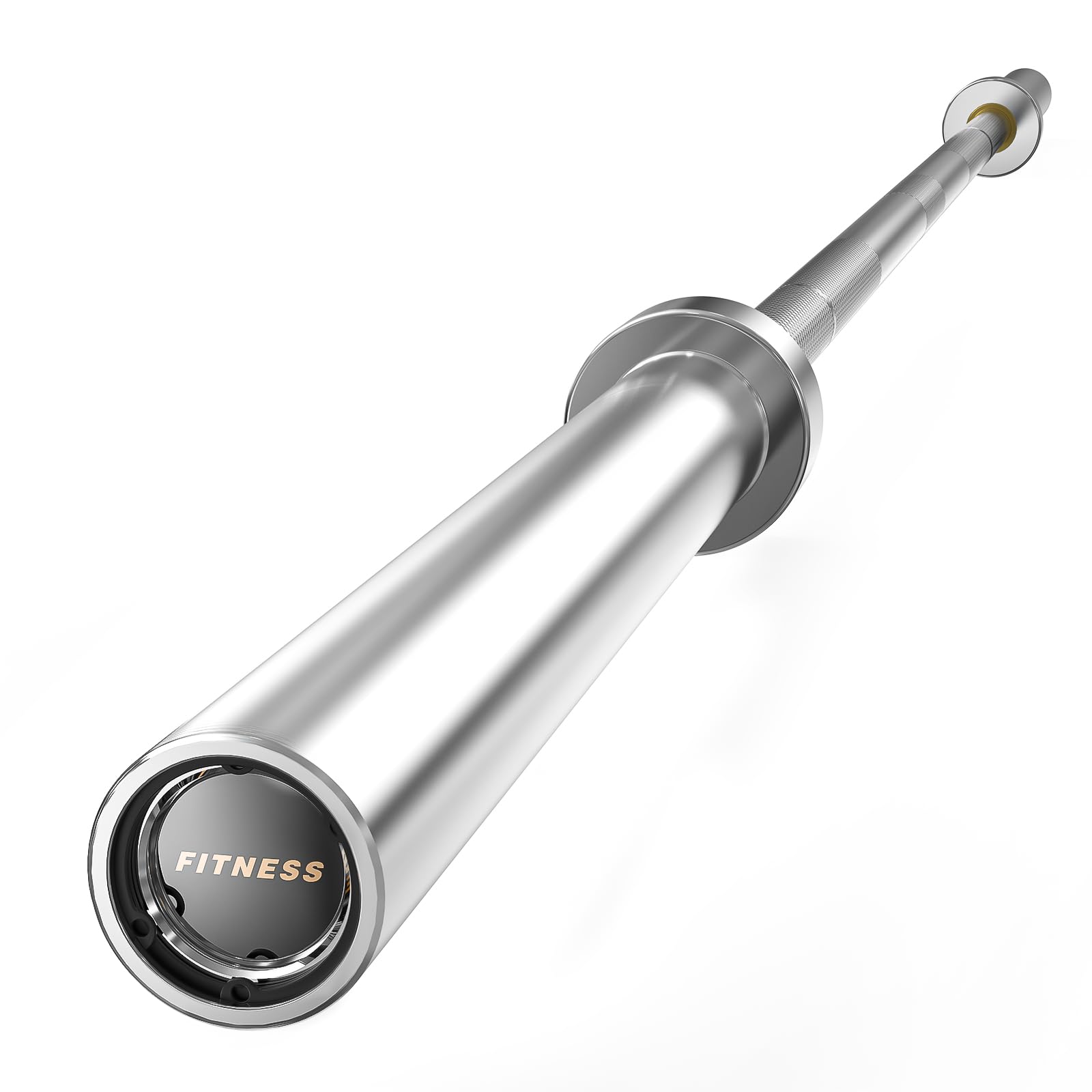
PAPABABE 7 ft Olympic Barbell

Top Pick
PAPABABE 7 ft Olympic Barbell

Rack lifting

Our Score 9.6/10
Check Price

Worth Noting

  • 30 mm shaft is thick for smaller hands
Bar Weight
45 lb
Shaft Length
51.57 in
Shaft Diameter
30 mm
Weight Capacity
1000 lb
Read the full review

If your plan involves a squat stand and a long road to a 300 lb deadlift, the short bars here stop being options and this one starts. The PAPABABE is 86 in overall with a 51.57 in shaft, which is the length that actually sits in a full-size power cage, and it's built around 190,000 PSI steel with a 1000 lb rating behind it.

This is the bar in this group we trust with a heavy squat. It's stiff, it doesn't whip the way a thin shaft does out of the hole, and the hybrid needle-bearing and bushing sleeves turn smoothly when you're pulling from the floor. The 45 lb starting weight is the other side of that: it is a load before you've touched a plate, and overhead press day will remind you. That's the bargain a full-size bar makes, and most lifters make peace with it inside a month.

Where it costs you is in the hands. Thirty millimeters is the thickest shaft in this guide, two more than the Olympic standard and five more than a women's bar, and if your grip runs small you'll feel that over a long set rather than a single rep. What it buys is stability under load and a bar that isn't going anywhere. When yours arrives, spin both sleeves and check for end play before you load it, and wipe the chrome down if your gym runs humid.

Bottom line: For a garage rack and years of heavy squats and pulls, this is the bar we point strong lifters to, provided a 30 mm shaft suits your hands.

#2

RitFit Olympic Barbell 4 ft

RitFit Olympic Barbell 4 ft

Small hands

Our Score 9.6/10
Check Price

Worth Noting

  • Too short to rack across a power cage
Bar Weight
20 lb
Overall Length
4 ft
Shaft Diameter
25 mm
Weight Capacity
350 lb
Read the full review

Twenty-five millimeters is the diameter of a dedicated women's bar, and the RitFit is the only one here that has it. You notice it the moment you close your hand: fingers wrap further, hook grip sets faster, and a set of rows stops being a forearm test. For anyone whose hands have never felt right on a standard Olympic bar, this is the one to try first.

At 20 lb it's light enough to press and to hold overhead while you learn the movement, and the 350 lb capacity is more than most home lifters will load on a four-foot bar. The needle bearings spin cleanly, the oxide finish has held up, and RitFit warrants it against bending for life, which is a real promise on a bar this short. It also comes in pink, and after a page of black and chrome that is a genuinely pleasant change.

The limit is the length. At 47.2 in it won't span a power cage, so rack squats and rack bench are out; think hip thrusts, RDLs, landmine work and floor presses instead. Treated as the bar you keep beside the rack rather than in it, it's excellent value. The one check we make on any short bar is the scale, and it's worth confirming the weight before you start loading it, since short bars vary more than full-size ones.

Bottom line: If your hands are small enough that a fat shaft is a real problem, this is the bar to buy, because nothing else here comes as close to a genuine women's bar.

#3

LIONSCOOL 4 ft Olympic Barbell

LIONSCOOL 4 ft Olympic Barbell

Hip thrusts

Our Score 9.6/10
Check Price

Worth Noting

  • No knurl marks to line up your grip
Bar Weight
20 lb
Center Knurl
None
Shaft Diameter
28 mm
Weight Capacity
500 lb
Read the full review

There's no center knurl on the LIONSCOOL, and if you've ever done hip thrusts with a bar that has one, you already know why that earns a mention. The 1.5 mm diamond pattern is trimmed across the top of each diamond, so it grips without the cheese-grater feel, and the bare middle of the shaft sits comfortably across your hips or your collarbone in a front rack.

At 20 lb and 28 mm it's far friendlier than a seven-foot, 45 lb bar, and its 500 lb rating is the highest of the four-foot bars in this group, so accessory work will never run it out of capacity. Extra-thick brass bushings and bearings give it a smooth, quiet spin, and the 9.5 in sleeves swallow a full stack of plates without feeling crowded. We keep reaching for it on hip thrust day because the bar simply never digs in.

Two things to know. The 47.2 in overall length means it lives on the floor rather than in a rack, same as the RitFit. And with no knurl marks anywhere on the shaft, there's nothing to line your hands up against on the bench, so you'll either develop a feel for the spacing or put a strip of tape where your index finger belongs.

Bottom line: For hip thrusts, front rack work and anything where a center knurl would dig in, this is the bar we hand people first.

#4

CAP Olympic Barbell 5 ft

CAP Olympic Barbell 5 ft

First barbell

Our Score 9.2/10
Check Price

Worth Noting

  • E-coat scuffs and flakes at contact points
Bar Weight
25 lb
Overall Length
5 ft
Shaft Diameter
28 mm
Weight Capacity
500 lb
Read the full review

Twenty-five pounds is the number that settled this one for us. A 45 lb bar is a commitment before you've added a single plate, and the 15 lb bars here trade away stiffness to get that light. The CAP 5 ft sits in the useful middle: you can press it, row it and clean it while you're still learning, and the 500 lb rating means you won't be shopping again after your first serious year of training. That balance is why it's our top pick for most women building a first home gym.

The shaft is 28 mm, the standard Olympic diameter rather than the 25 mm of a dedicated women's bar. In the hand that's a small difference, though if your hands are narrow or you're learning to hook grip, the RitFit below is the one to look at first. What we appreciated on the CAP is the knurling: a hill-style pattern with a rounded profile, mild enough for high-rep rows without tearing up your palms and still secure once you add chalk. The bronze bushings turn smoothly, and the bar feels solid rather than hollow at lockout.

Storage is easier than we expected at this length. It stands upright in a corner or hangs on two wall hooks, which is more than we can say for the seven-foot bars in this guide. The thing to check before ordering is your rack, because the bar is 60 in overall and spans less than a full-width power cage; measure the distance between your J-cups and compare before you count on racking it. Ours lives against the wall and comes out on pressing days, which tells you most of what you need to know.

Bottom line: Our pick for most women: light enough to press from day one, rated to 500 lb for the years after, and short enough to live in a spare room.

#5

Rage Fitness Training Barbell 6 ft

Rage Fitness Training Barbell 6 ft

Learning technique

Our Score 9.2/10
Check Price

Worth Noting

  • Aluminum shaft can bend under moderate loads
Material
Aluminum
Bar Weight
15 lb
Shaft Diameter
28 mm
Weight Capacity
300 lb
Read the full review

Fifteen pounds of aluminum is an odd thing to call a barbell, and we won't pretend otherwise: this is a bar for learning positions, not for loading. Where it earns its place is the length. Six feet gives you the hand spacing of a real bar, so the squat, hinge and press you rehearse here transfer directly when you move to a 45 lb bar, which is more than a shorter bar can offer.

The knurl is the aggressive 1.5 mm diamond pattern and it does not slide, exactly what you want while drilling a movement slowly. It also fits an Olympic rack, which is unusual at this weight, so you can practise in the same position you'll eventually squat in. Beginners and anyone returning from injury get real use out of it, and it pairs well with a heavier bar rather than replacing one.

The aluminum shaft is the catch. Load it past roughly a hundred pounds and it can take a set that never comes out, so treat that as your working ceiling rather than the 300 lb on the label. For warm-ups, tempo work and teaching a friend to hinge, none of that matters. Just don't buy it as your only bar, because the day you squat your bodyweight you'll want steel in your hands.

Bottom line: A genuinely useful teaching tool: six feet of real hand spacing at 15 lb, for the months before the weights get serious.

#6

LAVVON 57 in Olympic Barbell

LAVVON 57 in Olympic Barbell

Tight budgets

Our Score 9.0/10
Check Price

Worth Noting

  • Tight fit in some bench press racks
Plate Fit
2-inch Olympic
Bar Weight
12 lb
Overall Length
57 in
Weight Capacity
500 lb
Read the full review

Fifty-seven inches with 2-inch sleeves makes this the shortest bar here that still takes the plates you'd buy for a full-size bar. If your training space is a corner of a basement and your lifts are rows, curls, hip thrusts and the occasional light bench, the length stops being a compromise and starts being the point.

At a listed 12 lb it's light enough to press overhead for high reps, and the needle bearings give the sleeves a smooth turn for a bar in this bracket. We were also impressed by the small things: the spring collars hold, the knurl is comfortable rather than sharp, and the two-year warranty runs longer than most at this level. It's the cheapest route into Olympic plates in this guide, and it doesn't feel like a toy.

What you give up is length. Fifty-seven inches is a tight squeeze in some bench press racks, so measure the spacing of your uprights before you order and keep the packaging until you've tried it in place. The other arrival check is sleeve play, since the ends can have a little movement; give each one a shake and a spin. Set against that, the bar lifts smoothly and without drama at the loads it's built for.

Bottom line: The least expensive way into Olympic-plate lifting here, and a reasonable one for light training in a room with no space for a seven-foot bar.

How We Tested the Best Barbells for Women

We started with spec sheets, filtering for shaft diameter between 25 and 28mm, bar weight in the 15-kilo and 20-kilo range, dual knurl marks, loadable sleeve length, and a documented tensile strength — then cut anything that only came in one configuration or had no stated rating at all. That left 10 bars, and we've been living with them for eight months across a garage gym, a low-ceilinged basement setup, and one commercial floor where the bars get handled by everyone.

Grip and fit got measured before they got judged. I ran calipers across each shaft above and below the knurl, then had lifters with noticeably different hand sizes pull with bare hands, with chalk, and in a hook grip, reporting whether the thumb wrapped and whether the knurl bit into the palm or faded out by rep eight. Every bar went on a shipping scale to check its real weight against the claimed one, and we loaded plates and collars to see how much sleeve was actually usable. Functionality came down to spin: we counted rotations on an empty sleeve, then repeated it loaded, and noted which bars seized up after a few weeks of chalk dust.

Sturdiness and durability took the longest to judge. We dropped each bar from overhead onto rubber mats, checked it against a straight edge on the floor afterward, and watched the finish where it contacts the rack and where hands sit. Value for money wasn't about the sticker — it was which bars still looked and felt new after eight months and which had oxidized or worn smooth at the knurl. On weight capacity, every bar we kept was rated well beyond anything our strongest tester pulls, so the real test was whether it stayed straight under repeated heavy singles.

How to Choose Barbells for Women

Shaft diameter is the number you feel every rep

A dedicated women's bar uses a 25 mm shaft and weighs 15 kg. Nothing in this guide is exactly that, so you're picking the closest compromise. A 25 mm shaft, like the RitFit's, lets smaller hands close properly around the bar and makes hook grip far easier to set. The 28 mm shaft on the CAP and LIONSCOOL is the Olympic standard and suits most people. A 30 mm shaft, like the PAPABABE's, is a fat grip: stable under a heavy squat and noticeably harder to hold for a long set.

One caution: diameter tells you the shape, not the stiffness. A thin bar made of aluminum bends; a 28 mm bar of good steel doesn't. We put shaft diameter first, then check what the bar is actually made of before anything else.

Bar weight, and the ceiling above it

The lighter the bar, the easier your first year and the sooner you'll want something else. A 15 to 20 lb bar lets you press and hold positions with no plates at all, which is exactly why the RitFit and the Rage bar exist. A 25 lb bar like the CAP is still light enough to press but heavy enough to feel like a barbell. Forty-five pounds is a real load before you add a plate, and that's the price of a full-size bar.

Pick the lightest bar whose rating clears what you hope to lift in two years, then check the material. We treat any sub-20 lb aluminum bar as a teaching tool, whatever the capacity on the label says.

Length, storage, and the rack measurement nobody takes

Compact in a listing means it fits your room, not your rack. A four-foot bar is about 47 in overall, and a typical power cage spaces its J-cups somewhere around 47 to 50 in apart, so a four-foot bar often won't span them and ends up living on the floor. Five feet, or 60 in, clears more racks but not all of them. Seven feet fits everything and asks for the space to show for it.

Measure the distance between your uprights, compare it with the bar's overall length, and let that decide before color or finish gets a vote. This is the one check that turns a good bar into a frustrating purchase.

Knurling, center knurl, and what the finish has to survive

Knurl depth is a comfort decision. A 1.5 mm diamond pattern gives a secure hold, while a milder rounded knurl is kinder on high-rep work. A center knurl helps a back squat stay put and is miserable against bare skin in a front rack or a hip thrust, which is why the LIONSCOOL and the RitFit leave it off entirely.

Finish is a maintenance decision. Chrome resists humidity best, while oxide and E-coat show wear where the bar meets the rack and where plates slide on. If your gym is a garage, that difference will show up within a season.

Frequently Asked Questions

Final Verdict

Buy the CAP 5 ft if you want one bar to learn on and keep. Twenty-five pounds is light enough to press on day one, 500 lb of capacity means you won't be shopping again when the weights get real, and five feet stores against a wall.

If you already own a rack and plan to squat and pull heavy, step up to the PAPABABE 7 ft instead: its 51.57 in shaft spans a full cage, and the thick 30 mm grip is the one thing to think twice about. Small hands and a small room point to the RitFit.