Shoes & Apparel

Best Boxing Shoes of 2026

I spent my first year of boxing training in running shoes, and my feet paid for it: too much cushion under the arch, a heel that caught on every pivot, laces loose by round two. A real boxing shoe sits low and flat, locks your heel down, and lets you roll off the ball of your foot instead of clomping onto it. You feel the difference in the first jump-rope warmup.

The catch is that sizing in this category is genuinely inconsistent — a few of the pairs we tried ran a half size small, and a mid-top never fits quite like a low. My team and I have spent six months in 12 pairs, working them through bag rounds, mitt work, jump rope, and live rounds on gym floors that ranged from sticky to slick, with an eye on arch support, grip, and how the uppers held up after weeks of pivoting.

One thing worth knowing before you buy: mid-tops give you ankle coverage but stay stiff until they break in, while low-tops breathe better and suit faster footwork. Every pick below earned its spot on comfort and value first — looks and weight were tiebreakers, never the reason.

#1

Everlast Elite V2

Top Pick
Everlast Elite V2

All-around training

Our Score 9.2/10
Check Price

Worth Noting

  • Toe seam can lift early on some pairs
Cut
High-top
Weight
Lightweight
Outsole
Flat, grippy rubber
Read the full review

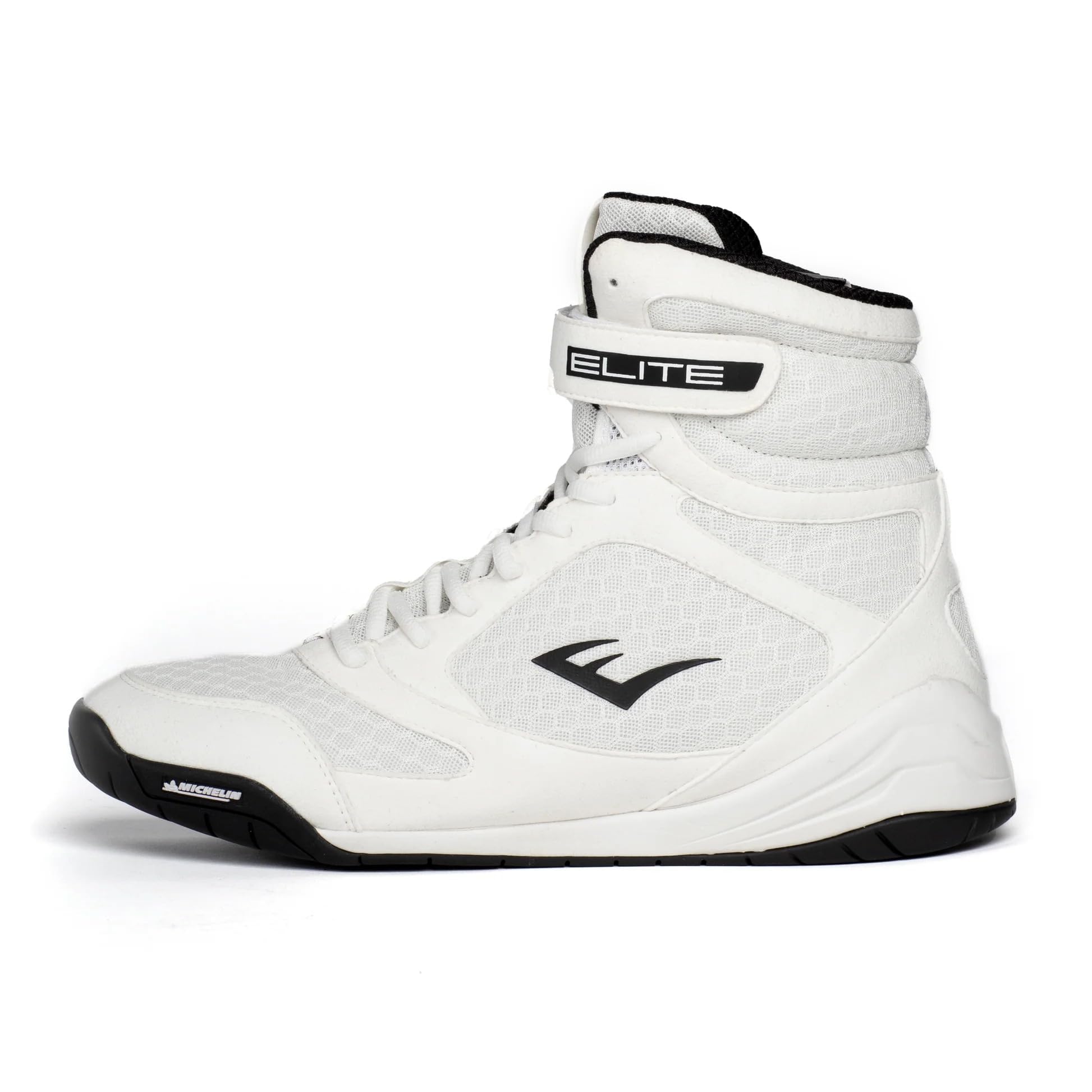
The Elite V2 is the steadiest shoe in this group, and the reason shows up where it matters once you start moving: the ankle. The high-top collar holds the joint through pivots and lateral steps, and the flat sole stays planted instead of loading you onto your toes. We noticed it most in drills that ask you to change direction on a dime — the foot plants, the ankle stays, and you move.

Fit is the quieter advantage. The shoe runs true for most feet, snug through the midfoot with just enough room at the toe to spread on a jab, and the heel sits deep in a cup that stops it sliding on hard stops. It is light without feeling flimsy, which is the balance you want across six rounds of bag work. On price it sits in the middle of this group: more than the budget pairs, well under the premium one.

The wear point to watch is the seam where the toe cap meets the sole; on some pairs it starts to lift early, which is worth checking before you commit to this as a single competition-season shoe. The collar also takes a few sessions to soften against the ankle bone. Neither is unusual for a boxing shoe, and neither knocked it off the top of the list.

Bottom line: We think the Elite V2 is the safest first choice here: steady ankle support, a flat grippy sole, and a fit most feet get right without sizing games.

#2

TITLE Speed-Flex Encore

TITLE Speed-Flex Encore

Wide feet

Our Score 9.0/10
Check Price

Worth Noting

  • Sizing runs short for some feet
Cut
Mid-top
Weight
Lightweight
Closure
Lace-up
Read the full review

It costs roughly half what our top pick does, and on the basics it gives up very little: a flat sole, a mid-top collar that covers the ankle without becoming a boot, and a build light enough that you stop noticing it during rope work. The toe box is the real selling point. Most boxing shoes run narrow, and this one has room across the forefoot, which is why it is the pair we name first when someone with wide feet asks what to buy.

The friction is the lacing. The upper runs high and the eyelets sit close together, so getting in and out is a project, and the fix is to loosen the top two rows every time rather than fighting the shoe. Do that and it goes on fine. The value math is what settles it for us: two pairs of these cost about what one premium shoe does, and for a first or second pair that is the arithmetic that matters.

Durability is the honest catch. The soles on some pairs start to separate within months of regular work, which makes this a shoe to buy as a replaceable training pair rather than a long-term one. At this end of the price range that is a trade most people can live with — just do not make it the only pair you own going into a competition.

Bottom line: We like this one for budget-minded boxers with wide feet: a flat, light, mid-top shoe that costs about half what our top pick does.

#3

Venum Elite

Venum Elite

Ground feel

Our Score 8.8/10
Check Price

Worth Noting

  • Runs big, so size down
  • Sole can separate from the upper
Cut
High-top
Closure
Lace-up
Outsole
Rubber, multi-directional tread
Cushioning
Minimal
Read the full review

The Venum Elite runs big — generous through the instep and long enough that most people land better a half size down than at their usual number. Get past that and you have the most technical shoe in this group: a faux leather and mesh upper, a rubber outsole cut with multi-directional tread for pivots and lateral pushes, and a padded high-top collar that stabilizes the ankle through fast changes of direction.

The cushioning is deliberately minimal, and that is the point rather than a shortcoming. You feel the floor through the forefoot, which is what you want when you are judging distance and driving off the back foot; there is no soft layer soaking up the response you need for a sharp step-in. It is also the sharpest-looking shoe here, with colorways that hold up outside the gym.

Two things temper it. The outsole is the wear point — the bond between sole and upper separates on some pairs, and at this price that is a real risk to weigh. The snug forefoot is the other: a wide foot will feel the edges after a few rounds. Boxers who work off feel will still find the response worth it, and the trade is easy to accept if you keep a tougher pair for heavy bag days.

Bottom line: Choose the Venum Elite if you want the most ground feel and ankle coverage in this group and you are willing to order a half size down.

#4

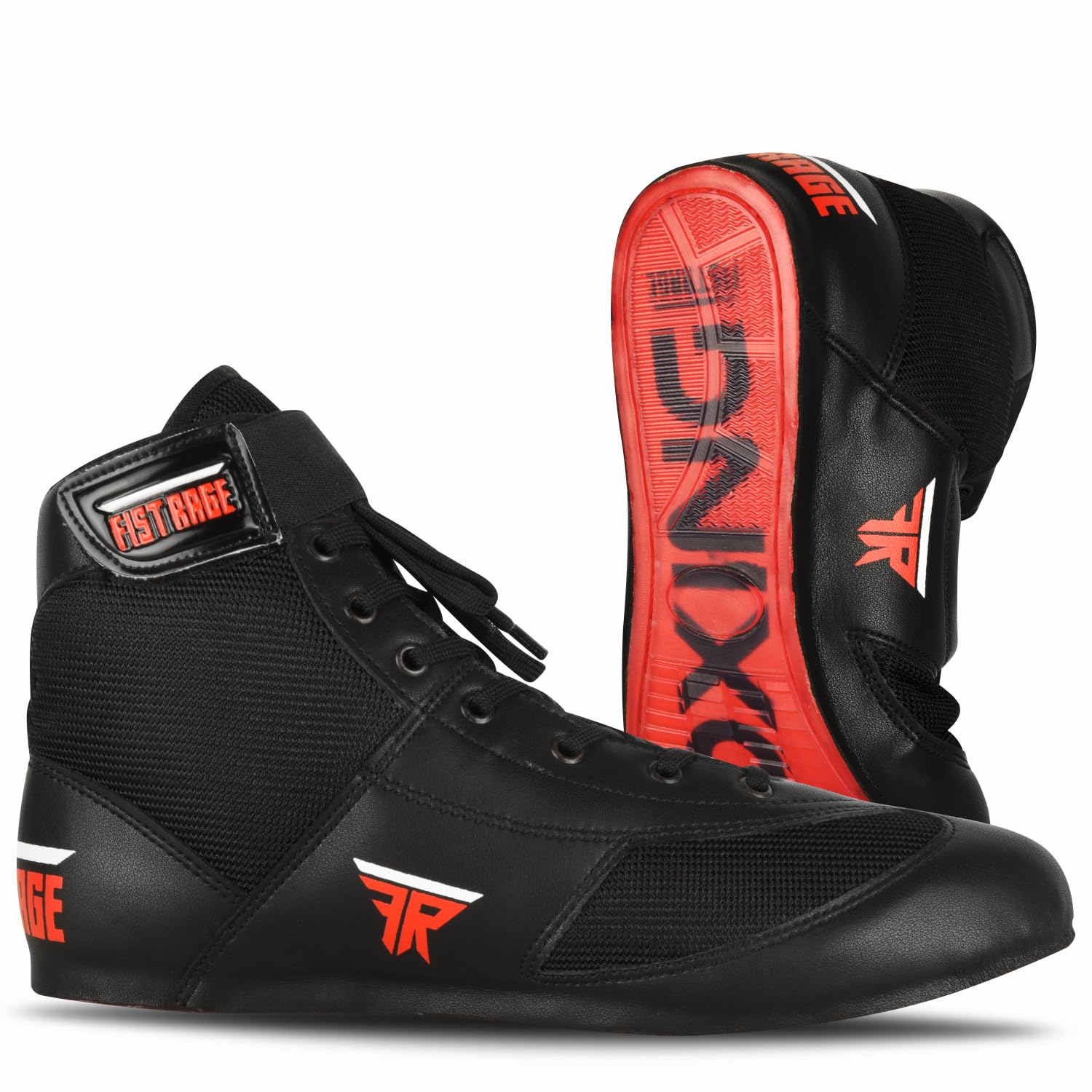
FISTRAGE Leather Boxing Shoes

FISTRAGE Leather Boxing Shoes

Beginners

Our Score 8.8/10
Check Price

Worth Noting

  • Narrow across the forefoot
  • Tongue and laces wear out early
Upper
Leather and mesh
Weight
Lightweight
Closure
Lace-up
Read the full review

If you are a few weeks into a beginner class and not ready to spend real money on footwear, this is the pair that gets you onto the mat. The leather and mesh upper breathes, the shoe is light enough to jump rope in, and it does the one thing a boxing shoe has to do — a flat, grippy sole that lets you pivot without skating.

What surprised us at this price is how much of the basics it covers; what did not surprise us is where it cuts corners. The tongue is the weak point, sometimes letting go within a couple of weeks of regular wear, and the laces are short enough that a spare set is worth buying with the shoes. Neither is a reason to skip it as a first pair — beginners spend months on stance and footwork patterns that do not ask much of a sole — but it is a shoe to wear out and replace.

The narrow forefoot is the bigger catch: even at your usual size, this one pinches across the ball of the foot for anyone with a wide stance. Buy it as a training tool for your first year rather than the pair you compete in, and it does its job.

Bottom line: The FISTRAGE is our pick for a first pair on a tight budget, as long as your feet are not wide and you treat it as a shoe to wear out, not keep.

How We Tested the Best Boxing Shoes

We built a shortlist of roughly 40 pairs sold in the U.S., narrowing on the things people actually ask about — a sole thin enough to feel the floor, sizing that runs close to true, and a price that makes sense for someone training a few nights a week. From there we cut it to 12 based on materials, closure style, ventilation, and whether the shoe came in a range of sizes wide enough to fit different feet.

Each pair went into my regular rotation for six months: Tuesday night bag classes, Saturday morning jump-rope and mitt work, open sparring, and a concrete-floored garage gym on the nights I couldn't make it to the club. I weighed every pair on a kitchen scale, then wore each one for full two-hour sessions in thin socks and thick socks to see how much room the toe box left and whether the arch was actually supported or just padded. On hardwood and on rubber mats, I ran three-minute jump-rope rounds to see which soles held their grip through a pivot and which laces came untied.

After each session I checked the seams at the toe and heel, since dragging the rear foot through a turn is what kills these shoes fastest, and I watched for cracked uppers or a flattened midsole by the second month. I noted how long each pair took to get on and off — some of the mid-tops needed two hands and a good minute — and whether the ankle collar softened or stayed rigid after a few sessions. Living with them that long also told us which ones still looked presentable after a dozen rounds, because value here isn't the sticker, it's whether the shoe survives a full season.

How to Choose Boxing Shoes

Start With the Sole, Not the Cushioning

The outsole is where a boxing shoe earns its money. You want a thin, flat rubber sole with tread that runs in several directions, so the ball of your foot can pivot on canvas or resin without catching and rolling your ankle. Thick, cushioned running soles are actively wrong here: they lift the heel and let the foot tip sideways mid-pivot. The Venum Elite is the clearest expression of the idea in this group, with minimal cushioning and a multi-directional tread; the Everlast and the TITLE both keep the sole flat and low to the floor. If a shoe feels like a trainer underfoot, it will move like one.

Match the Cut to Your Ankles

Low, mid, and high describe how much shoe wraps the joint, and it is a genuine trade. A high-top like the Everlast or the Venum adds lateral stability for pivots and cuts, which matters if you have rolled an ankle before or you are sparring regularly. A mid-top like the TITLE leaves you a little freer while still covering the joint. Height alone is not protection — a padded collar that fits snugly does more than a tall one that gaps — so lace up, press the sides of the collar against your ankle, and see whether it grips or floats.

Fit the Midfoot, Not the Length

A boxing shoe should feel snug through the arch and instep with about a thumbnail of room at the toe. Sizing is inconsistent enough across these brands that your everyday sneaker size is a starting point, not an answer: the TITLE runs short for some feet, the Venum runs big, and the FISTRAGE pinches across the forefoot. Lace the heel back into the counter and check that your toes do not slide forward when you push off. If you have a wide forefoot, start with the TITLE, which has the roomiest toe box of the group.

Know What the Extra Money Buys

Spending more mostly buys materials and construction rather than a longer life. The premium end of this group moves up to faux leather and mesh uppers, a molded rubber outsole, and padded collars that hold their shape past the first month; budget pairs use simpler uppers and a plainer sole. That difference shows up in how the shoe hugs your foot late in a session, not on the label. Buy the construction that suits your foot and your budget — an inexpensive flat-soled shoe beats an expensive one that fits badly.

Frequently Asked Questions

Final Verdict

The Everlast Elite V2 is the steadiest all-arounder on this page: an ankle collar that holds through pivots, a flat sole that keeps you connected to the floor, and a fit most feet get right the first time. If the price is a stretch, the TITLE Speed-Flex Encore covers the same ground for about half, with a roomier toe box and a lacing ritual you will get used to.

Go to the Venum Elite only if ground feel matters more to you than cushioning and you are prepared to size down; take the FISTRAGE if you are buying your first pair and expect to replace it once you know what you like.