Shoes & Apparel

Best Walking Shoes for Men of 2026

Every walking shoe feels fine on the carpet in the store. The verdict comes later — three miles into a dog walk, halfway down an airport concourse, on hour six of standing on concrete. What separates the pair you wear daily from the one that ends up by the back door is a pile of small things: whether the cushioning is still there past mile two, whether the heel actually locks your foot down, and whether the shoe looks reasonable with jeans, since most of us aren't changing footwear between errands and dinner.

I've had a dozen pairs of men's walking shoes in rotation for the past six months, worn on the same three-mile loop, on work trips, and through more grocery-store floors than I'd like to admit. Some broke down fast, a few took a week of break-in before they stopped biting, and a couple of genuinely lightweight pairs outlasted heavier ones I'd assumed would win. The picks below are the ones I kept reaching for without thinking about it.

#1

Skechers Go Walk Max Effort

Top Pick
Skechers Go Walk Max Effort

Short daily walks

Our Score 9.2/10
Check Price

Worth Noting

  • Little arch support for long days
  • Foam and outsole wear faster than the upper
Entry
Slip-on
Upper
Breathable mesh
Insole
Memory foam
Read the full review

This is the least expensive shoe in the group, and it's also the one that disappears on your foot. The mesh upper is thin and airy, the pair weighs next to nothing, and they slide on without a fight. For dog walks, errands, and a shift spent standing on a hard floor, that combination does more than a lot of technical features do.

What surprised us is how much softness Skechers gets out of a shoe at this price. It's a pillowy, sink-in ride — the thing people mean when they talk about walking on a pillow — and on a hot day the mesh keeps your feet from cooking. We came away thinking of it as the pair for a man who wants comfortable, uncomplicated shoes and doesn't want to think about them again.

The outsole curves up around the sides, which is a big part of why the heel-to-toe roll feels so easy. It's also why these are pavement shoes. On gravel, wet grass, or a rutted path that curve lets the shoe tip sideways under you, and the thin upper does nothing to hold your foot when it does. Keep them on sidewalks, store floors, and the treadmill, and they're happy.

Bottom line: Buy these if you want a light, soft, inexpensive walking shoe for short daily walks and long shifts on your feet — just don't expect much arch support.
#2

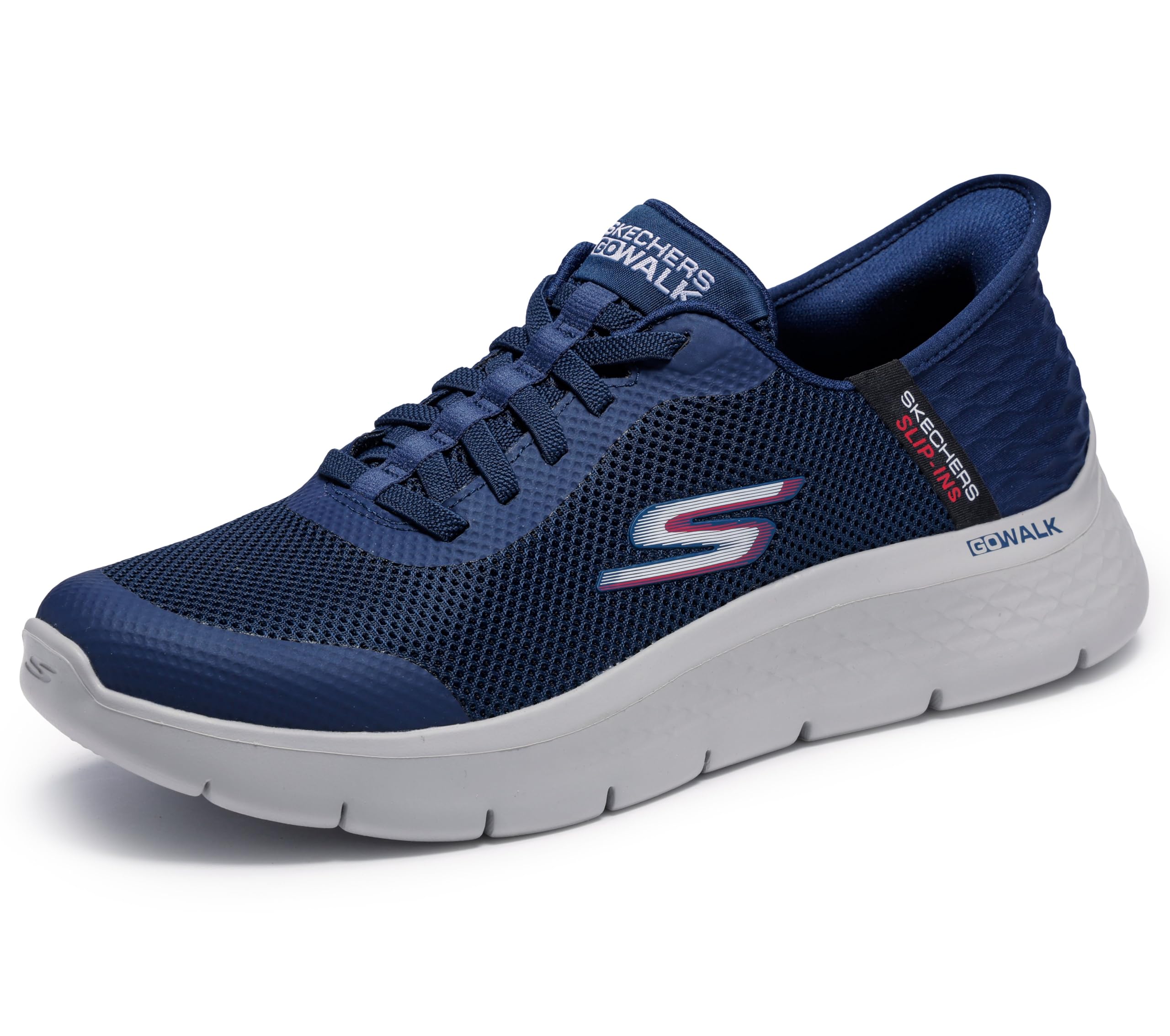
Skechers Slip-Ins Go Walk Flex Hands Up

Skechers Slip-Ins Go Walk Flex Hands Up

Hands-free entry

Our Score 9.2/10
Check Price

Worth Noting

  • Runs narrow for wider feet
  • Soles and insoles wear within months
Entry
Step-in, no hands
Laces
Lace-up look, nothing to tie
Model
216324WWBRN
Read the full review

You come through the door with an armload of groceries, step down into these, and the shoe closes around your heel without a hand involved. That's the whole idea, and it works: no bending, no laces, no leaving one shoe half-on because you couldn't be bothered. Anyone with a bad back, sore hands, or a house where shoes come off at the door will get more out of that than out of any cushioning upgrade on this page.

Underfoot they're light and flexible, and they have more arch support than a slip-on has any right to — enough that a long day on your feet doesn't leave you hunting for a chair. There's no break-in period either; they were comfortable on the first walk, which is not something we can say for every pick here.

Wear them with thin socks or none: a thick sock bunches at the heel and fights the step-in. From across the room they look like a lace-up, which is the point — there's nothing to tie and nothing to come undone, but they read tidier than a running shoe with jeans. That makes them the one pair here that works for a casual office as well as a walk.

Bottom line: The pair to buy if tying shoes has become a chore: step in hands-free, walk all day with real arch support, and skip the break-in entirely.

#3

Hoka Men's Bondi 9

Hoka Men's Bondi 9

All-day walking

Our Score 9.0/10
Check Price

Worth Noting

  • Costs more than every other pick here
Sizes
Standard and wide
Toe Box
Wide and roomy
Cushioning
Max-cushion EVA foam
Read the full review

The Bondi 9 is the most cushioned shoe in this group, and that one fact explains most of what follows. Stand in a pair and you can feel how much foam sits between your heel and the floor; walk a mile on concrete and the point stops being abstract, because the shoe takes the surface instead of relaying it back up through your knees. We found ourselves reaching for them on days that involved a lot of standing around as much as days that involved actual walking.

The wear side is where we have a reservation. The interior lining can wear through where your heel rubs, and the outsole can start separating from the upper before the cushioning feels flat. That's the price of all that soft foam — it's a shoe you replace rather than repair. Walk a couple of easy miles a few times a week and you'll likely get a long run out of a pair; if you log serious weekly mileage, expect a shorter life than the price suggests.

Fit is what makes the cushioning usable. The toe box is genuinely wide, so your toes can spread at push-off instead of stacking, and the shoe comes in wide sizes — if you normally order a wide, order the wide rather than going up half a size. Men with flat feet tend to get along with it too, since the broad platform supports the arch without forcing it up. Otherwise the length runs true, so start with your usual number.

Bottom line: If you're on your feet for hours at a time, the Bondi 9 is the pair we point you to: the deepest cushioning here and a toe box that lets your feet spread.

#4

Rockport Eureka Walking Shoe

Rockport Eureka Walking Shoe

Dressier casual wear

Our Score 8.6/10
Check Price

Worth Noting

  • Fit varies between pairs
  • Sole separation can appear early
Laces
Slightly stretchy
Upper
Leather
Widths
Standard and wide
Read the full review

Pull the Eureka out of the box and it doesn't look like a walking shoe. The leather upper, the clean lines, the slight shine — this is a shoe you can wear with khakis or black jeans without feeling like you forgot to change out of gym clothes. In a group where everything else is mesh and foam, that's the reason to look at it.

There's more than looks here, though. These are built like shoes rather than slippers: firm underfoot, steady side to side, with respectable arch support and stitching that holds its shape. They come in wide sizes too, which matters more than most men admit — if you've been squeezing into mediums, this is a pair that will actually give you the room.

The first week is the price of the leather. The tongue is thick and stiff, and on some pairs it presses against the front of the ankle until the shoe creases; lacing a little looser at the top helps, and so does breaking them in with short walks instead of a ten-mile first outing. That's normal for a leather walker, but it isn't the instant comfort the mesh picks here offer.

Bottom line: For a leather walking shoe you can wear to work, the Eureka is the pick here — firm, stable, and available in wide, once the stiff tongue softens up.

How We Tested a Dozen Pairs of Walking Shoes

We started by pulling every men's walking shoe we could find from brands we'd trust on a long walk, then cut the list by the things that actually decide whether a shoe works: width options, a removable insole, a price that matches the build, and whether it was designed for walking rather than repurposed from running. Twelve made the cut, and each went through six months of ordinary life.

Every pair started on the same three-mile loop before it was allowed anywhere near a longer day. We wore each one for a full day of errands first, noting where it pressed, whether the heel slipped when we didn't crank the laces, and how many days passed before it stopped feeling stiff. We also twisted each shoe in our hands to see where it bent — under the ball of the foot is right, mid-arch means trouble. Fit got checked twice, laces snug and laces loose, because a shoe that needs a death grip to stay on isn't really fitting.

Arch support was judged at the end of long days rather than in the store, watching for that evening ache under the foot and whether swapping the insole changed it. Each pair went on a kitchen scale, then into an airport, where we timed getting in and out of them one-handed with a bag in the other. And we watched the outsoles: heel wear, creasing across the toe, seams staying put, cushioning flattening or holding. Value came last, once we could compare the price to what the shoe looked like after a hundred miles.

How to Choose Men's Walking Shoes

How Much Cushioning You Actually Want

Max-cushion shoes like the Bondi 9 feel bottomless on concrete, and if you're walking an hour or more at a stretch, that foam is the difference between a good walk and a sore evening. Shorter walks, or a preference for feeling the ground, suit a firmer shoe that's easier to push off in.

The trap is assuming more foam is always better. Very soft midsoles can feel wobbly for the first few minutes and compress faster under a heavier walker, so a plush shoe is usually replaced sooner than a firm one.

Fit Lives in the Toe Box, Not the Number

Feet swell through the day, so try shoes in the afternoon and stand up in them: you want roughly a thumb's width ahead of your longest toe and no pressure on the little toe. If you normally take a wide, order the wide version rather than sizing up, because a longer shoe doesn't add width — it just slides your heel back until it lifts with every step.

That single mistake is behind most of the fit frustration with any walking shoe.

Laces, or Step In Without Your Hands

If bending to tie a shoe has become a chore — a bad back, sore hands, a house where shoes come off at the door — a step-in design like the Skechers Slip-Ins earns its keep. They work best with a thin sock; a thick one bunches at the heel and fights the entry.

Otherwise laces give you the most adjustable fit across the instep, and a slightly stretchy lace stays tied without a double knot.

Match the Sole to Where You Walk

A smooth, curved outsole rolls you from heel to toe, which is exactly what you want on sidewalk and store floors, and it's what most of these picks have. Gravel, wet grass, and rutted dirt ask for something flatter and grippier, with more rubber under the ball of the foot — a soft mesh walker will tip sideways on a root.

Be honest about where most of your walking happens before you fall for a pillowy sole.

Decide How Much the Look Matters

Mesh is cooler and lighter, and it's the right call if your shoes only see weekends and the walk to the gym. Leather reads sharper with khakis and black jeans, wipes clean, and covers an office dress code that mesh doesn't — which is the entire reason the Rockport Eureka made this list. If one pair has to do both jobs, look at the upper before anything else.

Frequently Asked Questions

Final Verdict

For all-day walking on pavement, we recommend the Hoka Bondi 9. The cushioning is the most generous here, the toe box gives your feet room, and it's the pair we'd reach for before a long day on your feet — with the caveat that the lining and outsole are the parts to keep an eye on.

If the budget won't stretch that far, the Skechers Go Walk Max Effort handles short daily walks at the lowest price in this group, as long as you don't need arch support. And if bending to tie a shoe is the part you dread, the Slip-Ins solve that outright.