Shoes & Apparel

Best Barefoot Training Shoes of 2026

The first week in a barefoot shoe is a lesson in humility: your calves ache, every pebble on the sidewalk introduces itself, and you wonder who talked you into this. Then your toes spread out and start pushing off on their own, and ordinary shoes begin to feel like casts. What a good barefoot trainer actually fixes is that bracing — the stiff heel counter and cushioned midsole that let your foot ride along without working. Take those away and the muscles in your feet have to earn their keep.

Eight months and 12 pairs later — lifting platforms, turf, treadmills, plenty of sidewalk — the gaps between them are bigger than a flat sole suggests. Fit decides nearly everything: a shoe that pinches your pinky toe or lets your heel slide defeats the point, however light it is. Most brands ask you to measure your foot and add a thumb's width, which is worth doing before you order. The picks below run from gym-only to pairs you could wear to dinner without anyone noticing the toes.

#1

AIRHAS Barefoot Trainer

Top Pick
AIRHAS Barefoot Trainer

Gym and lifting

Our Score 9.0/10
Check Price

Worth Noting

  • Fabric upper wears at the toe seam first
Drop
Zero
Insole
Removable
Toe Box
Anatomical, wide
Read the full review

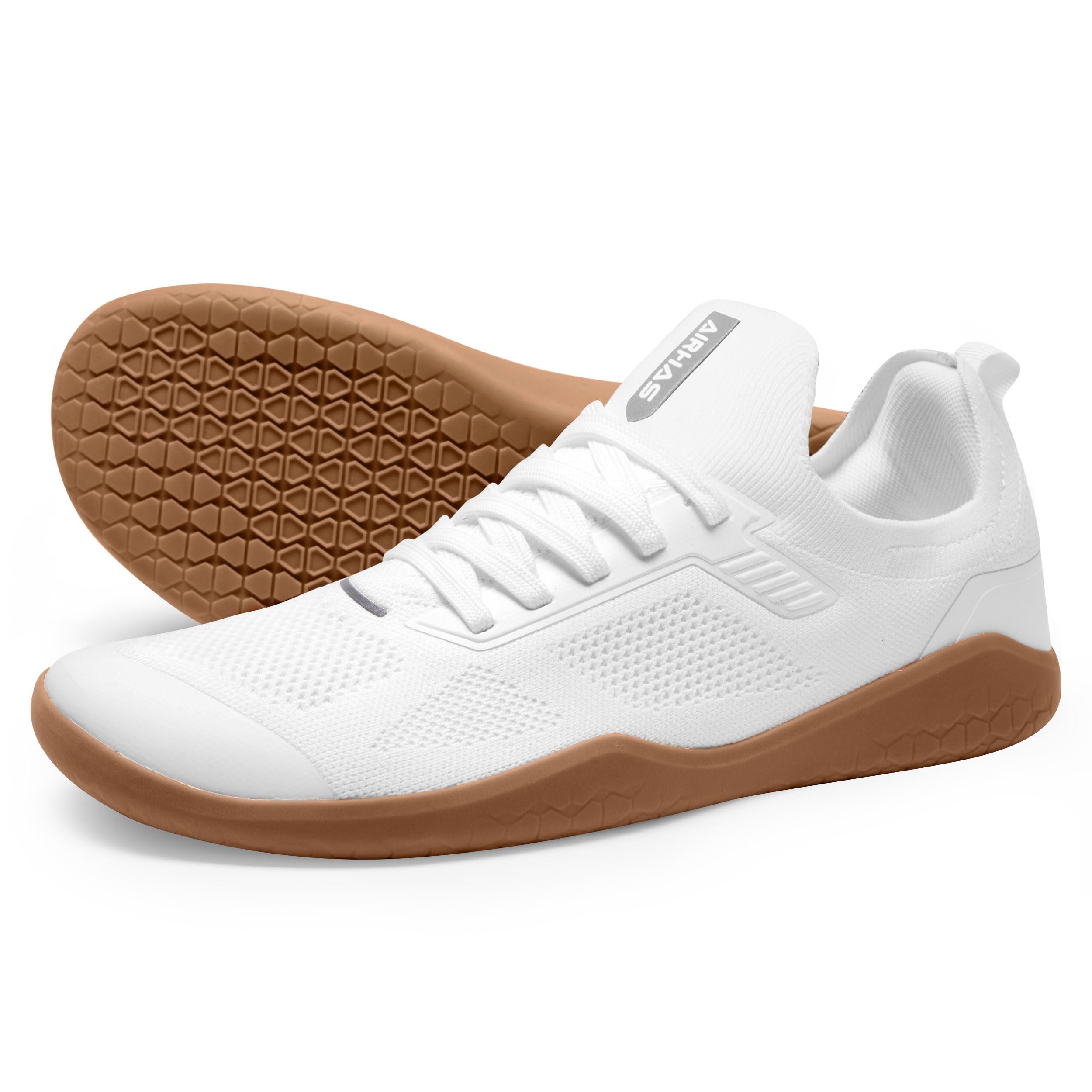
The toe box is where a barefoot trainer either works or doesn't, and the AIRHAS is the pair here that got it right. The front is shaped like a foot rather than tapered to a point, so the toes sit flat and spread when you set up for a squat instead of stacking on each other. We came in expecting a mid-range shoe to feel like one and were surprised by how much room there is up front without the rest of the shoe feeling sloppy.

Zero drop and a flat platform are what make it useful under a barbell — no ramp tipping you forward, no soft heel to press through on a deadlift. The insole lifts out, and we prefer it out: you gain room above the toes and a shorter path to the floor, which does more for balance than any amount of cushioning. The upper needed no break-in, and the slip-on shape means they're on in a second between sets.

The fabric upper is the part to watch — it's the least substantial piece of the shoe, and the toe seam is where wear appears first. Sizing runs close through the midfoot, so go up half a size if you're between sizes or plan to wear thicker socks. Neither is a dealbreaker, and neither showed up until we put real sessions on them.

Bottom line: The best all-round barefoot trainer here: a genuinely anatomical toe box, a flat zero-drop sole and a removable insole, for anyone who lifts and does circuits in one pair.

#2

Vibram FiveFingers V-Train 2.0

Vibram FiveFingers V-Train 2.0

Ground feel

Our Score 9.0/10
Check Price

Worth Noting

  • Fiddly to put on, one toe at a time
  • Toe pockets suit a narrow range of feet
Toe Design
Five separate toe pockets
Intended Use
Cross-training and balance work
Listed Weight And Dimensions
10 x 15 x 6 inches; 1.1 pounds
Read the full review

Five separate toes looks like a novelty until you set your feet for a heavy set. Each toe can press and spread on its own, and the sole beneath them is thin enough that the floor is simply there — a closed toe box, however wide, can't give you that. At a listed 1.1 pounds it's the heaviest shoe in this roundup, which sounds worse than it feels: on the platform the weight disappears.

For squats, deadlifts and single-leg work, this is the shoe we rate highest in the group, and it's the one that made the difference obvious — balance drills and split squats feel different when your toes can grip. It's also the most expensive pair here, which is the honest reason it isn't the automatic recommendation.

The look is unmistakable, and the fit is glove-like once they're on: seat each toe properly and nothing shifts under load. If you want one pair for everything, this isn't it; as a dedicated lifting shoe, it's the pick of this group.

Bottom line: The closest thing here to training truly barefoot, with unmatched ground feel for lifting — worth it if you want a dedicated gym shoe rather than an everyday pair.

#3

Oranginer Barefoot Cross-Trainer

Oranginer Barefoot Cross-Trainer

Treadmill and cardio

Our Score 8.6/10
Check Price

Worth Noting

  • Sole separates under heavy gym use
  • Runs short and snug through the midfoot
Toe Box
Big toe box
Intended Use
Cross-training and treadmill running
Listed Weight
8 oz
Read the full review

Eight ounces is the listed weight, and it's the number that explains this shoe. It's the lightest pair in the roundup, and the effect on a treadmill session is real — less shoe to drag through every stride, and our feet finished a cardio block less beaten up than in anything else here. The toe box is genuinely big too, cut wide and square at the front rather than merely rounded off.

Where it needs care is fit. The midfoot runs snug and the front comes up short, so go up half a size if you're between sizes and skip thick socks. Do that and you have a light, quick shoe for cardio, circuits and conditioning. The sole is the part that gives out first if you push it into heavy volume — this is a cardio shoe that lifts, not a lifting shoe that runs.

Bottom line: The lightest shoe here and the one to pick for treadmill miles and conditioning circuits, as long as you size up and leave heavy barbell volume to another pair.

#4

Weweya Minimalist Trainer

Weweya Minimalist Trainer

All-day wear

Our Score 8.6/10
Check Price

Worth Noting

  • Sole and stitching wear before the upper
  • Cushioning dulls the barefoot feel
Style
Minimalist trainer
Closure
Laced
Intended Use
Running, gym and hiking
Read the full review

Most barefoot trainers are gym tools that live in a gym bag. The Weweya is the one here built to keep going after you leave — more foam underfoot than the rest of the group, an upper that reads like an ordinary sneaker, and enough flexibility that you never feel like you're walking in a brick.

Fit is the thing to get right. The shape runs long for some feet while the toe room is tighter than the silhouette suggests, so try your usual size first and don't buy it to solve a wide-forefoot problem — the wider pairs in this guide do that better.

Cushioning is the trade you're making. There's more of it here than anywhere else in the group, which is exactly why it works for a full day on your feet and exactly why it's the least barefoot-feeling shoe we recommend: you feel the floor less, and for balance work that matters.

So it earns its place for a specific job — one pair that covers a light gym session, errands and travel without looking like gym kit. For serious lifting, the AIRHAS or the FiveFingers serve you better; for a single pair that goes everywhere, this is the one we keep by the door.

Bottom line: The pair to buy if you want one shoe for light training and the rest of your day — cushioned, ordinary-looking, and the least barefoot-feeling pick here.

#5

EWUHA Barefoot Shoe

EWUHA Barefoot Shoe

Budget daily wear

Our Score 8.6/10
Check Price

Worth Noting

  • Listed in women's sizing; runs small
  • Thin sole gives little protection from cold or stones
Closure
Elastic drawstring with toggles
Toe Box
Wide toe box
Intended Use
Walking, hiking and gym
Read the full review

This is the cheapest shoe in the roundup, and it's the one that surprised us most. The closure is the detail: sliding toggles on an elastic drawstring let you set each side separately, so a wider left foot isn't stuck with the same tension as a narrower right one — more adjustment than most shoes here offer, and faster than laces.

The listing sits in women's sizing even though the title covers men's and women's, and the sizes run small, so read the chart and go up if you're at the top of a range. Do that and you get a very light shoe with a wide front and a thin sole that's honest about the ground — good as a spare in the gym bag, for the pool, or for anyone who wants the barefoot feel without spending much. It's not the pair for heavy lifting or cold, rough ground.

Bottom line: A very cheap, very light wide-toe shoe for casual days and light gym work — check the size chart, because it's listed in women's sizing and runs small.

#6

MIFAWA Barefoot Water Shoe

MIFAWA Barefoot Water Shoe

Gym and pool

Our Score 8.6/10
Check Price

Worth Noting

  • Insoles and toe seams are the wear points
  • Nowhere for water to drain
Drop
Zero
Closure
Hook-and-loop strap
Toe Box
Wide toe box
Read the full review

Read the shelf label before the marketing copy: this is a water shoe that doubles as a gym shoe, and once you know that, the design makes sense. The upper is thin, quick to shed heat and cut wide at the front, and a hook-and-loop strap crosses the instep so you can cinch it in one pull rather than working laces between sets.

It's also the cheapest route into a zero-drop, wide-front shoe in this group, and for sweaty sessions, travel and pool-to-locker-room runs it does a job the others can't. Grip is the caveat — fine on a dry gym floor, but we took wet tile slowly.

As a second pair it's excellent value: in the bag for the pool, the beach or a sweaty circuit, and the strap makes it the quickest shoe here to get on and off. As the only trainer you own, its limits show up fast.

Bottom line: The one to buy as a cheap second pair for the pool, the beach and sweaty circuits — a wide, zero-drop crossover that isn't built for daily training.

#7

WHITIN W882 Wide Toe Box

WHITIN W882 Wide Toe Box

Wide feet

Our Score 8.4/10
Check Price

Worth Noting

  • Sizing runs small at the toe
  • Insole shifts forward while walking
Insole
Removable
Toe Box
Wide toe box
Intended Use
Walking and everyday wear
Read the full review

The W882 is shelved as a walking shoe, and that's the honest way to read it: this is a wide, flat everyday sneaker rather than a cross-trainer. The toe box is the reason to buy it — cut wide and square, the roomiest front in the cheaper half of this group, and if your feet have spent years in tapered shoes it's the pair that shows you what the fuss is about.

Two practical notes. The insole lifts out, and pulling it makes the fit roomier at the front and stops the shuffle you feel underfoot when it stays in — without it, this is one of the more comfortable shoes here for a full day. Sizing runs small at the toe, so if your second toe is the longest, go up.

What it isn't is a lifting shoe: there's no stability structure, and a heavy squat in it feels vague. As the pair you wear to the gym, walk the dog in and wear all weekend, it's a strong buy for wide feet at a modest price.

Bottom line: The pick for wide feet on a modest budget, as long as you want an everyday minimalist sneaker rather than a shoe for barbell work.

How We Tested 12 Pairs of Barefoot Training Shoes

The shortlist started with a spec filter: zero drop, a sole no thicker than about 12 millimeters, and a toe box wide enough that our testers' toes didn't brush the sides. From there we cut anything that came only in whole sizes, anything priced like a novelty, and anything with a stiff rock plate that fought the whole point of the shoe. Twelve pairs made it through, and each one was worn by at least two people with different foot shapes and arch heights.

Every pair went through the same eight months of ordinary use — lifting sessions, turf drills, treadmill intervals, dog walks, and the unglamorous stuff like standing through a long airport day. We wrote comfort notes at the end of each wear rather than the start, since a barefoot shoe feels wonderful for twenty minutes and tells you the truth by hour four. We also timed getting each pair on and off, because a snug collar with no pull tab is a daily nuisance you only notice once you're late.

To judge fit and sizing, testers traced their foot on paper and laid the outline against the insole; anything that ran short got marked down. Traction was checked on wet concrete, smooth gym flooring, and loose gravel, and arch support — or the deliberate absence of it — was scored by how the midfoot felt after a full day, not a single mile. Lightweight is easy to claim, so we weighed every pair ourselves, then re-weighed it after 50 miles to see how the outsole and upper were holding up. Quality and value came down to seams, wear at the heel edge, and how many realistic miles the price bought.

How to Choose Barefoot Training Shoes

Start With the Toe Box

The width of the front is the first thing to check, because 'barefoot' in a product title guarantees nothing — shoes that advertise a wide toe box can still measure like an ordinary sneaker across the ball. Measure across the ball of your foot, then compare it with the shoe's platform; you want the toes flat and splayed, not stacked on each other.

The AIRHAS and the WHITIN W882 are the two picks here that make the difference obvious, and it shows up in balance work before it shows up anywhere else.

Match the Sole to What You Lift

Zero drop and a thin sole are what make these shoes useful under a bar: no ramp tipping you forward, no cushioning to press through on a deadlift. The trade is protection — a very thin sole is tiring on pavement and unforgiving on rough ground, so it's a gym floor shoe, not a hiking shoe.

If your week is mostly cardio with some lifting, the more cushioned Weweya is the easier wear. If it's mostly barbell work, go as thin and flat as you can tolerate.

Weigh Light Against Durable

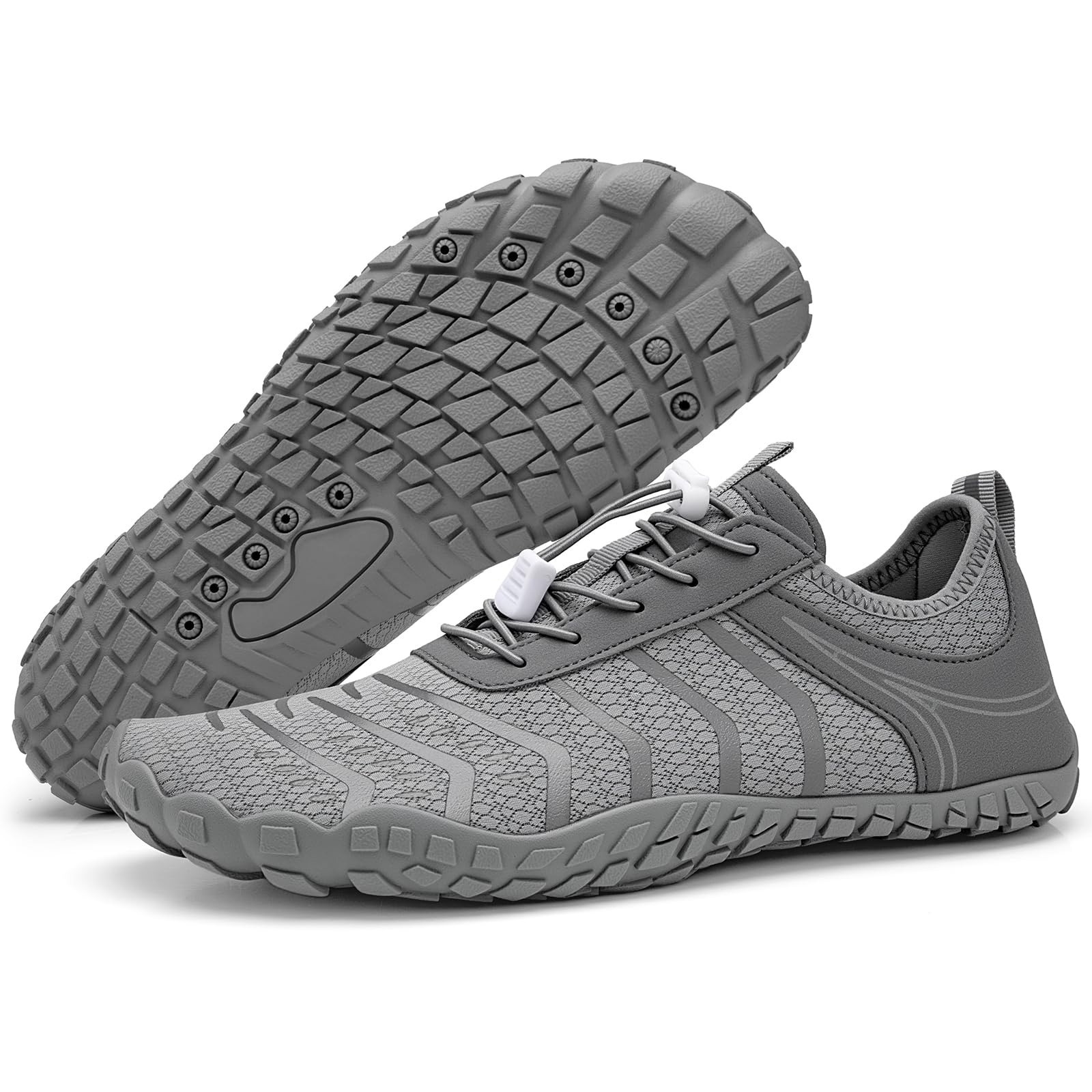
Light is pleasant: the Oranginer is the lightest pair here at a listed 8 ounces, and the Vibram is the heaviest at a listed 1.1 pounds. Weight alone doesn't decide it, though. Featherweight uppers are usually the first thing to go at the toe seam, while a slightly heavier build tends to survive more sessions.

Buy light if the shoes live in a gym bag or you're doing cardio in them; buy sturdier if they'll be on your feet five days a week.

Check the Insole Before You Train

A removable insole is a feature: pull it and you gain room at the front and a shorter path to the floor, which is why several of our picks are better without one. The catch is that a loose insole slides forward as you walk, and under a loaded bar a moving footbed is a stability problem.

If yours shifts, take it out rather than living with it. The WHITIN W882 is the clearest example of a shoe that improves with the insole gone.

Know Where the Shoe Stops

The category blurs at the edges. The WHITIN W882 is a walking shoe with great toe room and no stability structure for barbell work; the Vibram's toe pockets rule out wearing it anywhere but the gym; the MIFAWA is a water shoe first.

Decide the setting you'll use most — a gym floor, an all-day shoe, a pool bag — and buy for that rather than expecting one pair to cover all three.

Frequently Asked Questions

Final Verdict

The AIRHAS is the pair we point most people to. The toe box is genuinely anatomical rather than merely rounded, the sole is flat and zero drop for lifting, the insole comes out when you want more room — more than most trainers in this roundup offer for the money.

If your training is mostly barbell work and you want the closest thing to barefoot, the Vibram FiveFingers V-Train 2.0 is worth the step up. And if you want one pair that goes from a light session through the rest of the day, take the Weweya.