Recovery

Best TENS Units of 2026

A TENS unit runs on a small piece of misdirection: sticky pads send mild electrical pulses through your skin, and those pulses crowd out the pain signals your nerves keep trying to send. Nothing gets repaired — the ache just goes quiet enough that you can finish the workday or fall asleep. What separates a unit you'll reach for every week from one that ends up in a drawer never shows up in a product photo: it's how the pads hold on after the tenth session, whether you can find the intensity button without looking, and how long the battery actually lasts.

I've lived with 14 of them over the past five months, from desk-chair shoulder knots to post-run knee soreness, and the pattern was consistent. Value has almost nothing to do with the sticker price and everything to do with how many pads come in the box and what a replacement set costs you later. The picks below are the ones my team and I kept reaching for once the novelty wore off.

#1

AUVON Dual Channel TENS

Top Pick
AUVON Dual Channel TENS

Most first-time buyers

Our Score 9.2/10
Check Price

Worth Noting

  • Some units stop powering on within months
Pads
8 (four 2 in square, four 2 x 4 in)
Modes
20 pre-set
Battery
Rechargeable, USB
Channels
2, independent A and B
Read the full review

Independent channels are the whole argument for this one. Channel A and channel B each carry their own mode and their own intensity, so a steady pulse can work a lower back while something gentler works a shoulder, and the two never have to agree on anything. If your pain moves between two places on the same evening — and it usually does — that flexibility is worth more than another ten modes.

It is also the easiest of the group to live with. The controller runs about 4 inches long and under half an inch thick, so it disappears into a jeans pocket while the leads run up under a shirt, and the built-in battery charges over USB, which means no 9-volt habit and no hunting for disposables. The pad set is unusually practical: four 2-inch squares for a wrist, elbow or neck, four 2-by-4-inch rectangles for a back, and a holder that keeps the sticky sides off the carpet between sessions.

What the mode list does not advertise is how much of it is pattern rather than plain current. A good share of the twenty programs is kneading, tapping and wave shapes, and the flat continuous pulse — the setting most people end up parked on — is one option among several rather than the default. We found our two settings in an afternoon and stopped scrolling; if you enjoy fiddling, there is plenty to fiddle with.

Pads are the ongoing cost. AUVON rates them at up to 45 uses each, and a daily habit gets through that in well under two months, so order a spare pack with the machine rather than after the first pad peels loose mid-session.

Bottom line: The one we recommend to most people: two independently controlled channels, pads in two useful sizes, and a body slim enough to wear on the move.
#2

NueMedics Tens 24

NueMedics Tens 24

Large treatment areas

Our Score 9.2/10
Check Price

Worth Noting

  • Only large pads; small joints need folding
Pads
6 large electrodes
Modes
24, labeled by body area
Safety
Intensity locked until pads are placed
Charging
Type-C cable and wall charger
Read the full review

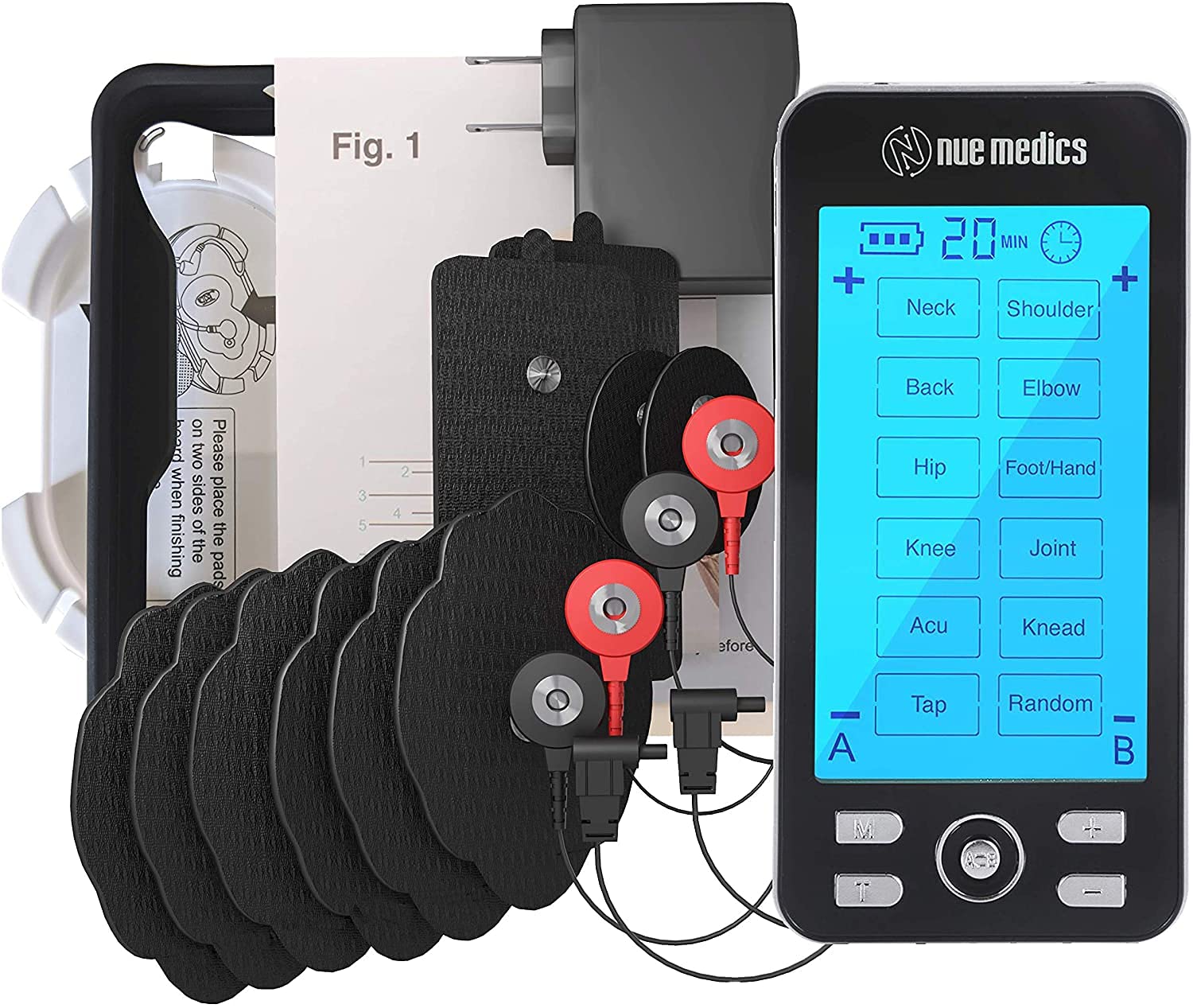
Six large electrode pads is a deliberate choice, and for a back, a hip or a shoulder blade it is the right one: three pairs of big rectangles, so a full session does not depend on rotating two tired pads halfway through. Electrode size is the part of a TENS setup that decides whether current reaches the muscle you are aiming at, and a large footprint covers more of a broad, flat area than a cluster of small squares.

The mode menu is what we appreciated most. Instead of two dozen numbered waveforms, the programs are labeled the way most people describe their own problem — neck, shoulder, back, elbow, hip, foot and hands, knee, joint — with knead, tap and random at the end. That is a much shorter path from 'my shoulder is locked' to a setting that feels right, and it is the sort of decision that gets a unit used instead of stored.

Two details are easy to miss. The intensity buttons do nothing until every pad is on skin, which is briefly annoying under a shirt and a very good idea the first time a lead works loose; and the box includes a wall charger alongside the Type-C cable, so it never needs a laptop to top up. It costs about what our top pick does, which is fair for the pad count and the charger, and it is the one to choose when the treatment area is big and fixed.

Bottom line: Buy it if your pain sits in big areas — back, hip, thigh — and you prefer choosing 'shoulder' from a menu to decoding a numbered mode list.

#3

TechCare PLUS24

TechCare PLUS24

Long sessions away

Our Score 9.2/10
Check Price

Worth Noting

Pads
10 across three sizes
Modes
24
Battery
Up to 20 hours per charge
Channels
2, independent
Read the full review

Twenty hours of continuous use on a single charge is a figure we treat as a ceiling rather than a promise — runtime claims rarely survive a cold room and an ambitious intensity setting. Even a generous fraction of it changes how you use the thing, though: this is the unit that lives in a bag, comes out on a trip, and still has bars left when you get home.

The pad spread is the other reason it stands out. Ten pads across three sizes — two large, six medium, two small — covers a lower back and a knee in the same session without folding anything in half, and the two channels take independent settings, so those areas do not have to share an intensity. The display is a full LCD rather than a couple of cryptic digits, so mode, level and remaining time are all visible at a glance.

Put those together and this is the unit for someone treating a big area and a small one in the same sitting, or for anyone who wants a machine that stays charged in a bag between uses. It asks for patience first: twenty-four modes, four variations inside each, cycled rather than selected, and nothing on the device explaining what mode seventeen is meant to do for a shoulder. Two evenings of pressing buttons gets you to your three programs, and after that it is two buttons and twenty minutes on the floor.

Bottom line: The one we take when a charge has to last: up to 20 hours claimed, ten pads across three sizes, and two channels that run to their own settings.

#4

Etekcity 4-Channel TENS

Etekcity 4-Channel TENS

Multiple areas together

Our Score 9.2/10
Check Price

Worth Noting

  • Charge can run down after a session or two
Pads
Up to 8 electrodes
Battery
Up to 7 days per charge
FSA/HSA
Eligible
Channels
4, independent
Read the full review

If both shoulders and a lower back are the problem, this is the only unit here that treats all of them at once. Four independent channels, eight pads, four circuits with their own settings, all live together — that is a different job from a two-channel box, not just a bigger version of one, and it is the reason this unit is on the list at all.

It stays small for what it does: 3.4 ounces and roughly the footprint of a deck of cards, so the channel count does not turn it into a tabletop box. The memory function restores your last setup when you switch it on, which matters more here than on a simpler unit — rebuilding four channels from scratch every evening gets old by the second week.

One detail decides the purchase in some households: it is listed as FSA and HSA eligible. If you have a balance to spend before the year turns, that moves it from a nice-to-have to something you can pay for with money already set aside. It is also the most expensive unit here, which makes that eligibility more than a footnote.

Budget for pads. The adhesive is the weakest part of the package — pads that stop gripping after a handful of sessions, well before the unit itself gives trouble. Four channels solving a real problem makes that worth absorbing; if you are treating one area, the two-channel AUVON does the same job with fewer pads to buy.

Bottom line: Worth it only if you genuinely treat several areas at once: four independent channels and eight pads, in the smallest body here that can run them.

#5

AUVON 24 Modes TENS

AUVON 24 Modes TENS

Small and simple

Our Score 9.2/10
Check Price

Worth Noting

  • Pads lose adhesion after a few sessions
  • Numbered modes take a session to learn
Pads
8 square
Modes
24
Battery
Up to 10 hours per charge
Intensity
20 levels
Read the full review

This is the unit for the office drawer, the gym bag, or the person who is not sure yet whether a TENS unit is for them. The controller is small enough to disappear into a shirt pocket, twenty-four modes and twenty intensity levels are more menu than a box this size suggests, and the ten-hour battery rating means charging becomes a weekend habit rather than a nightly one.

It is the AUVON we point people to when budget is the deciding factor. Same pad holder and pouch thinking as the top pick, eight square pads, a Type-C cable and controls that take about ten minutes to learn. What the top pick adds for the extra money is independent channel control — two areas at two strengths — and if you treat one area at a time, that is a feature you can leave on the shelf.

Against the rest of the group it is the middle option: more pads and a better battery than the TENKER, less flexibility than the top pick, and a smaller body than either. For straightforward one-area relief, that is the whole decision.

Bottom line: The pick for a first unit or a second one: pocket-sized, 24 modes, eight pads and a ten-hour battery, all at the low end of this group's prices.

#6

AVCOO 30 Modes TENS

AVCOO 30 Modes TENS

Awkward spots

Our Score 9.2/10
Check Price

Worth Noting

  • Thirty modes take cycling to work through
Pads
12 in three shapes
Modes
30
Weight
0.09 lb
Intensity
30 levels
Read the full review

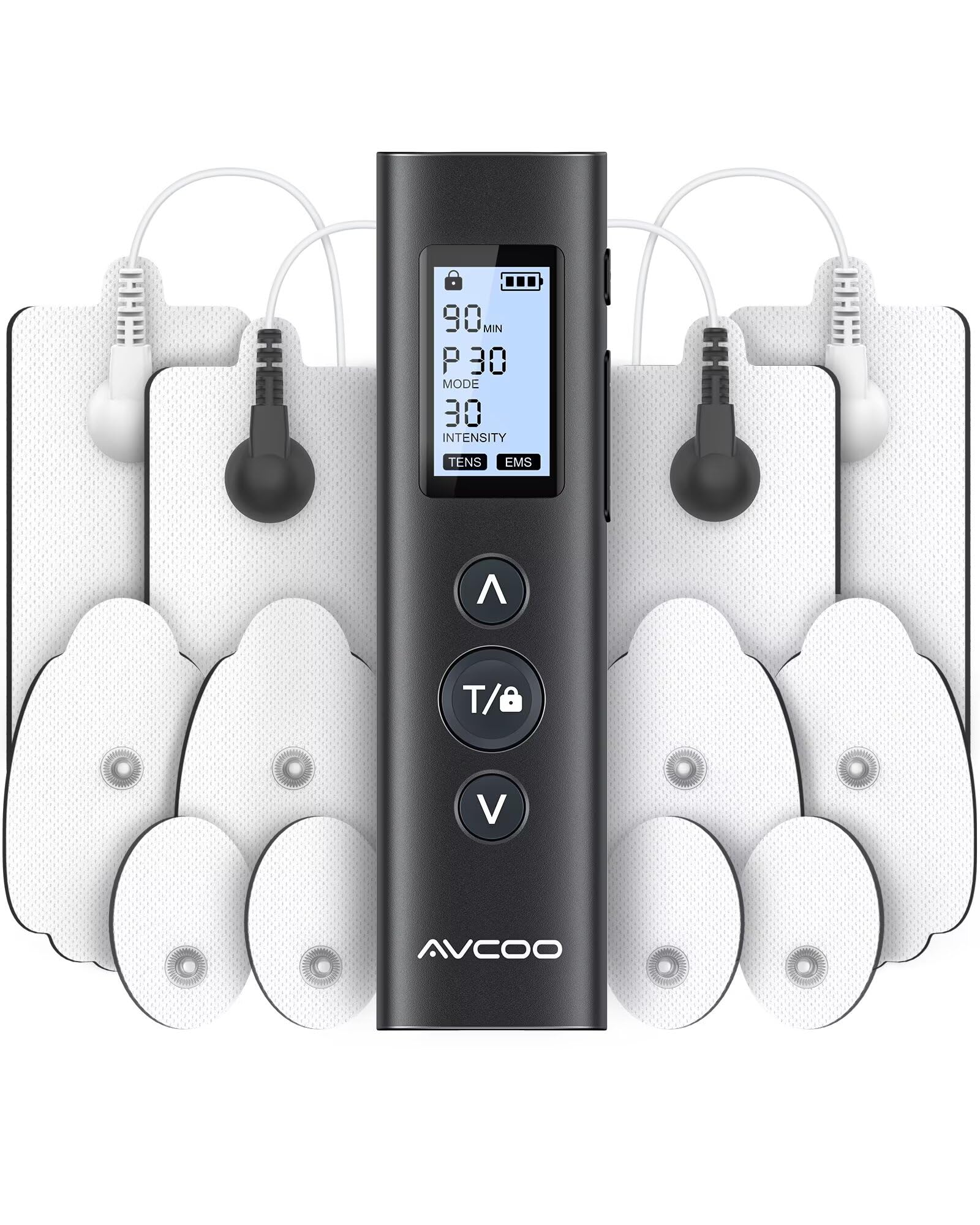
At 0.09 pounds and half an inch thick, this is the one that actually disappears — the sort of small where you forget it is in a jacket pocket until you reach for your keys. Thirty modes and thirty intensity levels in a body that size is the trade you make: the controls are small and set close together.

What it has that the bigger boxes do not is the pad selection: twelve pads in three shapes — 2-by-4-inch rectangles, palm-shaped 2-by-3s and small 1-by-2 ovals. The ovals are the useful part. A thumb, the base of the neck or the arch of a foot needs a small electrode placed precisely, and a folded rectangle is not the same thing.

It is the also-ran that keeps earning its place here: cheap enough to be a second unit, small enough to travel, and specific enough in its pad shapes to do something the larger machines cannot. The memory function brings back your last setting, and AVCOO rates the pads at more than fifty uses — worth knowing, because the battery is the part to watch, with capacity that can taper over months of regular use.

Bottom line: The one we reach for on awkward spots — thumbs, feet, the base of the neck — thanks to 12 pads in three shapes and a body that weighs almost nothing.

#7

TENKER 24 Modes TENS

TENKER 24 Modes TENS

Low-cost backup

Our Score 9.0/10
Check Price

Worth Noting

  • Backlight times out mid-session
  • Only two of eight pads are large
Pads
8 (six 2 in, two 2 x 4 in)
Modes
24
Outputs
Dual
Intensity
20 levels
Read the full review

The cheapest unit here is also one of the simplest, and for a first TENS purchase that is a good combination: twenty-four modes, twenty intensity levels, two outputs and eight pads, plus a pouch and cable ties so the leads do not turn into a nest in a drawer. We went in expecting to find the corners that had been cut. They are in the display and the pad shapes, not the therapy.

Two outputs mean two areas at once, or one machine shared between two people, and the rechargeable battery charges over USB. The cable is in the box; the wall adapter is not, so plan on a phone brick you already own. Power is not the compromise either — the top of the intensity range is more than most people will use, and the mode list covers the steady, tapping and kneading shapes you find at every price.

What you give up is polish: the controls feel basic, and nothing about the package suggests it was designed rather than assembled. None of that changes whether current reaches a sore muscle, and at this money that is the trade that matters. It is the unit for a first try, a backup, or the one that lives in the car.

Bottom line: Our budget pick: two outputs, eight pads and 24 modes for the least money here, with nothing about the therapy itself cut back.

#8

Belifu Dual Channel TENS

Belifu Dual Channel TENS

Tidy storage

Our Score 9.0/10
Check Price

Worth Noting

  • Pads lose their grip within a few sessions
Pads
10 reusable
Modes
24
Channels
2 (A/B)
Included
Storage bag and cable ties
Read the full review

Ten pads, a drawstring bag and a pair of fastening cable ties: this is the only unit here that arrives thinking about where it will live between sessions. If your last TENS unit ended up in a shoebox with its leads in a knot, that is not a trivial detail — a machine you can pack tidily is a machine you take with you.

The unit itself is a dual-channel box with twenty-four modes, twenty intensity levels and an adjustable timer, and the two channels take separate settings, so a neck and a back can run at different strengths at the same time. The rechargeable battery charges from a wall charger, a power bank or a laptop, which covers the case where it lives somewhere without a free outlet.

Where it falls behind the leaders is in the details you only discover after a few weeks. The mode list is long and does not explain itself, so finding your two settings is trial and error rather than a labeled shortcut, and the controls take a few sessions before they become automatic.

We keep it on the list because the kit is genuinely the best organized here and the price is level with our top pick. If your machine lives in a bag and you want pads to spare, that is the reason to choose it over the AUVON.

Bottom line: We keep it on the list for the kit: ten pads, a storage bag, cable ties and two separately controlled channels — with pad adhesive as the trade.

How We Tested the TENS Units

The shortlist started with specs rather than marketing copy: how many channels and modes each unit offers, whether intensity moves in fine steps or big jumps, what size pads come in the box, how easy replacements are to find, and whether it runs on AA batteries or a rechargeable cell. We set aside anything with a fixed timer under 15 minutes or pads you can only buy from one place.

Then we lived with 14 units for five months. Sessions happened where pain actually happens, not on a lab bench — in a desk chair at the end of a long workday, on the couch during evening TV, after weekend runs and long walks, and in a tote on a couple of overnight trips.

For adhesion, we rinsed each pad, let it air-dry, and counted sessions until a corner lifted or the pad stopped gripping at all. Battery life was timed from a full charge to shutdown on continuous mid-level use, which is closer to how people actually run these than a five-minute burst.

Ease of use came down to a thumb: could we drop the intensity a notch mid-session without looking or fumbling? We also noted whether the unit reset itself when the timer ran out, since that matters more than it sounds. Durability lived or died on the lead wires, the belt clip, and whether the buttons still clicked cleanly after months in a bag — and value got weighed against how many pads shipped in the box against what a refill set costs.

How to Choose TENS Units

Count channels before you count modes

One output is enough if you treat one area at a time, and it costs less. Two independently controlled channels — four pads, two areas, a separate mode and intensity for each — is what most people end up wanting, because backs and shoulders rarely flare alone, and running both at the same strength is rarely comfortable.

Four channels, as on the Etekcity, only pay off if you routinely treat both shoulders and a back in the same session. Otherwise you are buying pads and setup time you will not use.

Pads are the running cost

The controller is a one-time purchase; the pads are not. Count them, and look harder at the shapes than the total: ten pads across three sizes will handle a knee and a wrist without folding anything, while six large pads suit a back and nothing smaller.

Adhesion is what fails first, so store pads on their backing sheet, keep skin clean and dry, and price a replacement pack into the decision rather than discovering it three weeks in.

Treat runtime claims as ceilings

Twenty hours, thirty hours, seven days — those are best-case figures measured at modest intensity, and they rarely survive a cold room and a long session. Convert the claim into sessions instead. At twenty minutes a day, ten hours of runtime is about a month of use, which is plenty for most people.

The connector matters more than the number: USB charging means you can top up anywhere, and a proprietary plug means you cannot.

You will use two or three modes

Twenty-four modes sounds better than twelve and mostly is not. What matters is how fast you reach the two or three that work: numbered modes mean trial and error every time you forget, while modes labeled by body area, as on the NueMedics, get you close in one press.

Watch for menus that nest variations inside modes. Eight modes with four variations each takes more scrolling than eight flat ones, and nobody needs thirty programs to treat one shoulder.

Wearability decides how often it gets used

Pocket-sized units get used; tabletop boxes get put away. If you plan to wear one while moving, check the size and the lead length — a unit on a waistband needs enough cable to reach a shoulder blade without tugging.

A pad that lifts at one edge stops delivering current where you put it, so a holder or a spare set of pads matters more than it sounds. If two people share the machine, buy a second lead set so nobody waits.

Frequently Asked Questions

Final Verdict

Start with the AUVON dual channel. Two independently controlled channels and eight pads in two sizes cover the way most people actually hurt — a back plus a shoulder, a neck plus a wrist — and the controller is slim enough to wear while you get on with the day. If your pain sits in big areas and you want six large pads with body-part labels instead, the NueMedics is the calmer buy at about the same money.

And if four areas genuinely need treating at once, nothing here matches the Etekcity's channel count.