Recovery

Best Inversion Tables of 2026

Hanging upside down on purpose sounds less like a remedy than a dare. But if you've spent years hunched over a desk, you know the low-back ache that sends people searching for an inversion table — and the two worries that come with it: will the frame hold me, and will I be able to get off it. The right one takes weight off your spine for a few minutes at a time; the wrong one wobbles, pinches your ankles, or leaves you guessing whether the locking pin is really in the hole.

Over the past six months, my team and I have assembled, adjusted, and hung from seven tables, and the gap between a sturdy one and a flimsy one shows up during assembly, long before your back touches the pad. One thing nobody tells a first-time buyer: full inversion isn't the goal. Most people find relief somewhere around 40 to 60 degrees, which makes the ankle lock — not the maximum angle — the real deciding feature. The picks below are the ones we kept going back to.

#1

Teeter FitSpine X3

Top Pick
Teeter FitSpine X3

Premium daily sessions

Our Score 9.4/10
Check Price

Worth Noting

  • 66 pounds, so it stays where it is built
Warranty
5 years
Item Weight
66 lb
Maximum Incline
60%
Weight Capacity
300 lb
Read the full review

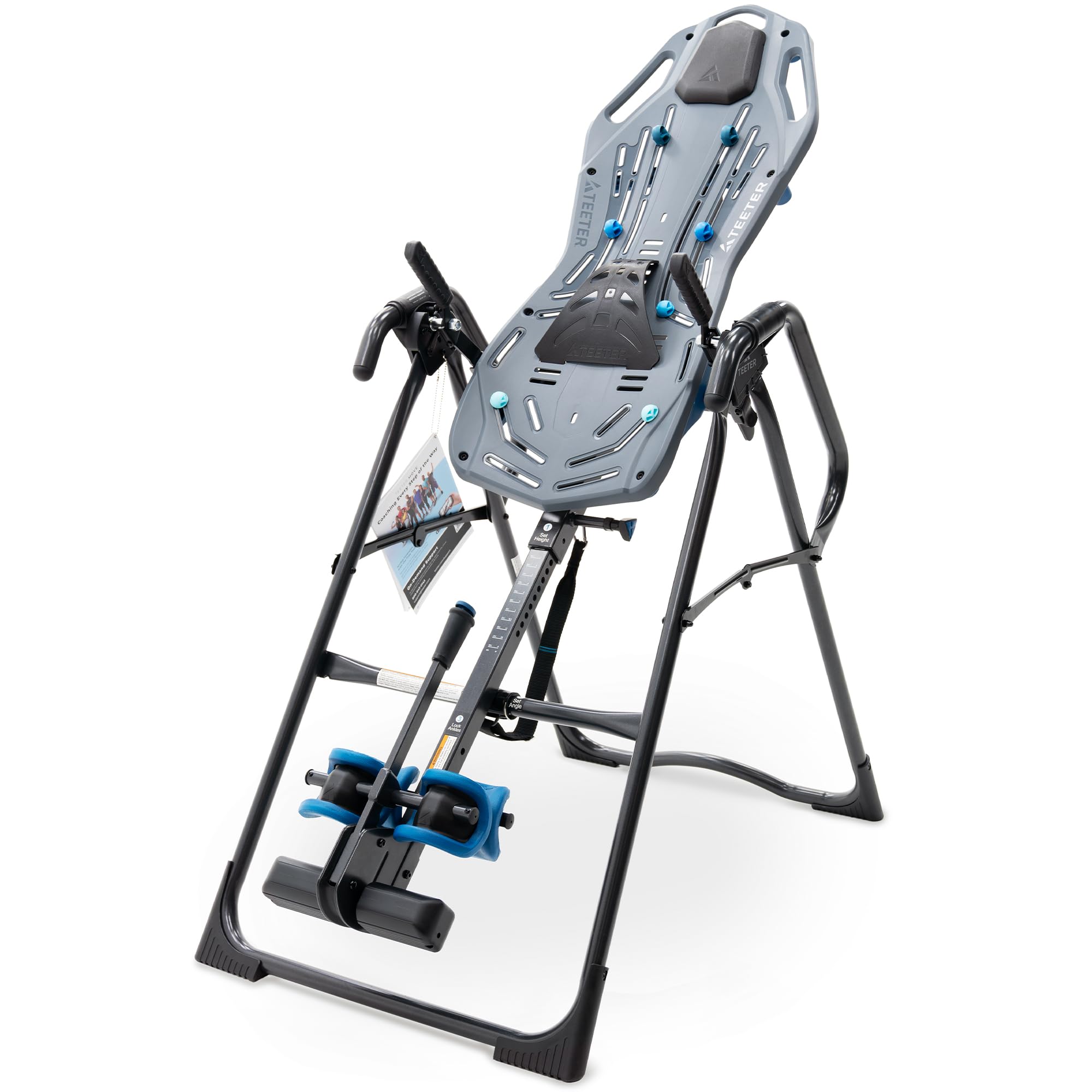
Eight acupressure nodes in varied heights that you position either side of your spine, a lumbar bridge with an adjustable arch, and traction handles over your head. The FitSpine X3 comes with more to tune than anything else in this group. The nodes are the interesting part: you set them where your back complains, and they press in while you hang, which turns a passive stretch into something closer to trigger-point work.

Two features matter more than the accessories. The EZ-Reach ankle system puts the clamp on an extra-long stainless handle so you set your ankles from an upright stance instead of folding yourself in half, and a secondary gravity-activated lock backs it up once you are in. The bed itself is an eight-point floating suspension, so the surface flexes and lets your body slide toward the head end rather than gripping you in place.

This is the most expensive table here, and the money buys the bed and the hardware that sits on it. Position the nodes once, forget them, and you have paid for something you never touch; the EP-550 carries the same FDA registration, UL certification, and five-year warranty without them. The ankle handle is the exception. It is the one upgrade you feel every session, and it is what we miss when we go back to a plainer table.

Bottom line: The X3 is for the rider who wants the most adjustable bed here: acupressure nodes, an arched lumbar bridge, and five-year coverage to match.

#2

Innova ITX9600

Innova ITX9600

Most home users

Our Score 9.2/10
Check Price

Worth Noting

  • Adjustable foot bar has some flex
  • One-year warranty only
Warranty
1 year limited
Angle Settings
6 positions
Weight Capacity
300 lb
User Height Range
4 ft 10 in to 6 ft 6 in
Read the full review

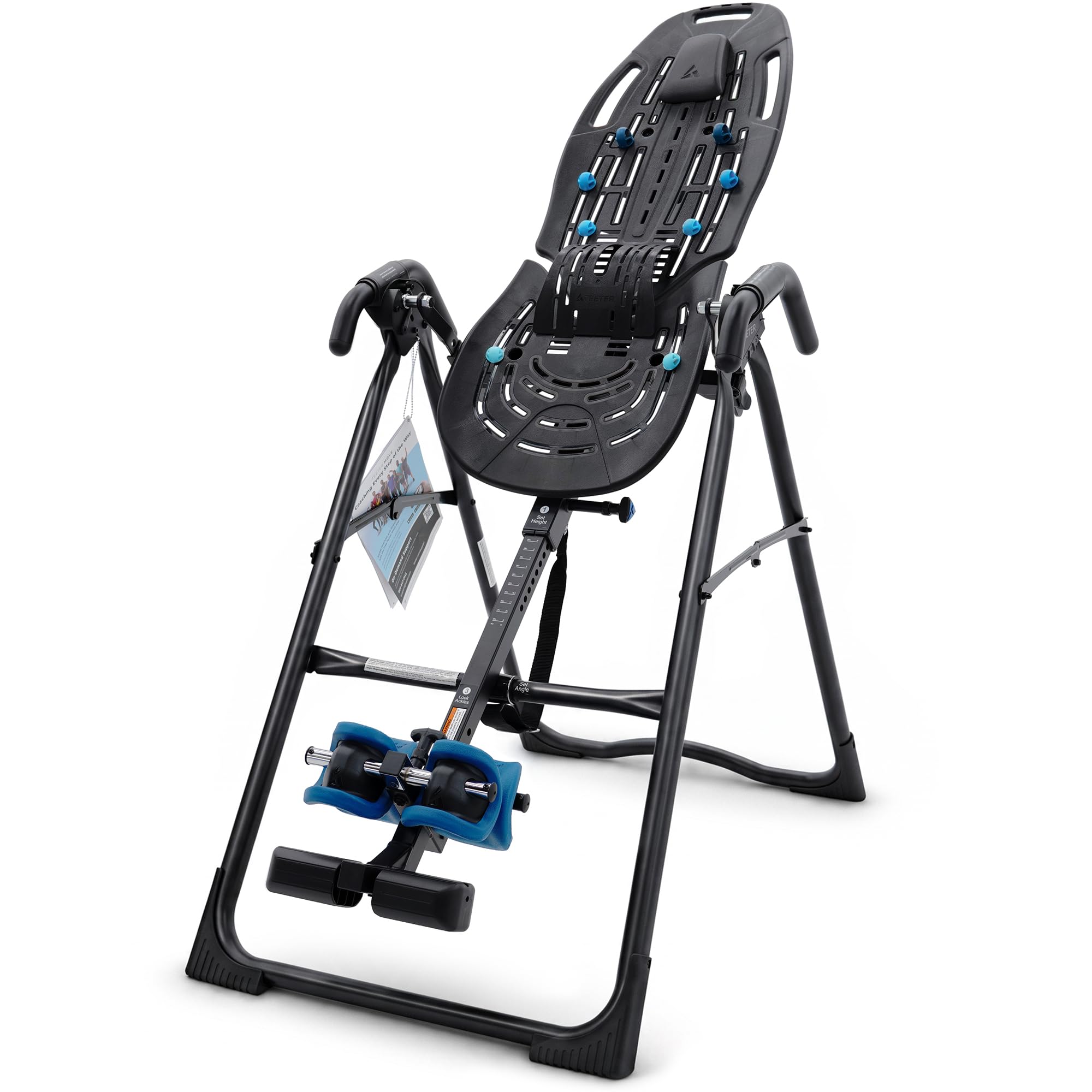
Six angle settings, a 300-pound limit, and a height range from 4 feet 10 inches to 6 feet 6 inches: nothing else in this group covers that many riders for so little. That is the short reason the ITX9600 is the table we point most people to first. Two details do more for daily use than the spec list suggests. The angle pin sits under a small protective cover, so you are not hunting for a hole with your fingertips while tipped back, and the ankle pads are reversible, trading places front to back depending on where you want the wider surface.

The backrest is what settled it for us. It is broad and padded enough that a session does not turn into a negotiation with your shoulder blades, and the headrest adjusts so your neck is not craned when you are flat. Set the height pin once for your own numbers and it holds, which matters in a house where two people share the table.

Assembly is the part to plan for. Budget a couple of hours, open the hardware bags in step order, and draft a second person for the frame. It is not difficult, just tedious, and at 52 pounds you want the finished table in its spot before you start rather than carrying it there afterward.

Bottom line: For most people setting up a first table at home, this is the one we point to: six angles, a 300-pound limit, and a padded bed for the least money here.

#3

Teeter EP-550

Teeter EP-550

Daily long-term use

Our Score 9.2/10
Check Price

Worth Noting

  • 60 pounds, so it is a two-person move
Warranty
5 years
Item Weight
60 lb
Certifications
FDA registered, UL certified
Weight Capacity
300 lb
Read the full review

The EP-550 has the strongest paper trail in this group: registration with the FDA as a 510(k) medical device, UL safety certification, and five years of coverage on a heat-treated steel frame. That last number is the one we weigh most. Inversion puts your whole body through two ankle clamps and a pivot, so a five-year warranty says more about how long the thing is meant to last than any adjective on the box.

The bed is the other half of the story. Teeter's ComforTrak surface flexes under you and lets your body slide toward the head end as you tip back, which is where the decompression comes from; a stiff board holds you in place instead. Wrap-around ankle cups and a two-position foot platform dial in the fit, and the grip-and-stretch handholds above your head give you something to pull against for a rowing stretch between tilts.

An angle-limit strap caps how far you go, and it is the simplest version of that job here: nothing mechanical to adjust, just a strap you shorten. The frame folds for storage without coming apart, so it can live against a wall between sessions. The ankle lock is deliberately firm, and if hand strength is a worry that release is the thing to try before you commit to any table.

Bottom line: The upgrade we recommend for daily use: FDA-registered, UL-certified, and backed for five years on a heat-treated steel frame.

#4

Innova ITM5900

Innova ITM5900

Heat and massage

Our Score 9.2/10
Check Price

Worth Noting

  • Vibration only, not a kneading massage
  • 60 pounds to move around
Warranty
1 year limited
Weight Capacity
300 lb
Heat And Massage
Multi-mode, auto or manual
User Height Range
4 ft 10 in to 6 ft 6 in
Read the full review

The pad covers the full length of the spine, with a contoured lumbar section at the bottom, and it runs in auto or manual modes for heat and vibration. Innova also lengthened the ankle release knob on this model, which sounds minor until you have had to fold forward and fish for a short handle with your feet clamped in place.

We treat the pad as a warm-up and the table as the reason to buy it. Underneath is the six-position pin with its protective cover, rated for 300 pounds and riders from 4 feet 10 inches to 6 feet 6 inches, and that is what actually decompresses you. What the heat buys is a reason to climb on during a cold morning, and on equipment that only works if you use it regularly, that counts for more than the feature list admits.

Bottom line: We like the heat and vibration running the length of the spine here, with a 300-pound, six-angle frame doing the actual work underneath.

#5

Body Vision IT9550

Body Vision IT9550

Small rooms

Our Score 9.2/10
Check Price

Worth Noting

  • No warranty listed
  • Shorter bed than the other picks
Backrest
38 x 16 x 1.5 in memory-style foam
Lumbar Pad
Adjustable and removable
Item Weight
46 lb
Weight Capacity
250 lb
Read the full review

At 46 pounds this is the table you can slide out of the living room without help, and that is worth more than it sounds. Most of the others here run 60 pounds and up and effectively stay where you build them. It suits lighter riders, with a 250-pound frame rating, so heavier users should look at the Innova or the Teeter instead.

The bed is a 38 by 16 inch memory-style foam pad with a removable headrest pillow and a lumbar pad that slides and comes out entirely, so you can put the support under your lower back, your mid-back, or your neck. The ankle system uses four high-density foam rollers rather than two, which spreads the pressure across a wider strip of shin instead of concentrating it in one spot.

The frame is shorter than the rest here, 40.5 inches long against 46 on the Innova, so it tucks into a corner a full-size table will not. Assembly is the easy part: the build is straightforward and one person can manage it in an afternoon without help.

Bottom line: The lightest table here, and the one we reach for when it has to move between rooms: memory-style foam, a sliding lumbar pad, and four ankle rollers.

#6

YOLEO Inversion Table

YOLEO Inversion Table

Tight budgets

Our Score 8.6/10
Check Price

Worth Noting

  • Instruction sheet contains errors
Warranty
2 years
Folding Design
Folds flat for storage
Weight Capacity
300 lb
Angle Adjustment
Adjustable rear cross bar
Read the full review

Balance is the thing to understand about this table before you order. The pivot is quick and the sweet spot is narrow, so small arm movements swing you further than you expect and holding a half-inversion takes deliberate work. Set the rear cross bar at a shallow angle for the first week and keep your hands near the frame until you know how it moves. A pin that is not fully seated is the one thing that can let you slip, so check the lock every time before you climb on.

What you get for the money is more than the price suggests: a 300-pound steel frame, memory foam over the backrest, ratchet ankle holders, a rear cross bar instead of the strap systems on some tables, and a two-year warranty, which is twice the coverage the Innova carries. The release arm is long, so you are not folding forward to reach the ankle lock.

Our honest read is that it earns its place on price rather than on feel. If you want one table to last a decade and be pleasant every time, spend up. If you want to find out whether inversion helps your back at all before committing real money, this does that job without asking much of you.

Bottom line: If the budget is fixed, the YOLEO gets you inverted with a 300-pound frame and a two-year warranty, though the build and the balance take patience.

What We Put Every Inversion Table Through

We started by gathering every inversion table we could find from the major fitness retailers and reading through the one- and two-star reviews for patterns — frames that arrived bent, manuals that didn't match the hardware, ankle clamps that let go mid-hang. From that pile we chose seven tables across the price range, deliberately mixing weight capacities, height ranges, and folding designs so we weren't just comparing versions of the same table.

Each one was assembled by a single person using only the tools in the box, and we timed it. We noted where the instructions went vague, whether the hardware bags were labeled, and how long it took before the table was genuinely ready to use rather than just bolted together. Then we set each up on carpet and on hardwood and leaned back: some frames rocked a few inches before the pivot caught, others didn't shift at all.

Safety came down to the ankle holders. We locked in, tugged hard against the boots to see if anything slipped, and checked whether the locking pin clicked audibly and whether the tether strap actually stopped the table before full inversion. Every table got used morning and evening for five to ten minutes over six months — that's where pain relief showed up, in whether we could let our neck go slack and come back up under control. We also tracked how the padding and the pivot felt after months of daily use, and whether the price bought real steel or just a longer feature list.

How to Choose an Inversion Table

Fit Comes Before Features

Every table here states a height range and a weight limit, and those two numbers decide more than the frame material does. The Innova tables fit 4 feet 10 inches to 6 feet 6 inches and carry 300 pounds; the Body Vision stops at 250. The trap is reading a high weight rating as a sturdiness rating. It is a limit, not a measure of how the pivot behaves under you.

Set the height adjustment to your own numbers before the first session, not the last user's. A table set for someone four inches shorter moves your center of gravity relative to the pivot, which is why it suddenly feels either sluggish or eager to tip.

The Ankle Hold Decides Whether You Keep It

Your ankles carry the whole load, so the hold is the part to get right. Foam rollers press on a narrow strip of shin; the wrap-around cups on the Teeter tables spread that pressure; the Innova pads reverse so the wider surface sits where you want it, and the Body Vision uses four rollers instead of two. Set the hold snug rather than tight, wear thick socks, and test the release once while you are still upright.

If grip strength is a concern, look at how far you have to reach. The long EZ-Reach handle on the FitSpine X3 and the extended ankle knob on the Innova ITM5900 both shorten that reach, and you will use that every single session.

How You Set the Angle, and How You Get Back Up

Three systems show up here: a six-position pin under a protective cover on the Innova tables, an angle-limit strap on the Teeter EP-550, and an adjustable rear cross bar on the YOLEO. More positions is not automatically better. What matters is whether you can hold a comfortable half-tilt and return upright using your arms alone, because that is the range you will actually live in.

A strap is the simplest cap and has the least to go wrong; a pin gives you repeatable stops you can return to. Spend your first week at a shallow setting and let the balance feel routine before you chase full inversion.

Certification and Warranty Tell You What You Are Buying

Two things separate the midrange and premium tables from the budget ones: FDA registration as a 510(k) device with UL safety certification, which the Teeter tables carry, and how long the warranty runs. The Innova models give a year, the YOLEO lists two, Teeter gives five, and the Body Vision lists none.

On a device that suspends you upside down by the ankles, the warranty is the maker's own statement about how long it expects the frame to hold up. Match its length to how often you plan to use the table, not to how much you like the color.

Space, Weight, and the Assembly Afternoon

Frames run roughly 40 to 46 inches long and 26 to 28 inches wide, but the measurement that catches people is the clearance behind your head when you tip back. Plan on a couple of feet of open floor and a level surface. Weight matters as much as footprint: a 46-pound table can be shifted between rooms, while a 66-pound one stays where it lands.

Budget an afternoon for the build and, on the heavier frames, a second person. Teeter's frames fold without coming apart and the YOLEO folds flat, so either can live against a wall between sessions; the cheaper Innova and Body Vision frames are better treated as furniture that has found its home.

Frequently Asked Questions

Final Verdict

Start with the Innova ITX9600. It fits almost everyone in a house, takes 300 pounds, and gives you six angles and a padded bed for the least money in this group, which is exactly what you want from something you will use for three minutes a day.

If you will be on it every day for years, the Teeter EP-550's FDA registration, UL certification, and five-year warranty are worth the step up. And if your back wants heat before it wants traction, the Innova ITM5900 is the one we keep recommending.