Recovery

Best Stretching Straps of 2026

A stretching strap is one of those tools you don't think about until you're mid-hamstring stretch, fingertips six inches from your toes, and your lower back is doing all the work. I've used them in physical therapy, at the gym, and on my living room floor, and the difference between a helpful strap and a frustrating one comes down to how it feels against your foot, whether the loops hold their shape, and if the stitching survives a firm pull. Over the past four months, I've tested 14 straps through daily routines—gentle morning mobility, post-run cooldowns, and longer deep-stretch sessions—and the good ones all made the same stretch feel more supported.

But the strap that works for a physical therapy exercise isn't always the one you want for a deep yoga stretch. After four months, I noticed the best straps shared a balance of give and grip—they stretched just enough to feel comfortable but didn't sag when I pulled hard. The picks below reflect that, whether you're rehabbing an injury or just trying to touch your toes.

#1

Tumaz Yoga Strap

Top Pick
Tumaz Yoga Strap

Yoga practice

Our Score 9.6/10
Check Price

Worth Noting

  • 6-foot length may be short for taller users
Width
1.5 inches
Buckle
Welded D-ring
Length
6 feet
Material
Cotton
Read the full review

A D-ring strap asks you to thread and cinch rather than hunt for the next loop, and Tumaz's cotton version makes that routine feel softer than most. The 6-foot strap is 1.5 inches wide, with a welded D-ring that lets you shorten the loop for a pose or lengthen it for a hamstring stretch. It is a different approach from a loop strap, not a lesser one.

We like the cotton for barefoot yoga and for anyone who finds nylon webbing slick or scratchy. The strap has enough texture to hold in the hand, and the D-ring adjusts continuously rather than in fixed steps. That makes it easy to fine-tune a pose, but it also means you give up the marked grip points that make a loop strap so good for repeatable PT exercises.

The 6-foot length handles common seated and supine poses, and the strap rolls up small enough to live in a mat bag. The color choices are a small pleasure, and the cotton is the part you notice every time you pick it up. We recommend it for yoga, Pilates, and general stretching where feel matters more than counting loops.

Bottom line: We choose Tumaz for yoga and gentle stretching when you prefer a soft cotton D-ring strap over fixed loops, and its 1.5-inch width feels kind in the hand.

#2

Gaiam Yoga Strap

Gaiam Yoga Strap

Long D-ring reach

Our Score 9.6/10
Check Price

Worth Noting

  • More strap to manage when shortened
Width
1.5 inches
Buckle
Metal D-ring
Length
8 feet
Material
Polyester blend
Read the full review

Gaiam's strap is for the person who likes a D-ring but keeps running out of strap. The 8-foot polyester blend is 1.5 inches wide, with a metal D-ring that cinches down for a secure loop and releases easily when you want to change position. It is a long, simple yoga strap rather than a loop-based rehab tool.

We like the extra length for taller users and for poses that need more slack, such as seated forward folds or shoulder work. The 1.5-inch width is comfortable in the hand, and the metal D-ring feels more substantial than a plastic buckle. The strap has enough friction to hold its adjustment without requiring a death grip.

It is less precise than a loop strap for physical therapy, where fixed grip points make exercises easier to repeat. The D-ring is secure, but the strap is still a yoga tool first.

We recommend Gaiam's 8-foot D-ring strap for taller users who want adjustable reach without loop hunting. The metal buckle and wide polyester webbing feel secure, and the length gives you room to grow into deeper poses. If you need numbered loops for rehab, choose the KneeSled instead.

Bottom line: We recommend Gaiam's 8-foot D-ring strap for taller users who want adjustable reach without loop hunting; the metal buckle and wide polyester webbing feel secure.

#3

OPTP Stretch Out Strap

OPTP Stretch Out Strap

Physical therapy

Our Score 9.4/10
Check Price

Worth Noting

  • Costs more than basic loop straps
Weight
4 oz
Included
Exercise book
Material
Nylon
Strap Type
Non-elastic
Read the full review

A stretching strap should feel like a tool, not a rubber band, and the OPTP Stretch Out Strap is the one we recommend first for that reason. The nylon webbing is non-elastic, so when you pull your leg toward you, the strap holds its length instead of giving back. Multiple loops give your hand or foot a place to settle, which matters more than the exact width when you are trying to relax into a hamstring stretch. At 4 ounces, it disappears into a gym bag.

What sets it apart from the basic loop straps here is the exercise book. We appreciate a strap that arrives with a way to use it, especially for physical therapy or a first flexibility routine; the illustrations give you positions to try instead of leaving you to invent them. The design is simple, but that is the point: no buckle to thread, no padding to bunch up, just webbing and loops.

The OPTP is not the most padded strap in this group, and someone who wants a softer handhold should look at the CTRL Sports strap. We still choose it as the default because the combination of dense nylon, useful loops, and the guide covers the most ground for the most people. The book is the part that keeps it from becoming another piece of gear you forget in a drawer.

Bottom line: We recommend the OPTP Stretch Out Strap as the default for physical therapy and general flexibility because its non-elastic nylon, multiple loops, and useful exercise book cover more ground than the basic straps here.

#4

Trideer Stretching Strap

Trideer Stretching Strap

Home PT

Our Score 9.4/10
Check Price

Worth Noting

  • Narrow 1-inch webbing
Width
1 inch
Length
75 inches
Included
User guide
Material
Polypropylene
Read the full review

The Trideer is the strap we point to when someone wants a straightforward loop strap and does not want to overthink the purchase. It is a 75-inch non-elastic webbing strap with a row of loops, so you can set your hand or foot at a comfortable distance and pull rather than reach. For hamstring, quad, and shoulder work, that is the whole job.

The 1-inch width keeps it light and easy to roll up, and the evenly spaced loops make it easy to move from a hamstring stretch to a shoulder stretch without rethinking the setup. The included user guide is brief, but it gives a beginner a place to start. For a strap at this level, the stitching and loop construction are the parts that matter, and they look tidy.

Seventy-five inches suits most adults. If you are tall or need extra slack for overhead stretches, an 8-foot strap is the better fit. We recommend it for home PT, a first stretching routine, or a spare strap for the gym. The webbing rolls up small enough to live in a drawer or a gym bag, which is why it makes such an easy second strap.

Bottom line: We choose the Trideer when you want a dependable loop strap for home PT without paying for extras; its 75-inch length and simple webbing do the core job.

#5

CTRL Sports Stretch Strap

CTRL Sports Stretch Strap

Padded grip

Our Score 9.4/10
Check Price

Worth Noting

  • Costs more than basic loop straps
Loops
10
Width
1.5 inches
Length
78 inches
Included
Carry bag and guide
Read the full review

Padded handles are the detail that makes the CTRL Sports strap worth a look. The 10-loop, 78-inch nylon strap has neoprene wraps at the handles, a small thing until you are holding a hamstring stretch for 30 seconds and the webbing starts cutting into your fingers. The difference is not cosmetic; it changes how long you are willing to hold the stretch.

We appreciate the 1.5-inch width, too. It gives more surface area than the 1-inch budget straps, and the 10 loops are spaced closely enough to make small adjustments without unclipping anything. The carry bag is a practical addition if the strap lives in a gym bag or travels between home and a clinic. We prefer this one for anyone with sensitive hands or grip strength that fades before the stretch does.

The trade-off is bulk. Neoprene handles and 78 inches of webbing take up more room than a bare strap, and the CTRL weighs more than the Trideer. That is a fair exchange for the comfort, but it is the reason we do not call it the travel-first pick. For a daily home routine or a PT kit that stays in one place, the padding earns its space.

Bottom line: We recommend the CTRL Sports strap for anyone whose hands need a break during long holds; the padded neoprene handles and 1.5-inch webbing make it the most comfortable loop strap here.

#6

SANKUU Yoga Strap

SANKUU Yoga Strap

Tall users

Our Score 9.4/10
Check Price

Worth Noting

  • Bulkier than shorter straps
Loops
12
Width
1.57 inches
Length
8 feet
Included
Workout poster
Read the full review

Eight feet is the number that earns the SANKUU strap a place here. The extra length matters if you are tall, have long arms, or need slack for overhead shoulder work; a 75-inch strap can run out before you find a comfortable grip. Twelve loops run along the webbing, so you can choke down without tying knots. At 0.18 kg, it is still light enough to carry.

The 1.57-inch width is wider than the 1-inch budget straps, and that extra surface area is welcome underfoot. We like the workout poster because it gives a new owner a routine to follow, and the nylon webbing feels substantial without being stiff. The loops are the real feature: they let you change hand position by a few inches instead of resetting the whole strap.

This is not the default strap for everyone. If you have ever reached the end of a short strap mid-stretch, the SANKUU is the fix. We recommend it for taller users, long-limbed athletes, and anyone who wants a single strap for yoga and PT alike.

Bottom line: We recommend the SANKUU for taller users and long-limbed stretches; its 8-foot length and 12 loops solve the reach problem that shorter straps create.

#7

Gradient Fitness Stretch Strap

Gradient Fitness Stretch Strap

Wide grip

Our Score 9.4/10
Check Price

Worth Noting

  • Costs more than basic loop straps
Loops
12
Width
1.5 inches
Length
8 feet
Material
Neoprene and nylon
Read the full review

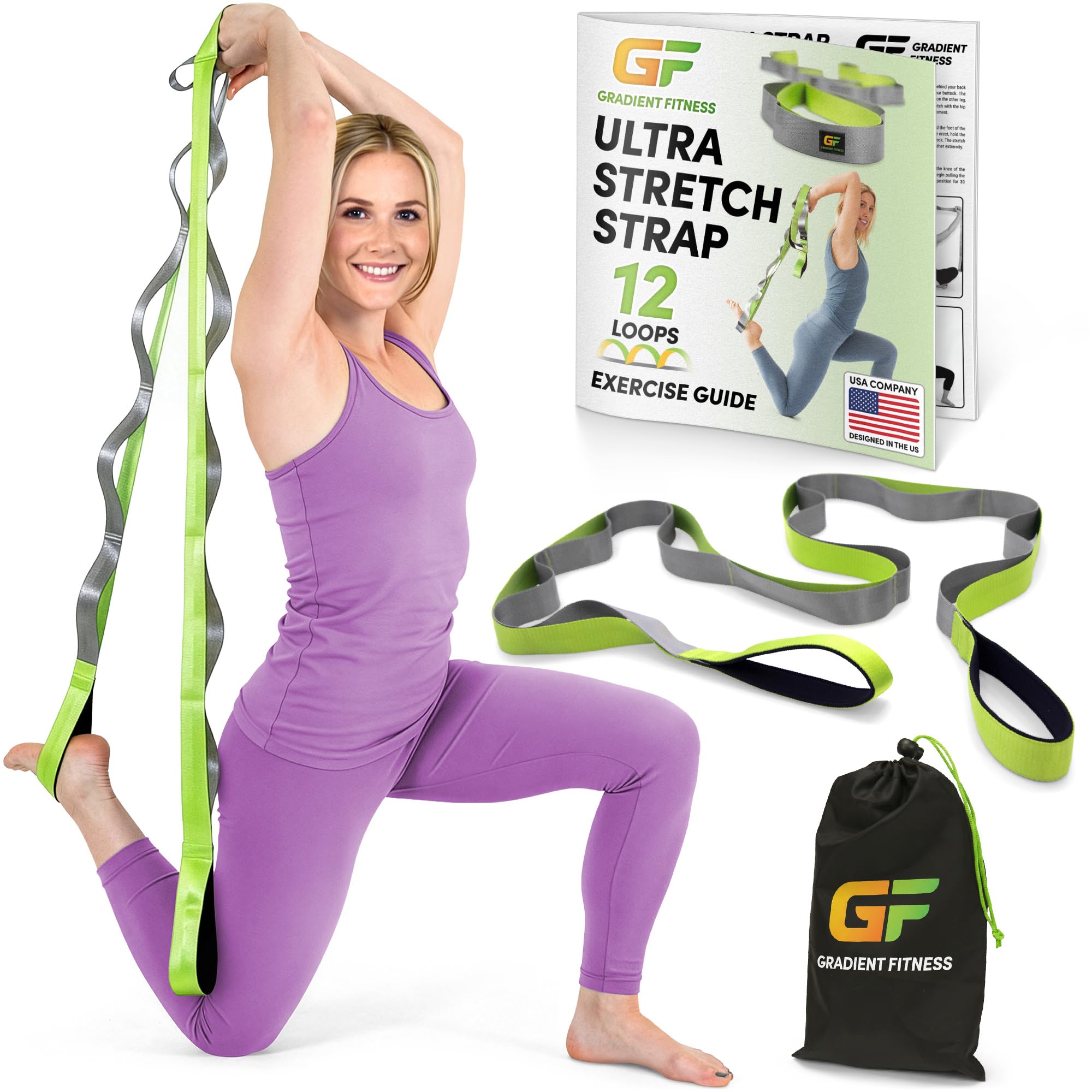
Comfort is the reason to choose the Gradient Fitness strap. The 8-foot, 12-loop design uses wide webbing with padded sections at the ends, so the strap is less likely to dig into your hands or feet during a long hold. That matters for rehab exercises where you are pulling gently but often, and for anyone whose grip gives out before the muscle does.

The 1.5-inch width and SBR padding are the details we appreciate most. The surface is sweat-resistant, which keeps it from feeling slick during a hot yoga session, and the 12 loops create fine adjustments for hamstring, hip, and shoulder stretches. A carry bag and instruction manual come with it, so it is ready to travel between home and the gym.

The Gradient is not the lightest or smallest strap here. At 0.21 kg, it is still easy to toss in a gym bag, but the padding and width make it a home or studio tool rather than a minimalist travel pick. If you want a wide, comfortable strap that handles sweaty sessions and sensitive hands, this is the one we choose.

Bottom line: We choose the Gradient Fitness strap when comfort during sweaty or long sessions matters most; its wide padded webbing and 12 loops are built for sensitive hands.

#8

KneeSled Ultra Stretch Strap

KneeSled Ultra Stretch Strap

Rehab tracking

Our Score 9.4/10
Check Price

Worth Noting

  • Costs more than plain loop straps
Loops
10 numbered
Width
1 inch
Length
80 inches
Included
Stretch chart
Read the full review

The numbered loops on the KneeSled are the feature that separates it from a generic strap. Ten loops run along an 80-inch nylon strap, and the numbers let you track how far you are reaching from one session to the next. That is useful after knee, hip, or ACL surgery, when progress is measured in small, repeatable gains rather than a deeper stretch.

We like the 80-inch length because it gives enough slack for heel slides and leg lifts without leaving a pile of excess webbing. The strap is non-elastic, with reinforced stitching and loops generous enough to get a foot in and out quickly. The 1-inch width is standard for this kind of rehab strap, so it is light rather than plush.

An illustrated stretch chart comes with it, which is helpful when you are following a home program and cannot remember the sequence. The strap is designed for controlled, low-load work, not for pulling yourself into a deep yoga pose.

This is a more specialized strap than the OPTP or Trideer. If you are doing general yoga or casual stretching, the numbering will not matter. For rehab where you want to see progress loop by loop, the KneeSled is the one we choose. Follow your therapist's program rather than inventing your own.

Bottom line: We recommend the KneeSled for rehab where you want to track progress loop by loop; the numbered 10-loop design makes repeatable home exercises easier to follow.

How We Chose and Tested Stretching Straps

We started by pulling together a shortlist from brands we already trusted, plus a few highly rated options that kept showing up in physical therapy forums and gym bags. We filtered for straps with clear loop or handle designs, adjustable lengths, and materials that ranged from cotton to nylon to woven webbing, and we kept an eye on price so we had a mix of budget and mid-range options. That left us with 14 straps, which we used for four months.

Testing happened wherever I stretch: on the living room floor during morning mobility, at the gym for post-run cooldowns, and during physical therapy exercises for a lingering hamstring issue. I used each strap at least three times a week, noting how the material felt against my foot, whether the loops stayed put or slid, and if the strap held its length after a hard pull. To check durability, I yanked each one into a deep hamstring stretch, dragged it across a rubber gym floor, and stuffed it into a gym bag without coiling it neatly. I also washed the ones that could be washed, following the care labels, to see if they frayed or shrank.

The most useful straps were the ones that stayed flat under tension and didn't roll up or dig into my arch. I paid attention to stretchiness too—some straps had just enough give to feel forgiving, while others were so stiff they felt like a seatbelt. Versatility came down to whether I could use the same strap for hamstring, quad, and shoulder stretches without needing to switch loops or tie knots. By the end of four months, the straps that survived without frayed edges, stretched-out loops, or a permanent curl earned a spot in the list.

How to Choose Stretching Straps

Loops or a D-ring

Start with how you want to hold the strap. A loop strap gives you fixed grip points, so a hamstring or shoulder stretch is easy to repeat and measure; that is why loop models suit physical therapy and home rehab. A D-ring strap adjusts continuously, which feels more natural in yoga but gives you fewer landmarks. We prefer loops for a rehab plan and a D-ring for studio-style stretching. If you want one strap for both, choose loops first; they are the more forgiving default.

Length and your reach

Length is where most people get caught. A 75-inch strap suits many adults for floor stretches, but it can run short for taller users, overhead shoulder work, or long-limbed bodies. An 8-foot strap gives more slack, though it also takes more room in a bag. Measure your reach by sitting with one leg extended and seeing whether you can hold a loop without rounding your back. If you are close to the end of a 75-inch strap, move up rather than straining.

Width, padding, and hand comfort

A 1-inch strap is light and packable, but it concentrates pressure in the hand. A 1.5-inch strap spreads the load, and padded handles or SBR webbing help further if you have sensitive skin, arthritis, or a grip that fades during long holds. The trade-off is bulk. We choose a wider padded strap for daily home use and a thin webbing strap for travel. If you only stretch for a few minutes at a time, the narrower strap is usually enough.

The guide matters more than the label

Many straps include a booklet, poster, or chart. That is useful if you are new to assisted stretching or following a home program, because the strap alone does not tell you where to put your foot. We prefer a guide with clear positions over a long list of exercises. For rehab, use the sheet your therapist gives you and treat the included guide as a backup, not a replacement.

Frequently Asked Questions

Final Verdict

We recommend the OPTP Stretch Out Strap to most people because it gets the fundamentals right: non-elastic nylon, multiple loops, a light 4-ounce build, and an exercise book that helps a beginner or a PT patient put it to use. It covers physical therapy, yoga, and travel without adding a buckle or a bulky pad.

If hand comfort is the priority, the CTRL Sports strap is the kinder loop strap; if you prefer a D-ring, Tumaz's cotton strap is the one we choose. For taller users who need more reach, SANKUU's 8-foot strap is the better fit. Those are specific needs, not reasons to doubt the OPTP as the default.