Recovery

Best EMS Muscle Stimulators of 2026

An EMS unit sends small electrical pulses through sticky pads to make a muscle contract, which is why the same device can ease a stiff lower back after a long drive or add a little extra work to a workout you'd otherwise skip. The trouble is that the technology is simple enough for anyone to slap a logo on, so the shelf is full of units whose pads curl off after ten minutes or whose booklet assumes a physiotherapy degree. A good one disappears into your routine; the bad ones end up in a drawer by February.

I've spent the past six months with 12 of them — on my own cranky shoulders, my partner's post-run calves, and a friend's tricky knee — and the gap between good and bad rarely showed up where I expected. Pad adhesion matters more than pulse count: a unit with 24 modes and pads that slide is worse than one with six modes and pads that stay put. The ones that earned a permanent spot on the nightstand are below.

#1

TechCare PLUS24

Top Pick
TechCare PLUS24

Daily all-round use

Our Score 9.2/10
Check Price

Worth Noting

  • Modes cycle in a fixed order and aren't explained
Battery
Rechargeable, up to 20 hours
Channels
2, independently adjustable
Included Pads
10 in three sizes
Intensity Levels
20
Read the full review

The pad kit is the first thing we noticed opening the TechCare PLUS24: 10 electrodes in three sizes, with two large rectangles for a back or thigh, six mediums for shoulders and calves, and two small ovals for the tight spots around a knee. Pads are the one part of an EMS kit you buy again and again, and a starter set that covers both a big muscle group and a small joint is worth more than an extra couple of modes.

That kit, the two independently adjustable channels, and a battery rated for up to 20 hours of continuous use are why this is the unit we hand to most people. We ran a shoulder on channel A and a lower back on channel B at different intensities in the same session — the entire point of dual channels — and the large LCD reads clearly at arm's length. It charges over USB-C with both the cable and the wall adapter in the box, and the whole thing disappears into a bag pocket.

The mode library is where it loses a little polish. Programs cycle in a fixed order and the on-screen names are shorthand rather than explanations, so getting back to the setting you liked means scrolling through every variation of the current one. Within a week we had three favorites and stopped exploring. That's fine for a daily routine; it isn't the device for someone who wants to understand the difference between programs.

Bottom line: The kit we recommend to most people: three pad sizes, two independent channels, and a rated 20 hours per charge make a daily routine easy to keep.

#2

AVCOO 3-in-1 TS2301

AVCOO 3-in-1 TS2301

Budget muscle work

Our Score 9.2/10
Check Price

Worth Noting

  • Forty steps means more tapping to climb
Battery
Rechargeable, up to 40 hours
Included Pads
12 in three shapes
Therapy Modes
TENS, EMS, RELAX
Intensity Levels
40
Read the full review

AVCOO's screen shows a human body rather than a list of numbers: you tap the area you want to work and the unit offers programs that suit it. On a device with 30 modes, that's the difference between finding a useful setting in a minute and scrolling a menu trying to remember whether mode 11 was the one that helped your shoulder.

Forty intensity levels and two independent channels back that up, with a rechargeable battery rated for up to 40 hours and 12 pads in three shapes. The RELAX setting is the softest of the three therapies and, in our sessions, the one that got used on a stiff neck after a long day rather than for anything athletic. It clips to a waistband and stays put while you move around the house.

This is our budget pick, and it's where we point someone who wants the most capability for the least outlay. Compared with the CESLIFF it trades the oversized screen for a third therapy mode and a battery rated for 40 hours, which is the better trade for most people. The one thing to accept is more button presses to climb 40 steps — a small annoyance on a sore day, not a reason to look elsewhere.

Bottom line: Our budget pick for anyone who finds 20 intensity steps too blunt: 40 levels, three therapy modes, and a long-rated battery make it the best value here.

#3

CESLIFF 24-Mode TENS EMS

CESLIFF 24-Mode TENS EMS

Low-light sessions

Our Score 9.2/10
Check Price

Worth Noting

  • Housing feels plasticky next to the premium picks
Modes
24
Display
Large backlit LCD
Channels
2, independently adjustable
Intensity Levels
36
Read the full review

CESLIFF's screen is roughly twice the size of most of the displays in this group, with bigger icons and a backlight. That sounds like a small thing until you're flat on your back with pads on a shoulder, holding the unit at arm's length without your glasses, trying to work out whether you're on level 14 or level 24.

It's the unit we reach for when we want to change something mid-session without sitting up, and that is worth more than it sounds — the less effort a change takes, the more likely you are to adjust intensity as the muscle warms up instead of gutting out the rest of the session at the wrong level. You get 24 modes, 36 intensity levels, two independent channels, and four lead wires, so all four pads can go wherever they're needed. The belt clip holds on a waistband while you move.

Two things keep it off the top spot. The housing is plasticky, and while nothing has cracked, it doesn't feel like a device that will survive a gym bag for years. And the modes are numbered rather than explained, so you'll find two you like and ignore the other 22. Neither is a dealbreaker at this end of the range; both are the reason the TechCare gets the recommendation.

Bottom line: If squinting at a small screen mid-session is what stops you using a stimulator, start here: big backlit display, 36 levels, four leads.

#4

Belifu Dual Channel TENS EMS

Belifu Dual Channel TENS EMS

First-time buyers

Our Score 9.0/10
Check Price

Worth Noting

  • Included pads wear out before the device does
  • Thin manual leaves the 24 modes unexplained
Modes
24
Channels
2, independently adjustable
Included Pads
10 reusable pads
Intensity Levels
20
Read the full review

Belifu's dual-channel unit is what we suggest to someone who isn't sure EMS will become part of their week. It arrives charged, with 10 self-adhesive pads, a drawstring bag for the leads, and reusable cable ties — kit that usually gets sold back to you piece by piece. Everything lives in one bag, which is the difference between a device you use and one that ends up in a drawer with its wires snarled.

The controls are the simple kind: A and B channels, 24 modes, 20 intensity steps, and a timer. On a sensitive area like the side of the neck, the gap between one step and the next is noticeable, so start lower than you think you need and walk up. The battery is the quiet strength here — it runs through a long stretch of short sessions and tops up from any USB port, so a dead unit is one you forgot to plug in rather than one that ate batteries.

Pads are the compromise. The gel on the included set gives up before the machine does, and once a corner lifts the current stings instead of working the muscle. Buy a spare pack with the unit and this stays a very sensible first device; skip that and you'll be ordering pads in the middle of a good routine. The manual is thin too, which leaves the 24 modes more or less unexplained.

Bottom line: Buy this to try EMS without committing much. It arrives charged with a full pad kit, and it's simple enough that you'll actually keep using it.

#5

Comfytemp 3-in-1 TENS Unit

Comfytemp 3-in-1 TENS Unit

Custom routines

Our Score 9.0/10
Check Price

Worth Noting

  • Soft buttons need a firm press
Modes
20 plus a DIY mode
Timer
10–60 minutes
Included Pads
10 in two sizes
Intensity Levels
20
Read the full review

A DIY mode is what separates Comfytemp's unit from the rest of the budget field: set the pulse width and frequency yourself, save it, and run it whenever you want. Most people will never open that menu, and we think that's a shame — it's the feature that lets you clone the one preset you like and slow its ramp so it doesn't hit all at once.

Around it, the design is friendly. A 3-inch screen shows a body map, the timer runs from 10 to 60 minutes, and there are 10 pads in two sizes with two independent channels to run them. The charge holds up across plenty of short sessions and it tops up over USB rather than eating batteries. If you like the idea of a big screen but want more control than the CESLIFF offers, this is the middle ground.

The trade-off is granularity. Twenty intensity levels is the shortest ladder here, and on a sensitive spot the jump between levels is felt rather than eased. The housing is light too, with soft buttons that need a firm press. Neither matters if the unit lives on a nightstand; both matter if it's going in a bag.

Bottom line: For tinkerers, a DIY mode and a body-map screen give you control the presets don't — as long as you don't need the finest intensity ladder.

#6

iSTIM EV-805

iSTIM EV-805

Multi-site sessions

Our Score 9.0/10
Check Price

Worth Noting

  • Steep learning curve on 24 programs
  • Costs several times the budget picks
Battery
Rechargeable, backlit display
Channels
4, independently adjustable
Programs
24 preset, 5 TENS and 3 EMS
Included Pads
24 pads
Read the full review

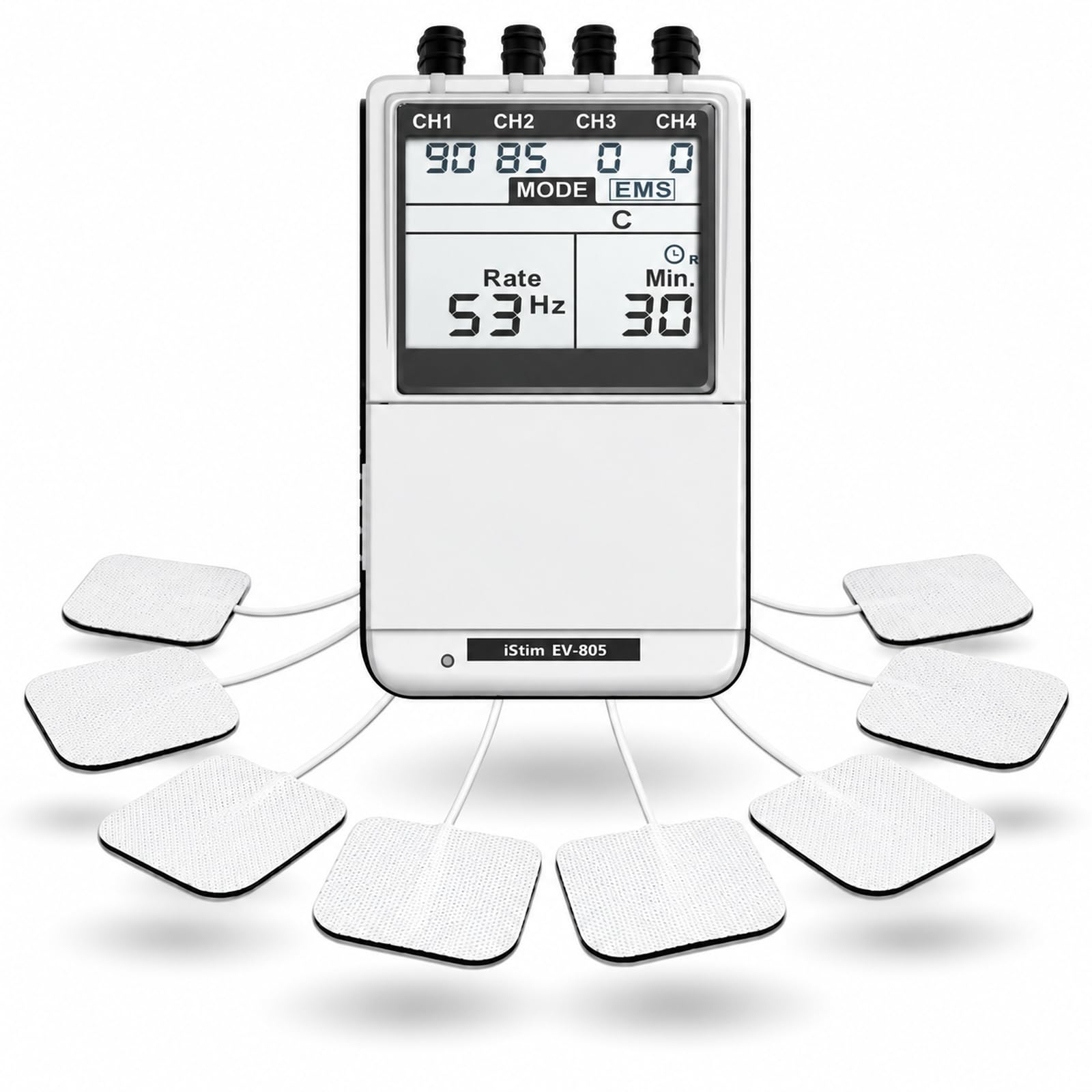
Four channels is the whole reason to consider the EV-805. Two channels treat two areas; four let you work both quads and both hamstrings, or a lower back and both shoulders, without stopping to move pads between muscle groups.

Each channel adjusts on its own, and the 24 programs break into 5 TENS modes and 3 EMS modes with variations. Output is the other thing you notice: on legs we stayed in the bottom third of the range, and the contraction is strong and clean rather than sharp. It comes with 24 Japanese-gel pads in several sizes, a backlit screen, a storage case, and a rechargeable battery that goes several sessions between charges.

It is not a beginner's device. The buttons are numerous, the manual assumes some familiarity, and there's a real learning curve before you're confident about which program belongs on which muscle. Set against that: the build feels clinical, the case keeps everything together, and the pads are better than the ones in the budget kits.

We recommend it for two specific buyers — a household where two people treat different areas in the same session, and anyone rehabbing one muscle group who wants four pads on the same limb at once. If neither describes you, the TechCare does the daily job for a fraction of the outlay.

Bottom line: The choice for working several muscle groups at once: four independent channels and 24 programs, worth the premium only if you'll use them.

#7

AUVON 3-in-1 TENS Unit

AUVON 3-in-1 TENS Unit

Midrange flexibility

Our Score 9.0/10
Check Price

Worth Noting

  • Only two pad shapes, so small joints share the square
Modes
24
Charging
USB-C
Included Pads
12 in two sizes
Intensity Levels
40
Read the full review

Sitting between the budget units and the TechCare, the AUVON is the sensible middle: 24 modes, 40 intensity levels, two channels, and 12 pads — eight small squares for joints, four large rectangles for a back — with USB-C charging instead of a proprietary cable.

The 40 levels do real work. On a thin-skinned area, the step between one level and the next is the difference between a contraction you can hold and one you want to shake off, and the extra steps mean you rarely have to choose between too little and too much.

The kit is generous by the standards of this group: a dozen pads with a holder that keeps the gel clean between sessions, and a screen that shows the functions in plain enough terms that setup takes minutes rather than an evening. It's small enough to sit in a pocket while you work at a desk, which is where a lot of these sessions actually happen.

We recommend it when the finer ladder matters to you and the CESLIFF's big screen doesn't, or when you want a bigger pad kit than the Belifu includes without stepping up to the TechCare. Buy it somewhere with straightforward returns: the housing is the lightest here, and a unit can give out after a few months, so register the warranty the day it arrives.

Bottom line: A sensible middle: 40 intensity levels and a 12-pad kit without the premium outlay, though buy it somewhere with an easy return.

#8

Beurer EM59

Beurer EM59

Heat plus stim

Our Score 8.4/10
Check Price

Worth Noting

  • Pads struggle to stay put once heat is on
Timer
5–100 minutes
Channels
2, independently adjustable
Programs
64 preset plus 6 custom
Therapy Modes
TENS, EMS, and heat
Read the full review

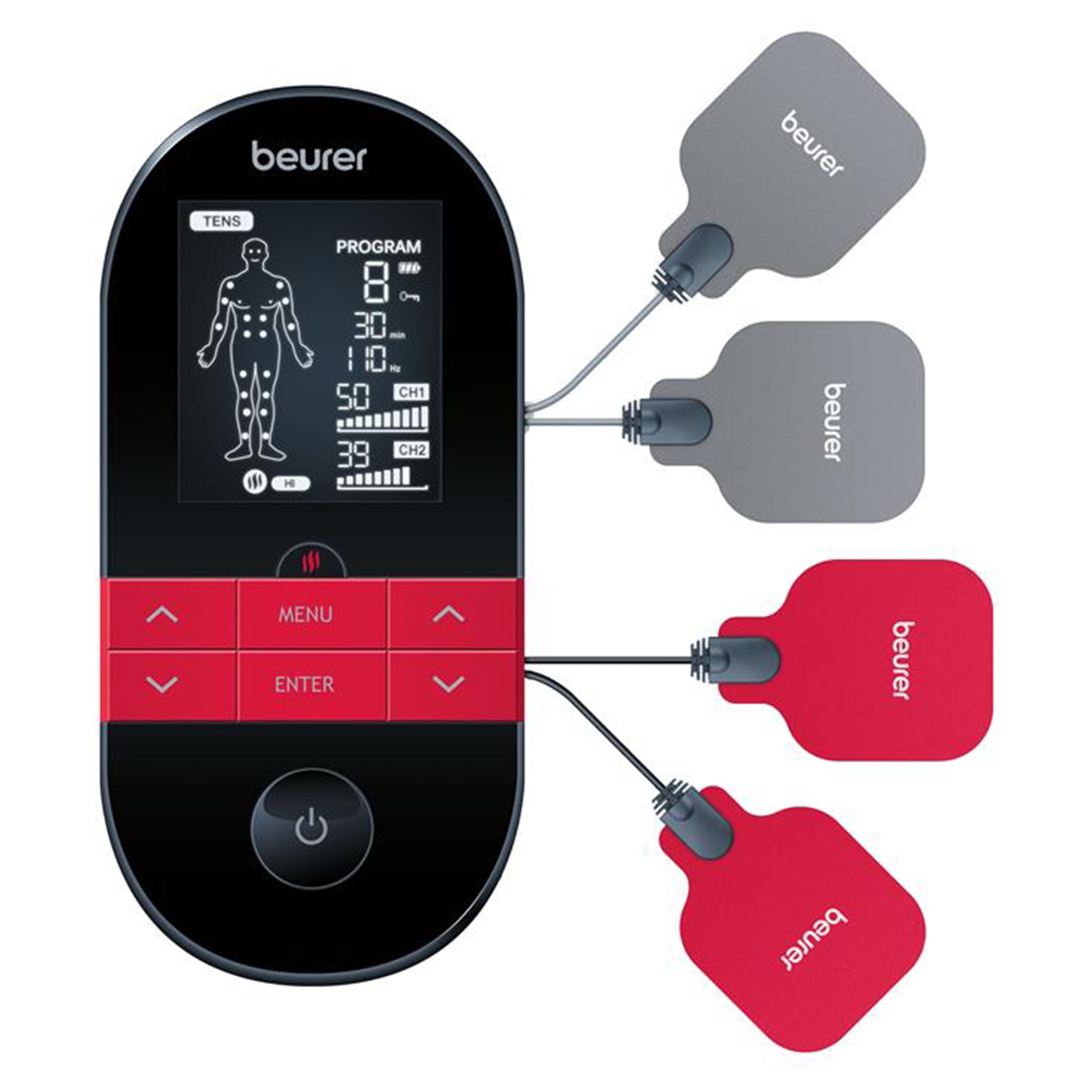
Heat is the feature nothing else in this group has. The EM59 adds a warming setting alongside the pulses, and for a chronically stiff shoulder or a lower back that knots every evening, warmth plus stimulation is a different experience from stimulation alone — closer to a treatment than a workout.

Around that sit 64 preset programs and six slots you configure yourself, two independently adjustable channels, a 5-to-100-minute timer, and a screen that shows where to put the pads for what you've chosen. That guidance is genuinely better than the numbered-mode approach the cheaper units use: you pick lower back, not mode 17. It's light, it clips to a waistband, and the battery goes a long stretch of sessions.

We think it's the best pick here for daily work on one stubborn area, because heat, a long timer, and real placement guidance add up to more than the sum of their parts. The pads are the part we'd change: a warm electrode that lifts at the corner stings, so press them down firmly and keep a spare set on hand. If heat isn't what you're missing, the iSTIM gives you more channels for similar money.

Bottom line: The only unit here with heat, which makes it our pick for a chronically stiff shoulder — provided you keep a spare set of pads.

How We Tested the Best EMS Muscle Stimulators

We started by gathering every EMS unit we could find that was actually in stock, then narrowed the field by the things that matter before you ever turn one on: whether replacement pads were easy to buy, whether the unit was rechargeable or ran on disposables, how many channels it had, and whether the instructions were written in plain English or translated badly enough to turn pad placement into a guessing game. We also priced out a year of replacement pads, since that's where the ongoing cost of owning one of these actually lives. That left us with 12 units, which we used for six months.

Testing happened where these devices really get used — in a desk chair at 9 p.m. after a day hunched over a laptop, on the kitchen floor with a calf propped on a stool after a run, in the passenger seat on a long drive with a locked-up lower back. We stuck the pads on, ran a full 20-to-30-minute session, then stood up, bent over, and walked around to see whether the pads held or started peeling at the corners. After each session we washed them the way the manual instructed and kept count of how many sessions they lasted before they stopped gripping.

Battery life got timed rather than guessed: we ran each unit from full charge to dead on the highest intensity we'd realistically use and wrote down the minutes. For ease of use, we handed the manual to someone who'd never touched an EMS unit and watched whether they could place the pads and choose a program without asking us a single question. We logged whether the programs felt genuinely different from one another or were the same pulse under twelve different names, whether the intensity steps jumped too fast to be comfortable, and asked every tester to rate their discomfort before and after each session so we could tell which units were doing real work and which were just buzzing.

How to Choose an Ems Muscle Stimulator

Channels Decide What a Session Can Cover

Two channels mean four pads and two treatment areas; four channels mean eight pads and four areas at once. If you're working one shoulder in the evening, two channels is all you need, and every pick here except the iSTIM has them.

If two people share the unit, or you're treating both legs after a run, count the areas before you buy. Moving pads mid-session resets the routine and breaks the warm-up, which is the real reason the multi-channel machines cost more.

Intensity Steps Beat Mode Counts

Twenty-four or thirty modes reads like a feature list, but in practice almost everyone settles on two or three programs and never leaves them. Intensity levels are what you touch every single session. A 20-step ladder can jump from a comfortable contraction to an unpleasant one on a thin-skinned area like the front of the shin, while 40 steps give you somewhere to land in between.

Ten extra modes add almost nothing to a routine. Ten extra intensity steps change how the device behaves on a sore neck, which is why the finer ladders here (AVCOO, AUVON, CESLIFF) are worth paying attention to.

Budget for Pads, Not Just the Device

Electrode gel is a consumable, and it's where a cheap unit stops being cheap. Pads lose tack as the gel picks up oil and lint, and a corner that lifts turns a smooth contraction into a sting. Store them on their plastic film between sessions and buy a spare pack with the device rather than after the first one fails.

Kits that include three pad sizes — the TechCare and the AVCOO — cover a broad back and a small joint out of the box, which saves a second order and means you can start on the area that actually hurts.

Rechargeable Over 9V

A rechargeable unit rated for 20 or 40 hours runs weeks of 20-minute sessions between charges. A 9V unit drains in days and quietly becomes a drawer resident. Check that the cable is USB-C rather than proprietary and that the box includes a wall adapter; several kits here ship with the cable but not the plug.

Treat runtime ratings as best-case figures. Charge when the battery indicator drops rather than waiting for the unit to shut off halfway through a session, and keep the cable with the unit rather than in a drawer of mystery cables.

Output and Where It Matters

EMS works by making a muscle contract, and the difference between a capable unit and a weak one is whether you feel that contraction or just a prickle on the surface. More intensity levels and a stronger output ceiling give you room to work a large muscle like a quad without jumping straight to a clench.

Start lower than you think you need and walk up over the first few minutes. The muscle groups that need the most current are the ones with the most tissue over them — glutes and quads — while the neck and forearm need very little.

Frequently Asked Questions

Final Verdict

After eight units, the TechCare PLUS24 is the one we recommend without a caveat. Two independently adjustable channels, three pad sizes, and a battery rated for 20 hours cover a daily routine better than any extra mode count, and nothing about it needs a workaround.

The requirement that changes our answer is heat: if stiffness is the problem and pulses alone haven't moved it, buy the Beurer EM59. And if two people share the unit, the iSTIM's four channels save you swapping pads in the middle of a session.