Recovery

Best Calf Stretchers of 2026

A calf stretcher is simple: an incline for your foot, a place to lean, and a stretch you can repeat without thinking. The problem is that a bad one slides, tips, or puts your ankle at an angle that feels like a balance test instead of relief. I've used stairs, rolled mats, and wall leans—all free, none especially kind to bare feet. A good stretcher fixes the guesswork by holding your foot steady so you can relax into the stretch.

Over six months, my team and I used nine calf stretchers, from wooden boards to padded wedges, and the differences came down to sturdiness, fit, and whether the stretch reached the calf. A steeper angle isn't automatically better; if your heel lifts or your foot slides, you cheat the stretch without noticing. We also watched for quality and durability after repeated use, and weighed whether each earned its place for pain relief and value. The picks below are the ones we kept reaching for.

#1

StrongTek Wooden Slant Board

Top Pick
StrongTek Wooden Slant Board

Home calf stretching

Our Score 9.6/10
Check Price

Worth Noting

  • Heavy at nearly nine pounds to move between rooms
Weight
8.97 lb
Material
Lauan hardwood plywood
Deck Size
16 x 12.5 inches
Incline Settings
15, 20, 25, 30 and 35 degrees
Read the full review

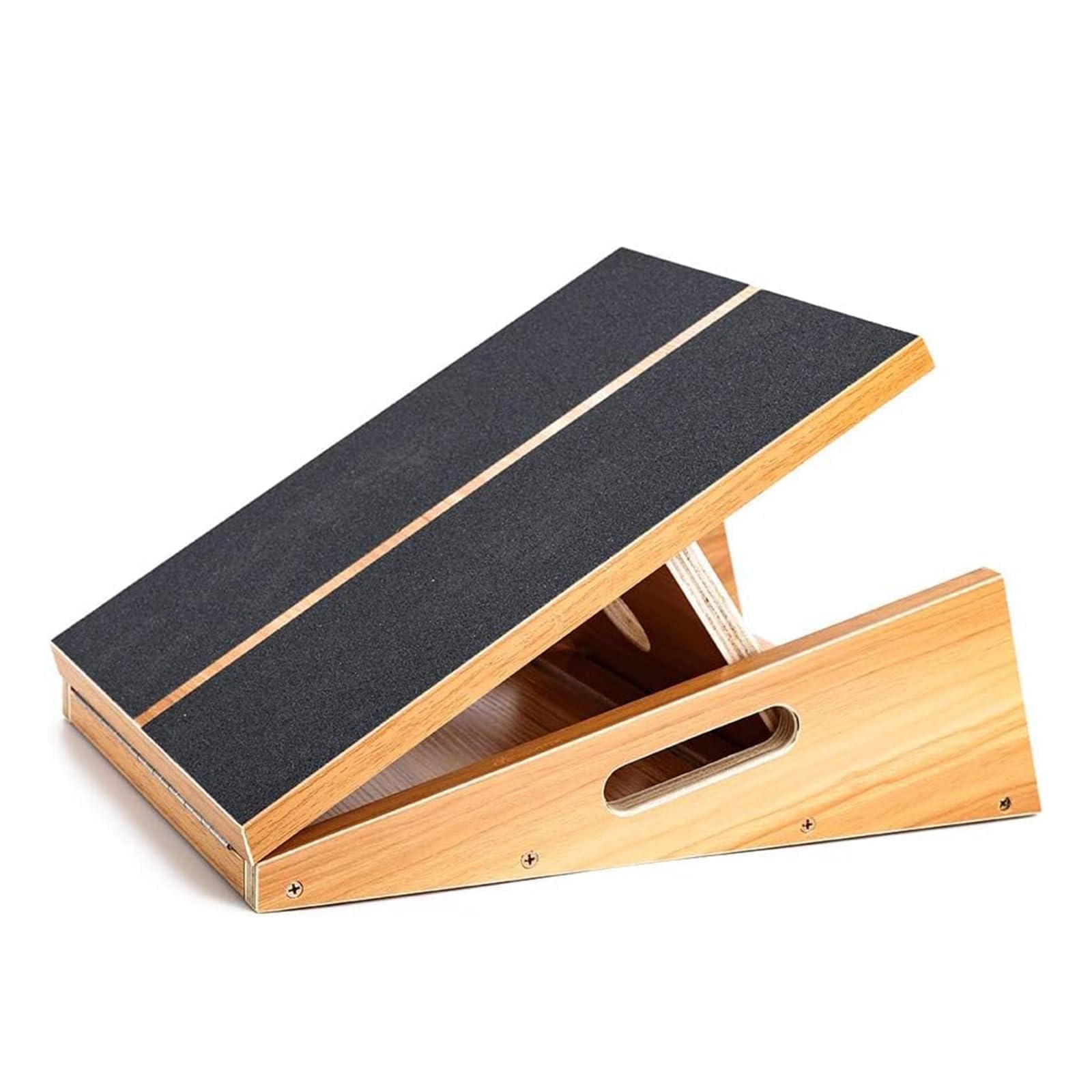
Fifteen degrees is the least dramatic number on the StrongTek board and the one that matters most. It is the gentlest of five settings, and it is the reason we point most people here: a calf that has been tight for weeks can settle into a 15-degree incline and let go, where a steeper board turns the same stretch into a contest. The steps run 15, 20, 25, 30 and 35 degrees, so the thing keeps working as the calf loosens.

Part of why it feels so calm underfoot is the build. The Lauan hardwood plywood is thick and finished like a small piece of furniture rather than gym equipment, and the deck is wide enough at 16 by 12.5 inches for both feet side by side. That is the quiet advantage over a single-foot rocker: you can stand there with one hand on a doorframe and stretch both calves at once, hands free, for as long as you like. The side handles are the detail we ended up appreciating most, because they turn picking it up and leaning it against a wall into a one-hand job.

The top setting is where the board gets serious. We treated 35 degrees as something to build toward rather than a daily stop, and that spread between the first and last step is what justifies owning a board instead of borrowing a stair. If the price gives you pause, the MUCITAGF covers the identical five angles and claims more capacity; what the extra buys here is the heavier, better-finished deck and a design that has been on the market since 2018.

Bottom line: We recommend it to anyone who wants one board to take a tight calf from a cautious first stretch to a serious one; the five-angle range and hardwood build earn the price.

#2

MUCITAGF Wooden Slant Board

MUCITAGF Wooden Slant Board

Value wooden board

Our Score 9.4/10
Check Price

Worth Noting

  • Does not fold, so it stays where you leave it
Warranty
3 years
Assembled Size
16 x 12.5 x 6 inches
Weight Capacity
500 lb
Incline Settings
15, 20, 25, 30 and 35 degrees
Read the full review

The MUCITAGF board covers exactly the same ground as our top pick, 15, 20, 25, 30 and 35 degrees, with a different set of numbers behind it: a 500-pound capacity, a three-year manufacturer warranty, and a plywood deck measuring 16 by 12.5 inches. It also costs meaningfully less, which is the first thing most people notice about it.

Second place rather than first, then, and still the board we suggest most often to someone setting up a first home gym. The plywood is a step down in finish from the StrongTek's hardwood, though the frame underneath is reinforced and the standing surface is textured, with a slip-resistant base, so socks and bare feet both hold. What settled it for us is the capacity: 500 pounds ties the best figure any wooden board here claims, and it means a shared household can leave it out without wondering who is going to stand on it.

Three years of warranty is the other thing worth knowing, because a slant board is a purchase you make once and then stop thinking about. At 3.85 kg it is light enough to shift between rooms without planning, and the integrated side handles mean you can carry it one-handed with the other hand free for a wall.

Bottom line: Our pick if the StrongTek's price gives you pause: the same five angles, a 500-pound rating and a three-year warranty make this the value buy of the group.

#3

ProStretch Original

ProStretch Original

Plantar fasciitis relief

Our Score 9.0/10
Check Price

Worth Noting

  • 250-pound weight limit rules some users out
Type
Foot rocker
Weight
14 oz
Weight Limit
250 lb
Fits Shoes Up To
Adult size 12
Read the full review

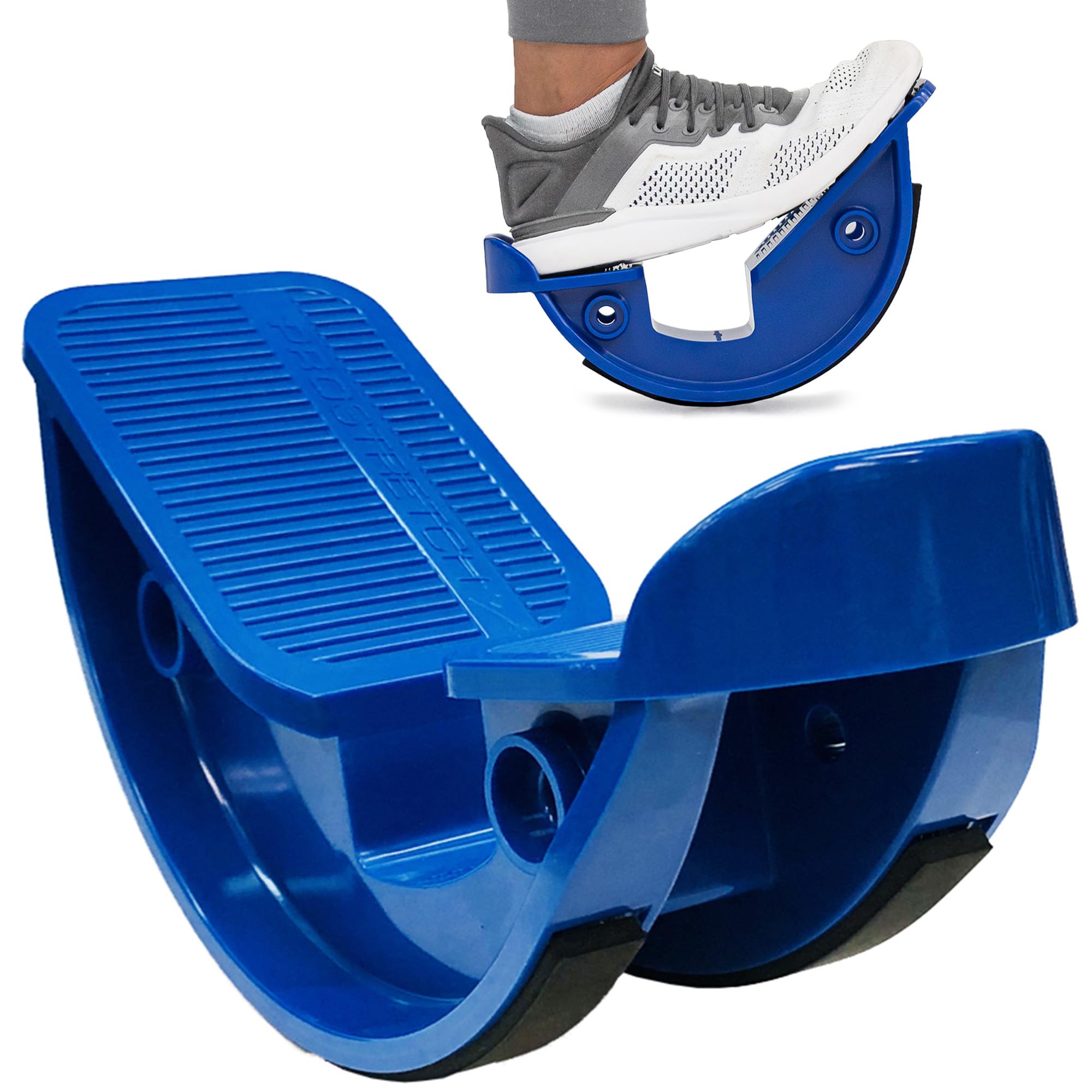
The ProStretch is not a board you stand on and hold. It is a rocker you pivot over, with the foot locked in a cradle and the heel dropping as the frame tips forward, and that shape is why we recommend it specifically to anyone whose trouble starts in the arch or the Achilles rather than in the belly of the calf. The rocker keeps the foot in the position that puts the stretch through the plantar fascia and the lower leg instead of letting the ankle quietly roll away from it.

It works one foot at a time, which sounds like a drawback until you use it: the balance point forces a slow, controlled movement instead of the bouncing most of us default to. The rubber strips underneath held it steady on our floor, and at 14 ounces it goes into a gym bag without a second thought. Two conditions come with it, both from the instructions: athletic shoes and socks, which genuinely make the stretch cleaner, and adult shoe sizes up to 12.

It is a foot tool first and a calf tool second, and the stretch it gives is narrower than a board's. What it does better is isolate the plantar fascia and the Achilles, which is why it earns its place next to a board rather than replacing one. The rubber strips under ours are still doing their job after repeated sessions, and nothing about the frame feels like it is going to give.

Bottom line: Buy this one if plantar fasciitis or an angry Achilles is the reason you are here; the rocker shape targets the foot in a way a flat board does not.

#4

NOONCRAZY Wedge Set

NOONCRAZY Wedge Set

Small spaces

Our Score 9.0/10
Check Price

Worth Noting

  • Slides on glossy floors without a mat
Weight
10.6 oz
Material
EPP foam
Block Size
12 x 6 x 4.9 inches
Weight Capacity
960 lb
Read the full review

Ten and a half ounces. That is the whole NOONCRAZY set, two wedge blocks that stack into different angles, and it is why this is the one that ends up living in a desk drawer rather than behind a door. The EPP foam is dense rather than spongy, and the pair claims a 960-pound capacity, which sounds far-fetched until you stand on it and feel how little it gives.

The angles come from stacking rather than a hinge: use the shallower wedge alone for a gentle stretch, add the steeper one underneath for more, or put one under each foot and stretch both calves at once. The top surface is textured and grips socks or bare feet, and each block is 12 by 6 inches, wide enough to take a full shoe when you stack them for calf raises or squats.

Where it falls short is the feel underfoot. Foam is not wood, and on the steepest stack you can sense the blocks flexing slightly, which is fine for stretching and less reassuring once you start loading them. For a tight calf in a small flat, at a fraction of what the boards cost, none of that matters much, and the set wipes clean in a second.

Bottom line: For apartments, desks and gym bags, nothing here beats a pound of foam that stacks to five angles and disappears into a drawer.

#5

TEMI Folding Slant Board

TEMI Folding Slant Board

Small homes

Our Score 9.0/10
Check Price

Worth Noting

  • Starts at 20 degrees, steeper than our top picks
Storage
Folds flat
Material
High-density hardwood
Weight Capacity
500 lb
Incline Settings
20, 25, 30 and 40 degrees
Read the full review

The hinge is the whole idea here. The TEMI collapses flat, so a board that would otherwise stand in a corner can go behind the sofa or into a closet between sessions and come back out with one hand. In a small apartment, that is the difference between a stretching habit and a board you stop noticing.

Unfolded, it gives you four settings, 20, 25, 30 and 40 degrees, a 500-pound capacity, and a textured non-slip deck with a built-in handle. The hardwood is dense and the edges are finished properly; nothing about it feels like a folding table, which is the thing we were braced for.

Folding hardware is still hardware. Every hinge is a place where a board can loosen over time, and a folding board takes more load through its joints than a solid one does, so check the hinge and the deck edges when it arrives and keep half an eye on them afterwards. Ours has been fine, but that is the part of this design worth watching.

What we like most is that the fold does not cost you the things a board is for: the deck is big enough for both feet, the 40-degree top end goes steeper than either of our top two picks, and it comes back out of the closet without a fight. If you have the floor space to leave a board out, the StrongTek is the better board. If you do not, this is the one that gets used.

Bottom line: The one we point to when the board has to disappear between sessions: it folds flat, holds 500 pounds, and reaches a steeper angle than either top pick.

#6

PowerStep UltraFlexx Foot Rocker

PowerStep UltraFlexx Foot Rocker

Trying a rocker

Our Score 9.0/10
Check Price

Worth Noting

  • Short 10-inch platform crowds larger feet
Type
Foot rocker
Weight
14.1 oz
Use With
Sturdy athletic shoes
Dimensions
10 x 5 x 1 inches
Read the full review

Ten inches long, five wide and about a pound, the PowerStep UltraFlexx is the smallest thing in this guide. It is the same idea as the ProStretch, a rocker that holds your foot at an angle while you shift weight forward, built into a shorter, lighter plastic frame with a non-skid bottom.

Used as intended, with sturdy athletic shoes, it does what a rocker should. The non-skid base keeps it from walking across the floor, and the shape keeps the heel down and the ankle from rolling out, so the stretch lands in the calf and under the arch. It stows in a gym bag or under a desk, which is the reason it survives in a house that already owns a board.

We think of it as the try-it-out rocker. It costs less than the ProStretch, it takes up almost no room, and if the motion does not suit your foot you have not sunk much into finding out. What it does not offer is the ProStretch's longer track record or its rubber build, so treat it as the entry point rather than the long-term tool.

Bottom line: A cheap, compact way to find out whether a rocker suits your foot before spending more on the ProStretch.

#7

DMoose Foot & Calf Stretcher

DMoose Foot & Calf Stretcher

Travel and stretching

Our Score 8.8/10
Check Price

Worth Noting

  • Not hands-free: you hold the pull
Included
Digital exercise guide
Hand Loops
7
Foot Padding
8 mm neoprene
Strap Length
52 inches
Read the full review

The days you most need to stretch a tight calf are often the days you least want to stand on a board. That is the case for keeping a strap around. The DMoose is a 52-inch nylon strap with a padded neoprene cradle at one end, seven hand loops along its length, and two hook-and-loop straps that close over the foot.

We reach for it when we are already on the floor. Foot in the cradle, heel seated, pull the strap toward you and the calf stretches while you lie back or lean against a couch, with no balance required and no chance of the ankle cheating the angle. The 8 mm padding is what makes that comfortable rather than a chore, because the pull lands across the sole of the foot instead of biting into the arch. It handles hamstrings and hips the same way, and it packs down to nothing.

Fit is the caveat. The cradle is generous, and on a smaller foot the heel can sit shallow unless you seat it deliberately before pulling, which is the difference between a good stretch and a strap that slides off mid-pull. The included digital guide is worth a look for exactly that reason, since foot placement is the whole trick with a strap.

Bottom line: We keep this strap for the days we cannot be bothered to stand up: it travels flat, pads the foot, and stretches the calf from a doorway or a hotel floor.

How We Tested the Best Calf Stretchers

To build the shortlist, I read specs and customer reviews for more than 30 calf stretchers, then narrowed the field to nine based on adjustable angles, surface grip, materials, footprint, and price. We skipped models with vague sizing, loose hinges, or a shape that only worked for one foot position. Over six months, the same nine lived in my living room, beside the kitchen counter, and in a gym bag, so they got used before morning coffee, after evening walks, and between sets at the gym.

Sturdiness came first: I shifted weight side to side, leaned forward at the steepest setting, and noted whether the base slid on hardwood, carpet, or rubber gym flooring. For fit, testers with women's size 6 through men's size 12 tried each one barefoot, in socks, and in sneakers, and we marked where heels lifted, toes crowded, or ankle cups pressed. To judge the stretch itself, we held each position for 30 to 60 seconds and checked whether the heel stayed down and the pull landed in the calf rather than the arch. We also asked testers to note pain relief the next morning—less tightness on stairs, easier first steps—rather than relying on how it felt in the moment.

Quality and durability were judged after repeated use: we looked for cracks, compressed padding, wobbly joints, and worn grip. Value came down to how often each stretcher got picked up without being a hassle to store or set up. The models that scored best made the stretch easy to repeat, not just intense the first time.

How to Choose Calf Stretchers

Start With the Shape, Not the Brand

Four kinds of tool turn up in this category, and they solve slightly different problems. A slant board is a static incline you stand on: it stretches both calves at once, hands free, and gives you a progression of angles, which makes it the best default for a home. A rocker holds one foot in a cradle and pivots, biasing the stretch toward the plantar fascia and the Achilles, and that is the tool to pick if the arch rather than the calf belly is the sore spot.

A strap is for stretching lying down, which is what makes it the travel and small-space pick. Foam wedges are the cheapest route to an incline and the easiest to stash. If two of those descriptions fit your week, buy for the one you will do most often.

The Lowest Angle Decides Whether You Use It

On a slant board, the smallest number matters more than the largest. A genuinely tight calf needs a gentle first step: 15 degrees is comfortable for most people, 20 is workable, and a board that starts at 30 turns the first stretch into a fight you will lose interest in. Steep angles are easy to add later, which is why our two top boards run 15 to 35 degrees and our folding pick starts at 20.

Ignore the top of the range as a selling point. Almost nobody needs 45 degrees in the first month, and the buyer who pays extra for a steep maximum often ends up on the second-lowest setting anyway.

Grip, Capacity, and the Floor Underneath

The detail that decides whether you trust the thing is what it does on your floor. Grip tape and textured decks handle socks and bare feet well, but a light foam wedge can skate on polished wood, so plan on a rug or a mat if that is what you have. A heavier board is less likely to shift, which is part of what the weight buys.

Read the capacity figure too: 250 pounds on the ProStretch, 500 on the wooden boards, higher claims on the foam. If you share the stretcher with a heavier partner, buy for them rather than for yourself.

Storage Decides Whether You Keep Using It

A calf stretch takes two minutes, and the tool that lives within arm's reach gets used. A nine-pound hardwood board is a fine thing to leave beside a couch and a poor thing to carry upstairs every day; a folding board, a one-pound wedge, or a strap in a bag solves the same problem differently.

Before you choose, decide where the stretcher will live, then buy the one that suits that spot. It matters more than a couple of degrees of incline.

Frequently Asked Questions

Final Verdict

The StrongTek board is the recommendation we make without a caveat: five angles that start gently enough for a genuinely tight calf, a hardwood deck that does not shift, and handles that make a heavy board easy to live with. If the price is the sticking point, the MUCITAGF covers the same angles and rates higher for capacity. If the pain sits in the arch rather than the calf, the ProStretch is the better tool, and the DMoose strap is the one for a bag.

Start with a board unless you know you will not stand on one. It is the version of this purchase that people keep using past the first month, and the adjustable angle is what keeps a calf progressing once the first setting stops feeling like a stretch.