Home Gym

Best Power Towers

The top of a pull-up is where a cheap power tower gives itself away: the frame rocks back a half inch, the dip bars rattle against the uprights, and you spend more energy bracing than pulling. A solid one fixes that and a handful of other problems at once — a pull-up bar, a dip station, and an anchor for leg raises and push-ups, all in one compact footprint that tucks into a corner instead of taking over a room.

I've had a tower parked in my home office for three years, and the spec sheet never tells you the two things that actually matter: whether the base stays planted at the top of a hard set, and whether the height adjustment still lines up cleanly after a few months of use. My team and I assembled and trained on 12 towers over eight months, from budget frames to heavy steel ones, and the price gap didn't reliably predict the winner. A tower that wobbles quietly becomes a clothes rack; the ones below are the ones we kept coming back to.

#1

Mifaso 12-Outlet Power Tower

Top Pick
Mifaso 12-Outlet Power Tower

Tight budgets

Our Score 9.6/10
Check Price

Worth Noting

  • One master switch controls every outlet
Max Load
15A / 1875W
USB Ports
2 USB-A + 2 USB-C
AC Outlets
12
Surge Rating
1080 joules
Read the full review

Count what is already on the desk: two monitors, a dock, a lamp, speakers, a phone cable, a tablet cable, and the brick for something you have forgotten. That is eight outlets before anyone brings a laptop in, which is why the twelve on this tower matter more than any single feature. Mifaso stacks them around four sides and adds four USB ports, two of them USB-C.

The rating is what separates it from the cheaper end of this category: 15A and 1875W, the highest load figure in this group alongside one other pick. That is enough headroom for a small space heater or a laser printer sharing the tower with your desk gear. Surge protection is 1080 joules and the plug head is 0.35 inch, so it tucks behind furniture instead of holding it off the wall.

Six feet of cord is the limit to plan around: fine beside a desk, short in a room where the outlet is behind the sofa, and in that case the 10-foot SUPERDANNY is the better buy. Within that reach there is little to complain about. The plug is flat enough to hide, the button resets a tripped breaker, and the tower gets on with its job without asking for attention.

Bottom line: The value pick: 12 outlets, two USB-C ports, and a 15A rating that leaves room for a heater as easily as a phone, for the smallest outlay here.
#2

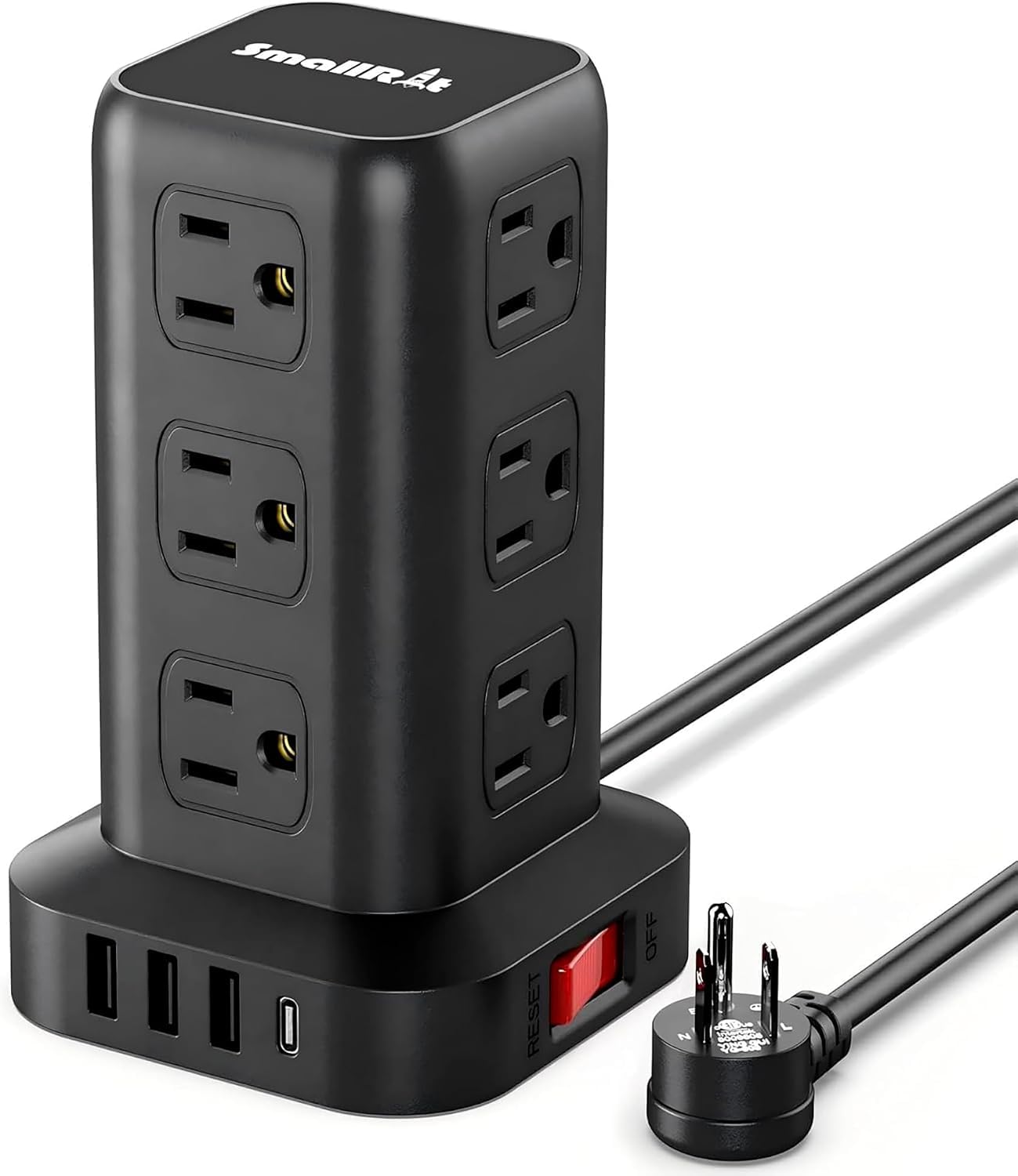
SMALLRT 12-Outlet Power Tower

SMALLRT 12-Outlet Power Tower

Narrow shelves

Our Score 9.6/10
Check Price

Worth Noting

  • Only one USB-C port
  • Pricier than the top pick with no extra ports
Cord
6.5 ft
Footprint
5.7 x 3.38 in
USB Ports
3 USB-A + 1 USB-C
AC Outlets
12
Read the full review

One face of this tower is 3.38 inches, which is the measurement that matters when the only free surface is the strip of counter beside a microwave or the gap between a bed and a wall. The octagonal body comes in a black finish that reads as furniture rather than office equipment, and the base carries an anti-slip mat so it does not skate when you pull a plug.

The rest is conventional and well executed: 12 AC outlets, four USB ports with one USB-C, a 6.5-foot cord, and overload protection with a reset switch. Total USB output is 3.4A shared, with each USB-A capped at 2.4A and the C port at 3A. It is a 10A tower, so it is happiest with desk gear, a monitor, a lamp, a laptop and a printer, rather than anything that heats a room.

USB-C is where it gives ground to the top pick: one port instead of two, and the same 3.4A ceiling to share between them. It also costs more than several towers here that hand you more sockets for less.

It keeps its place because we think the finish and the base are better than most, and because a tower that looks like a black column rather than a plastic toy is worth something on a bedside table. If your devices are mostly AC and your space is narrow, this one earns the shelf; if you are charging three phones and a tablet every night, the second USB-C port on our top pick is worth more than the nicer housing.

Bottom line: A narrow, well-finished tower with 12 outlets and a steady base; buy it for a tight shelf, not for USB-C charging.

#3

AiJoy 12-Outlet Power Tower

AiJoy 12-Outlet Power Tower

Matching a room

Our Score 9.6/10
Check Price

Worth Noting

  • 3.1A shared across four USB ports
  • 1200 joules, below the leaders here
Cord
10 ft
USB Ports
3 USB-A + 1 USB-C
AC Outlets
12
Surge Rating
1200 joules
Read the full review

Purple is why some people will pick this one, and we are not going to pretend otherwise. A tower that sits on a dresser or a console table is visible, and a finish that matches the room is a legitimate reason to choose it over a slightly better-specified grey box you would want to hide.

It is not a compromise on paper: 12 AC outlets arranged around four faces, four USB ports made up of three USB-A and one USB-C sharing 3.1A, 1200 joules of surge protection, a 10-foot cord, and separate power buttons rather than a single master. The two-year warranty is the longest in this group alongside two others.

Against the picks above it is mid-pack on USB, with 3.1A shared across four ports and a single USB-C, which means phones charge overnight rather than quickly. The 1200-joule rating also sits below the 1800-joule leaders. What lifts it into the roundup is that it does the big things properly, 12 usable outlets, a long cord, a stable base, and does them in a finish you can leave out in the open. Fewer people have lived with this one than with our top picks, and that is the only reason it sits lower.

Bottom line: The one to buy when the tower has to look good in a room: a real colour choice, 12 outlets, and a 10-foot cord.

#4

UWIWUTEI 16-in-1 Power Tower

UWIWUTEI 16-in-1 Power Tower

Most desks

Our Score 9.4/10
Check Price

Worth Noting

  • Four USB ports share just 3.4A
Cord
6 ft, 0.3 in flat plug
USB Ports
2 USB-A + 2 USB-C
AC Outlets
12
Surge Rating
1800 joules
Read the full review

Twelve outlets on a base that measures 3.15 inches square is the whole argument for this tower. Stand it in the back corner of a desk and the sockets climb rather than spread, so the space it claims is roughly what a mug claims. At the other end, the plug is only 0.3 inch deep, which lets a desk or a nightstand sit almost flush against the wall instead of being pushed out by a plug head.

This is the tower we recommend first, because it gets the unglamorous things right. The 12 outlets are wide-spaced, so a laptop brick and a monitor plug can live side by side instead of fighting over one gap, and two of the four USB ports are USB-C, where several picks here give you just one. The 1800-joule surge rating is the highest in this group alongside one other pick, and the tower stands 5.79 inches tall, so it disappears behind a monitor.

The USB budget is the part we mind. Four ports share 3.4A, so a phone charges steadily rather than quickly, and a tablet plus a phone splits what is there. If your desk is mostly USB-C devices, the TenTrend's dual 20W ports are the better buy. For the lamp, the monitor, the dock, and the spare charger, it simply does the job and disappears behind them.

Bottom line: We point anyone consolidating a desk at this one: 12 widely spaced outlets, two USB-C ports, and 1800 joules of surge protection on a base the size of a mug.

#5

SUPERDANNY 9-Outlet Power Tower

SUPERDANNY 9-Outlet Power Tower

Long reach

Our Score 9.4/10
Check Price

Worth Noting

  • Master switch cuts every device at once
  • Nine outlets, the fewest in this group
Cord
10 ft
USB Ports
2 USB-A + 2 USB-C
AC Outlets
9
Surge Rating
1080 joules
Read the full review

Ten feet of cord is the reason to pick this over the top pick. That is the difference between a tower beside your chair and one on the floor behind the sofa, and it is the first measurement we check for a bedroom, where the socket tends to be behind the bed. The base weighs 1.6 pounds, so when you pull a stiff adapter out one-handed, the tower stays where you left it instead of tipping over.

Nine AC outlets is three fewer than the leaders here, but they are distributed around the tower, so chunky adapters clear each other. The four USB ports include two USB-C and share 4.5A, which is more headroom than the top pick gives a phone and a tablet together. Surge protection is rated at 1080 joules, and a master switch on top cuts power to everything at once.

Its 5.5-inch square base is the widest in this group, which is the number to check before you give it a shelf corner. Otherwise it is a plain grey column that hides under a monitor stand, and after living with it we stopped noticing it, which is about the highest compliment a power strip can earn.

Bottom line: Buy this one when the outlet is across the room: a 10-foot cord, a weighted base that stays put, and two USB-C ports with more shared output than the rest.

#6

TenTrend 20-in-1 Power Tower

TenTrend 20-in-1 Power Tower

Charging-heavy desks

Our Score 9.4/10
Check Price

Worth Noting

  • Can tip when every port is loaded
Cord
10 ft, 0.27 in flat plug
Footprint
3.4 x 3.4 x 6.5 in
USB Ports
8, incl. dual 20W USB-C
AC Outlets
12
Read the full review

Two 20W USB-C ports are what separate this tower from everything else in the group, and it is the difference we kept coming back to. That is the wattage a phone actually asks for, so the charger in your drawer can stay there: plug the cable into the tower and the phone charges at the rate it was designed for rather than the trickle a shared port gives it. Most towers here treat USB-C as a checkbox; this one treats it as a charger.

The rest of the specification is generous too: 12 AC outlets plus eight USB ports, which is 20 devices on one column, and a housing made from a fire-resistant ABS and polycarbonate blend rated to 1382°F. The plug head is 0.27 inch, the thinnest in this group, and the cord runs 10 feet, so a desk against a bare wall is not a problem.

Weight is the compromise. Load every port with thick cables and it can tip when something snags a cord; run the stiff adapters low and the phone cables high and it settles down. Twenty ports on a 6.5-inch column also invite a tangle, so a pack of cable ties earns its keep with this one.

Bottom line: For a desk that charges as much as it powers, this is the one: two 20W USB-C ports and eight USB outlets in total, alongside 12 AC sockets.

#7

PASSUS 12-Outlet PD18W Tower

PASSUS 12-Outlet PD18W Tower

Shared workspaces

Our Score 9.4/10
Check Price

Worth Noting

  • Only one USB-C port among five
Switches
4 independent
USB Ports
4 USB-A + 1 USB-C
AC Outlets
12
Surge Rating
1800 joules
Read the full review

Four switches, one per side, change how the tower gets used. You can leave the router and a monitor running on two faces, kill the bank feeding three phone chargers overnight, and never reach behind the desk to do it. That sounds like a small thing until you have crawled under a desk at midnight to unplug a charger.

The hardware underneath is solid: 12 AC outlets set 1.7 inches apart, which is enough clearance for most adapters, five USB ports, and 1800 joules of surge protection, the joint-highest rating in this group. The cord runs 10 feet and the base is 4.84 inches square, so it stands steady on a counter without taking much room.

Of the five USB ports only one is USB-C, and it is an 18W PD port, which is fine for a phone and not for a laptop; the four USB-A ports run 2.4A each. That mix suits a shared space, where most of what gets plugged in is a phone or a tablet, better than it suits a single user with a USB-C laptop and nothing else. If that is your desk, the TenTrend's dual 20W ports are the better match.

Bottom line: Built for a table several people share: four side switches let you kill the banks nobody is using and leave the router and monitor running.

How We Tested 12 Power Towers at Home

We started with a long list pulled from customer reviews, then narrowed it by cross-checking stated weight capacity, assembled footprint, pull-up bar height range, and the steel gauge each brand was willing to disclose. That left 12 towers, which we built ourselves — some in spare bedrooms, some in garages, one in a living room whose other occupants were very patient — and lived with for eight months.

Each tower stayed assembled for at least three weeks. We did pull-ups and dips on them before work and again after dinner, noting how far the frame shifted at the top of a hard set and whether the grips twisted under sweaty hands. Every base got measured with a tape, then walked around, since a tower only saves space if you can still reach the closet behind it. Where the bars adjusted, we moved them up and down repeatedly to see whether the pin slid in cleanly or needed a second person and a shove.

Halfway through and again at the end, we went back over every pad and joint, checking for compressed foam, loosened bolts, and chipped paint. What separated the winners was rarely a feature on the box — it came down to whether the welds held and whether the padding survived daily use. On value, we asked what the extra spend actually bought: thicker steel and a wider base, or nicer packaging and a logo.

How to Choose Power Towers

Count outlets, then check the gaps

Twelve outlets sounds better than nine until you try to use the two next to a laptop brick. Wide-spaced sockets — the PASSUS lists 1.7 inches between them — are what let adapters share a tower without blocking each other. Count the plugs with a brick on them rather than the cables you own: a laptop supply, a monitor supply, and a speaker brick each need room that a phone cable does not.

Our rule is to plan on one blocked neighbour per adapter, then buy one or two outlets more than the count suggests. If your gear is mostly slim plugs and cables, a nine-outlet tower with generous spacing serves you better than a cramped twelve.

Read USB wattage as a shared budget

Almost every box here says four or five USB ports including USB-C, and that tells you very little. What matters is the total: 3.4A across all ports is roughly 17 watts, which is a slow lane once two devices are plugged in. 4.5A is better, and a single PD port rated at 18 or 20 watts beats both for one phone on a deadline.

USB-C on its own does not mean fast charging. Look for a stated PD wattage instead of a port count, and expect the tower to divide its USB budget among whatever is connected.

Cord length and the flat plug set the address

Six feet is enough when the outlet sits beside the desk; 10 feet is what lets the tower live where you want it rather than where the wall allows. The plug head matters just as much. The flat designs here run from 0.27 to 0.35 inch deep, the difference between a bookcase sitting flush and standing an inch off the wall.

Measure along the floor from the outlet to the spot you have in mind, then add a foot of slack so the tower is not hanging from the socket by its plug.

Weight and switching decide how it lives

A tower loaded with adapters gets pulled every time a cable is yanked, and a light one follows the cord across the desk. A heavier base, like the 1.6 pounds on the SUPERDANNY, plus a rubber foot is what keeps it planted.

Switching splits the group in two. A master button suits a desk you shut down at night; per-side switches suit a table where one person's charger should not cost another person's router. Decide which of those is your desk before you pay for either.

Joules, amps, and the limits of a tower

Surge ratings here run from 1,080 to 1,800 joules. More is better, but all of them are sacrificial parts: a tower that takes a big hit, buzzes under load, or runs hot should be replaced rather than repaired.

Check the amperage against what you plan to plug in. A 15A tower on a 125V circuit is rated around 1,875 watts, and a space heater can eat most of that by itself. Anything that heats belongs on its own wall outlet, not in a tower with your monitors.

Frequently Asked Questions

Final Verdict

For most desks, the UWIWUTEI 16-in-1 is the one to buy: 12 wide-spaced outlets and two USB-C ports in a footprint you will forget about, with 1800 joules behind them and a base small enough to sit at the back corner of anything.

Two situations call for something else. If the nearest outlet is across the room, the SUPERDANNY's 10-foot cord and weighted base solve a problem the top pick cannot. If phones and tablets are most of what you charge, pay for the TenTrend's dual 20W USB-C ports, which is the one gap the top pick leaves open.