Cardio Machines

Best Cardio Machine for Weight Loss

Every cardio machine looks sensible in the store and turns into a very expensive coat rack by March. The one that survives that fate usually isn't the one with the biggest screen — it's the one you can step onto without thinking, adjust mid-interval without breaking stride, and use at 6 a.m. without waking the house. That's what a good machine actually fixes: it takes the commute, the class schedule, and most of the excuses out of your week.

I've owned two treadmills I regretted and one rower I still use, and the difference was never the feature list — it was how the thing felt at minute 20. Over the past six months, my team and I assembled, rode, and sweated through seven cardio machines to find the ones that hold up past the honeymoon. What we kept running into is that the reasons people quit — resistance that jumps in ugly steps, a deck that bottoms out, a frame that wobbles when you pick up the pace — never show up on a spec sheet. The picks below are the ones that stayed solid.

#1

MERACH Exercise Bike

Top Pick
MERACH Exercise Bike

Daily home cardio

Our Score 9.0/10
Check Price

Worth Noting

  • No upper-body engagement, unlike the rowers here
Drive
Belt
Dimensions
40"D x 22"W x 45"H
Weight Capacity
300 lb
Resistance Levels
100
Read the full review

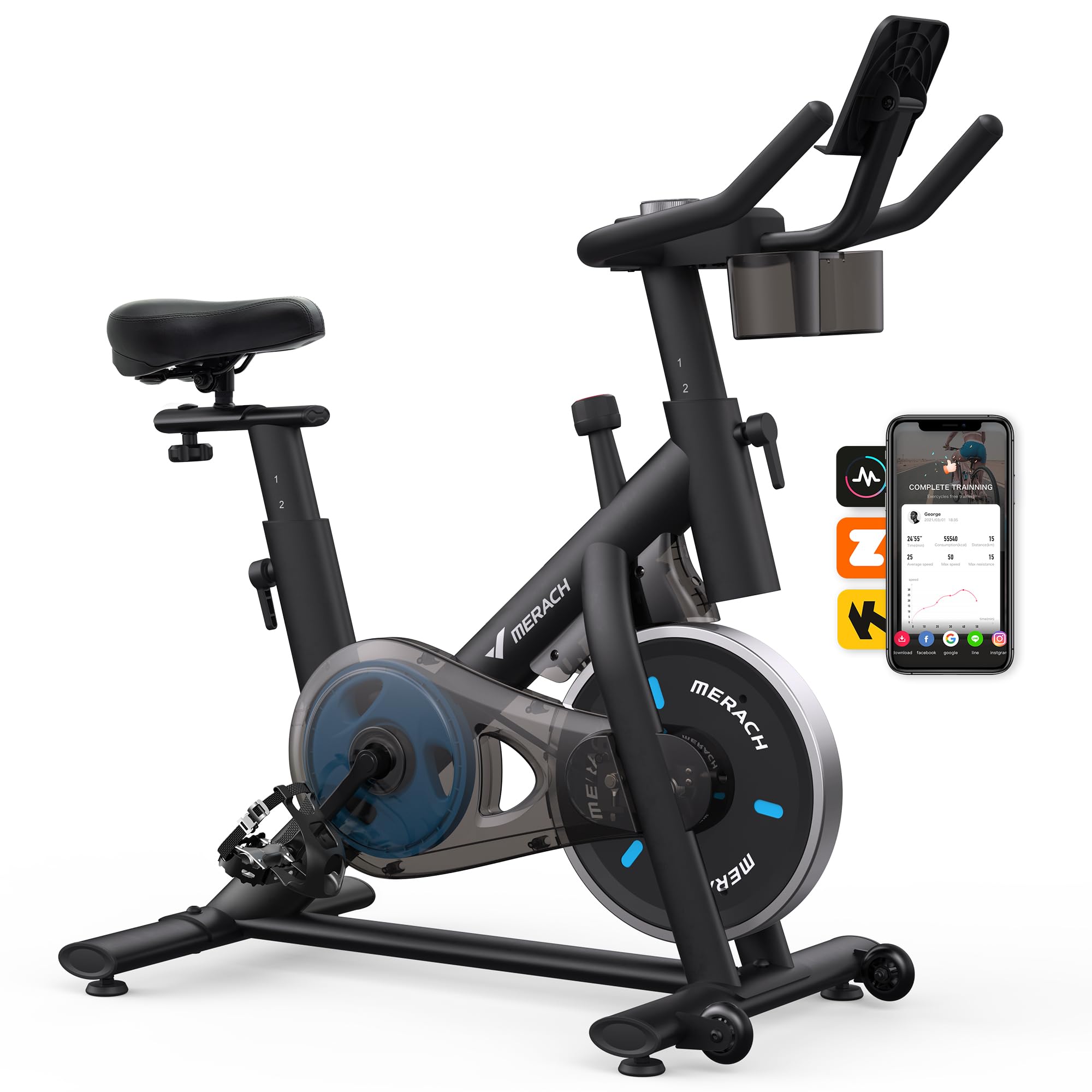
Quiet is the feature we care most about on an indoor bike, because the machine you can use without the whole household knowing is the machine that gets used. The MERACH runs a belt drive rather than a chain, and Merach's own figure puts the noise below 25 dB. We take the number loosely — what matters is that the ride stays smooth and hushed from an easy spin to a standing climb, with none of the whirr that builds up on a cheap chain drive.

The rest of the package supports that habit. A heavy steel frame with a triangular brace keeps the bike planted when you stand up to pedal, and it carries a 300-pound rating. The seat and handlebars both adjust through a wide range, so two people of different sizes can share it, and the resistance dial moves in fine steps instead of jumping from easy to brutal. We also appreciate the unglamorous details: transport wheels, two bottle holders, caged pedals, and a device cradle that puts the free Merach app, or an episode of something, at eye level.

The saddle is the one part to plan around. It is firm, half an hour is roughly where it stops being comfortable, and a gel cover or a replacement seat is worth ordering with the bike rather than after the third ride. Assembly is straightforward, and the footprint, 40 inches deep by 22 wide, asks for about as much floor as a coffee table.

Pedaling is the least technical movement in this group: no stroke to learn, no balance to hold, nothing to think about except the show you are watching. For someone who wants to climb on five evenings a week, that simplicity is worth more than any extra resistance level.

Bottom line: Our default pick for home cardio: quiet enough for an apartment, stable enough to stand and pedal, and adjustable enough that two people can share it.

#2

Sunny Smart Magnetic Rower

Sunny Smart Magnetic Rower

Full-body sessions

Our Score 8.8/10
Check Price

Worth Noting

  • Resistance tops out early for fit rowers
Rail Length
45.7 in
Resistance Type
Magnetic
Weight Capacity
300 lb
Storage Position
Upright
Read the full review

The first thing to know about any budget rower is where the resistance stops. On the Sunny, the top of the dial is a fair pull for a beginner and a modest one for someone who already rows, and a strong user ends up holding the highest setting for a whole session. If you are fit and want a machine that keeps fighting back, that ceiling matters more than the number of levels on the label.

We still put it at the top of the rowers here, because everything else is right. Magnetic resistance is smooth and quiet enough to row in front of the television without touching the volume, and the dual-rail base stays solid when you push the pace. The rail gives taller rowers room, the seat is padded, and the foot straps hold without fiddling. Upright storage is the detail we appreciate most in a small place: tip it against a wall and it takes a corner instead of the middle of the room.

It asks more of you than a bike does, though. A stroke is a sequence — legs, then body, then arms — and rushing it puts the load on your lower back, so ten minutes of attention in the first week pays for itself. The monitor shows time, distance, calories, strokes per minute and a 500-meter split, which is more than enough to keep a session honest.

Assembly is mostly painless, though the final section of rail is easier with a second pair of hands. What you get for the floor space is the most complete workout in this group: you finish with your heart rate up and your arms, back and legs all aware they did something.

Bottom line: The rower we recommend for a full-body session at home — quiet, solid, and easy to stand against a wall, provided you are not already a strong rower.

#3

Marcy Foldable Upright Bike

Marcy Foldable Upright Bike

Small apartments

Our Score 8.8/10
Check Price

Worth Noting

  • Only eight resistance levels, so coarse jumps
Frame
Folds for storage
Dimensions
32.5"D x 16"W x 44"H
Weight Capacity
250 lb
Resistance Levels
8
Read the full review

The Marcy's trick is simple and, for anyone in a one-bedroom, decisive: the frame folds. Set up, it is an upright bike with a small footprint. Done, it collapses into something you can stand in a closet or behind a door. We think that single feature is worth more than the extra resistance levels a bigger spin bike offers, because a machine you can put away is a machine that does not take over your living room.

It is not a stripped-down toy otherwise. Eight levels of magnetic resistance cover easy spinning through to a decent hill, the ride is quiet enough for early mornings, and the frame holds steady when you push. Assembly is quick, and the console runs on its own batteries, so there is no cable to route across the floor. The seat adjusts for different riders and the display tracks time, speed and distance — the basics, done without fuss.

Two things to weigh. The frame is rated to 250 pounds, the lowest rating here, so heavier riders should move up to the MERACH instead. And the upright position puts more weight through the saddle than a forward-leaning spin bike does, which makes a gel cover a sensible add-on from the start.

Where it earns its place is the corner of a room you never intended to use for fitness. If you have ruled out a cardio machine because you do not have a spare room, this is the one that changes the arithmetic.

Bottom line: For a small flat or a room that has to do several jobs, this folding bike is the practical answer — just check the weight rating before you commit.

#4

Sunny Compact Hydraulic Rower

Sunny Compact Hydraulic Rower

Budget rowing

Our Score 8.8/10
Check Price

Worth Noting

  • Rail feels short above about 6 ft 2 in
Dimensions
58.1"D x 20.1"W x 24.8"H
Item Weight
22.4 lb
Weight Capacity
300 lb
Resistance Levels
12
Read the full review

Of the two rowers here, this is the one for a room with about five feet of wall and nothing more. At 22.4 pounds it is the lightest full-size machine in the group, light enough to tip onto its end and tuck beside a bookcase, yet the frame still carries a 300-pound rating. That combination is rare in this set, and it is most of the reason to look at it.

Hydraulic resistance is the trade-off, and it is worth understanding before you order. The cylinders warm up as you row and the pull softens with them, so a session that starts at a hard setting finishes feeling like a moderate one; you end up clicking up a notch or two partway through. That is fluid resistance behaving normally rather than a fault, but it makes this rower a better fit for steady half-hour sessions than for intervals where you want the same load every round.

We like the inclined rail. The seat sits slightly downhill, so your body weight feeds the leg drive and the stroke asks more of your quads and glutes than a flat-rail design. At a conversational pace it is quiet; go hard and it gets loud. Tall rowers should measure themselves against it, because somewhere around 6 foot 2 is where the rail starts to feel short.

Add the free SunnyFit app, with guided rows and scenic routes on a phone propped in front of you, and you have more than this price class usually offers. Rowers are the machines people most often abandon because they are big and awkward to stow. This one is neither.

Bottom line: The rower to buy when space is tight and sessions are steady — light, compact and rated to 300 pounds, with a resistance curve you learn to work with.

#5

Niceday Mini Stepper

Niceday Mini Stepper

Desk-side movement

Our Score 8.8/10
Check Price

Worth Noting

  • Squeaking can develop within weeks
  • Resistance bands are a wear point
Assembly
None required
Footprint
1.29 sq ft
Resistance Type
Hydraulic
Weight Capacity
300 lb
Read the full review

Steppers promise cardio in the corner of a room with no assembly and no excuses, and the Niceday keeps that promise for the least money here. It arrives ready to step on, it is light enough to carry one-handed, and it takes up not much more than a square foot, which means it stays out beside the sofa rather than going into a cupboard between uses.

The case for it is the ten-minute slot. It is small enough to stand in front of the television, quiet enough that an episode passes while you step, and short-strided enough that you keep a rhythm without thinking about it. Two minutes in, your calves and glutes are working and your heart rate is up. For adding movement to a desk job or a rained-off week, that is real value.

What it is not is a sole cardio machine. The effort comes from how long you keep stepping rather than from anything you build toward, and the monitor, which covers steps, time and calories, is basic. We rate it as the thing that fills the gaps between longer sessions, or as a starter machine for someone who wants to prove the habit before spending more.

Two wear points to watch. The silicone pad keeps the step quiet out of the box, but a squeak can develop within a few weeks and oiling does not always cure it. And the resistance bands are the flimsiest part of the package — check them before each session and stop at the first sign of fraying.

Bottom line: The cheapest way into daily cardio: no assembly, a one-square-foot footprint, and enough of a burn to justify ten minutes while dinner cooks.

#6

Stamina Cardio Climber

Stamina Cardio Climber

Intense low-impact work

Our Score 8.4/10
Check Price

Worth Noting

  • Most expensive machine here by far
Warranty
5 years frame, 90 days parts
Resistance Type
Magnetic
Weight Capacity
300 lb
Resistance Levels
8
Read the full review

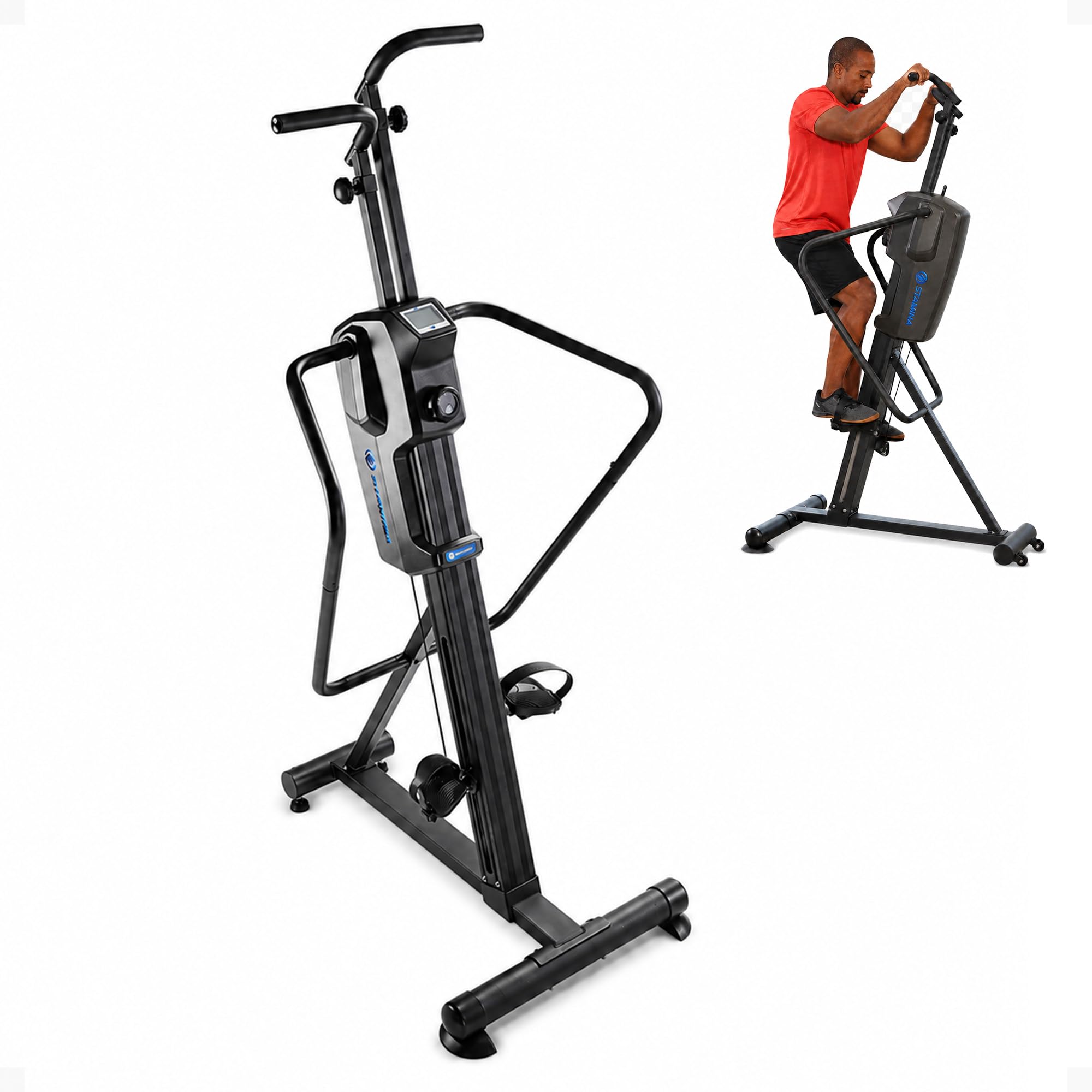
Climbing machines humble people. There is no seat, no flywheel to coast, and no way to fake the stroke: the pedals drop under your weight and you have to drive them back up, over and over, with your arms pulling on the handles for help. This is the machine in the group most likely to leave you winded within two minutes.

We like it for exactly that. Fifteen minutes on the Stamina is a real session, and the eight levels of magnetic resistance are quiet and smooth enough to use in a bedroom. The two sets of handlebars let you push, pull or hold neutral, which shifts the work between your legs, back and arms when one set of muscles has had enough.

The build is serious: thick tubing, a 300-pound rating and a five-year frame warranty, plus transport wheels so you can move it without dismantling anything. Assembly is straightforward, and the phone holder and müüv coaching app are there if you want company while you climb.

Two things to know. It is the most expensive machine here by a wide margin, and there is less real-world history behind it than the bikes and rowers in this group, so you are trusting the design more than a long record. Stand it on a firm, level floor rather than deep carpet, and give the stride a session or two to feel natural.

Bottom line: For short, hard, low-impact sessions this climber delivers more per minute than anything else here — if you can stomach the premium and the shorter track record.

How We Chose and Tested the Best Cardio Machines for Weight Loss

We started with a shortlist of roughly 30 machines sold by major retailers and trimmed it by price, footprint, warranty length, and whether replacement belts, cables, and consoles could actually be ordered. Anything that locked core workout features behind a subscription got cut early. Seven machines made the final list — a mix of treadmills, ellipticals, rowers, and indoor bikes — and each one lived in a real home for six months rather than a showroom.

Every machine came out of the box on a garage floor with a stopwatch running. We noted whether one person could manage the build solo, how many tools it took, and how long it was before the first real workout; one took about 25 minutes, another ate an afternoon and a second set of hands. After that we used them the way people actually do: 30-minute weekday mornings before work, longer weekend sessions, and at least one household member of a different height and weight on each machine.

Every couple of weeks we checked belt tracking, listened for new squeaks, and grabbed the handlebars and seat to feel for play. Mid-workout we watched how resistance responded — whether a jump from an easy setting to a hard one landed smoothly at a walking pace or hit with a jolt during a sprint — and whether anyone could start a workout without opening the manual. Comfort got judged honestly at minute 40, when deck cushioning and seat padding stop being marketing copy, and we rolled each machine through a doorway and over a rug to see if moving it was a one-person job.

At the end, value came down to cost per use against a gym membership and how much of the machine we still trusted after months of daily load. We also logged whether we could genuinely reach a hard effort on each one — heart rate climbing, breathing labored, no death grip on the handles — because a machine that can't get you out of breath isn't doing the job.

How to Choose the Right Cardio Machine for Weight Loss

Consistency Beats Intensity

Weight loss rewards minutes, not heroics. A moderate half hour you repeat five times a week does more than one brutal session you spend the rest of the week avoiding, and that is why the least expensive machine here can outperform the most expensive one. A stepper parked beside the sofa gets used in ten-minute bursts that add up; a rower that lives behind a stack of boxes does not.

So ask what you can face on a Tuesday night. If you want to watch television while you move, a bike or a rower lets you; a climber mostly does not. If your day is fragmented, something with no setup is worth more than something with more resistance.

Check the Resistance Ceiling

Every machine here has a top end, and a budget one reaches it sooner. Fine resistance steps matter more than a big number on the box, because you want to nudge the effort up as your fitness does rather than jump from comfortable to impossible.

The two rowers are the machines to think hardest about. Neither will keep a strong rower challenged forever, and the hydraulic one softens further as its cylinders warm, so the pull you set at the start of a session is not the pull you get at the end. If you are already fit, budget for a machine with headroom; if you are starting from nothing, almost anything will challenge you for a year.

Fit the Room and the Floor

Length is the measurement that surprises people. A rower runs about five feet, the bikes here take roughly 40 by 22 inches, and a mini stepper needs barely a square foot. Then look up as well as down: compact in a listing describes footprint, not height, and the height is what decides whether a machine disappears behind a door or sits in the middle of the room.

Noise is the other half of fit. Belt drives and magnetic resistance are the quiet technologies in this group; stepping machines thump, and hydraulics get louder the harder you pull. Upstairs, a mat under the machine protects both the floor and your relationship with whoever lives below.

Match the Machine to Your Body

Weight ratings here run from 250 to 330 pounds, and the rating is worth checking before anything else — a machine rated below your weight is not a bargain at any price. Fit comes next: an adjustable seat and handlebars let two people share a bike, and rail length decides whether a tall rower feels cramped at the front of the stroke.

Contact points matter too. Budget bikes almost always ship with a firm saddle, and a gel cover is the cheapest upgrade you will make. On a rower, check that the seat is padded and the foot straps hold without constant fiddling, because those are the two things you notice on every stroke.

Decide How Much the App Matters

The SunnyFit and Merach apps cost nothing and add guided sessions and scenic routes; the Stamina pairs with müüv for coaching. Treat connectivity as a tiebreaker rather than a reason to buy. No app rescues a machine you do not enjoy climbing onto, and a phone holder plus one series you only watch while exercising does most of the same job.

Frequently Asked Questions

Final Verdict

Our pick for most people is the MERACH bike. It is the quietest, steadiest, most adjustable machine in this group, and the saddle is the only part you will want to change — which is a good place to be.

If you want your upper body working too, the Sunny magnetic rower gives you more per minute and stores upright against a wall. If floor space decides everything, the Marcy folds into a closet. And if the budget is tight, the Niceday earns its place in ten-minute pieces.