Accessories

Best Punching Bags of 2026

A punching bag is one of the few pieces of home gym gear that can genuinely hurt you when it's wrong: too light and it swings into your ribs, too heavy and every hook rattles your shoulder, badly sealed and you're sweeping sand off the garage floor for a month. What a good one buys you is simpler than that — a stable, forgiving target you can hit hard without thinking about where it's going. Weight is the number most people get wrong; the old rule of thumb is to pick a bag around half your body weight, then adjust for what your ceiling and your floor can actually take.

I've hung bags from a basement beam and watched a cheap one rotate a quarter turn with every cross. Over the past six months, my team and I put eight bags through the same ten-round sessions, from heavy hanging bags to freestanding ones you fill yourself, and the gaps between them came down to stability, seams, and how long assembly really took on a Tuesday night. The ones that earned a spot below all share one thing: you stop noticing them and just train.

#1

Century BOB

Top Pick
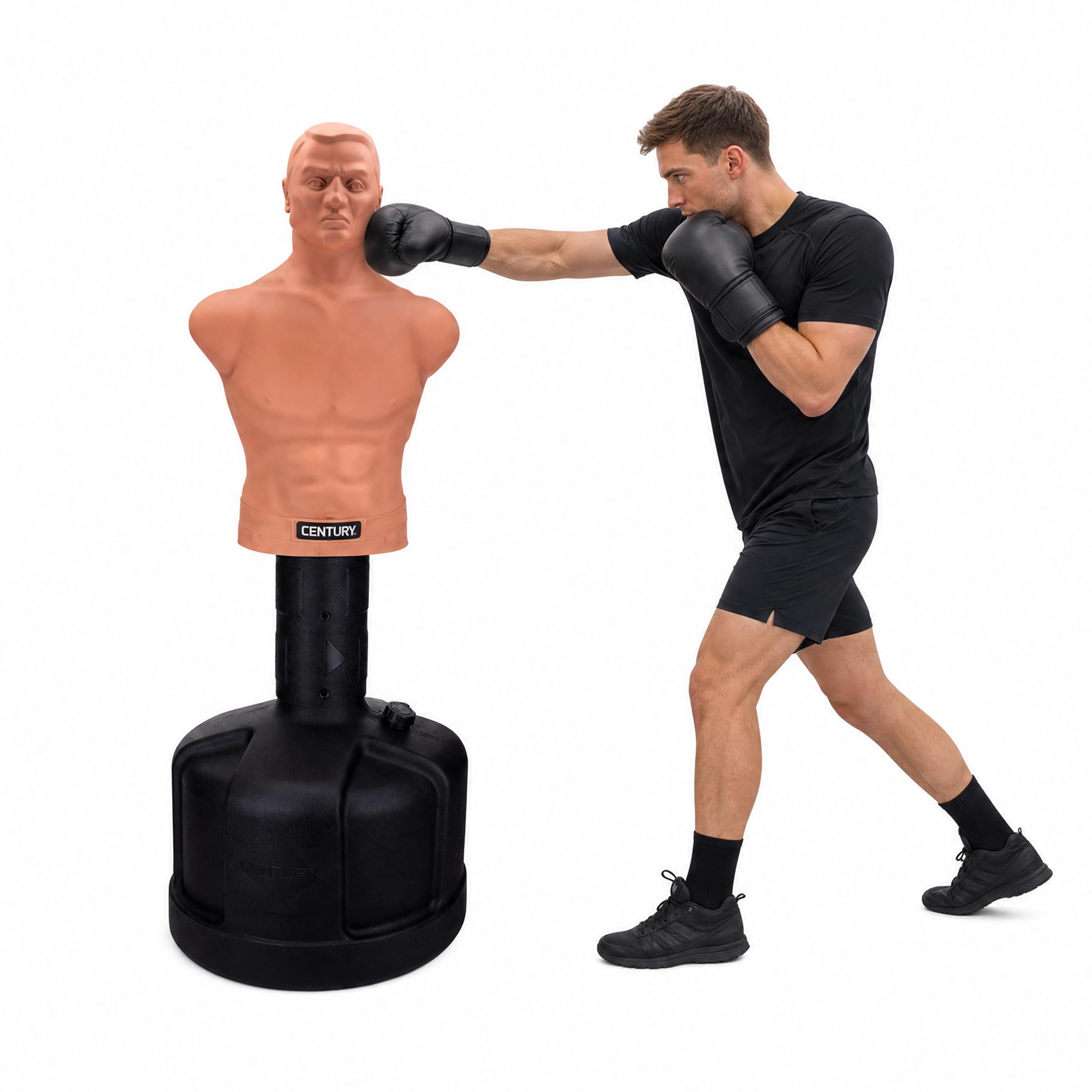
Century BOB

Accuracy without mounting

Our Score 9.6/10
Check Price

Worth Noting

  • Bolt holes can be fussy to line up
  • Base is hard to move once filled
Shell
Plastisol
Empty Weight
37 lb
Height Range
60" to 78"
Base Capacity
Up to 270 lb
Read the full review

Every other bag in this guide gives you a cylinder. BOB gives you a head, a jaw, shoulders, and a torso, and that's the whole argument: you can work a straight right to the chin, then drop a hook to the body, and find out whether your aim holds when the target has a shape. We think it's the most useful freestanding bag here for exactly that reason — a face shows you how loose your punches are in a way a bag never will.

The adjustability is what makes it a household bag rather than one person's toy: seven positions from 60 to 78 inches, the widest range in this group, so a teenager and a six-foot adult can both work head height without moving it. The base takes up to 270 pounds of sand or water, and you feel that weight when you sit down on a combination — it rocks back rather than tipping over. It does travel across the floor under a hard combination, so plan on resetting it between rounds.

What you're paying for is the shape, and the fact that it never touches your ceiling. A plastisol shell wipes down after a session, and there's no chain, no swivel, and no mount to buy — which matters if you rent, or if the only open floor in the house sits under a light fitting.

Bottom line: Buy it when accuracy matters more than power and you can't hang anything: the only human-shaped target here, with a bigger height range than any bag in this guide.

#2

Everlast Elite 80 lb

Everlast Elite 80 lb

First home setup

Our Score 9.6/10
Check Price

Worth Noting

  • Fill can settle unevenly side to side
  • 42-inch body rules out low kicks and knees
Shell
PVC
Included
Chain and tie-down strap
Bag Weight
80 lb
Dimensions
13"W x 42"H
Read the full review

The Elite is the least expensive hanging bag here, and the money went where it should: 80 pounds of sand-and-cloth fill, a PVC shell, and a double-reinforced D-ring with a nylon strap at the top. We were pleasantly surprised by how much of this bag is hang point and strap system rather than graphics, and that's the part that decides whether a heavy bag survives a year.

The detail worth knowing about is the bottom tie-down strap. Anchor it to a floor point and the bag stops swinging on hard crosses, which most bags at this level don't offer; without an anchor you hang it and let it move, which is the normal heavy-bag experience. The 80-pound fill is light enough to move with a straight left and heavy enough that it doesn't bounce off your shin, and the shell wipes down after a session.

Bottom line: The budget hanging bag we point to first: 80 pounds, a reinforced hang point, and a tie-down strap that keeps hard crosses from turning into a swing.

#3

Fairtex HB6

Fairtex HB6

Muay Thai kicking

Our Score 9.6/10
Check Price

Worth Noting

  • Sold unfilled; fill material is a separate purchase
Fill
Unfilled
Shell
Synthetic leather
Dimensions
14.17"W x 70.87"H
Empty Weight
5.25 lb
Read the full review

The HB6 ships empty, and that's the feature: you pick the fill, you decide how hard it packs, and you end up with a bag tuned to your own shins. What arrives is a 70.87-inch synthetic-leather cylinder, 14.17 inches across, with a non-tear lining and heavy straps at the top.

The length is the reason to buy it. A bag this long gives you a surface from head height down past your knees, so low calf kicks, front pushes, and knees all land on something instead of air. The 14-inch width is a bigger target than the slim 11-inch Ringside, which makes round kicks and body work more forgiving — and clinch work a little harder, because there's more bag to get your arms around.

Filling takes an evening and a serious amount of material, and packing it firmly the first time saves you topping it up in a month. Do it properly and the shell is the nicest-feeling surface here: smooth, thick, and pleasant against a bare shin.

What settles it for us is control. Firm packing gives you a bag for power work; looser packing gives you volume and speed, and no other bag here lets you make that call. If you've filled a bag before, or you enjoy the tinkering, it's worth the effort; if you want to hang something and hit it the day it arrives, the pre-filled Ringside is the same idea without the homework.

Bottom line: The best-feeling long bag here if you're willing to do the filling: premium synthetic leather, a shape built for knees and low kicks, and firmness you control.

#4

Ringside Powerhide 100 lb

Ringside Powerhide 100 lb

All-round training

Our Score 9.4/10
Check Price

Worth Noting

  • Firm fill is hard on bare knuckles
Shell
Powerhide synthetic with foam liner
Included
Chain and swivel
Bag Weight
100 lb
Dimensions
14"W x 43"H
Read the full review

A hanging bag is judged by what it does after the punch lands. At 100 pounds with a soft, dense fill, the Powerhide takes the shot and settles quickly instead of swinging out and making you chase it back. The shell is Powerhide synthetic leather over a foam liner, so there's a forgiving layer before the firm core, and the 14-by-43-inch body is sized for punches, elbows, and body kicks.

We recommend it as the default for anyone with somewhere solid to hang a bag. It's the most complete hanging package here: chain, swivel, and D-rings ship in the box, so the only thing left to buy is a mount rated for 100 pounds. The build is what earns the money — reinforced stitching, a dense fill that stays even instead of lumping at the bottom, and a surface that takes repeated hard rounds without going shiny and thin.

Forty-three inches is the honest limit. This is a boxing and body-kick bag; if your training runs to low kicks and knees, the longer Ringside further down is the better tool. For everyone else it's the easiest of the hanging bags to live with, and it doesn't ask for the ceiling clearance a 70-inch bag does.

Bottom line: This is the bag we tell most people to hang: 100 pounds of dense fill, chain and swivel included, and a shell that takes hard sessions without lumping or tearing.

#5

Ringside Muay Thai 100 lb

Ringside Muay Thai 100 lb

Kicks and knees

Our Score 9.4/10
Check Price

Worth Noting

  • 69-inch length limits where it fits
Shell
Powerhide synthetic leather
Included
Chain and swivel
Bag Weight
100 lb
Dimensions
69"H x 11" dia
Read the full review

Sixty-nine inches of bag buys you strikes a 42-inch heavy bag can't take. Hang this one low enough that the bottom sits around knee height and the lower third becomes a leg-kick target, the middle takes teeps and body kicks, and the top is where your hands live.

The 11-inch diameter matters as much as the length. It's slim enough to wrap your arms around for clinch knees, which is awkward on a wide banana bag, and there's less bag to catch a sloppy round kick, so you turn the hip over or you feel it. The 100-pound fill is Powerhide over a dense core: firm enough that shin kicks in shorts are comfortable, heavy enough that it doesn't fly off your foot.

Of the long bags here, this is the one we recommend for most people. It arrives at 100 pounds with the chain and swivel in the box, so there's no fill to source and no evening spent stuffing a shell. The warranty is 120 days, which is short for something you plan to kick for years — check the strap stitching when it arrives and keep half an eye on it, because that's where a heavy bag gives out first.

Bottom line: For anyone training low kicks, knees, or clinch work, this is the long bag to get: filled, hardware included, and slim enough to wrap your arms around.

#6

FITVEN Freestanding Bag

FITVEN Freestanding Bag

Family cardio at home

Our Score 9.0/10
Check Price

Worth Noting

  • Base is the wear item, not the bag
Height
70"
Included
Boxing gloves
Base Fill
Up to 205 lb sand
Suction Cups
12
Read the full review

A freestanding bag solves the problem the hanging bags create: no mount, no ceiling, no joists to find. The FITVEN is the fullest version of that idea here — a 70-inch bag on a 12-cup base, springs and dual absorbers for a 15-to-45-degree rebound, a pair of gloves in the box, and a three-year warranty.

Stability comes from the base. Up to 205 pounds of sand is what actually holds the bag when you sit down on a punch, and the 12 suction cups add grip on a good floor. Fill it to the listed capacity and it stays planted through combinations; under-fill it and it walks.

Fill it with sand, not water. Water is easier to pour and easier to drain when you move, but it works its way out of the fill port and the screw holes, and a base that's slowly emptying is a base that's slowly losing the fight. Sand packs dead, doesn't slosh, and doesn't find seams.

Where it lands for us: the spring rebound is quick and bouncy, which trains combinations and rhythm well and feels nothing like 100 pounds of anything. That's a fair trade for the price and the lack of drilling, and every caveat here is manageable — sand instead of water and a base filled to the mark.

Bottom line: Fill the base with sand, not water, and you have a good-value freestanding setup for casual boxing and cardio at home.

#7

GIKPAL Freestanding Bag

GIKPAL Freestanding Bag

Quiet apartment training

Our Score 8.8/10
Check Price

Worth Noting

  • Slim striking column limits hook and body work
Height
70"
Rebound
Spring-free tumbler
Base Fill
180 lb sand or 205 lb water
Suction Cups
12
Read the full review

Most freestanding bags bounce back on coil springs, and springs announce every combination with a metallic rattle. The GIKPAL does without them: the bag rides on a spring-free tumbler that rocks off a fixed base and returns without metal-on-metal contact, so the rattle of a spring stack isn't part of the workout.

We like the trade. Fewer moving parts means nothing to wear out or come loose, and the rebound is quick and predictable — easy to set a rhythm against and good for combination work. Stability comes from the base: 12 suction cups plus up to 180 pounds of sand or 205 pounds of water, so fill it to capacity before you judge how planted it feels.

The striking column is on the slim side, which suits straight work, speed, and footwork and is less satisfying when you want to lean on a hook and feel something push back. It's also the smallest footprint of the freestanding bags here — 70 inches tall, sized for users from about 47 to 70 inches — and it stays light to move until the base is filled, not after.

Bottom line: A freestanding bag for upstairs rooms and thin walls: no springs to rattle, a base that takes 180 pounds of sand, and a slim body that suits speed over power.

#8

MESETAST 4 ft Set

MESETAST 4 ft Set

Budget starter kit

Our Score 8.8/10
Check Price

Worth Noting

  • Sold unfilled; you supply about 50 lb of fill
Shell
Oxford cloth and PU
Included
Gloves, wraps, hanger, swivel
Bag Length
4 ft (47.24")
Fill Limit
About 50 lb
Read the full review

One order gets you a 47-inch bag, a pair of 12-ounce gloves, hand wraps, a hanger, expansion bolts, a swivel, a carabiner, a jump rope, a grip trainer, and a reflex ball. It's the most complete kit here, and the bag arrives empty.

We treat the 50-pound fill cap as the headline, because it sets what this bag is. Fifty pounds snaps back fast and moves easily, which is fine for combinations, cardio, and footwork, and it's the reason a hard puncher will overpower it inside a round. Fill it with cloth, foam, or a mix rather than pure sand — the instructions cap the load, and a bag stuffed past that stops feeling like a bag and starts feeling like a wall.

As a starter kit it does the job: hanging hardware, gloves, wraps, and a few extras in a single order, at the lowest price in this guide. The question worth asking is whether you'll still be using it in a year. If the answer is probably, put the money toward a 100-pound bag now; if it's maybe, this is the cheapest way to find out.

Bottom line: One order, one low price: a 47-inch bag with gloves, wraps, hanger, and bolts for anyone finding out whether home boxing will stick.

How We Put Eight Punching Bags Through Six Months of Rounds

We started by narrowing a long list of hanging and freestanding bags down to eight, filtering for filler type, listed weight, mounting hardware, and whether the height worked for different ceilings and different reach. Price only mattered in context: a lighter bag with double-stitched seams beat a heavier one that needed a mount I couldn't install in a rental. Each bag then lived in a real training space for six months — a garage, a basement corner, and a shared gym room — not a showroom.

Setup came first. I timed assembly solo using only the included hardware, hung bags from a beam and a joist, and filled freestanding bases with water in one spot and sand in another to see which stayed put. Then I threw body kicks at each base to watch for it creeping across the concrete, and checked the suction cups on smooth floor versus a rubber mat. Hardness got the thumb test on day one and again in month four, pressing into the padding to see how fast it packed down.

Every bag went on a bathroom scale against its listed weight and got measured from top loop to base, so our 5-foot-4 and 6-foot-1 testers could see where it landed during hooks, knees, and low kicks. We ran the same ten rounds on all eight — jabs, crosses, hooks, body kicks — and each week looked for filler dust or sand escaping a seam, frayed stitching, and zippers starting to give. Workout suitability came down to that: did the bag absorb a hard cross without swinging wild, and could you finish a round without resetting your stance.

How to Choose Punching Bags

Hanging or Freestanding: Where Will It Live?

A hanging bag gives the most honest response. It swings, it's heavy, and it teaches you to hit through the bag rather than push it. It also needs a mount rated for the bag's weight, fixed to something structural, and a room where a swinging bag won't find a lamp or a wall. Freestanding bags remove the drill and move between rooms, but they're rebound machines: the base takes the punishment and the bag gives energy back.

Renters, low ceilings, and rooms with nothing to bolt into point one way; a garage or basement points the other. One trap worth knowing before you order: suction cups only grip smooth, non-porous floors. On carpet or textured concrete the cups do nothing and the base weight is doing all the work.

Match the Fill to How Hard You Hit

A 100-pound bag gives a grounded, resistant target and swings less. Eighty pounds is plenty for most home strikers. A four-foot bag capped around 50 pounds of fill is a fitness tool, not a heavy bag, and it will move under a hard cross. For freestanding models the base does the work instead: up to 270 pounds on the Century BOB, 180 to 205 pounds on the models here.

Sand is the better default. It packs dead, doesn't slosh, and doesn't find seams the way water does. Water is easier to pour and to drain when you move, so choose it knowingly rather than because it's the first option on the label.

Length and Diameter Decide What You Can Throw

Forty-two or 43 inches covers punches, elbows, and body kicks, and it hangs comfortably in a normal room. Sixty-nine or 70 inches puts striking surface down at knee height, so low kicks, knees, and teeps all have somewhere to land.

Diameter matters as much. An 11-inch bag is easy to wrap your arms around for clinch knees; a 14-inch bag gives a wider target for round kicks and forgives a drifting aim. If you only box, the short bag is the better buy, because you'll use the whole surface instead of the top third.

Check the Shell, the Fastenings, and What's in the Box

PVC and synthetic leather both work. What fails first is usually the seam, the strap, or the D-ring, so look at how the bag is hung rather than how it's printed. A foam liner under the shell softens impact and helps the bag hold its shape over time.

Chain and swivel included saves an order and a guess. A bag that ships unfilled means you source and pack the fill — an evening's work and a real cost that belongs in the budget before you compare prices.

Frequently Asked Questions

Final Verdict

The Ringside 100 lb Powerhide is our pick for most people: 100 pounds of dense fill, chain and swivel in the box, and a shell that takes hard sessions without lumping or tearing. It's the bag we point to when someone asks what to hang.

If you can't put a mount in, the Century BOB is the freestanding answer, and the only bag here that gives you a head to aim at. On a tight budget, the Everlast Elite gets you hanging for the least money — as long as your training doesn't include low kicks.