Accessories

Best Heavy Punching Bags of 2026

The wrong heavy bag makes itself known fast: it swings on every hook, the filler settles into a brick at the bottom, and the seams start to give after a few weeks. The right one takes a punch without wandering, holds its shape through kicks, and feels like it will outlast your gloves. That's the difference between a bag you use twice and one you keep circling back to. Over the past eight months, I've put 10 heavy bags through regular rounds in a garage gym and a basement corner, and the gap between good and bad is wider than the price tags suggest.

I've learned that the number on the label matters less than how that weight is packed—a 70-pound bag filled unevenly will swing worse than a well-balanced 50-pound one. Material and appearance count too, especially if the bag lives somewhere you actually see it. We looked at vinyl that stayed supple, canvas that softened without sagging, and stitching that didn't fray where the chains meet the shell. The picks below are the ones that earned their spot when we stopped being polite to them.

#1

Outslayer 100 lb Filled

Top Pick
Outslayer 100 lb Filled

All-round home bag

Our Score 9.8/10
Check Price

Worth Noting

  • Mount and chain not included
Fill
Fabric only
Warranty
10 years
Filled Weight
100 lb
Striking Length
55 in
Read the full review

The Outslayer 100 arrives filled and wrapped in a reusable vinyl cover, and that small logistical difference is a large part of why it is our top pick. Filling a bag yourself means sourcing 100 pounds of fill and hoping it settles evenly. This one is ready to hang, and the fill is fabric only, so there are no sand pockets to turn into hard spots. We like the 55-inch body for boxing and mid-level kicks; it is not a six-foot Muay Thai bag.

The 14-inch diameter gives you a generous target for hooks and straight punches, and the fabric core keeps the feel consistent from the first session instead of changing as sand shifts. The 10-year warranty is generous for a heavy bag and tells you what the maker expects from the shell and stitching. You still need a rated ceiling or wall mount and a way to connect the bag; no chain or hanger is in the box.

That makes this the bag we recommend for a standard home gym where the ceiling is already sorted and the training is boxing-first. The reusable cover is a practical touch for moving or storing the bag, but the real appeal is that it arrives ready and hits the same way every round. If you want a six-foot bag for low kicks, the longer Outslayer is the better tool.

Bottom line: Our top pick for a home gym with a rated mount: the Outslayer arrives filled, hits with a consistent fabric feel, and carries a 10-year warranty.

#2

Outslayer 6 ft 130 lb

Outslayer 6 ft 130 lb

Muay Thai kicks

Our Score 9.8/10
Check Price

Worth Noting

  • Needs a high ceiling and strong mount
Fill
Fabric only
Warranty
10 years
Filled Weight
130 lb
Striking Length
72 in
Read the full review

Six feet of bag changes the math. The Outslayer 130 is long enough that low kicks, knees, and front kicks land on the bag instead of the air beneath it, and 130 pounds keeps it from jumping when you sit down on a hook. The 14-inch diameter is wide enough for power shots without turning the bag into a barrel.

We choose it for Muay Thai and kickboxing because the length does the work: you can drill low kicks and knees at realistic heights without dropping your guard to chase the bag. The fabric fill again avoids sand hard spots, and the 10-year warranty matches the smaller Outslayer. It uses heavy-duty webbing and D-rings rather than a chain assembly, so check that your mount has a compatible attachment point.

Ceiling height is the catch. The body is 72 inches before the 12-inch hanging straps, so an 8-foot ceiling leaves little room for a mount and clearance; measure the drop before ordering. In a room with the height, this is the bag we pick for anyone whose training is built around kicks and knees.

Bottom line: Choose the six-foot Outslayer if low kicks and knees are central; its length and 130-pound body make Muay Thai work feel natural.

#3

Everlast Elite 80

Everlast Elite 80

First home bag

Our Score 9.6/10
Check Price

Worth Noting

  • Bottom tie-down needs a separate floor anchor
Length
42 in
Diameter
13 in
Included
Chain assembly
Filled Weight
80 lb
Read the full review

The Everlast Elite is the bag we point to when someone wants a real hanging bag without turning the purchase into a project. It arrives with a chain assembly, a double-reinforced D-ring and nylon strap system, and an 80-pound body that one person can hang without a fight.

The bottom tie-down strap is the detail that matters most. It gives you a way to anchor the bag and calm the swing, which is a big deal in a small room. You need a floor anchor or a weighted point to use it; the strap alone does nothing. We recommend the Elite for a first home setup or a garage bag where the training is boxing and conditioning rather than low kicks.

The 42-inch body is a boxing-focused shape, and the fill is firm enough that you will want gloves. It is not the bag for a Muay Thai session built on low kicks, but it is a sensible spend for a beginner who wants a complete hanging kit and a way to keep the bag from wandering.

Bottom line: A sensible first hanging bag: the Everlast Elite includes its chain, anchors at the bottom, and keeps the setup manageable.

#4

Fairtex HB6 Banana

Fairtex HB6 Banana

Traditional Muay Thai

Our Score 9.6/10
Check Price

Worth Noting

  • Arrives unfilled; filling takes trial and error
Fill
Unfilled
Shell
Synthetic leather
Length
70.87 in
Diameter
14.17 in
Read the full review

The Fairtex HB6 is a banana bag, and the shape is the whole argument. At just over 70 inches long, it gives you a continuous target from head height down to the low calf, which is why it suits Muay Thai teeps, low kicks, and knees.

The synthetic leather and non-tear lining feel premium, and the extended cylinder is designed to absorb front pushes and calf sweeps without folding away. The straps and swivel are included, so the hardware side is straightforward.

It arrives unfilled. You supply the fill and pack it evenly, and the bag is light and floppy until you do. That gives you control over density, but it also turns setup into a project rather than a delivery-day workout.

We recommend the HB6 for a traditional Muay Thai setup where you want a long banana profile and are willing to spend an afternoon getting the fill right. If you want a bag that is ready to hang, the filled Outslayer is the easier choice. The HB6 rewards patience with a shape that is hard to match for low kicks and knees.

Bottom line: Traditional Muay Thai work is what earns the Fairtex HB6 a place, but only if you are willing to fill it yourself.

#5

Ringside Powerhide 100

Ringside Powerhide 100

Compact boxing

Our Score 9.4/10
Check Price

Worth Noting

  • Short body is not built for low kicks
Length
43 in
Diameter
14 in
Included
Chain and swivel
Filled Weight
100 lb
Read the full review

The Powerhide is short on purpose. At 43 inches long and 14 inches across, it puts a broad, dense target at chest and head height, which is exactly what we want for hooks, uppercuts, and tight combinations in a small room. We like it as the compact boxing pick because it does not ask for a six-foot wall or a high ceiling.

The 100-pound soft fill and foam liner give it a firm, resilient feel; this is not a pillow bag. If you like bare-knuckle sessions, the firmness may be more than you want, and gloves are the sensible default. The chain and swivel are included, so you are not hunting for hardware beyond a rated mount.

For a garage gym with a heavy bag stand and a boxing focus, the compact shape is a fair trade. The 14-inch diameter also gives you more surface than the narrower Ringside Muay Thai bag, so your hooks do not slide around the edge.

Bottom line: For a boxing-first room with limited space, the short, wide Ringside Powerhide is the compact bag we recommend.

#6

Ringside Muay Thai 100

Ringside Muay Thai 100

Knees and elbows

Our Score 9.4/10
Check Price

Worth Noting

  • Narrow surface is less forgiving for wide hooks
Length
69 in
Diameter
11 in
Included
Chain and swivel
Filled Weight
100 lb
Read the full review

The 69-inch Ringside is a tall, narrow bag built for more than punches. Its 11-inch diameter is easier to wrap your arms around for clinch work than a fat heavy bag, and the length gives knees and elbows a clean line from head height down toward the thighs.

At 100 pounds, it is heavy enough to stay put during combinations without feeling like a slab. The chain and swivel are in the box, which is a real convenience, and the Powerhide shell has a firm, slightly slick feel that makes gloves a good idea.

We recommend it for a Muay Thai or kickboxing session that mixes punches, knees, and elbows, especially if you want a complete hanging kit. The 69-inch body plus chain can hang too low in a standard room, so measure the drop from your mount before ordering. If you mostly box, the shorter Powerhide is the easier fit.

Bottom line: When punches, knees, and elbows share the session, we pick the 69-inch Ringside for its clinch-friendly shape.

#7

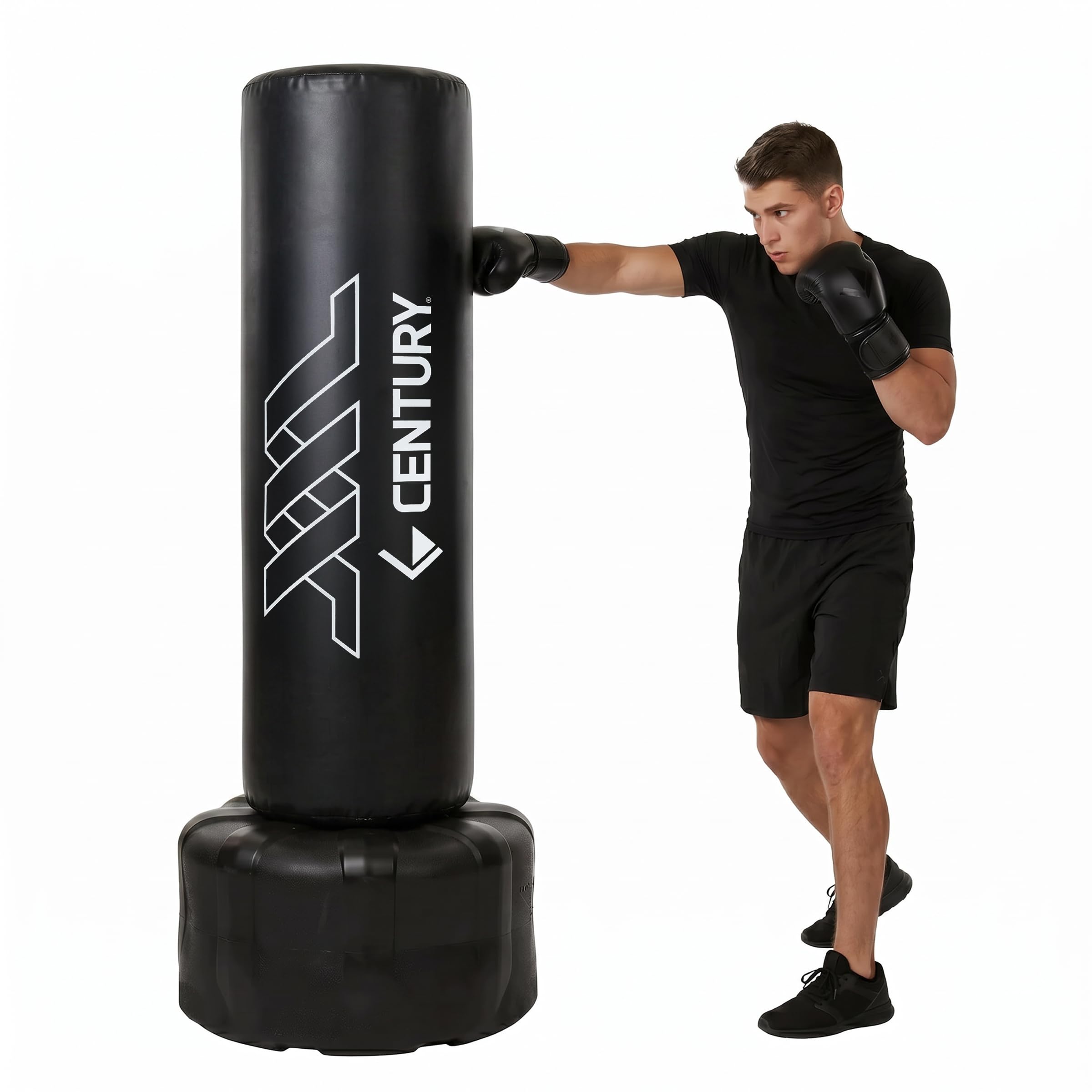
Century Wavemaster XXL

Century Wavemaster XXL

No-ceiling spaces

Our Score 9.2/10
Check Price

Worth Noting

  • Base moves under hard combinations
Diameter
18 in
Mounting
Freestanding
Height Range
52-69 in
Striking Height
52 in
Read the full review

The Wavemaster XXL stands 69 inches tall with an 18-inch striking area, and it adjusts down to 52 inches for shorter users or kids. It needs no ceiling mount, no joist finder, and no drilling. The base fills with water or sand, and the bag rolls on its edge when you tip it, so it can be moved out of the way between sessions.

That mobility is the appeal for a garage or spare room, and the 18-inch diameter gives you a generous target for hooks and straight punches. The base is heavy and wide, but it is not a suction cup and it is not bolted down; it stays put best on a smooth, level floor.

We recommend the Wavemaster for renters and anyone who cannot hang a bag, provided the training is technique and conditioning rather than power. If you want to unload on the bag, choose a hanging model; if the room decides the purchase, this is the compromise we make. The height adjustment is a genuine bonus for a household with different-sized users.

Bottom line: Renters and finished ceilings point to the Wavemaster, as long as the training is technique rather than power.

#8

Proslayer 6 ft 150

Proslayer 6 ft 150

DIY long bag

Our Score 9.2/10
Check Price

Worth Noting

  • Ships unfilled; you supply about 150 lb of fill
  • No mounting hardware included
Fill
Unfilled
Length
72 in
Diameter
14 in
Target Fill Weight
150 lb
Read the full review

The Proslayer is a six-foot bag sold as an empty shell. It weighs about 7 pounds as delivered, so the 150-pound figure on the listing is the weight you build into it, not what lands on your porch.

The vinyl shell, webbing handles, and D-rings look straightforward, and the 72-inch body gives you a long target for kicks. There are no wall mounts in the box, so you need a rated mount and a plan for getting 150 pounds of fill into the bag without lumps.

Filling is the real cost. You are trading money for an afternoon of work, and the result depends on how evenly you pack the fill. That is not a dealbreaker for a garage gym, but it is a different purchase from a bag that arrives ready to hang.

We recommend the Proslayer to a DIY-minded buyer who wants a long bag on a tight budget and already has a mount. If you want the bag to arrive filled and consistent, the Outslayer is the safer buy. The Proslayer earns its place by making a six-foot training space possible for very little money.

Bottom line: Budget-minded DIYers should start with the Proslayer, then add fill and a mount.

How We Chose and Tested Heavy Punching Bags

We started by pulling together more than 30 bags from brands we trust, then narrowed the list by material, available weights, whether they ship filled or empty, and what hardware comes in the box. We ended up with 10 bags that represent the range of what shoppers actually consider: basic vinyl, midweight canvas, and a few heavier options for serious kickboxing. Each one lived in a real training space—a garage gym with a ceiling mount, a basement corner with a stand, and a spare room where we moved the bag to see how it handled being shoved against a wall.

For eight months, we used each bag at least three times a week: quick morning jab sessions before work, longer evening rounds when stress was high, and weekend sessions where we mixed in kicks and knees. Stability was easy to judge—we marked the floor under each bag and noted how far it drifted after a three-minute round of hooks and body shots. Hardness got a thumb test and a knuckle test: we pressed into the surface to see if it felt spongy, dense, or brick-hard, then threw 50 jabs to check whether our hands stung through gloves. Length mattered for kicks as much as punches; our 5-foot-10 tester checked whether he could land head-height jabs and low kicks without hunching.

For unfilled bags, we timed how long it took to add shredded fabric and sand, and whether the filler settled evenly or clumped at the bottom. We weighed every bag empty and after filling to see how close it came to the listed weight. After each session, we inspected seams, straps, and material for fraying, cracking, or stretching. We also noted what came in the box—chains, gloves, a stand—and whether the bag needed extra hardware to hang safely, since that affects the real value. Appearance got a simple gut check: would we leave this bag visible in a home gym, or does it look like a garage-only piece?

How to Choose Heavy Punching Bags

Hanging or Freestanding

A hanging bag gives the most honest feedback because the bag is free to swing and you have to supply the power. It also needs a rated ceiling or wall mount and enough height that the bottom hangs near shin level. A freestanding bag removes the drilling and the joist search, but its base moves under hard combinations; it is a technique tool first. If you rent or have a finished ceiling, we think that trade can be worth it.

Measure the drop before you buy. A 55-inch bag plus a few inches of chain fits a standard room; a 72-inch bag with 12-inch straps can crowd an 8-foot ceiling. The Century Wavemaster is the freestanding compromise we choose when hanging is not an option, as long as you accept that it is not a power bag.

Weight and Length by Discipline

For boxing and general conditioning, 80 to 100 pounds and a 42- to 55-inch body are enough; the shorter bag keeps the target at chest and head height and is easier to fit in a garage. For low kicks, knees, and teeps, look for a 69- to 72-inch bag and 100 to 150 pounds. The longer body lets you strike at realistic heights without dropping your guard.

Heavier is not automatically better. A 130-pound bag demands more from the mount and the ceiling, and a 100-pound bag with the wrong shape can still miss your training. We prioritize length over weight, then choose the heaviest bag your mount can handle.

Fill, Feel, and Setup

Fabric-filled bags avoid the hard and soft spots that sand can develop, and they are usually more consistent from the first round. Sand gives a denser, heavier feel but can settle unevenly; unfilled bags let you choose the density but turn setup into a project. Check whether the advertised weight is the filled weight or the target fill weight, because an unfilled bag arrives as a shell.

The Outslayer bags arrive filled with fabric and carry a long warranty; the Fairtex and Proslayer are shells you fill yourself. We prefer a filled bag when you want to train the day the box arrives. If you enjoy tuning the density, an unfilled bag can be the better value.

Mounting, Hardware, and Noise

A ceiling mount must be rated for the bag's filled weight and the dynamic load of hard punches, not just the static weight. Check whether the bag includes a chain, swivel, or bottom tie-down; the Everlast Elite includes a chain and a bottom strap, while the Outslayer 100 needs a separate hanger. A bottom tie-down calms the swing but needs a floor anchor to do anything.

Noise travels through the structure, so a hanging bag in an upstairs room can be heard throughout the house. A freestanding bag is quieter to install but can scuff floors and walk across smooth concrete. We like a mat under a freestanding base and a short, snug chain on a hanging bag to solve most of the annoyance.

Frequently Asked Questions

Final Verdict

The Outslayer 100 lb Filled is the heavy bag we recommend first because it arrives ready, uses a fabric fill that stays consistent, and backs the shell with a 10-year warranty. It is the simplest path to a serious home setup.

If low kicks and knees drive your training, choose the six-foot Outslayer 130; if you cannot hang a bag, the Century Wavemaster is the freestanding compromise, provided you are training technique rather than power.