Accessories

Best Ballet Barres of 2026

The kitchen counter has been the unofficial barre for generations of dancers, and it's a bad one. It's the wrong height, the edge digs into your palm during a long hold, and the chair you drag over slides the moment you lean on it. A real barre fixes all three: it sits at your shoulder height, it stays put, and it's long enough to work both sides without repositioning. The joinery mattered more than I expected — a barre that flexes even a little makes you grip harder and dance smaller.

We've spent six months with a dozen barres in living rooms, spare bedrooms, and one converted garage studio, and the differences came down to things no product photo shows: how far the feet spread, whether the height knobs hold under load, and whether the wood is sanded where your hands go. Measure your shoulder height before you shop — a few top out lower than you'd expect. The picks below cover freestanding and wall-mounted setups for very different rooms.

#1

Dolibest Pink Ballet Bar

Top Pick
Dolibest Pink Ballet Bar

Young dancers

Our Score 9.4/10
Check Price

Worth Noting

Base
4 wide rubber pads
Color
Pink
Barre Length
4 ft
Height Range
11–47 in
Read the full review

Pink is doing real work here. A barre in a child's bedroom or the corner of a playroom is furniture as much as equipment, and a stand that matches the room gets left out and used instead of folded behind a door — which is why we recommend this one for exactly that job. Under the color it is alloy steel with a 4-foot crossbar and four rubber pads that are wider than most, spreading the load on carpet and softening contact on wood.

The 11-to-47-inch range is the same span as our top pick, so the barre grows from a four-year-old's shoulder height to an adult's hip height without a second purchase. At roughly 24 pounds shipped it feels substantial to move — you carry it rather than slide it — and the wide pads give it a reassuring grip on a hard floor.

What it is not is the bargain hunter's barre: the finish and the wider pads cost a little more than the plain black freestanding models. That is a fair trade if the color is the reason the barre gets to live in the room at all, and a poor one if it is headed for a garage.

Bottom line: If the barre is going in a child's room and the look matters, this is the one we recommend: pink steel, 11 to 47 inches, four wide rubber pads.

#2

SELEWARE Adjustable Ballet Barre

SELEWARE Adjustable Ballet Barre

Most home setups

Our Score 9.2/10
Check Price

Worth Noting

  • 4-foot barre limits traveling combinations
Bar Diameter
1.5 in
Barre Length
4 ft
Height Range
11–47 in
Weight Limit
350 lb
Read the full review

Eleven inches to 47 inches is the range that makes this barre the one we point most people toward. That spread covers a small child on the bottom setting and a six-foot adult near the top, so one purchase serves the household rather than one dancer. The crossbar is 1.5 inches in diameter, the same as a studio barre, and the adjusters are star-shaped hand knobs rather than smooth discs — they turn with a palm instead of a wrestling match.

We recommend it because nothing in this set balances adjustment, steadiness, and price this well. The stated capacity is 350 pounds, the highest of the freestanding barres here, and the frame is alloy steel sitting on anti-slip mats rather than bare metal. The whole package runs about 21 pounds, light enough that we shift ours between rooms without folding anything down, and setup is a ten-minute job: two uprights, a crossbar, and a knob at each joint.

Living with it is easy. The matte black frame wipes clean, the mats keep it off a wood floor, and at full extension the bar sits at hip height for a tall adult. One habit worth forming: the bars lock on threaded screws, so give each knob a firm final turn — a joint left half-tight is where a crossbar that creeps downward comes from. It is not the barre for anyone who wants a fixture that never moves; that is a wall-mounted job.

Bottom line: We recommend it as the default home barre: 11 to 47 inches of adjustment, a 350-pound steel frame, and a ten-minute setup that suits a whole household.

#3

VITA Barre Wall-Mounted WB15

VITA Barre Wall-Mounted WB15

Permanent home studio

Our Score 9.2/10
Check Price

Worth Noting

  • Height is fixed once installed
Height
Fixed
Mount Type
Wall
Bar Diameter
1.5 in
Barre Length
5 ft
Read the full review

Nothing else in this roundup feels like a studio fixture the way a barre bolted into studs does, and that is the whole case for the WB15. It is 5 feet of solid wood at 1.5 inches in diameter, carried on powder-coated steel brackets that can be spaced along the wall to suit the room. Once the screws are in, it does not walk, rock, or need a session-by-session check — which is why we recommend it to anyone whose practice space is not also the living room.

The height is fixed. You choose it when you drill, and that is the honest trade: adjustment given up in exchange for a barre that will not budge a millimeter. For one adult with a settled practice height it is a good deal. For a household with a growing dancer and an adult sharing a wall, it is not — that needs knobs.

The wood arrives natural, unfinished, and sanded smooth, which reads as a shortcut until you remember that a sealed barre also means a slippery one. A rub of wood oil darkens it and gives it a wipeable surface. The brackets come with caps that cover the bolt heads and the barre is capped at both ends, so it looks finished from across the room, and all the hardware for mounting into wood studs is in the box. It asks for 5 feet of clear wall and studs at the bracket points — that is the whole requirement.

Bottom line: For a permanent home studio we rate this above every freestanding barre here — a bolted five-foot wood barre that never shifts, as long as you have studs.

#4

GOFLAME Double Ballet Barre

GOFLAME Double Ballet Barre

Shared practice

Our Score 9.2/10
Check Price

Worth Noting

  • Pink is the only finish
Feet
4 rubber anti-slip
Bar Type
Double
Barre Length
4 ft
Height Range
Up to 47 in
Read the full review

A double barre earns its place when two people share a practice space. Here the middle crossbar travels up to 47 inches and each bar locks on its own fastener, so a parent can work at hip height while a child uses the lower bar — or one dancer can switch between a high bar for balance and a low one for hamstring work without resetting anything.

The frame is a triangular base with four high-friction rubber feet, which is the geometry that keeps a freestanding barre from tipping when weight shifts forward, and the whole thing ships around 19 pounds and comes apart enough to move between rooms. The finish is a proper rustproof lacquer rather than a thin paint, so it holds up to being wiped down after a sweaty class.

Where it asks for patience is the joints. Six threaded fasteners hold the height settings, and a fitting that is not fully snug leaves that bar free to slide, so check every collar when it comes out of the box and again after the first week. Get them tight and it is steady enough for daily class, which is why we keep pointing two-dancer households here instead of at two separate barres.

Bottom line: Two bars at two heights, and the reason we recommend it for a household with two dancers working at different levels.

#5

VITA Barre Prodigy

VITA Barre Prodigy

Studios and schools

Our Score 9.2/10
Check Price

Worth Noting

  • Knobs loosen between sessions
Bar Type
Double
Warranty
10 years
Barre Length
8 ft
Height Range
6–46 in
Read the full review

Eight feet is a different category of barre. Set up at 96 inches long and 21 inches deep, the Prodigy leaves room to travel through a combination instead of marking it in place, and the two aluminum bars adjust anywhere from 6 to 46 inches, so one can sit at a child's height while the other stays at an adult's. Aluminum keeps the span light: the package ships at about 13.5 pounds, which is remarkable for something this long.

Assembly is where it earns its keep — no tools, one person, a few minutes — and we like that in a barre meant to travel to a studio, a theater, or a grandparent's house. A frame that needs an Allen key every time is a frame that stays in the closet. The 10-year limited warranty is the longest here, and this is one of the few pieces of home equipment that plausibly outlives the room it lives in.

The cost of that length is weight, or the lack of it. On polished hardwood the base can slide when you push into the barre, and a mat or a grippy rug under the feet settles it. If you are used to wood under your hands, aluminum feels cooler and a touch slicker, though the 1.5-inch diameter is the same grip a studio barre gives you.

Bottom line: Eight feet of barre, two heights, and no tools — we recommend it for a studio, a school, or a home where two dancers practice together.

#6

SELEWARE Wood Wall Barre

SELEWARE Wood Wall Barre

Budget wall mount

Our Score 9.0/10
Check Price

Worth Noting

  • Two mounting holes per bracket leave little leeway
Warranty
2 years
Mount Type
Wall
Barre Length
4 ft
Weight Limit
550 lb
Read the full review

Four feet of real wood on 5-millimeter steel brackets, rated to 550 pounds — this is the wall-mounted barre we recommend when the budget is tight and the wall is solid. That rating is the highest in this set, which matters less for barre work than it sounds and more than you expect the day someone clips a band to it.

Placement matters more than usual here. Find your studs first and mark the brackets against them, because a wall barre's weak point is never the steel — it is a bracket fixed to drywall. Done properly, there is no shake in it at all, and the barre reads as part of the room rather than equipment parked in it.

The barre itself has rounded ends and a smooth transition from wood into matte black metal, a small thing that makes it look bought rather than built. At 4 feet it suits a single dancer working in place, and the 2-year manufacturer warranty sits sensibly between the three-month and ten-year extremes in this group. A nursery, a spare bedroom, a garage corner: this is the wall barre we point to when budget is the deciding factor.

Bottom line: A wood-on-steel wall barre rated to 550 pounds at a budget price — we recommend it for a garage gym or a child's room where the barre never moves.

#7

Costzon Double Ballet Barre

Costzon Double Ballet Barre

First barre

Our Score 9.0/10
Check Price

Worth Noting

  • 120-pound weight limit, the lowest here
  • Three-month warranty is the shortest here
Bar Type
Double
Warranty
3 months
Barre Length
4 ft
Weight Limit
120 lb
Read the full review

Thirteen and a half pounds is light enough to lift with a hand on each upright and carry into the next room, which is most of this barre's appeal. You get two 4-foot bars, both adjustable, with foam padding and four anti-skid feet, on an iron and ABS frame that is sturdier than the weight suggests.

We recommend it where the barre leads a double life — a teenager practicing in her room, then the barre moving to the hallway so somebody else can stretch. Assembly is quick, the feet hold on tile, and the bars stay put under a moderate lean. Just be clear about what you are buying: a barre for balance, stretching, and barre class, not a rig for anything athletic and loaded.

The 4-foot width is the real limit on movement — fine for a full barre sequence in place, tight for anything that travels. For a first barre, a second barre for a kid, or a rental where drilling is not an option, that is a fair set of compromises, and the low weight means it actually gets moved instead of gathering dust in a corner.

Bottom line: A light, inexpensive double barre we recommend for a child's first practice space or a small apartment where the barre moves every day.

#8

flybold Wall Barre with Turning Board

flybold Wall Barre with Turning Board

Barre plus turns

Our Score 9.0/10
Check Price

Worth Noting

Includes
Turning board
Mount Type
Wall
Bar Diameter
1.5 in
Barre Length
4 ft
Read the full review

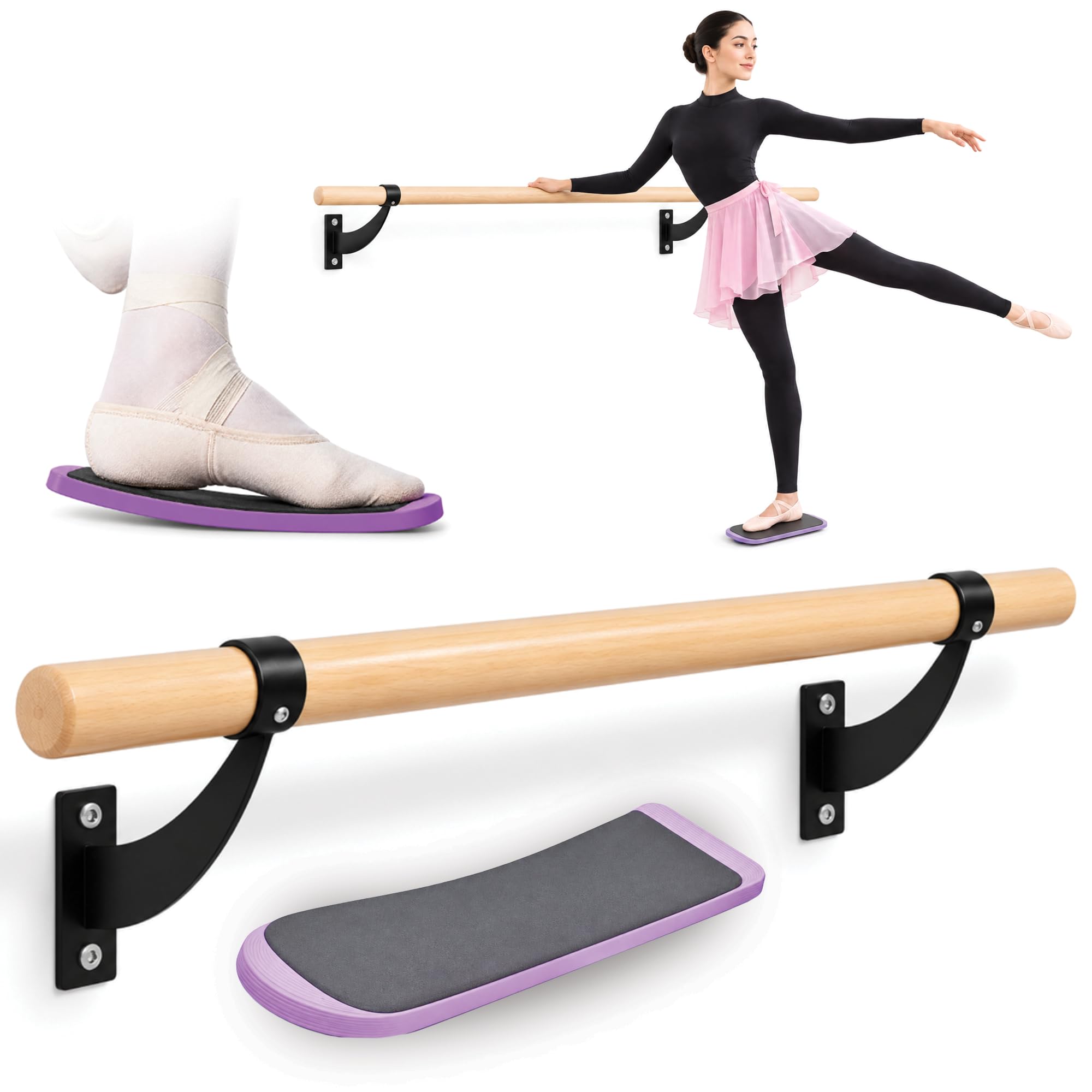
A turning board is the unexpected part of this box. Most barres here are just a barre; this one adds a spinning disc for pirouette practice, the piece of equipment a dancer usually buys once the barre habit sticks. The barre itself is 4 feet of beechwood at 1.5 inches in diameter, held in steel brackets with locking screws.

Mounting is the whole project. The brackets fix at whatever height you choose, and once the locking screws are down the bar does not move — it is a wall barre, so the stability question is answered by your studs rather than by the frame. Set it at hip height for class, a hand's width higher if the main use is balance work and slow extensions.

Where it sits in the lineup is the budget end of wall-mounted: a 4-foot barre for one dancer working in place, with a turning board the pricier wall options do not include. If there is a spare wall and a dancer who is serious about turns, that combination is hard to argue with.

Bottom line: A budget wall barre with a turning board in the box — we recommend it for a dancer who drills turns as well as barre work.

#9

Booty Kicker Folding Barre

Booty Kicker Folding Barre

Tight floor space

Our Score 8.8/10
Check Price

Worth Noting

  • Frame can rock during fast weight shifts
Material
Steel and wood
Folded Width
5 in
Weight Limit
250 lb
Assembled Size
38 x 34 x 37 in
Read the full review

Five inches. That is the folded width of this barre, and it is the number that decides whether it works in a small apartment. Open, it stands 38 inches long by 34 wide by 37 tall, holds a stated 250 pounds, and pairs a steel frame with a hardwood barre and nickel-plated accents, so it reads more like furniture than gym equipment.

The hinge is a quick-release design, which means one person can open it, work, and close it again without hunting for a pin. The weight rack across the front is the detail we keep coming back to: a couple of dumbbells parked there add ballast down low, and that is the cheapest stability upgrade you can make to any freestanding barre.

Assembly is where it asks for patience. The printed instructions are thin, and the company's video does a clearer job of walking through the order of steps, so budget half an hour and a second pair of hands for the first unfold. After that it is a barre that disappears against a wall between sessions, which is the entire point — you are paying for the hinge, not the paint.

Bottom line: The one barre here that folds flat to five inches and stands against a wall — we recommend it when floor space is what you do not have.

How We Tested a Dozen Ballet Barres at Home

We started by pulling every home barre we could find that listed a real height range, kept a footprint under roughly four feet, and shipped with either a freestanding base or wall-mount hardware in the box. From there we cut the list to 12 that covered the actual spread: solid wood, metal, single barre, double barre, folding and fixed. Each one lived in a room rather than a studio corner for six months — a living room, a spare bedroom, a converted garage — and got used daily by two dancers, plus a nine-year-old on the lowest settings and a few adults who only wanted them for stretching.

Assembly came first. We built each barre alone using only the included tools and timed it, noting where the instructions stalled or a second pair of hands became necessary, then we took it apart and rebuilt it once more to see whether the hardware stripped or the joints loosened. Then we worked: pliés in every position, grand battements, and long holds with full body weight leaning into the barre, followed by a check for feet that had crept or lifted. We ran the same set on carpet and on hardwood, watching for rocking and for scuff marks left behind.

Height changes got tested mid-session, the way you'd actually do them — one person, no tools, timing the swap and checking whether the pins or knobs seated securely once weight was on the barre. We folded and carried each folding model to a closet to see whether it fit and how awkward it was to move, and measured freestanding footprints against the floor space a person needs to actually work. Hand feel mattered more than expected: we ran our palms along the full length of every barre looking for rough sanding, splinters, and seams where a veneer met a core. The least expensive models held up better than I assumed; when one failed, it was usually thin hardware rather than thin wood.

How to Choose a Ballet Barre

Wall-Mounted or Freestanding

A wall-mounted barre is the steadiest thing you can own and the least flexible: it goes where the studs are, and its height is set the day you install it. If you can find two studs at the right spacing and one person uses it, that trade is worth taking — the VITA WB15 and the SELEWARE wood barre are immovable once bolted in.

Freestanding barres buy height adjustment, portability, and no drilling, at the cost of some movement under load. The trap is assuming freestanding means stable anywhere: a light frame on polished hardwood will walk when you push into it, while the same frame on carpet or a mat stays put. If your floor is slick, budget for a mat before you budget for anything else.

Height Range and Who Shares the Barre

The useful range for a home barre runs from about 11 to 47 inches, which spans a small child's shoulder to a tall adult's hip. A barre that covers that whole span, like our top pick, serves a household without a second purchase.

Two bars are worth the extra hardware when two people practice together or one dancer works at two heights in a session. A single fixed barre is the right answer only when one person uses it at one height — and if that person is still growing, it is the wrong answer.

How Long a Barre Do You Need?

Four feet is the standard home length and enough for a full barre sequence in place; it is not enough for traveling combinations or two dancers side by side. Five feet, which is what the VITA WB15 comes in, gives a little more room to move. Eight feet is studio territory — the VITA Prodigy is the only one here — and worth it only if you teach, share, or work on movement across the floor.

The trap is how a barre photographs: a short one looks generous in a listing and feels cramped the first time you try a développé that travels.

Weight Ratings, Bar Diameter, and Finish

Stated capacities in this group run from 120 pounds to 550, and the figure is about more than safety: a barre rated to 550 is built from heavier stock, which is part of why it feels planted. Barre class and stretching are leaning work rather than hanging work, so a lower rating is usable — but do not clip a resistance band to a light freestanding frame and pull hard.

Bar diameter is more consistent. A 1.5-inch bar is the studio standard and what several of these use, and it suits small hands as well as large ones. Wood is warmer and grips better with a little moisture; aluminum and powder-coated steel wipe down more easily. Raw wood wants an oiling if you want it sealed.

Frequently Asked Questions

Final Verdict

Most people should buy the SELEWARE 4-foot freestanding barre. It adjusts from 11 to 47 inches, holds 350 pounds, sets up in about ten minutes without a toolbox, and moves between rooms — which is what a home barre actually has to do. Nothing else here covers that many situations as cleanly.

If you have a spare wall and one settled practice height, the VITA WB15 is the better spend: bolted into studs it does not move, and that solidity is worth giving up adjustment for. If two dancers share the room, take the GOFLAME instead and set the two bars at different heights.