Accessories

Best Balance Trainer Balls of 2026

A balance trainer is about as low-tech as home gym gear gets: half an inflatable dome on a flat platform, and a bodyweight squat suddenly takes real concentration. That wobble is the point — your ankles, hips, and core spend the set making tiny corrections — but it's also why a mediocre one ends up in a closet. A dome that's rock hard, a base that creeps across the rug, a pump that quits halfway through inflating, and you've bought an expensive doorstop.

I've used half balls for years, mostly barefoot on my living room rug, and my team has now spent six months with 12 of them. We inflated each with its own pump and put them through squats, planks, push-ups, and single-leg balances in sneakers, socks, and bare feet.

Firmness surprised me most: people overinflate these, which makes balancing harder, not easier. Base width matters too — a wider platform feels steadier but eats floor space — and resistance bands are only as good as the loops they clip into. Whether a pump and bands come in the box changes what you're actually paying for. The picks below survived all of it.

#1

Lifepro Horizon Half Balance Ball Trainer

Top Pick
Lifepro Horizon Half Balance Ball Trainer

All-around home use

Our Score 9.4/10
Check Price

Worth Noting

  • Inflation can take patience
Warranty
Lifetime support
Deck Height
8.5 inches
Deck Diameter
23.6 inches
Maximum User Weight
440 lb
Read the full review

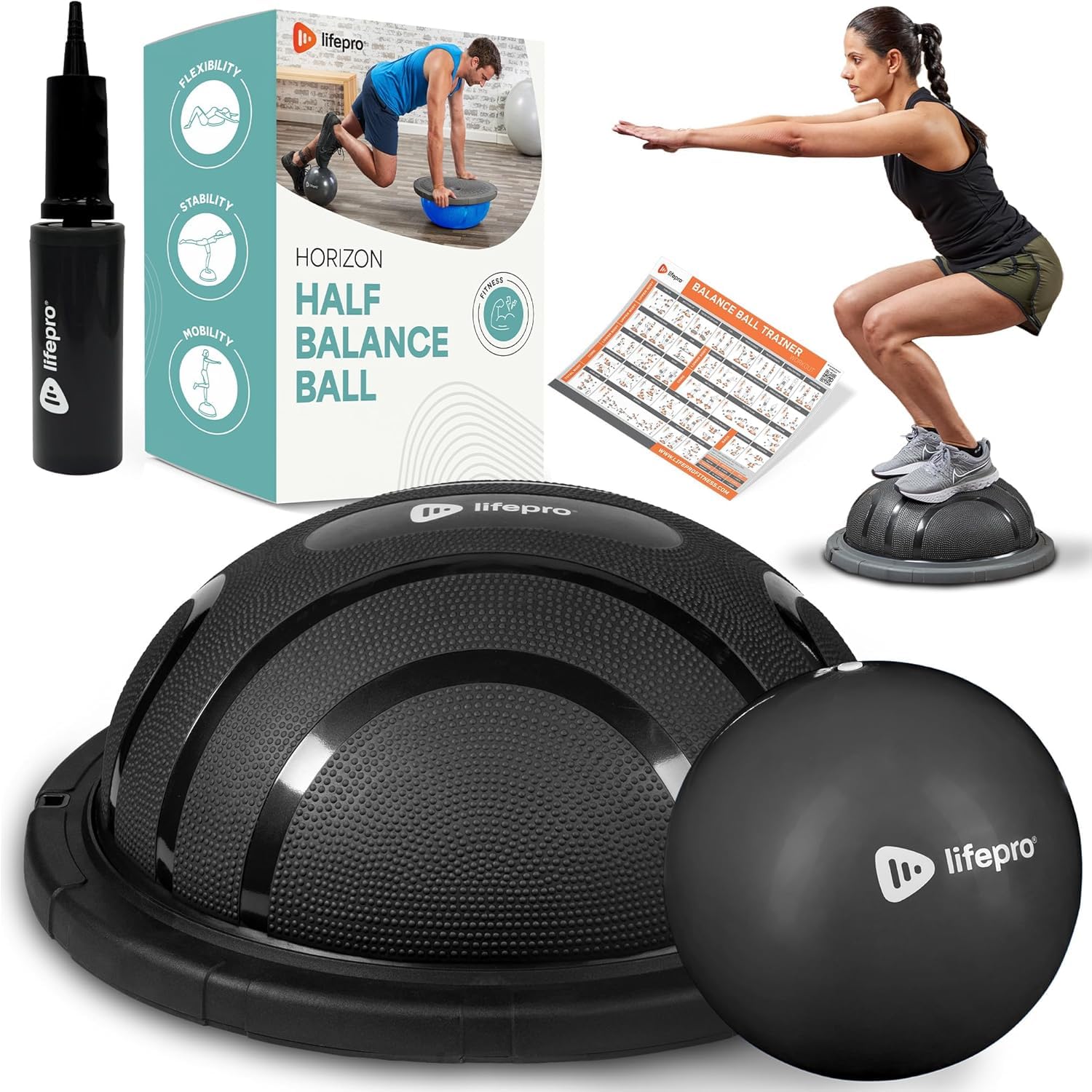
The Horizon's two-way design is the first thing we noticed: flip it dome-up for a familiar half-ball surface, or base-up for a tippier challenge. At 23.6 inches across and 8.5 inches tall, it sits in the same footprint as most trainers here, but the 440-pound rating gives it more headroom than the BOSU classic. The package includes an air pump, a 10-inch Pilates ball, a tape measure, and plugs, so you can inflate it and get moving without hunting for extras.

We think that combination makes it the best default for most homes. The textured surface grips underfoot, and the 440-pound capacity covers bigger users without forcing them into a commercial-grade model. We also like the lifetime support behind it; inflatable PVC can develop a slow leak, and a company that stands behind the base is worth something. The pump and valve are included, and the setup is straightforward.

Where it earns its keep is in variety. The dome side is forgiving enough for planks, push-ups, and split squats; the flat side turns the same platform into a wobble board for seated balance work and core drills. We appreciated the included Pilates ball for between-set core work, and the two-way design makes the same platform useful for both standing balance and seated core drills. It is not a travel trainer; it stays put in a living-room gym, which is the right trade for daily use.

If you want one half ball for strength, balance, and rehab-style work, this is the one we reach for first. The 440-pound rating and textured deck are the practical reasons; the two-way design is why we kept coming back to it. The tape measure is a small thing, but it is the detail that made our first inflation feel less like guesswork.

Bottom line: The Horizon is our top pick for most homes: a stable 440-pound half ball with a grippy two-way deck and useful extras.

#2

BOSU Balance Ball Exercise Trainer

BOSU Balance Ball Exercise Trainer

Classic balance work

Our Score 9.0/10
Check Price

Worth Noting

  • Short 90-day warranty
Warranty
90 days
Deck Height
8.5 inches
Deck Diameter
26 inches
Maximum User Weight
300 lb
Read the full review

The BOSU Balance Ball Exercise Trainer is the familiar full-size version: a 26-inch dome on a black base, with a 300-pound weight rating and a 90-day warranty. We have used this shape in gyms for years, and the familiarity is the point; the 26-inch deck gives you room to land a foot, and the non-slip rubber surface is forgiving when you are learning to stand on one leg. It is not the cheapest half ball here, but it is the one we trust for familiar balance work.

What we appreciate most is how neutral it feels. The dome is tall enough to challenge your ankles and hips without turning every exercise into a circus act, and the flat side is stable enough for push-ups and planks when you flip it over. The included guided workout is a nice starting point if you have never used a half ball, and the pump gets you inflated without a separate trip to the garage. We did find the first inflation fussy; the valve takes a firm push, and the dome needs a few rounds of air before it settles.

The BOSU still earns its place as the classic choice: it is stable, recognizable, and built around the exercises that make a half ball useful. The 26-inch deck is the detail that makes it feel like the full-size version rather than a scaled-down copy.

Bottom line: The BOSU classic is the familiar full-size half ball we recommend when a roomy 26-inch deck and brand-name support matter more than price.

#3

Yes4All Half Balance Trainer

Yes4All Half Balance Trainer

Heavy users

Our Score 9.0/10
Check Price

Worth Noting

  • Smaller deck than 26-inch trainers
Warranty
1 year
Deck Height
7.25 inches
Deck Diameter
23.5 inches
Maximum User Weight
880 lb
Read the full review

The Yes4All Half Balance Trainer's headline number is hard to ignore: an 880-pound user weight rating, the highest in this group. The deck measures 23.5 inches across and 7.25 inches tall, so it is a little lower and a little smaller than the BOSU classic, and the matte black PVC surface is textured for grip. It ships with an air pump, a plug, and a tape measure, plus a one-year warranty.

That capacity is not just bragging rights. A stiffer base can feel more secure under a heavier user, and the lower 7.25-inch dome is less intimidating for step-ups and split squats. The wide, flat base sits still on a wood floor and does not slide when you shift your weight. The textured surface gives your feet something to push against, even in bare feet.

For heavier users or anyone who wants a planted, low-slung half ball, this is the pick we point to first. The 880-pound rating and sturdy base are the practical reasons; the 23.5-inch deck keeps it manageable in a smaller room. We did notice that air retention can be finicky; check that the plug is seated all the way. The one-year warranty is a better safety net than the 90-day coverage on the BOSU classic.

Bottom line: We recommend the Yes4All for heavier users: an 880-pound rating and a low, planted deck that stays put.

#4

VEVOR Half Exercise Ball Trainer

VEVOR Half Exercise Ball Trainer

Budget home gyms

Our Score 9.0/10
Check Price

Worth Noting

  • Smaller deck than 26-inch trainers
Deck Height
7.9 inches
Deck Diameter
22.8 inches
Deck Material
PP and PVC
Maximum User Weight
660 lb
Read the full review

The VEVOR Half Exercise Ball Trainer is the budget option, and it still lists a 660-pound user weight rating. The deck is 22.8 inches across and 7.9 inches tall, with a PP and PVC build and a textured dome. It comes with a pump and a set of accessories, and the compact size makes it easy to tuck beside a couch. If you want to try a half-ball trainer without spending much, this is the one we recommend.

The 660-pound rating is generous for the money, and the 22.8-inch deck is small enough to store but still wide enough for two-foot planks. The textured dome gives it a secure feel under bare feet, and the included resistance bands are a bonus; the deck is the reason it earns a spot. It is also light enough to move from room to room without a second pair of hands.

The budget shows up in the inflation kit. The pump is small, the nozzle takes some fiddling, and the first fill takes longer than it should. Once it is up, though, the VEVOR holds air well enough for regular use, and the low deck is easy to step onto. For a first half ball or a second one for a small home gym, that is a fair trade.

Bottom line: The VEVOR is our budget pick: a 660-pound half ball that covers the basics without asking for much space or money.

#5

ATIVAFIT Balance Ball Trainer

ATIVAFIT Balance Ball Trainer

Small spaces

Our Score 9.0/10
Check Price

Worth Noting

  • Smaller deck than 26-inch trainers
Surface
Cloud-textured PVC
Deck Height
7.1 inches
Deck Diameter
23.4 inches
Maximum User Weight
660 lb
Read the full review

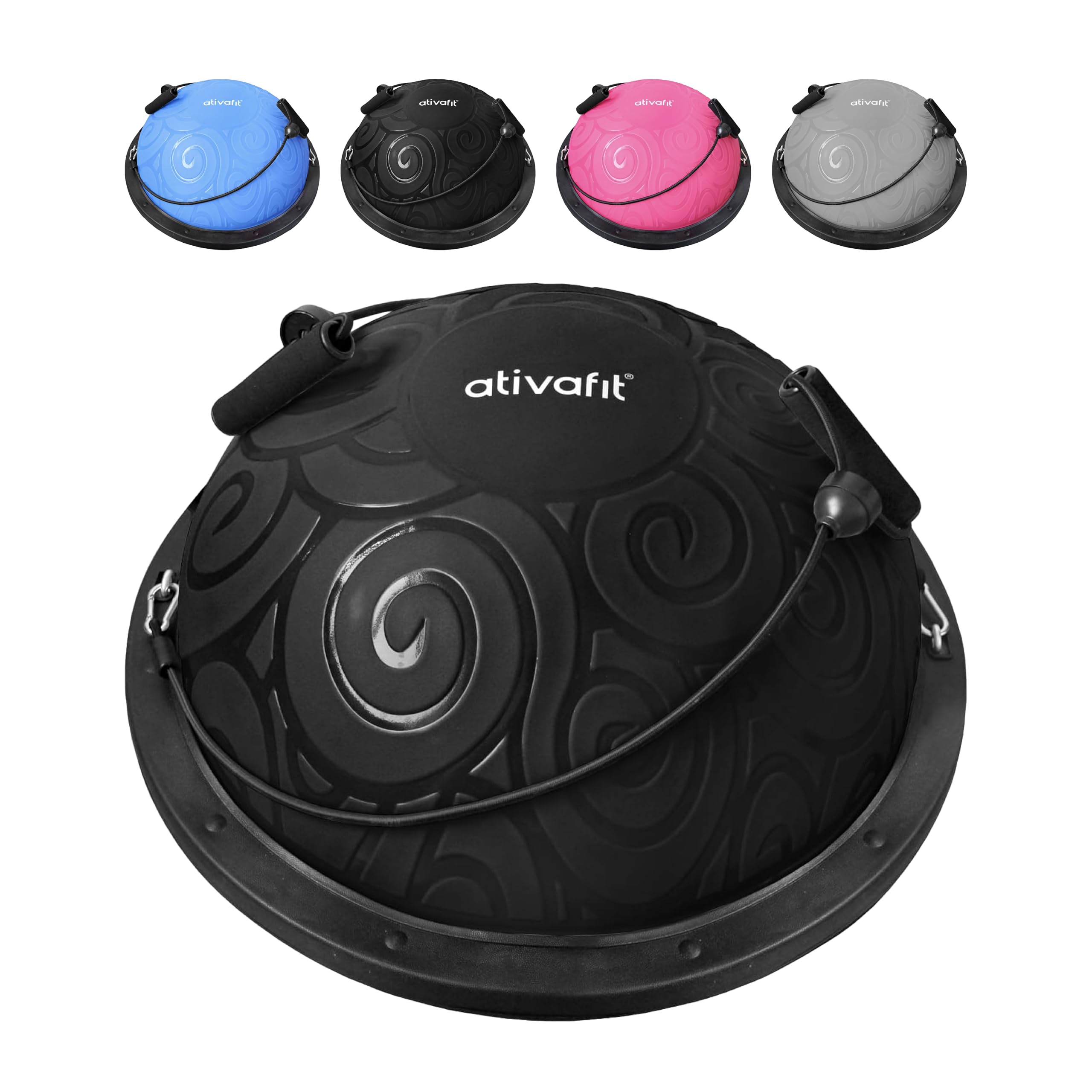
The ATIVAFIT Balance Ball Trainer is a compact half ball: 23.4 inches across, 7.1 inches tall, and rated to 660 pounds. It comes with two resistance bands, an air pump, and a valve plug, and the PVC surface has a cloud-textured matte finish that is meant to keep feet from sliding. The six rubber feet on the base are a practical detail if you plan to use it on a hard floor.

The size suits a small apartment or a corner of a living room. The lower dome is easier to step onto than the 26-inch BOSU, and the bands add a way to work arms while you balance. The bands are light and best for warm-ups rather than serious resistance work, but they are useful for beginners who want something to hold while they find their footing. The 660-pound rating also gives it more headroom than the BOSU classic.

For a compact home setup, this is the one we reach for: the 23.4-inch deck stores easily, and the lower 7.1-inch dome is less intimidating for beginners. The inflation experience is the part to plan for; the hand pump is small, and the first fill takes a while. Once inflated, the surface grips well and the base stays put, and the one-year guarantee covers the kind of valve or seam trouble that can show up in any PVC trainer.

Bottom line: The ATIVAFIT is our small-space pick: a compact 660-pound half ball with light resistance bands for beginner warm-ups.

#6

ZELUS Balance Ball Trainer

ZELUS Balance Ball Trainer

Workout variety

Our Score 8.8/10
Check Price

Worth Noting

  • Pump and bands are weak points
Included
Foot pump and bands
Deck Height
9.8 inches
Deck Diameter
23 inches
Maximum User Weight
660 lb
Read the full review

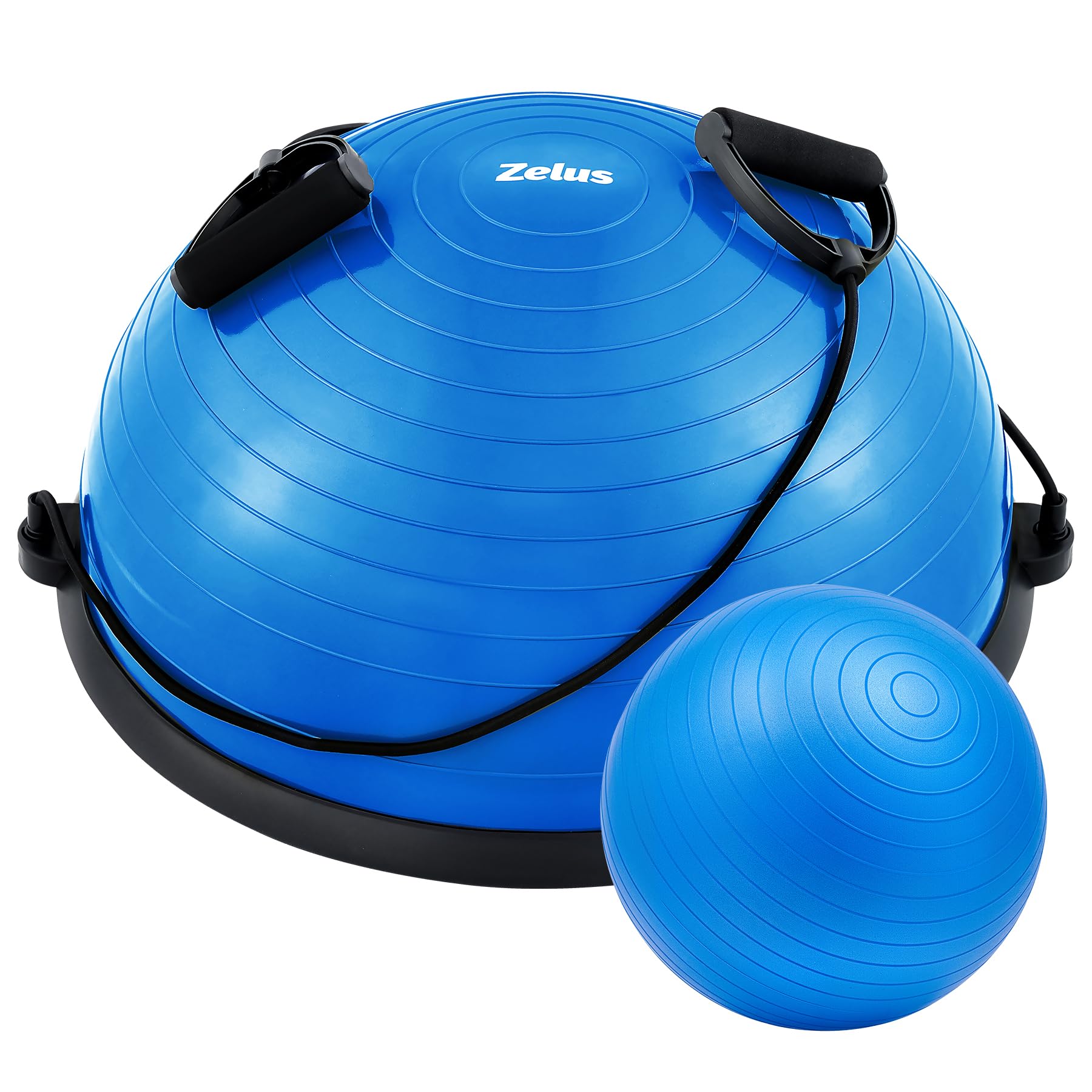
The ZELUS 23-inch Balance Ball comes as a kit: the half-ball trainer, two 30-inch resistance bands, a foot pump, and a 55cm yoga ball. The trainer itself is rated to 660 pounds and stands 9.8 inches tall, which makes it the tallest dome in this group. The ABS base has six slip-resistant feet, and the PVC surface is textured for grip.

We think the bundle is the reason to consider it. The extra yoga ball gives you a second tool for stretching and core work without buying a separate exercise ball, and the resistance bands attach to the trainer for light arm work. The 660-pound rating is reassuring, and the six feet keep the base from walking across the floor. It is a good choice if you want one purchase to cover balance, stretching, and a little strength work.

The taller 9.8-inch dome is the detail to respect: it is more demanding than the lower decks here, so start with the dome up and your hands on a wall. The included accessories are a bonus rather than the main event; the trainer itself is the reason to buy. For a first home setup, that variety is worth more than a fancy pump.

Bottom line: The ZELUS is our bundle pick: a 660-pound half ball plus a yoga ball and bands for varied home workouts.

How We Tested the Best Balance Trainer Balls

We started by rounding up every half-ball trainer we could find that listed an actual weight capacity, shipped with a pump, and gave resistance bands somewhere to clip. That filtered out the vague listings and the ones where you'd be buying accessories separately, and left 12 trainers, which we used for six months in living rooms, a garage gym, and one small apartment where storage space decided which ones stayed.

Every trainer arrived flat. We timed how long each took to fill with its own pump, noted whether the nozzle stayed seated or kept popping off, and judged whether the pump felt like it would survive a second inflation. Then we marked each dome and pressed it weekly, which is how slow leaks surfaced — a couple went noticeably soft within a month while others held firm through the whole six.

In use, every trainer got the same circuit: squats, planks, push-ups, timed single-leg holds with eyes open and closed, and band rows with the handles clipped in. We ran it barefoot, in socks, and in sneakers, on carpet and hardwood, watching whether the base crept or the texture held. Testers of very different weights stepped on each one so we could see how much the dome gave, and we measured base diameter and dome height against a size 9 foot and against the shelf it would live on.

Durability was a running tally rather than one test: seams, creases that wouldn't flatten, handles that pulled, band loops that frayed after repeated clip-ins. We also kept track of what came in the box, since a trainer that needs a separately bought pump and bands is a worse deal than one that arrives ready to use.

How to Choose a Balance Trainer Ball

Start with deck size and dome height

Most half-ball trainers here run 22.8 to 26 inches across and 7.1 to 9.8 inches tall. A wider deck gives you more room to land a foot and is easier for two-foot planks; a narrower deck stores more easily but can feel cramped for wide stances. Height changes the challenge: a taller dome forces more ankle and hip work, while a lower deck is easier to step onto. We prioritize a deck that fits your stance over the biggest number. Measure the floor space plus arm room, and remember a 9.8-inch dome needs more clearance than a 7.1-inch one.

Check the weight rating before anything else

Every trainer here lists a maximum user weight, and the range is wide: 300 pounds on the BOSU classic, 440 on the Lifepro Horizon, and 880 on the Yes4All. Use the stated rating as a hard limit, not a suggestion, and leave a little margin if you plan to add a weighted vest or do dynamic jumps. A higher rating usually comes with a stiffer base, which can feel more stable underfoot. We do not treat a 660-pound rating as overkill if you are near the limit; it is the difference between a planted deck and a wobbly one.

Treat air retention as a feature

Inflation and air retention are the most common frustrations in this category, and they are worth checking before you buy. A pump that threads cleanly, a valve plug that seats firmly, and a dome that holds its shape overnight matter more than a long list of accessories. Inflate to the recommended firmness, wait a day, and see if it sinks. If a trainer arrives with a missing plug or a pump that will not connect, return it rather than fighting it. We like models with a one-year warranty or lifetime support for exactly this reason.

Grip, base, and accessories

Look for a textured dome and a base with six rubber feet; those two details do more for safety than a resistance band. Bands are a nice extra for beginners who want something to hold, but they are usually light and should not drive the purchase. A flat side with raised feet can also get in the way when you flip the trainer over, so check the base if you plan to use it dome-down. We prefer a clean, grippy deck over a bundle with weak accessories.

Frequently Asked Questions

Final Verdict

The Lifepro Horizon is the one we recommend for most homes. It has the best mix of stability, a 440-pound rating, a grippy two-way deck, and useful extras, and it costs less than the BOSU classic. If you are near the top of the weight range, the Yes4All's 880-pound rating is the safer call. If you want the familiar full-size BOSU feel, the classic remains the recognizable choice.