Accessories

Best Reaction Balls of 2026

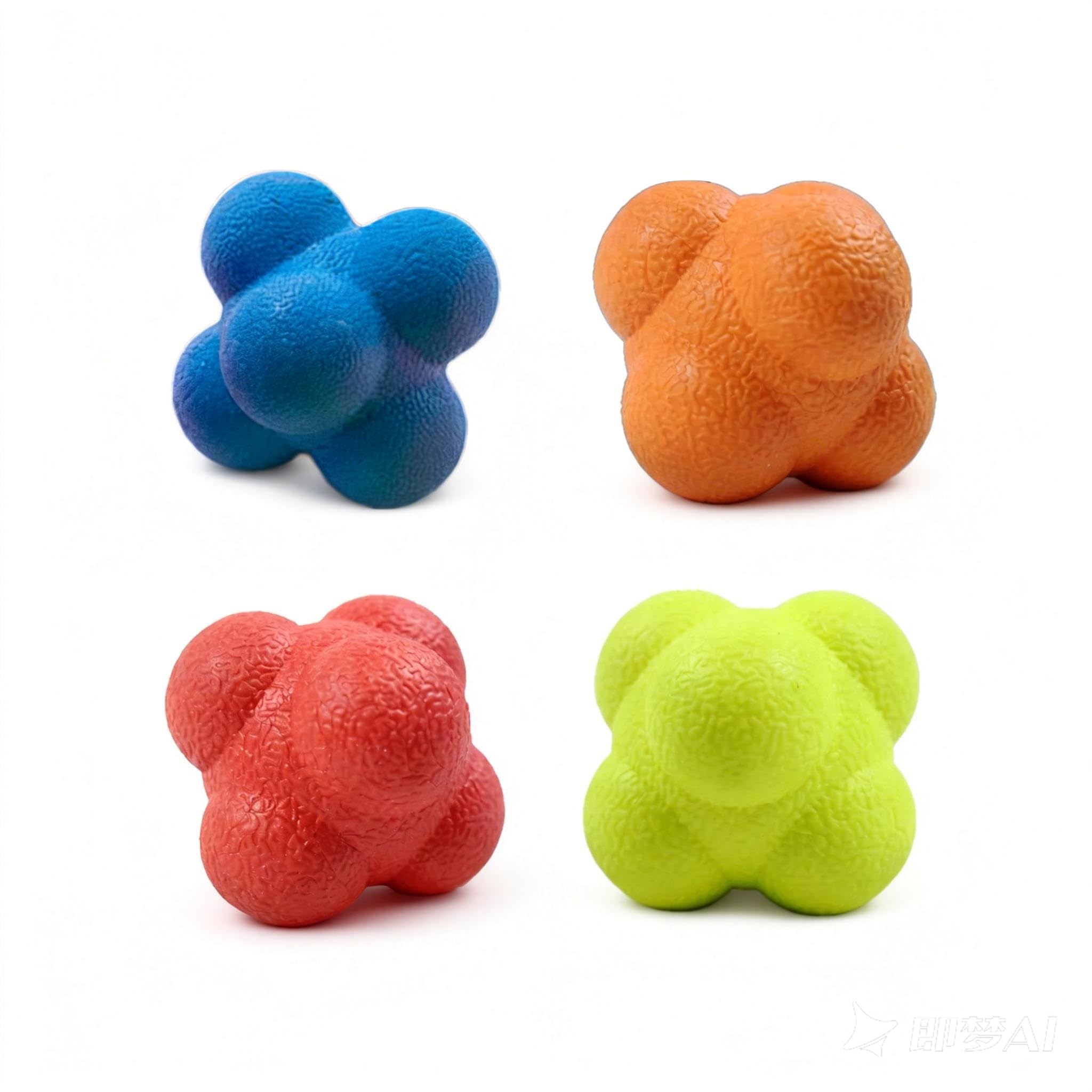
A reaction ball is a six-sided rubber ball with molded nubs, and the whole point is that it refuses to bounce where you expect. Throw it at a wall or drop it on concrete and it kicks off at a random angle, forcing your hands and feet to react in a split second. That unpredictability is what makes it a real training aid for hand-eye coordination and footwork — and why it's honestly fun.

I got hooked watching a coach warm up a youth team with one, and there's been a ball in my gym bag ever since. Over the past three months, we've bounced 16 of them off the same garage wall and driveway, with players from middle-school age to adults, and the spread in quality is real. The nubs do the work: deeper, more varied shapes give wilder hops, while a shallow pattern makes a ball predictable and pointless. A strong rubber smell out of the box usually means a softer compound that scuffs and goes flat fast. The picks below stayed lively and kept us coming back.

#1

SKLZ Reaction Ball

Top Pick
SKLZ Reaction Ball

Everyday reflex training

Our Score 9.2/10
Check Price

Worth Noting

  • Sold as a single ball; partner drills need two
Diameter
3 inches
Material
Rubber
Pack Size
1 ball
Construction
Six-knob design
Read the full review

Three inches of yellow rubber doesn't look like much until the first one kicks sideways off the driveway. The SKLZ is our default reaction ball because of the six-knob shape: every throw lands on a different knob, so every hop asks a slightly different question of your hands. At 3 inches across it sits close to a baseball in the palm, which is why the drill carries over to fielding so well.

We bounced it off a garage door, a block wall, and a gym floor, and the useful distance is shorter than it looks. Five or six feet with a low stance beats a hard throw every time. Partner volleys are harder than they look, because the ball never comes back where you sent it, and the feedback is instant: within a rep you know whether you were set before the bounce or just reacting after it.

The rubber is solid and the knobs are the only real wear point. Check them for tears rather than leaving the ball in a hot car or a wet gear bag; a scuffed ball bounces like a new one, and a torn knob is your cue to replace it.

Compared with the Champro, which is the same 3-inch size for less money, the SKLZ is the one we hand a beginner first, mostly because the yellow tracks so clearly against dark pavement and is easy to spot when it rolls under the car.

Bottom line: Our pick for most athletes: a 3-inch knobby ball that turns any wall or driveway into honest reflex work, at a price that makes sense for a single ball.

#2

AIRLAXER Reaction Ball 3-Pack

AIRLAXER Reaction Ball 3-Pack

Small-group coaching

Our Score 9.2/10
Check Price

Worth Noting

  • 2.83-inch balls run slightly under baseball size
Colors
Orange, yellow, green
Diameter
2.83 inches
Material
Rubber
Pack Size
3 balls
Read the full review

Three balls, three colors, and a diameter just under 3 inches. The count is the whole point of this set, because one ball is a drill and three is a session: you can set up stations, run a relay, or keep two in play while the third rolls under a car.

The rubber is dense and springs back hard, and the orange, yellow, and green are easy to tell apart when you're calling colors across a gym or sorting teams. Three colors also mean three kids can argue about which one is theirs instead of arguing about whose turn it is.

The bounce is at its best on pavement, concrete, or a gym floor. On turf the knobs dig in and the hops flatten out, so a grass field is the wrong place to judge them; a driveway, a tennis court, or a block wall gets you the drill you paid for.

For a coach, a PE teacher, or a parent with two kids who both want a ball, this is the set we point to: three balls for less than one premium single, and enough of them to keep a small group moving. If you train alone, buy one good ball instead.

Bottom line: The coach's pick: three color-coded reaction balls that turn a single drill into stations and relays, for less than one premium ball costs.

#3

Champro Reaction Ball

Champro Reaction Ball

Budget team bag

Our Score 9.0/10
Check Price

Worth Noting

  • Rubber smell takes a few days to air out
Color
Orange
Diameter
3 inches
Material
Molded rubber
Pack Size
1 ball
Read the full review

The Champro is the reaction ball that ends up living in the car, because there's nothing precious about it: 3 inches of molded orange rubber you can throw against a brick wall, a garage door, or a partner's glove and forget about until next week.

It's close enough to tennis-ball size that a spare tennis-ball tube makes a decent case for it in a bag. The bounce is properly erratic, landing on an edge and shooting off at an angle you didn't plan for, and it holds up to pavement better than the price suggests. It also doubles as a dog toy and a kid magnet, which is either a bonus or the reason it disappears.

What we come back to is the value. This is the same 3-inch size as our top pick for less money and it does the same job on the same surfaces, which makes it the ball to buy two or three of for a team bag or a household of kids. If you want a single ball that feels like a small event every time it kicks, the SKLZ is the nicer object; if you want a bucket of them, this is the sensible buy.

Bottom line: The value pick: a 3-inch reaction ball that takes pavement abuse and costs less than our top pick, for anyone outfitting a team bag or a family.

#4

GoSports Reaction Ball

GoSports Reaction Ball

Beginner hand-eye work

Our Score 9.0/10
Check Price

Worth Noting

  • Single ball, sold in green only
Weight
4 oz
Diameter
3 inches
Material
TPR rubber
Warranty
6 months
Read the full review

Six months of warranty on a rubber ball is unusual, and it's the first thing that stands out about the GoSports. The rest is straightforward: 3 inches across, TPR rubber, 4 ounces, and a green that shows up well against gym floors and grass.

The extra heft matters more than we expected. At 4 ounces it has more thump than the lighter balls here, so a short throw off a wall comes back with a little more pace and feels closer to fielding a real ground ball. The bounce variation is wide, and the rubber is firm enough to survive concrete.

It's the least expensive full-size ball in this group, which makes it a sensible first buy if you want a 3-inch ball and nothing more. There's less of a track record behind it than behind the SKLZ or the Champro, and that's the only reason it sits lower here; nothing about the ball itself gave us pause.

Bottom line: A plain, well-priced 3-inch ball with an unusual six-month warranty, for a beginner who wants a full-size ball and doesn't need a brand badge.

#5

Vector Ball S

Vector Ball S

Cognitive speed work

Our Score 8.8/10
Check Price

Worth Noting

  • Costs several times a plain reaction ball
Weight
5.7 oz
Charging
Not required
Diameter
3 inches
Material
Thermoplastic polyurethane
Read the full review

Every impact flashes a color, red or green or blue at random, and the drill is what you do with it: right hand for red, left for green, both for blue. That's the idea behind the Vector Ball S, and it makes for a different workout from a plain reaction ball, because you're training a decision as well as a catch.

We think it earns its place for a specific athlete: the one whose problem isn't lazy hands but slow recognition, the hitter who picks up spin a beat late, the keeper who reacts instead of reading. At 5.7 ounces it's substantially heavier than the plain rubber balls here, so it feels closer to a baseball coming off a bat and rebounds with more force.

The build is sealed thermoplastic polyurethane, waterproof, with no charging and no cords, plus a one-year manufacturer warranty, so it lives in a gear bag without fuss. The catch is daylight: in bright sun the flash is hard to read, which makes an open field at midday the wrong setting. Under lights, in a gym, or in shade it's instant, and indoors is where this ball does its best work anyway.

None of that makes it a first reaction ball. It's the upgrade you buy after a cheap rubber one has done its job, or the tool a coach pulls out when athletes start going through the motions.

Bottom line: A premium pick for athletes training recognition and decision speed rather than just hands: the color flash adds a layer a plain rubber ball can't.

#6

Yaegoo Reaction Ball 6-Pack

Yaegoo Reaction Ball 6-Pack

Full-squad practice

Our Score 8.8/10
Check Price

Worth Noting

  • Squad-sized pack is more than one athlete needs
Diameter
2.75 inches
Material
High-density rubber
Pack Size
6 balls
Construction
Six-hemisphere design
Read the full review

Six balls in one bag is the reason to look at this set. It's one of the least expensive ways here to put a reaction ball in every player's hands at once, and the green, orange, and red let you split a group into pairs without anyone arguing about teams.

Each ball is 2.75 inches across and built on a six-hemisphere pattern from high-density rubber, so it caroms off whatever it hits. That's a bit smaller than the 3-inch singles we recommend for adults, and for younger players it's closer to the right size in the hand.

Where it fits is a team, a PE class, or a family with several kids: anyone who wants a bucket of them for stations and relays. You're buying quantity here rather than the nicest single ball in the group, and for that job the trade is the right one.

Bottom line: Six 2.75-inch reaction balls in three colors, the practical buy for a team, a class, or a family that needs a ball for everyone at once.

#7

ROLUXENTIA Reaction Balls 4-Pack

ROLUXENTIA Reaction Balls 4-Pack

Family and classroom

Our Score 8.8/10
Check Price

Worth Noting

Diameter
2.8 inches
Material
High-density rubber
Pack Size
4 balls
Read the full review

Four balls at 2.8 inches, in a mix of bright colors that are easy to spot when one rolls into the grass. That's the pitch, and for a family with kids or a coach running a class, it's a good one.

They're made of high-density rubber and hop the way a reaction ball should, with the ball landing on a facet and heading somewhere you didn't plan. We used them for short throws at a wall, partner volleys, and a running game with kids who never noticed they were training.

Bright colors are more useful than they sound: the ball you can see is the ball you catch, and in a gym or a hall full of kids, a mixed handful makes it easy to hand out teams in seconds.

This is the pack for a family, a classroom, or a vacation bag, with enough balls that nobody stands around waiting. If you're training seriously on your own, a single 3-inch ball is the better buy.

Bottom line: A four-ball pack for a family, a classroom, or a vacation bag, so nobody waits a turn, at a price that suits a group rather than a single athlete.

#8

GSE Sports Reaction Ball

GSE Sports Reaction Ball

Younger players

Our Score 8.8/10
Check Price

Worth Noting

  • 2.6-inch ball is small for adult hands
Diameter
2.6 inches
Material
High-density rubber
Construction
Six-sided
Read the full review

At 2.6 inches, this is the smallest ball in the group, noticeably smaller in the hand than the 3-inch SKLZ and Champro. That single number tells you most of what you need to know about who it's for.

It's a six-sided high-density rubber ball in orange, and it does what the shape promises: it lands on a point and shoots off at an angle. It's at its best on concrete or packed dirt, where it gets enough grip to kick properly; soft or loose ground swallows the hop and the drill gets easy.

The smaller diameter is the reason to buy it or the reason to skip it. For a younger player, or for someone working in a tight space where a 3-inch ball keeps ending up under the sofa, the smaller ball is quicker and easier to control. Adults training for baseball want the full 3 inches.

Bottom line: A small, inexpensive six-sided rubber ball that suits younger players and tight spaces better than it suits adult baseball training.

How We Tested the Reaction Balls

We started by pulling every reaction ball we could find from the usual training-gear retailers and the larger sporting-goods sites, then cut the list down by ball diameter, nub depth and count, material, and price. Anything that looked like a rebranded hollow toy ball got dropped early. From that pool we ordered 16 and put them through the same three months of use.

Testing happened where these balls actually live: a concrete garage wall, a driveway, a basement floor, a gym court, and a stretch of backyard grass. Our group ranged from middle-schoolers to adults in their forties, which mattered more than we expected — a ball that felt manageable for a 12-year-old could be flat-out boring for a college athlete, and the reverse was true just as often.

For each ball, we dropped it from shoulder height 20 times onto concrete and marked where it landed, which showed us both how high it bounced and how wide the spread of angles really was. We noted how it sat in the hand, whether the size made one-handed catches feel cramped, and how rough the nubs were on bare palms. On unboxing we sniffed each one, then checked again after a week sealed inside a gym bag. Durability was the long game: we threw each ball against the wall in sets of 50 and watched for scuffs, hairline cracks, flattened nubs, and that sad moment when a ball stops kicking sideways and just bounces straight.

How to Choose a Reaction Ball

Start with the surface, not the ball

The six-sided or knobby shape only does its job on something hard and smooth. Concrete, asphalt, a garage door, a gym floor, a tennis court, or a block wall all give the ball enough grip to land on a point and carom. Grass, turf, and thick carpet absorb the energy, and the wild hop turns into a dull roll.

Pick your training spot before you pick a ball, and check that the wall you plan to use has nothing breakable beside it. If a lawn is all you have, treat the ball as an easy hand-eye warm-up rather than the real drill.

Size and weight: baseball scale or something quicker

Three inches is baseball-adjacent, and it's the size we recommend for anyone training for fielding, because it fills the hand like a ball coming off a bat. The smaller balls here, from 2.6 to 2.83 inches, are quicker off the ground and easier for younger players to get a hand around, but they read as a different drill.

Weight changes the feel as much as diameter. The heavier balls in this group come back with more pace and feel closer to a real ground ball; the lightest ones are easier on bare hands. Bare hands are the point, since a glove slows the catch and hides late footwork.

One ball, three, or a bucket

Buy for how many people train at once. One ball suits a solo athlete with a wall, a three-pack covers a coach running stations, and a six-pack fits a full squad or a PE class.

The multipacks cost less per ball, but those balls usually run a little smaller than the best singles and you don't get to choose a favorite. If you're buying for yourself, one good ball beats six cheap ones; if you're buying for a group, buy the count you need and don't overthink the rest.

When the electronics are worth paying for

One ball here flashes a random color on every impact and asks you to answer with a specific hand. That layers a decision onto the reflex drill, and for an athlete whose problem is recognition speed rather than hand speed, it's a genuine upgrade.

It costs several times a plain rubber ball, and a beginner gets more from a cheap ball and a wall. Buy it once the basics have gone boring, not before.

Frequently Asked Questions

Final Verdict

If you want one reaction ball and no second-guessing, buy the SKLZ. It's the size that transfers to fielding, the knobs make every hop honest, and it survives a driveway.

Buy the Champro instead if you're outfitting several players on a budget, the AIRLAXER three-pack or the Yaegoo six-pack if you coach, the GSE if the hands are smaller, and the Vector Ball S if you're training recognition speed and want a decision attached to every bounce.