Accessories

Best Balance Pad of 2026

A balance pad is a simple-looking slab of foam that makes your floor less predictable. Stand on one and the small muscles in your feet and ankles work harder to keep you upright. The difference comes down to firmness and density: too soft and your heel sinks until the pad is basically a mat, too firm and you might as well stand on the floor. The right one turns a flat living-room floor into a low-stakes balance drill.

I keep one by the bathroom sink and stand on it while I brush my teeth—the least glamorous use case, and the one that stuck. We put ten pads through eight months of daily life, plus structured sessions, and the differences showed up once the foam broke in. A pad can feel supportive in week one and pack down near the heel by month three; a grippy surface can still slide. We weighed size, price, and suitability: a pad too small for a squat stance or too flimsy to last a year isn't a value. The picks below held up.

#1

ProsourceFit Balance Pad

Top Pick
ProsourceFit Balance Pad

Everyday balance work

Our Score 9.6/10
Check Price

Worth Noting

  • Foam is softer than the firmest picks here
Weight
12 oz
Surface
Non-slip
Material
TPE foam
Dimensions
15.5 x 12.75 x 2.25 in
Read the full review

Most balance pads arrive looking interchangeable: a foam rectangle, a grippy surface, and dimensions that can be hard to picture until the box is open. We used each pad for standing balance drills, for kneeling work, and as a cushion beside a standing desk, because those are the jobs these pads are bought for. A good one should disappear underfoot and still ask something of your ankles.

The ProsourceFit is the one we reach for first. Its 15.5-by-12.75-inch platform gives most adults room for a two-foot stance, and the 2.25 inches of TPE has enough give to cushion knees without turning every exercise into a wobble. The surface stayed put on a smooth floor in socks and bare feet, and at 12 ounces it is easy to move from room to room. That combination makes it the safest default for a first pad.

What keeps it from being perfect is width. If you have a very wide stance or size 14 feet, the 12.75-inch width starts to feel like a target rather than a platform; that is where the extra-large pads earn their place. For most homes, though, the standard platform is the better trade: it still fits a two-foot stance, and it stores more easily than a 20-inch-wide mat. The foam is soft enough to kneel on, which is exactly the compromise we want in a pad that will be used for rehab as often as for hard balance work.

Bottom line: We recommend the ProsourceFit as the default balance pad for home rehab, standing drills, and knee-friendly floor work; it is stable, portable, and sized right for most adults.

#2

AIREX Balance Pad Elite

AIREX Balance Pad Elite

Premium daily rehab

Our Score 9.4/10
Check Price

Worth Noting

  • Premium price compared with the rest of this set
Weight
16 oz
Surface
Waffle texture
Material
Closed-cell foam
Dimensions
20 x 16 x 2.5 in
Read the full review

The AIREX Elite is the pad we reach for when we want clinic-like construction at home. The closed-cell foam has a dense, slightly springy feel, the waffle texture grips bare feet, and the 20-by-16-inch surface gives you room to shift without hunting for the edge. If a pad is going to live on the floor and be used daily, that construction is easier to trust than a bargain rectangle.

At 2.5 inches thick, it still creates an unstable surface, but the instability is controlled rather than mushy. We liked it for single-leg stands, calf raises, and kneeling work because it does not collapse under a knee. The closed-cell skin also wipes clean and resists the moisture that can make open-cell foam smell after sweaty sessions. That matters if it doubles as a seat cushion or sits in a therapy corner.

The size is the main thing to check. The 20-by-16-inch platform is generous for stance work but takes up more floor than a compact apartment or crowded home gym may want to spare; the upside is that you can move your feet without stepping off. It is not the pad to tuck behind a door. For a dedicated rehab corner, though, the extra surface is part of the appeal.

Bottom line: We recommend the AIREX Elite for daily rehab and balance sessions when you want a large, closed-cell pad that resists moisture and keeps its shape.

#3

ANVICTOX XL Balance Pad

ANVICTOX XL Balance Pad

Wide stance training

Our Score 9.4/10
Check Price

Worth Noting

  • Edges can tear with rough handling
Weight
1.26 lb
Surface
Textured
Material
TPE foam
Dimensions
19.8 x 15.7 x 2.4 in
Read the full review

The first thing we noticed about the ANVICTOX XL is how much less careful we had to be about foot placement. At 19.8 by 15.7 inches, it gives a wide stance somewhere to go, and the 2.4-inch TPE slab is thick enough to feel substantial underfoot without swallowing your balance entirely.

That extra size is the point. If you wear a large shoe, like to set your feet shoulder-width apart, or want to work on weight shifts without stepping off the edge, this is the pad in this group that makes those drills feel natural. The textured TPE surface gripped a smooth floor in our sessions, and the foam has a firm, slightly springy feel rather than a bottomless squish. It also works as a generous knee pad for floor work.

The trade-off is storage and floor space. This is a broad pad, and it takes up more room than the standard rectangles when you are not using it; we tended to lean it against a wall rather than slide it under a sofa. That is a fair exchange if your main complaint with smaller pads is that your feet keep running out of room.

Bottom line: We recommend the ANVICTOX XL for anyone who needs a wider platform for big feet, wide stances, or weight-shift drills.

#4

StrongTek Balance Pad

StrongTek Balance Pad

Firm balance work

Our Score 9.4/10
Check Price

Worth Noting

  • Firm foam can feel harsh for long kneeling
Weight
11.2 oz
Surface
Textured
Material
TPE foam
Dimensions
15.8 x 13 x 2 in
Read the full review

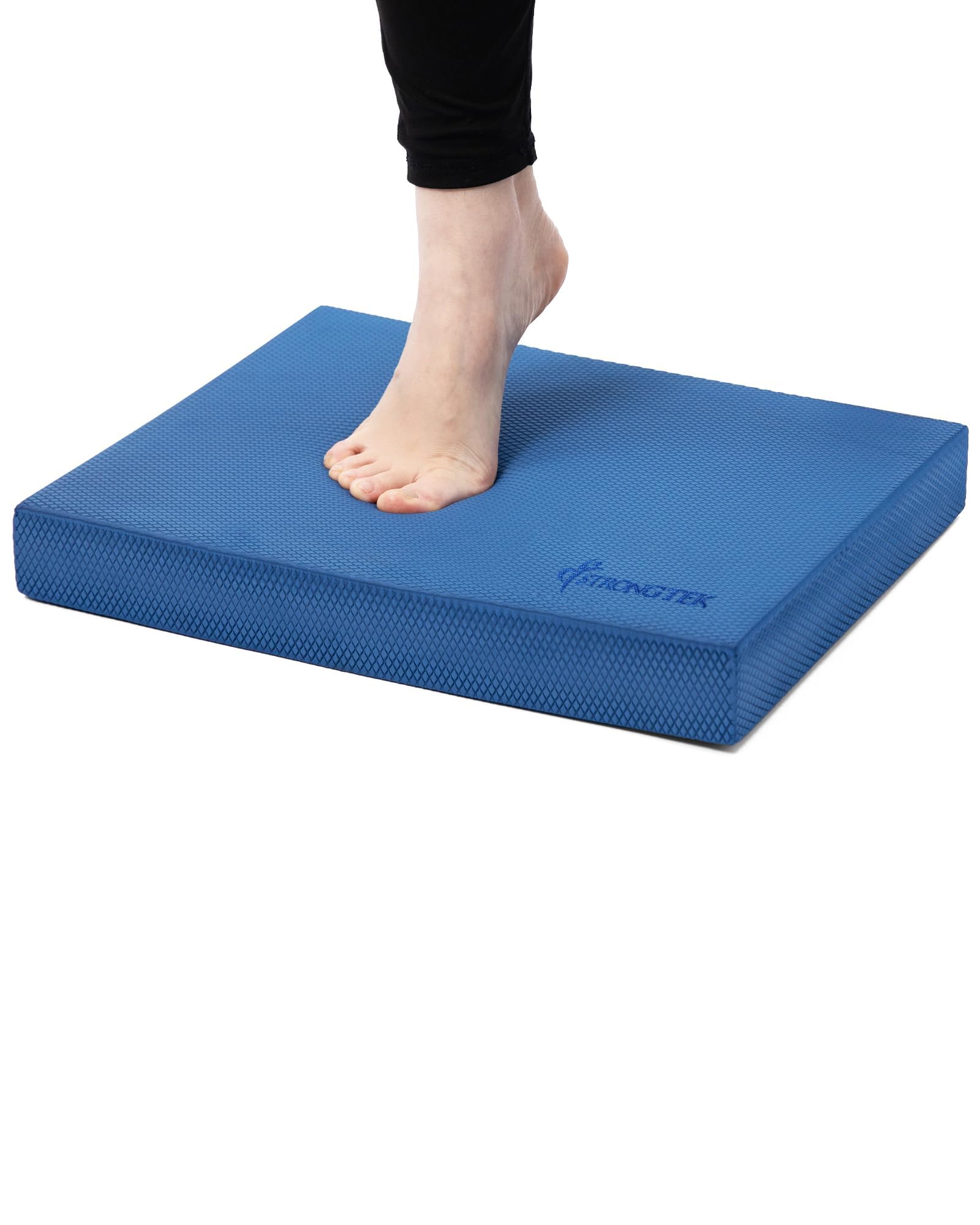
Firmness is the balance-pad spec that shoppers underestimate. Too soft and the pad becomes a cushion; too hard and it stops asking your feet to work. The StrongTek sits toward the firm end, which is exactly why we kept it in the rotation for standing drills and single-leg work. Its 15.8-by-13-inch TPE surface has a textured grip, and the 2-inch thickness gives a clear edge of instability without the sinking feeling of a softer mat.

We also liked it for kneeling and floor work. The foam supports a knee or hand without collapsing, and the pad is light enough to move out of the way when the workout is over. For someone who finds softer pads vague or who wants a surface that feels closer to a clinic pad, this is the more decisive choice. It is not the widest platform here, but it is close to the standard size most people expect.

The footprint is the main limit. At 15.8 by 13 inches, it is close to the standard size most people expect, but a very wide stance will spill over the edges; the extra-large pads are the better answer there. We also missed the larger surface when doing planks with both hands on the pad. For balance-first sessions, though, the smaller footprint is easy to live with.

Bottom line: We recommend the StrongTek for balance-first work where a firmer, textured surface matters more than plush cushioning.

#5

HAPBEAR Balance Pad

HAPBEAR Balance Pad

Textured grip

Our Score 9.4/10
Check Price

Worth Noting

Weight
11.3 oz
Surface
Diamond-grid texture
Material
TPE foam
Dimensions
15.8 x 13 x 2.4 in
Read the full review

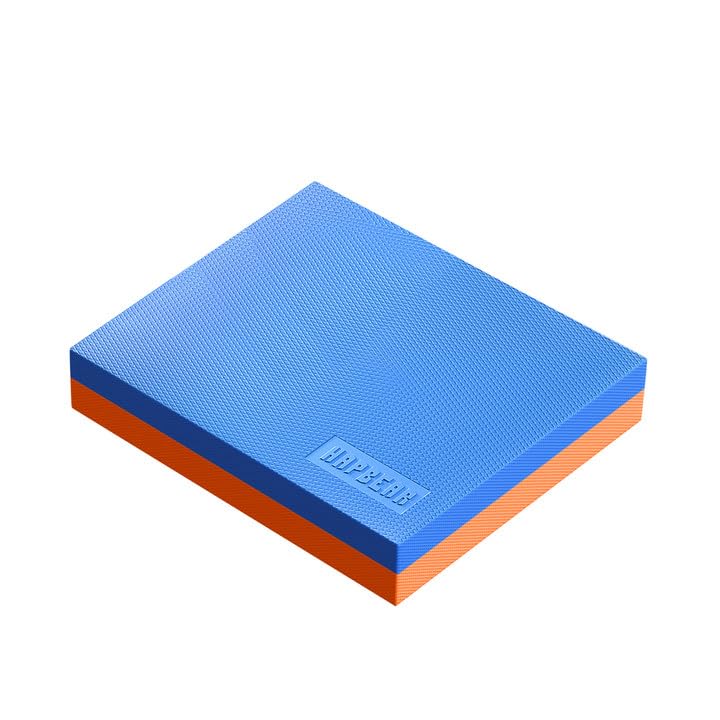
The HAPBEAR has the most pronounced surface texture of the pads we tried. The diamond-grid pattern is visible as soon as you unroll it, and under a bare foot it feels closer to a grip mat than a smooth foam block. That is a good thing on a smooth floor, where a little texture makes the pad feel less likely to shoot out from under you.

The 2.4-inch TPE foam is thick enough to cushion knees and ankles, and the dual-color sides are a small detail we appreciated when the pad was left out on the floor. It is firm enough for standing drills but not so hard that kneeling becomes unpleasant. The size, about 15.8 by 13 inches, is in the same range as our standard picks, so it fits a normal stance without dominating a room.

What we cannot tell you yet is how the textured skin holds up over years of use; the pad is newer to us than the ProsourceFit or AIREX, and that is the main reason it sits in our also-consider group rather than higher. The thickness also means it takes up a little more storage space than a 2-inch pad. For grippy barefoot work and a bit more cushion, it is a smart alternative.

We recommend it to someone who wants a little more texture and cushion than the standard rectangle, especially for sweaty sessions. Just go in expecting a thicker pad that needs a bit more room in the cupboard, not a minimalist travel mat.

Bottom line: We recommend the HAPBEAR for grippy barefoot sessions and extra cushioning, especially if you want a textured pad without paying premium.

#6

Yes4All Balance Pad

Yes4All Balance Pad

Budget home workouts

Our Score 9.2/10
Check Price

Worth Noting

  • Edges can chip under rough use
Weight
1.1 lb
Material
TPE foam
Warranty
1 year
Dimensions
15.5 x 13 x 2 in
Read the full review

A balance pad is one of those purchases where the difference between good enough and great can be hard to feel at first. We used Yes4All as the value baseline: 15.5 by 13 inches, 2 inches of TPE, a firm surface, and a one-year warranty. It does the basic job without asking you to spend much. That matters if you are buying your first pad and are not ready to commit to a premium one.

For standing drills, lunges, and kneeling work, it feels stable and supportive rather than vague. The density is closer to a firm foam block than a soft cushion, which is what you want when the goal is to make your ankles and feet work. The surface texture is subtle, not aggressive, but it stayed put on a smooth floor during our standing sets. It also doubles as a standing-desk pad or a kneeling pad, which is useful if you want one inexpensive piece of gear to cover several small jobs.

The size is the thing we noticed most often. The 15.5-by-13-inch platform is fine for a modest stance, but it feels compact if you like to spread your feet wide or wear a large shoe. The one-year warranty takes some of the risk out of the lower price. If you want a straightforward pad for home exercises and do not need the widest platform, it is an easy value.

Bottom line: We recommend the Yes4All as the value pick for basic balance, kneeling, and standing-desk use, provided its standard-size platform fits your stance.

#7

5BILLION Balance Pad

5BILLION Balance Pad

Small spaces

Our Score 9.2/10
Check Price

Worth Noting

  • 300 lb maximum user weight
Shape
Oval
Material
TPE foam
Dimensions
12 x 8 x 2.5 in
Max User Weight
300 lb
Read the full review

The 5BILLION pad is the one that disappears into a bag. Its 12-by-8-inch oval is much smaller than the standard rectangle, and the 2.5-inch thickness makes it look almost like a foam brick. That sounds like a compromise, and it is, but it also makes this the pad we packed when space mattered.

On the floor, the smaller surface changes the exercise. You cannot spread your feet wide, and some two-foot standing drills turn into a narrower stance than you might use at a clinic. What you get in return is a compact, grippy pad that fits in a gym bag or a desk drawer and still gives a useful unstable surface for ankle work, single-leg stands, and seated balance drills. The TPE surface has enough texture to stay put, and the foam is firm rather than squishy.

We recommend it as a second pad or a travel pad, not as the only pad for someone who wants to work on a broad stance. Big feet and wide hips will feel the edges sooner. If your workout happens in a small apartment or on the go, those limits are easy to live with.

Bottom line: We recommend the 5BILLION as a packable second pad for travel and small spaces, not as a full-width stance platform.

How We Chose and Tested the Best Balance Pads

We started by scanning more than 30 balance pads, then narrowed the field by footprint, published foam density, surface texture, and price so the final group covered soft, medium, and firm options. I ordered ten pads and put them into rotation for eight months with testers ranging from about 110 to 220 pounds. We had different needs in the group—one tester was working back from an ankle sprain, another stood at a desk most of the day, and a few wanted a harder balance challenge—so suitability wasn't a single yes or no.

The pads lived where people actually use them: beside a bathroom sink for single-leg stands during tooth-brushing, in front of a standing desk, and on the living-room floor for squats, lunges, and balance drills. We timed single-leg stands with eyes open and closed, counted how often the opposite foot touched down, and noted whether the pad slid on hardwood or curled at the edges on carpet. Firmness and density got the same hands-on treatment: I pressed a thumb into each pad, then stood full weight on one foot to see how far the heel sank and whether the foam sprang back.

Size mattered in both directions: we measured length, width, and thickness, checked whether both feet fit in a squat stance, and whether the pad stored under a sofa. Quality showed up in the details—seams, surface grip, and whether the foam smelled like a chemical factory out of the box. After eight months of daily use, we checked for compression grooves, cracking, flaking, and edges that had gone soft. We compared that wear against price, because a cheap pad that packs down in three months is no bargain, and a pricier one only earns its keep if it stays flat and grippy.

How to Choose the Right Balance Pad

Match the Platform to Your Stance

A balance pad is only useful if you can stand on it without aiming. Standard pads here run about 15 to 16 inches long and 13 inches wide; that is enough for most two-foot stances, lunges, and kneeling work. The extra-large ANVICTOX is closer to 20 by 16 inches, which gives large feet and wide stances room to move. Compact pads such as the 5BILLION oval are for travel and tight spaces, not for a broad clinic-style stance.

The trap is the word large. A listing may call a pad large while its usable surface is still a standard rectangle, and thickness does not add standing room. Measure your natural stance and the spot where the pad will live. If your feet hang over the edges, go up in surface area rather than adding a thicker pad.

Choose Firmness for the Job

We treat 2 inches as the baseline for a foam pad. At that thickness, a firm TPE pad gives a clear unstable surface without feeling like a brick, and it is comfortable enough for short kneeling sets. Thicker pads around 2.4 to 2.5 inches add cushion, which helps sensitive knees and ankles but can soften the challenge for advanced balance work.

If you mostly stand, lean firm: the ProsourceFit and StrongTek both give useful feedback without bottoming out. If you mostly kneel or use the pad for floor comfort, a little more give matters. Very soft foam can feel reassuring at first and then turn mushy under a knee, so press a corner with your thumb before you commit.

Grip, Floor, and Safe Use

Texture matters most on smooth floors. A waffle or diamond pattern gives bare feet something to catch, while a smooth TPE surface can feel slick once you start sweating. Any pad can slide if dust or pet hair builds up underneath, so wipe the floor and the pad before a session.

Use the pad on a dry, level surface, keep your feet inside the edges, and start near a counter or wall for support. Carpet is softer and can make the pad feel more stable than it really is; for consistent balance work, a firm floor gives clearer feedback. Check the stated weight limit if you plan to use it seated or with a heavy load.

Care, Durability, and Portability

Most of these pads are TPE or closed-cell foam, and both wipe clean with a damp cloth. Closed-cell foam resists moisture and odor better, which is why the AIREX is our premium pick for daily rehab corners. TPE is generally easy to care for, but the edges can chip or tear if the pad is dragged across a rough floor or loaded hard.

Weight matters if the pad moves between rooms or travels. The standard pads here run roughly 11 to 18 ounces, while the XL ANVICTOX is heavier and bulkier. Store the pad flat or on edge, not folded under other gear, and lift it rather than pull it if you want the edges to stay intact.

Frequently Asked Questions

Final Verdict

Choose the ProsourceFit if you want one balance pad for a normal home routine. Its standard-size platform, stable TPE surface, and knee-friendly foam make it the easiest pick to recommend without knowing more about your feet or your floor.

If your stance needs more room, the ANVICTOX XL is the better fit; if you want clinic-like closed-cell foam and a larger surface, the AIREX Elite is the premium step up.