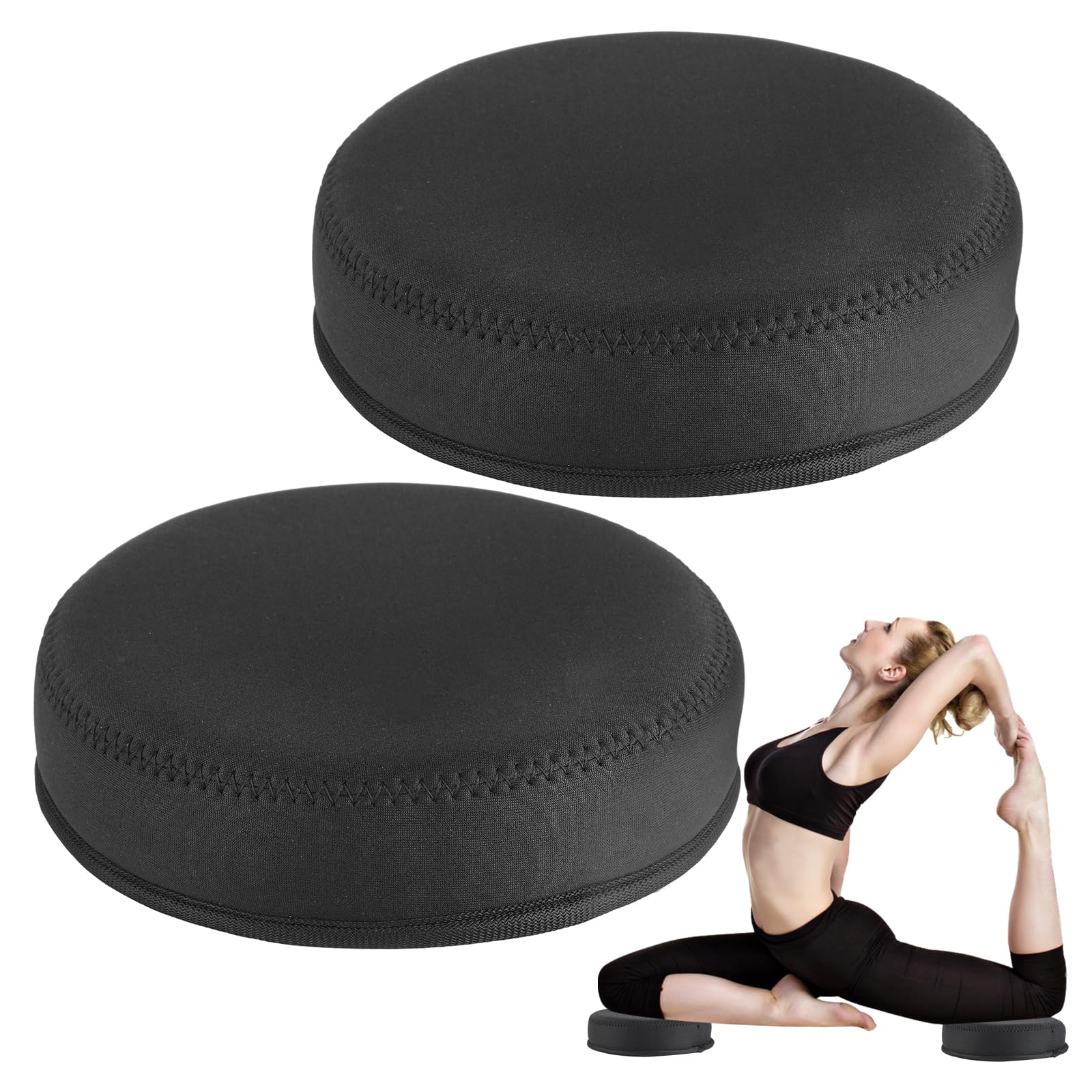
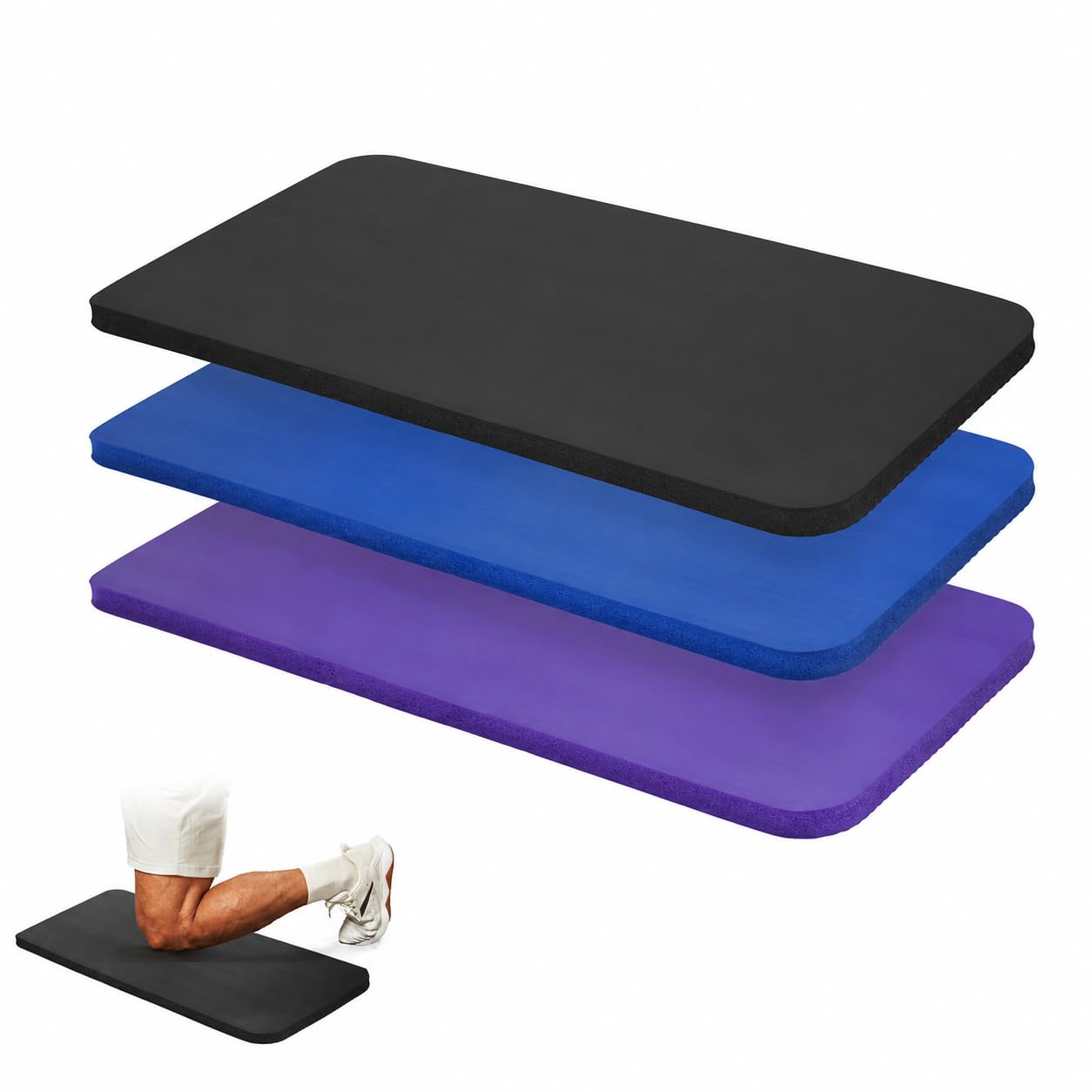
Yoga & Mobility

Best Yoga Knee Pads of 2026

The moment I decided a knee pad was not optional came about ten minutes into a hip-opening sequence, kneeling on a studio floor that felt one thin mat away from concrete. My knees were the only part of me that wasn't relaxing. A yoga knee pad solves a narrow problem very well: it puts a real layer of cushion between kneecap and floor so you can stay in the pose instead of shifting your weight every twenty seconds. The catch is that a pad which is too soft bottoms out under you, and one that's too thin does almost nothing at all.

Over the past four months we've rotated 14 pads through studio classes, living-room flows, and plenty of kneeling on hardwood, and the differences came down to density and grip far more than raw thickness. A pad that slides across your mat is worse than no pad, and one that still smells like a tire in week two never gets used again. The picks below are the ones that held up on support, cushioning, comfort, and quality, right down to the straps and Velcro that decide whether a pad actually makes it to class.

#1

Heathyoga Yoga Knee Pad

Top Pick
Heathyoga Yoga Knee Pad

Everyday yoga practice

Our Score 9.2/10
Check Price

Worth Noting

  • Half-inch foam is the thinnest long pad here
Material
Closed-cell TPE
Thickness
0.5 in (12 mm)
Carrying Strap
Included
Length X Width
26 x 10 in
Read the full review

Twenty-six inches is the width of a standard yoga mat, and this pad is cut to match it. Lay it across your mat and both knees land on foam with room to spare; the ten-inch depth runs from knee to shin, which is the part that actually digs in during a long tabletop hold. The foam is closed-cell TPE rather than the open-cell NBR most pads use, and that turned out to be the detail we cared about most: sweat stays on the surface instead of soaking in, so a damp cloth is the whole cleanup.

It also does the boring things right. Through sun salutations and a slow hip-opening sequence it stayed exactly where we put it, with no creep toward the back of the mat and no curling at the edges. That sounds like the minimum, but a pad that shifts an inch every time you move is a pad you stop bothering with.

Rolling it up is why it lives in the bag. The included strap holds the roll tight and doubles as a handle, the closed-cell face doesn't pick up mat fuzz, and it air-dries quickly after a wipe. It isn't machine washable, which is fine — nothing about it needs a machine.

What settles it is the combination rather than any single number: mat-width coverage, foam dense enough to hold a kneecap off the floor, and a surface you wipe instead of wash. Against the disc-style pads here it gives up the ability to slide one pad under a single wrist, and it gains a full-width landing for both knees. For a normal practice, that's the right trade.

Bottom line: We recommend it because it covers both knees at mat width and wipes clean instead of soaking up sweat — the right buy for anyone who wants one pad for a normal class.

#2

Kinesis Yoga Knee Pad

Kinesis Yoga Knee Pad

Very sore knees

Our Score 9.2/10
Check Price

Worth Noting

  • Mesh bag is a tight squeeze for the pad
Material
NBR foam
Carry Bag
Included
Thickness
1 in (25 mm)
Length X Width
24 x 12.2 in
Read the full review

A full inch of foam is roughly the thickness of a deck of cards, and it's more padding than any other long pad in this guide. That matters if your kneecap has no natural padding left, or if you've been doubling a folded blanket on your mat and still feeling the floor. The difference between this and a half-inch pad is immediate — you stop negotiating with the floor and just kneel.

Twelve-point-two inches of width is the other half of the argument. It covers knee to shin and then some, so shifting from a low lunge into child's pose doesn't mean dragging the pad back under you. At 8 ounces it's heavier than the lightest pad here, which is the honest cost of an inch of foam: noticeable in a tote, invisible on the floor.

We buy it for the cushion, not the straps. The velcro strips on the back are meant to let you wrap the pad around a rolled mat so the two travel as one piece, and when the adhesive holds that's a neat trick — but the glue under those strips can let go and leave a sticky patch on the foam. Skip the straps and carry it in the mesh bag. The foam is the part worth having.

Bottom line: For genuinely sore knees we look here first: a full inch of foam across a wider face than anything else in this guide, provided you ignore the velcro strips.

#3

Zealtop Yoga Knee Pad

Zealtop Yoga Knee Pad

Travel pair

Our Score 9.2/10
Check Price

Worth Noting

  • Slides on smooth floors without a mat
Size
7.87 x 7.87 in
Material
Foam
Thickness
1 in
Pads Per Pack
2
Read the full review

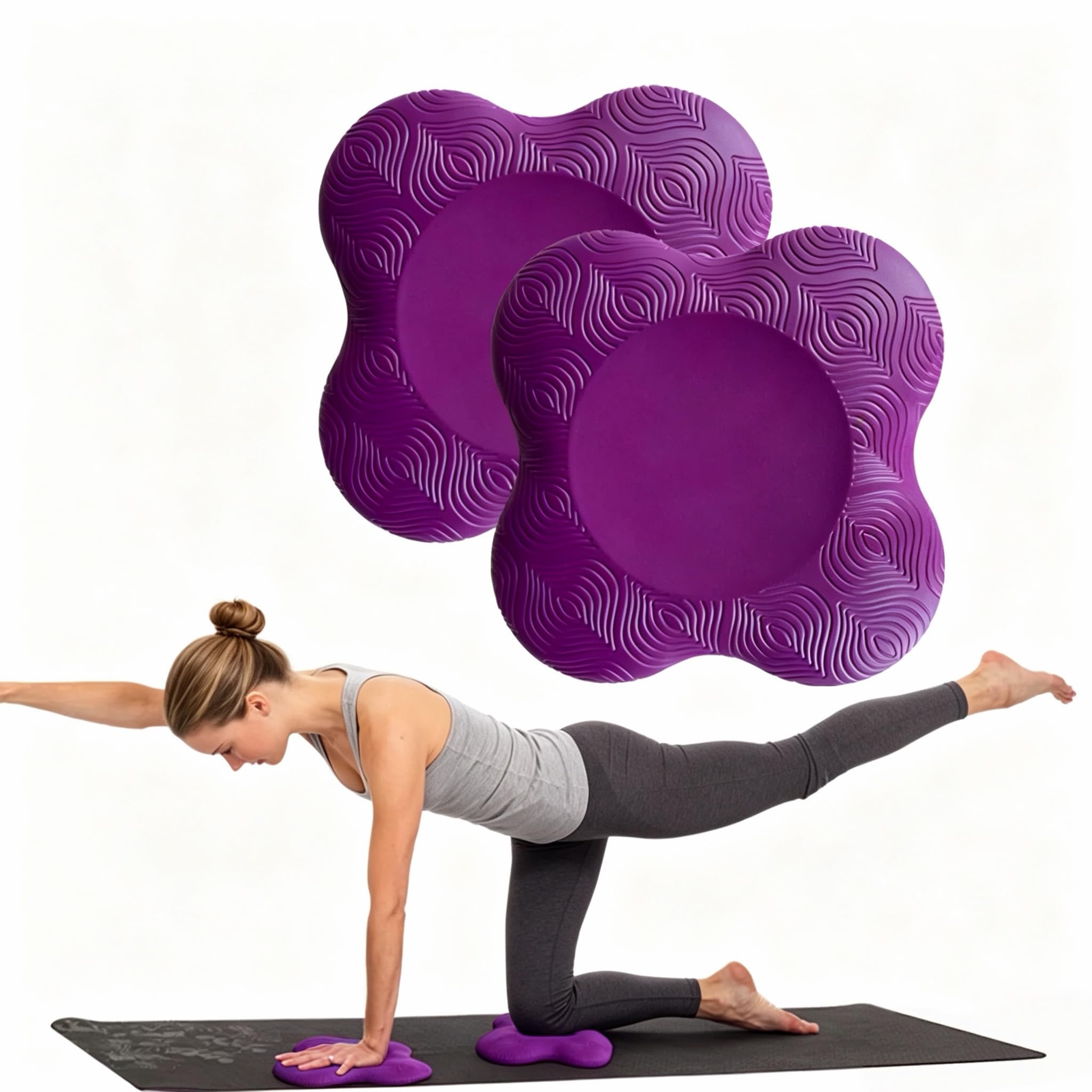
Two palm-sized pads instead of one strip is a different answer to the same problem, and for some poses it's the better one. Each pad is nearly eight inches across and a full inch thick, with a shallow dip in the middle that cradles the kneecap rather than letting it perch on a crown of foam. That's the same depth as the widest long pad here, compressed into a square you can drop in a tote. We moved them constantly — one under a knee here, one under an elbow there — and that's the thing a single long pad can't match.

What they don't do is stay put on a polished floor. On a mat they behave; on bare hardwood or a gym floor they can slide out from under you mid-pose, so keep them on your mat or a towel. Two pads in the pack means one can live in the car and one in the studio bag, which is more flexibility than a single mat gives you. For the money, that's a fair trade for the slip.

Bottom line: Buy these if the padding needs to move with you — one under each knee, one under an elbow — and you practise on a mat rather than a bare floor.

#4

Gaiam Yoga Knee Pads

Gaiam Yoga Knee Pads

Wrists and elbows

Our Score 9.2/10
Check Price

Worth Noting

  • Firm foam is unforgiving under a bony knee
Size
7.6 in diameter
Material
Polyurethane foam
Thickness
0.79 in
Pads Per Pack
2
Read the full review

Two hexagons, 7.6 inches across and about three-quarters of an inch thick, cut from polyurethane foam. The foam is dense — closer to a gel kitchen mat than to the soft NBR pads here — and that density is why they've stayed flat and square instead of sagging into a pancake where a knee sits.

What you're buying is coverage that follows you around. Two separate pads mean one under each knee for cat-cow, then one under a wrist and one under an elbow in side plank, then one under a hip in pigeon. A single long mat does knees beautifully and everything else awkwardly; this pair does the whole body adequately and the awkward spots better than anything else here.

Grip depends entirely on what's underneath, and it's the one thing to test before you commit. On a sticky mat these stay where you set them; on smooth hardwood or a slick mat they skate, especially in poses where you press down and forward. If your practice is on a decent mat, it never comes up. If you work on a bare floor, it will.

Wrist-heavy sequences are where we reach for these, and where a 24-inch strip has nothing to offer. They're also the set that survives a tote — no roll to unfurl, nothing to crease, no strap to lose. That's a narrower job than the long pads do, and for that job they're the most useful pair here.

Bottom line: For wrists, elbows and hips, where a long pad can't reach, these two firm hexagons do more than anything else here — just don't expect plush.

#5

HASSLICKIT Knee Pad Mat

HASSLICKIT Knee Pad Mat

Smooth floors

Our Score 9.2/10
Check Price

Worth Noting

  • One pad per pack, so elbows and knees share it
Material
NBR foam
Thickness
0.8 in
Carrying Strap
Included
Length X Width
24 x 9.8 in
Read the full review

Two usable faces is the reason we pick this one. One side is smooth, one is textured, and which goes down depends on the floor — textured side down on a polished studio floor, smooth side down on a mat that already has grip to spare. It's the only pad here that lets you change the answer instead of living with it.

The rest is solid. Eight-tenths of an inch of odor-free NBR is more than the half-inch pads give you, the 24-by-9.8-inch cut spans a mat when you lay it across, and it rolls around its own strap so it lives in the mat bag. It's a single pad, though — if you want something under each elbow at once, a pair of discs is the more sensible buy.

Bottom line: This is our pick for a polished studio floor: flip it textured-side down, and the 0.8 inch of foam handles most knees without a second pad.

#6

ProsourceFit Yoga Knee Pad

ProsourceFit Yoga Knee Pad

Studio bag pad

Our Score 9.0/10
Check Price

Worth Noting

  • Can creep on a smooth floor
Weight
5.6 oz
Material
NBR foam
Thickness
0.63 in (15 mm)
Length X Width
24 x 10 in
Read the full review

At 5.6 ounces this is the pad that actually travels. It's the lightest of the long pads here, and it rolls small enough to push into the same bag as the mat without a second thought. The 24-by-10-inch face is ribbed rather than smooth, which does more for grip than the flat pads manage, and the fifteen millimeters of NBR under it is dense enough that a knee doesn't reach the floor.

Our read is that most people don't need an inch of foam — they need enough that a kneecap stops complaining, and 15 mm of high-density foam covers a wide range of bodies. If you've been folding a towel at the front of your mat, this replaces it and stays put. The ten-inch width is the thing to understand before you buy: run it across the mat and both knees land on it, run it lengthwise and it's a strip for one knee. Ours lives across the top of the mat.

The NBR is the older, plainer foam, and here that's a virtue — dense and slightly rubbery rather than pillowy, so it doesn't bottom out the way soft foam does, and the ribbed face keeps it anchored on a sticky mat. It isn't plush, and it won't be the pad you choose if you want a cloud under your knee. It is the one we keep reaching for when the bag is already full.

Bottom line: The pad we hand to anyone who wants a long pad without thinking hard about it: light, dense enough to work, and it rolls into the mat bag.

#7

ECOESPTI Yoga Knee Pad

ECOESPTI Yoga Knee Pad

Bony knees

Our Score 9.0/10
Check Price

Worth Noting

  • Small 6.7-inch footprint needs repositioning
Size
6.7 x 6.7 in
Material
Memory foam and EPE
Thickness
1.57 in (40 mm)
Pads Per Pack
2
Read the full review

A stack of memory foam over EPE, wrapped in a waterproof cover, is a different construction from the single slabs of NBR that make up most of this guide. At 1.57 inches these are more than three times the thickness of the half-inch pads, and each one is only 6.7 inches square — a lot of depth in a small footprint.

Where it earns that extra thickness is the order of the give. The memory foam yields first, then the EPE underneath takes the load, so it's soft on contact and supportive once you're settled — a kinder landing than a firm slab, and noticeably different on tile or concrete. The cover is the practical half: moisture beads on it and wipes straight off.

The small footprint is the trade. Six and a half inches covers a knee, not a mat, so you place these individually and move them between poses — one under each knee for tabletop, one under a wrist for plank. The pair comes with a storage bag, which matters more than it sounds when you're carrying loose pads around in a tote.

Bottom line: Choose these when an inch of foam still leaves you feeling the floor — the softest landing in the guide, as long as you don't mind moving two small pads between poses.

#8

DEAYOU Yoga Knee Pads

DEAYOU Yoga Knee Pads

Multi-room use

Our Score 8.8/10
Check Price

Worth Noting

  • Only sold as a three-pack
Material
High-density foam
Thickness
0.6 in (15 mm)
Pads Per Pack
3
Length X Width
24 x 10 in
Read the full review

Three pads in one pack is the whole idea, and it solves something a single pad can't: you stop ferrying one between the studio, the living room, and the car. Each is 24 by 10 inches and 0.6 inch thick — the same footprint as the single pads here — with a ridged surface on top that helps it hold on a mat.

The foam sits at the thin end of what we recommend for knees. At 0.6 inch it's in the same range as the pads we like for everyday practice, dense enough to kneel on through a class, and it rolls small enough to disappear into a mat bag. It isn't the pad for a knee that's already bruised and objecting to every pose.

Three pads, three places: one rolled into the studio bag, one under the desk for lunchtime stretching, one in the car for the days you end up practising on a hotel floor. If you only need one pad, buy one of the better ones here instead. The pack is the product.

Bottom line: The pitch is three decent pads instead of one, so you stop carrying gear between rooms; skip it if your knees need more foam than this.

How We Tested Yoga Knee Pads

We built a shortlist of roughly 40 pads from studio instructor recommendations, retailer bestsellers, and brands our fitness editors already use, then filtered by thickness (most landed between a quarter inch and a full inch), surface material, price, and whether the pad used a strap, a Velcro band, or nothing at all. Fourteen made the cut, and we bought each one ourselves.

Every pad went through the same four months of real use. I kept a stack beside my mat at home for daily morning flows and carried two to a weekly studio class, and everyone on the team worked their assigned pads into cat-cow, child's pose, low lunges, pigeon, and any sequence that parks weight on a knee. We also moved them onto bare hardwood and a carpeted rug to see how the undersides behaved on surfaces other than a mat.

In the poses, we noted whether a knee ever felt the floor through the pad, and whether the cushioning sprang back between sessions or stayed flattened. Thumb presses and slow weight shifts showed which pads recovered quickly and which collapsed under a kneecap. We rocked side to side to see whether a pad crept across the mat, then repeated the check with damp hands and a slightly sweaty mat to judge grip and slip resistance. Portability got the same treatment: rolled each pad, strapped it to a tote, and opened and closed every Velcro closure more than twenty times to see if the hooks fuzzed or lost hold. Finally, we smelled each pad straight out of the packaging and again after a week of use, since a chemical odor that lingers is the fastest way for a pad to end up in a closet.

How to Choose Yoga Knee Pads

How Much Cushion You Actually Need

Thickness on a listing is measured before anything presses into it, which is why a soft half-inch pad can leave you feeling the floor while a firm pad at the same depth doesn't. Our rule: if a folded blanket under your knee still lets you find the floor, move up to a full inch. The Kinesis and the ECOESPTI pair are where we point people. If a half-inch pad has been fine at the studio, don't add bulk you'll only have to carry.

One Long Pad or a Pair of Spot Pads

A 24-to-26-inch pad laid across your mat covers both knees for tabletop, cat-cow, and child's pose, which is most of what a typical practice asks for. A pair of small pads or discs does something different: it follows you to wrists in plank, elbows in forearm work, a hip in pigeon, and the back of a head in supported fish.

If your practice is mostly kneeling poses on a mat, buy the long pad. If it is heavy on arm balances, wrist-sensitive poses, or equipment like a reformer, the pair is more useful. Plenty of people end up with both, and the pair is the one that goes in the tote.

Grip Is What Decides Whether You Keep Using It

A pad has to grip two different things, and they don't behave the same way. A smooth underside that locks onto a sticky mat can skate across polished hardwood, and a heavily textured underside that grabs the floor can fight a mat you're trying to stay connected to. Test it where you actually practise: set the pad down and run a slow cat-cow. If it creeps, flip it or put it on the mat. The reversible HASSLICKIT exists precisely because both cases come up.

Foam, Sweat, and Cleanup

Closed-cell foams such as TPE and denser NBR sit sweat on the surface, so a damp cloth handles it. Loose, spongy open-cell foam drinks it and holds it, which is how a pad starts to smell like a gym bag. None of these is machine washable, and rolling one away damp is the fastest way to ruin a good pad: wipe it, let it air dry completely, then roll.

Width, Length, and Getting It to Class

A standard mat is 24 inches wide, so a 24-to-26-inch pad laid across it covers the full width; the same pad run lengthwise covers one knee. Decide which way you'll use it before comparing lengths, because those numbers mean different things in each orientation.

Two traps. Compact on a listing means it fits a tote, not that it vanishes. And pads ship rolled, so give a new one a day or two flat on the floor before your first class, otherwise you'll spend the session on a pad that is trying to curl back up.

Frequently Asked Questions

Final Verdict

Buy the Heathyoga. It's the pad that gets out of the way: full mat-width coverage, foam dense enough that a knee stays off the floor, and a closed-cell surface you wipe rather than wash.

Two situations change the answer. If your knees need more than a half-inch, the Kinesis gives you a full inch across a wider face. If even an inch isn't enough, the ECOESPTI memory-foam pair is the softest landing here. Everyone else can stop at the Heathyoga.