Yoga & Mobility

Best Pilates Mats of 2026

A Pilates mat has to do two opposing jobs: cushion your spine and knees through roll-ups and side-lying work, then stay firm enough that you don't wobble in a single-leg stretch. Go too soft and your balance goes; go too thin and every vertebra reminds you why you're there. What you're really buying is a surface that makes the work feel supported instead of punishing—one that grips bare feet without turning into a slip-and-slide.

What surprised me most is how much a mat's surface changes the work. A mat that feels lovely under your knees can be a nightmare for planks if your hands creep forward; a thinner, tackier mat can feel more stable but leave your sit bones complaining. We unrolled 14 mats over six months in studios, living rooms, and hotel rooms, and the keepers all stay put on hardwood, don't smell like a tire aisle out of the box, and still roll flat after weeks of use. The picks below are sorted by what they're best at.

#1

Gaiam Premium 6mm Print Mat

Top Pick
Gaiam Premium 6mm Print Mat

Everyday Pilates

Our Score 9.4/10
Check Price

Worth Noting

  • 68-inch length is short for taller users
Size
68 x 24 in
Weight
3.1 lb
Material
PVC, 7P-free
Thickness
6 mm
Read the full review

Six millimeters is the number we keep coming back to for Pilates. It's enough foam to keep a spine, a pair of knees, and hip bones off a hardwood floor, and thin enough that you still feel the ground when you're balancing on one leg, which is exactly where an inch-thick mat goes wrong. The Gaiam Premium is built on that 6 mm of dense PVC, and it's the mat we point to first when someone asks what to buy for a general practice.

The surface does the rest. It's tacky rather than slick when dry, so planks and kneeling sequences feel locked in, and the texture keeps the mat from skating across a floor. Damp is the limit: once your hands get sweaty the PVC turns slick, and a wipe with a damp cloth before you start brings the tack back. If you sweat through a whole class, keep a small towel under your palms.

Two practical notes before you order. It arrives with the chemical smell most printed PVC mats have, and the maker's advice to unroll it and air it out for two to three days is the timeline we plan for. At 3.1 pounds it's also the heaviest mat in this group, which is fine for something that lives in one room and less fine if you carry it to a studio three times a week.

Against the thicker picks, you give up cushion for kneeling and rolling work. What you get instead is a mat that doesn't squirm under a standing sequence, doesn't compress into dents where you plant your feet, and covers Pilates and yoga without a second purchase. That's the trade we take, and the reason it's the default here.

Bottom line: Our default Pilates mat: 6 mm of dense, tacky PVC that cushions spine and knees without the wobble of a thick foam mat.
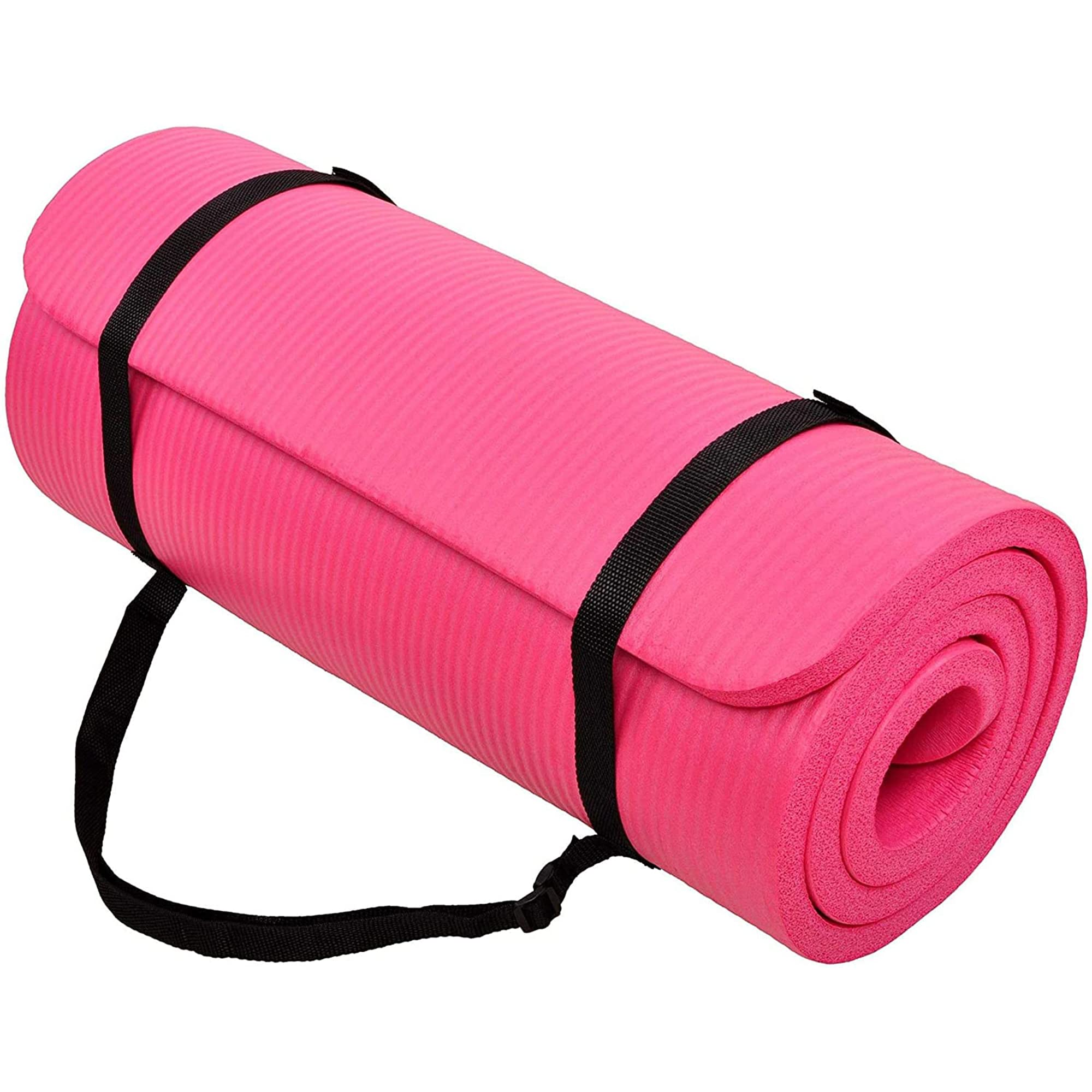
#2

BalanceFrom 1-Inch Mat

BalanceFrom 1-Inch Mat

Sensitive joints

Our Score 9.4/10
Check Price

Worth Noting

  • Foam can tear with rough handling
Size
71 x 24 in
Weight
2.2 lb
Warranty
2 years
Thickness
1 in
Read the full review

An inch of foam changes what floor work feels like. Hip bones stop digging in, a tailbone stops complaining during roll-downs, and kneeling sequences stop being a negotiation. BalanceFrom builds that inch into a 71-by-24-inch mat that weighs 2.2 pounds and carries a two-year warranty, which is more backing than anything else in this group.

It changes standing work too, and not in your favor. Single-leg balances, standing leg lifts, and any sequence where weight moves from foot to foot get wobbly on foam this deep, because you can feel the mat give under the standing foot. That's the honest trade for the cushioning, and it's why we treat this as a floor-work mat rather than an all-rounder.

If your practice lives on the mat, with roll-downs, bridging, side-lying leg work, and the stretches after a run, the depth is pure benefit, and this is the one we name first when someone tells us their knees hurt. If you're working toward standing balances, take the top pick's 6 mm instead and fold a blanket under your hips for the floor work.

Bottom line: The mat we name when knees and hips need real padding: a full inch of foam built for floor work rather than standing balances.

#3

Gaiam Thick 10mm Mat

Gaiam Thick 10mm Mat

Knee comfort

Our Score 9.2/10
Check Price

Worth Noting

  • Tears and pills with regular use
Size
72 x 24 in
Weight
2.8 lb
Material
NBR foam
Thickness
0.39 in
Read the full review

If the top pick is a firm handshake, this is the cushion you sink into, and it's the mat we hand over when someone tells us the floor is the problem. It's Gaiam's NBR foam at roughly 10 mm, thicker, softer, and 72 inches long, which means taller users get the full coverage in supine work that the 68-inch Premium doesn't offer.

Soft NBR is lovely under a knee and less lovely under a standing foot. It compresses, it can stretch in a strong pose, and it takes longer to settle flat after being rolled. Smell is the other thing: despite the low-odor claim, it can arrive with a strong foam smell, so unroll it somewhere airy for a few days before your first class.

For knees that hurt on a thin mat, hips that complain during side-lying work, or anyone easing back into Pilates after an injury, the extra depth is worth the softness. It's also the least expensive way here to get a genuinely plush surface from a brand with a long track record. The rest is ordinary in the ways that matter: it rolls, it carries, and it wipes clean.

Bottom line: The plush option: soft NBR around 10 mm deep that's kind to knees and hips, for practice that stays close to the floor.

#4

CAP Barbell 1/2-Inch Mat

CAP Barbell 1/2-Inch Mat

Budget setups

Our Score 9.2/10
Check Price

Worth Noting

  • 68-inch length is tight for taller users
  • Shows wear with daily use
Size
68 x 24 in
Included
Carry strap
Material
NBR foam, latex-free
Thickness
0.5 in
Read the full review

This is the least expensive full-size mat in the group, and we're comfortable recommending it to anyone who wants to try Pilates without committing much. You get half an inch of latex-free NBR foam, a 68-by-24-inch surface, and a carry strap. No bag, no alignment lines, nothing that needs explaining. Put it on a hard floor, take your shoes off, and it does the job.

What you give up is longevity and a little polish. It's soft NBR like the other thick mats here, comfortable under a knee and quick to show marks where you plant your hands and feet, and it isn't the mat to buy if you want the surface looking new after a year of daily practice. What it does have going for it is stability: the ridged surface stays put on hardwood instead of creeping across the room.

Bottom line: The budget pick: a plain half-inch NBR mat with a strap that does everything a first Pilates mat needs.

#5

Fitvids 1/2-Inch Exercise Mat

Fitvids 1/2-Inch Exercise Mat

Hard floors

Our Score 9.0/10
Check Price

Worth Noting

  • Grip fades once hands get sweaty
Size
71 x 24 in
Included
Carry strap
Material
NBR foam
Thickness
0.5 in
Read the full review

Concrete, tile, and a thin rug over hardwood are where this mat earns its keep. Half an inch of NBR foam is about as much cushion as you can add before a mat starts interfering with your balance, and Fitvids builds it into a 71-by-24-inch surface that wipes clean with soap and water and rolls up around the included strap. It's the mat we put in front of anyone whose knees complain before anything else does.

Long sessions on a hard floor are where we appreciate it most. The foam is soft enough that a tailbone stops being a problem in roll-downs and hip work, and the length covers most adults without a gap at the head or feet. It's also the budget end of this group, which makes it the low-risk way to find out whether you actually want a thick mat.

The catch is the foam itself. NBR is soft and stretchy, so hands can creep forward through a long downward dog and the surface can bunch under your feet; pressing your palms toward the outer edges rather than the middle helps. Treat it as a mat that stays in one room, because rolling soft foam tight and hauling it around every week is what shortens its life.

Bottom line: Our pick for hard floors: half an inch of cushioning that spares knees and tailbones without the price of the premium mats.

#6

YOGATI Alignment Mat

YOGATI Alignment Mat

Learning alignment

Our Score 9.0/10
Check Price

Worth Noting

  • Thin under knees and elbows
  • Can stay curled after storage
Size
72 x 24 in
Weight
1.81 lb
Material
TPE
Thickness
0.24 in
Read the full review

The alignment lines are the reason to look at this one. Two lines run the length of the mat, laser-etched rather than printed, and they give you a reference for hand placement in down dog, heel position in a lunge, and whether your shoulders are square in a plank. For someone learning Pilates from videos with nobody correcting them, that's a real crutch, and it's the only mat here that offers one.

The rest of the package is ordinary in a good way. It's TPE, 72 by 24 inches, 0.24 inch thick, and light enough at 820 grams to sling over a shoulder on the way to class. The two-tone finish is reversible, so whichever side faces up looks deliberate, and a shoulder harness comes with it.

Thin is the honest caveat. There isn't much between your knees and the floor in tabletop or side-lying work, and that's the part we minded most. If it's been rolled tight, it can also stay curled at the ends, so unroll it and weight the corners for a day before your first session. The closed-cell surface is less forgiving than the grippiest mat here once hands get damp.

Buy it if you're new to Pilates, practicing from videos at home, and want help learning where your limbs belong. It's also the mat to throw in a bag for a class or a trip, since it weighs next to nothing and rolls small. If long kneeling holds are part of your week, put the money toward depth instead.

Bottom line: The beginner's mat: laser-etched alignment lines that teach hand and foot placement, on a light, thin TPE surface.

#7

Gruper TPE Yoga Mat

Gruper TPE Yoga Mat

Sweaty hands

Our Score 8.8/10
Check Price

Worth Noting

  • Thin under knees and elbows
  • Shows wear at the edges with heavy use
Size
72 x 24 in
Included
Strap and bag
Material
TPE
Thickness
0.24 in
Read the full review

Most mats grip fine until your hands get damp, and then they don't. This one held through the sweaty stretches of our sessions where softer foam started to slide, and it's the mat we trust most in this group once bare feet stop being dry. The surface is closed-cell TPE, 72 by 24 inches and 0.24 inch thick, and it comes with both a carry strap and a storage bag, which is more than most mats here include.

Where it earns a place is a home practice that gets warm: a long hold, bare feet, a room without much air moving. It's also the sensible buy if you want the mat and the bag in one order. The trade sits under your knees, because at 0.24 inch there isn't much between you and the floor, so kneeling sequences and spine work on a hard surface want something thicker. The TPE is denser than the NBR mats here, though, so it doesn't stretch the way they do.

Bottom line: The grippiest mat here: a closed-cell TPE surface that stays put when hands get damp, with a bag and strap included.

How We Tested the Best Pilates Mats

We started by pulling every Pilates mat we could find from brands we trust, then filtered by thickness (most ranged from 5mm to 15mm), material (PVC, TPE, natural rubber, cork), price, and dimensions. We cut any mat that was too narrow for shoulder-width work or too long to roll into a standard carrier. That left 14 mats, which we bought ourselves so no brand could send us a “better” sample.

For six months, those mats went everywhere my practice went: weekly mat classes, my living room floor (hardwood), a carpeted studio, and a few hotel rooms. I did the same 30-minute flow on each—roll-ups, planks, side-lying leg work, and single-leg balances—barefoot, and noted where my hands and feet slid as I warmed up. I measured actual thickness with a caliper, then checked how each felt under my knees in kneeling work and under my spine in supine series. I also ran a simple sweat test by spritzing my hands and feet to see if grip held, and on hardwood I watched for creeping during side planks; on carpet, a few mats turned into a slip-and-slide. To judge portability, I weighed each mat, carried it to class for a week, and noted whether the strap dug into my shoulder or the roll stayed tight.

Back home, I rolled and unrolled each mat daily for a month to check for creasing, surface wear, and whether it lay flat again. I sniffed each one straight out of the box and again after two weeks of use—some PVC mats had a chemical smell that lingered. Value came down to price relative to how it wore: a cheap mat that shed flakes after a month was no bargain, while a pricier one that kept its grip and shape looked like the better buy. The mats that scored highest did all of the above without asking you to adjust your practice.

How to Choose Pilates Mats

Thickness Is a Balance Decision

For Pilates, think 4 to 6 mm for a mat you'll stand on, around 10 mm if your knees and hips need the padding, and a full inch only if your practice stays on the floor. The trap is assuming thicker means more supportive: foam gives under a standing foot, and an inch of it turns a single-leg balance into a wobble.

Pick by the work you do most. Standing sequences and full flows belong on a 6 mm mat like our top pick; roll-downs, bridging, and side-lying work are noticeably more comfortable on the BalanceFrom's inch of foam. If you do both, buy for the standing work and fold a blanket under your hips for the floor.

Grip Means Two Different Things

Almost every mat on this page is sold as non-slip, and that word usually describes the underside, meaning the mat won't slide across hardwood. What matters more in Pilates is the top surface under bare, slightly damp feet and hands.

A closed-cell TPE like the Gruper holds its grip once you start to sweat; a tacky PVC like the Gaiam Premium grips beautifully dry and then goes slick. Neither is wrong, so match the surface to how much you sweat and keep a hand towel within reach if you're somewhere in between.

Material Predicts How It Ages

NBR is the soft, light, inexpensive foam behind most of the thick mats here, and it's the one that stretches, tears, and marks most readily. PVC is denser and tackier, heavier in the bag, and generally longer-lived. TPE sits between: firm, closed-cell, light, and usually thin.

If cushioning matters most, NBR is the honest choice and you accept a shorter life. If you want a surface that still looks new after a year of barefoot practice, buy PVC or TPE and add padding where you kneel.

Length, Width, and the Carry

Twenty-four inches wide is the standard here and suits most people. Length is where the mats separate: 68 inches works for most adults, but if you're much over five foot ten, a 71- or 72-inch mat keeps your head and heels on the surface during supine work.

What comes in the box matters as much as the roll. A strap or bag decides whether the mat actually leaves the house, and the Gruper TPE and the YOGATI both ship with one.

Frequently Asked Questions

Final Verdict

If you want one mat and no second thoughts, buy the Gaiam Premium 6 mm. It sits where Pilates needs it, with enough foam for a spine and a pair of knees and little enough that standing work stays honest, and its tacky PVC is the closest thing here to a mat that handles both Pilates and yoga.

If your knees are the reason you're shopping, go thicker. The BalanceFrom's inch of foam is the more comfortable mat for floor-based practice, and it's the pick we suggest when standing balances aren't the goal.