Yoga & Mobility

Best Cork Yoga Mat of 2026

Cork mats run on one small piece of physics that foam can't match: the surface gets grippier as it gets damp, so the sweat that turns a rubber mat into a slip-and-slide actually helps a cork one hold. I switched after one too many downward dogs spent sliding backward, and I haven't gone back. The catch is that the differences between one cork mat and the next are exactly the things a product photo can't show you — how thick the cork layer really is, whether the backing curls up at the corners, and whether it still smells like a wine cork by week three.

Over the past six months my team and I have practiced on nine cork mats, and the pattern held: the good ones grip from the first sun salutation and lie flat without a fight. Cork is heavier than foam, so weigh one before you fall for the print, and keep in mind that a thicker mat is kinder to your knees but a shakier place to balance. What follows are the mats that earned a permanent spot by the mat rack.

#1

Ecoga Cork Yoga Mat

Top Pick
Ecoga Cork Yoga Mat

Firm, stable practice

Our Score 9.2/10
Check Price

Worth Noting

  • Firm 5 mm
Base
Natural rubber
Weight
6.6 lb
Thickness
5 mm
Dimensions
72" x 24"
Read the full review

Six and a half pounds is a lot for a mat that measures 5 mm thick, and that number tells you what this is: cork over a dense natural rubber base, with far more rubber under you than the foam-based mats at the same thickness. Set it down and it stays down.

We think that density is the whole argument. Standing poses feel planted, balance work is not a negotiation with the floor, and 5 mm of firm cushioning keeps you honest about where your weight sits. It is the opposite of a soft, thick mat, so which one you want depends entirely on whether your knees or your balance complains more.

The mat is 72 by 24 inches with a centre alignment line, and it ships with a strap and a carry bag. Wipe it with a damp cloth after class and let it dry flat. Rolled up it is heavier than its thickness suggests, but the strap makes the walk to a studio manageable, and the extra mass is what you are buying.

Bottom line: If thick foam leaves you unsteady, this is the fix: we found it the steadiest surface in the group, and the firm 5 mm keeps standing poses honest.
#2

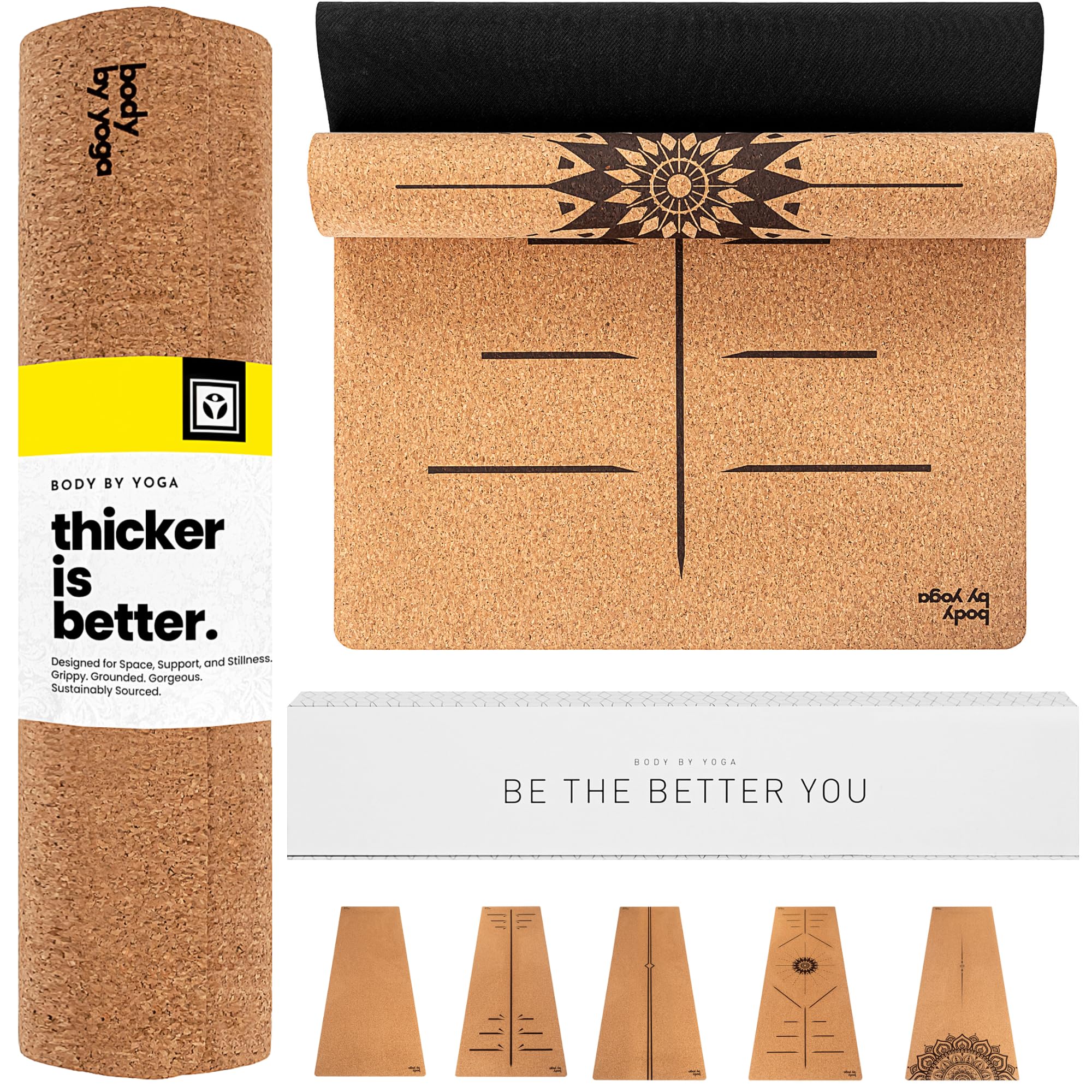
Body By Yoga Luxury Cork Mat

Body By Yoga Luxury Cork Mat

Home studio practice

Our Score 9.0/10
Check Price

Worth Noting

  • 9.9 pounds, so it stays in one room
Weight
9.9 lb
Materials
Cork and natural rubber
Thickness
0.25 in
Dimensions
80" x 26"
Read the full review

Eighty inches by 26 is a lot of mat. It runs eight inches longer than the 72-inch mats that make up most of this group, and you notice it at the edges of a practice: wide-legged folds, seated twists and long reclining stretches keep your hands and feet on cork instead of sliding onto bare floor. Taller practitioners feel it first, but anyone who has shuffled backward to keep a heel on the mat will get the point immediately.

Size alone would not earn the top spot. What does is the build: a quarter inch of cork over dense natural rubber, with a cork face that feels like a slab rather than a veneer glued to foam. Balance poses stay where you put them, kneeling sequences are comfortable, and the mat refuses to creep across a wooden floor mid-flow. We kept coming back to it for standing work, where a spongier mat would have us wobbling.

Cork is the reason to choose this over any foam mat. Dry hands slide a little at first; a few minutes in, the surface goes tacky rather than slick, which is the opposite of what happens to a rubber or TPE mat in a warm room. Cleaning is a wipe with water. It is hand wash only, and it wants to dry flat rather than be rolled up wet.

You can order it with alignment lines or without. If you are working on hand and foot placement, the marked version is worth taking; otherwise the plain cork is easier to read. Against the other 80-inch mat here, the Satori, we prefer this one's denser, plainer feel — the Satori wins on looks and loses nothing else that matters much.

Bottom line: Our default pick: if your mat lives in one room, this is the roomiest, steadiest cork surface in the group, and the one most practices will be happy with.

#3

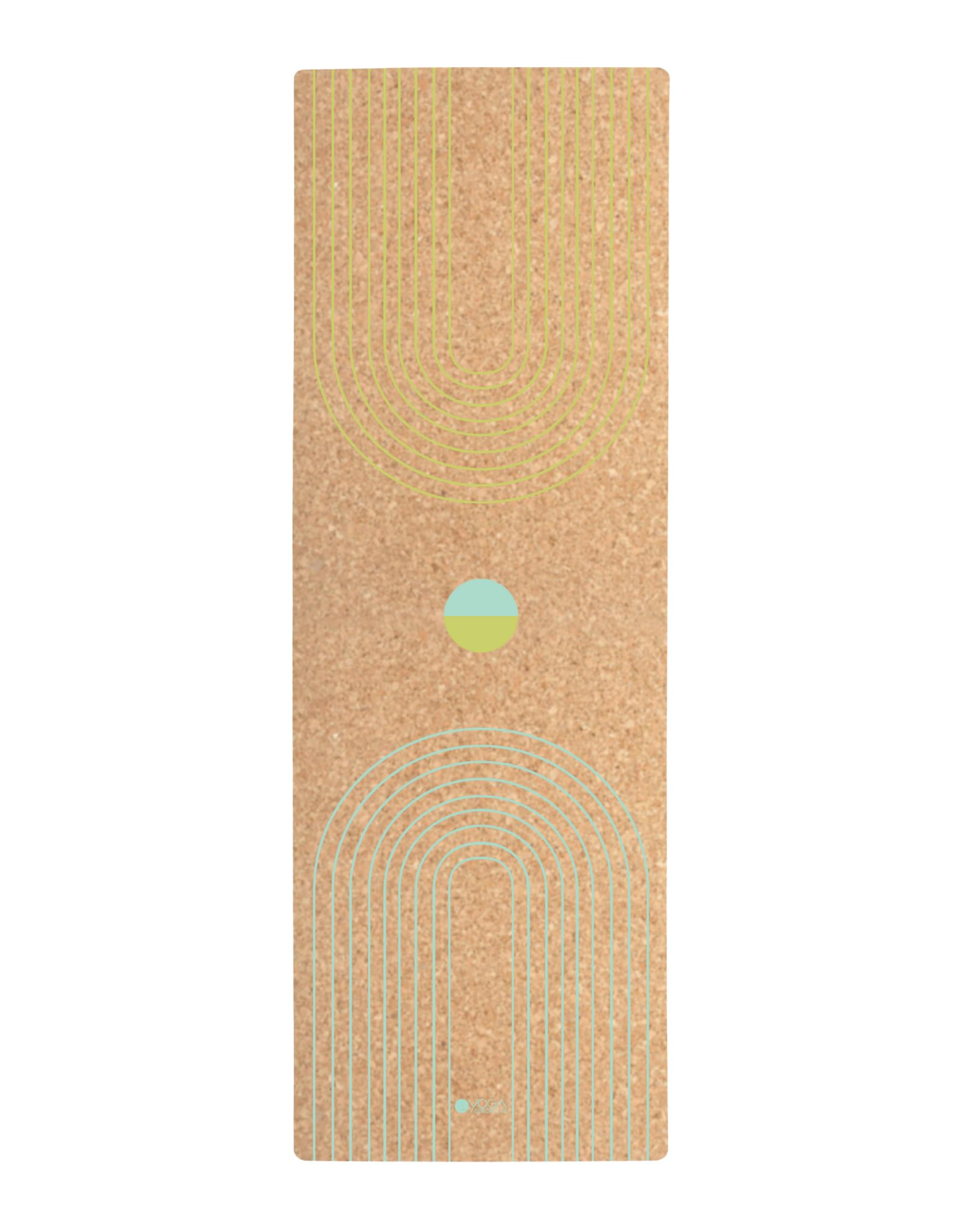
Yoga Design Lab Cork Mat

Yoga Design Lab Cork Mat

Hot yoga

Our Score 9.0/10
Check Price

Worth Noting

  • Thin
Care
Hand wash only
Weight
3.86 lb
Surface
Cork
Includes
Carrying strap
Read the full review

A hot room is where cork earns its keep, and this is the mat in this group built for one. Cork goes tackier as it dampens while synthetic surfaces head the other way, so the sweat that sends you sliding on a foam mat actually helps here. We buy it for heated vinyasa and power classes, and it is the only pick here we hand to someone whose practice is defined by sweat.

The rest of the mat supports that job. The surface drinks sweat instead of letting it pool, so there is no towel to reposition between flows, and a carrying strap comes in the box for the walk home. At 1.75 kg it is one of the lighter mats here, and it rolls tightly enough to live in a tote.

What it is not is a cushioning mat. It is thin — a travel-weight mat in practice — and a long kneeling sequence will send you looking for a blanket. Use it over another mat if your knees are the reason you buy thick mats in the first place. On its own it is a hot-room specialist, and it is also the best-looking thing in this set, with printed patterns that hold their color.

There is a rubbery smell out of the box that fades after a couple of days of airing. Unroll it in a spare room before your first class rather than discovering it in the changing room.

Bottom line: This is our hot-room mat: cork holds its grip when the room and your hands are wet, and the thin profile is the trade you make for it.

#4

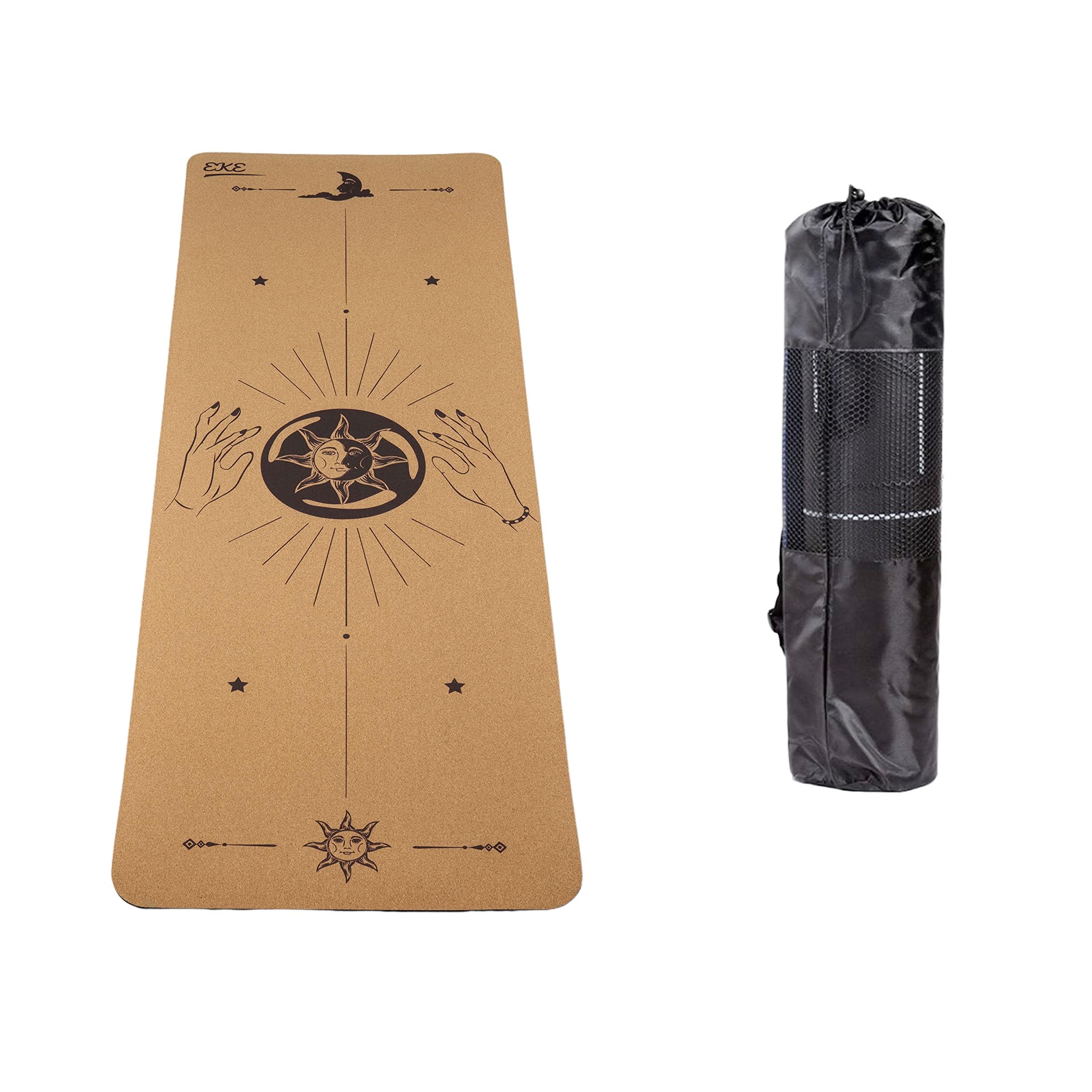
EKE Cork Yoga Mat

EKE Cork Yoga Mat

Joint comfort

Our Score 9.0/10
Check Price

Worth Noting

  • Thick base mutes feedback in balance poses
Base
TPE
Weight
2.8 lb
Thickness
7 mm
Dimensions
72" x 25.6"
Read the full review

The alignment marks on this mat are hidden in a sun-and-moon pattern: look for them and they line up your hands and feet, ignore them and they read as decoration. It is a small idea we ended up using more than the bolder printed lines on other mats here, because nothing on the surface shouts at you mid-pose.

Under the cork is 7 mm of TPE, which makes this the cushiest mat in the group and the one to take if kneeling, wrist-heavy sequences or a long savasana are where your practice lives. At 2.8 pounds it is light for its thickness, and it comes with a strap and a bag.

The trade is floor feel. Seven millimeters of foam between you and the ground softens balance poses — you get stability, not precision — and anyone working on standing balances will notice the vagueness under the standing foot. For restorative, yin and knee-heavy sessions, we think it is the most comfortable mat here, and comfort is what keeps you coming back to the mat on the days you do not want to.

Bottom line: Comfort is the whole point here, and this is the mat we hand to sore knees: 7 mm of cork-topped padding with balance work as the trade-off.

#5

Y O Gayo Premium Cork Mat

Y O Gayo Premium Cork Mat

Alignment practice

Our Score 9.0/10
Check Price

Worth Noting

Base
Natural tree rubber
Weight
8.36 lb
Dimensions
72" x 26"
Alignment Lines
Included
Read the full review

Unrolling this mat in a quiet studio is not a subtle experience. The cork-and-rubber sandwich crackles and pops as it flattens, which is fine at home and faintly awkward in a room of people holding child's pose.

What you get for that is a 72 by 26 inch mat with alignment lines worked into the design — marks for hands and feet that stay visible without dominating the surface. They are the reason to choose it over the plainer mats here, and they are worth having if you are still working out where your hands belong in downward dog.

The cork grips well once damp, the 5 mm base is firm rather than squishy, and the pattern reads as deliberate rather than decorative. There is a slight new-mat smell at first; it fades after a few days of airing, and a damp wipe speeds that up.

At 3.79 kg it is the heaviest mat here after our top pick, so plan on it living where you practice rather than commuting with you. None of the noise or the bulk matters if it stays on your floor, and the lines are what keep it in rotation: they survive a wipe-down, they disappear when you ignore them, and after a few weeks we were checking hand placement without thinking about it, which is the highest compliment a marking can get.

Bottom line: Alignment lines you will actually use: we recommend this one to anyone working on hand and foot placement.

#6

GURUS Cork Yoga Mat

GURUS Cork Yoga Mat

Carrying to class

Our Score 8.8/10
Check Price

Worth Noting

  • Cork layer can lift and shed with daily use
Base
Natural tree rubber
Care
Hand wash only
Weight
1.54 lb
Dimensions
72" x 25"
Read the full review

If our top pick is the mat that stays in the living room, this is the one that goes in the bag. At 700 grams it is the lightest mat here by a wide margin — light enough that carrying it to a studio stops being a decision — and it still unrolls to a full 72 by 25 inches.

Light does not mean skimpy. The cork sits on natural tree rubber, and the cushioning is firm rather than plush: plenty under knees in a low lunge, not so much that standing poses go vague. The cork grips well once hands are damp, and there is no rubbery smell to air out, which is more than several mats here manage. It is also genuinely good-looking in a plain, unfussy way.

One quirk of the shipping: it can arrive with the ends curled from being rolled tightly in the warehouse. Roll it the other way, leave it flat overnight, and it settles — no need to send it back.

Between this and the Numat, our other light pick, this one feels firmer underfoot and comes with more practice behind it. The Numat brings a bag and printed alignment lines; this one brings the better mat. We would take the mat.

Bottom line: The one we carry: it weighs next to nothing, grips when damp, and still cushions knees, as long as you can live with a cork layer that may shed over time.

#7

Numat Cork Yoga Mat

Numat Cork Yoga Mat

First cork mat

Our Score 8.8/10
Check Price

Worth Noting

  • 24 inches wide
Weight
2 lb
Includes
Carrying bag and strap
Thickness
6 mm
Dimensions
72" x 24"
Read the full review

The box is the pitch here: a 72 by 24 inch mat, a carry strap, a bag and printed alignment lines, in something that weighs about two pounds and rolls down small enough for a gym locker. For a first cork mat, that is a complete kit rather than a mat you then have to accessorize.

The lines are more useful than we expected. They mark hand and foot placement along the length of the mat, so in downward dog and warrior you have something to check against instead of guessing at the width. The cork top grips once damp, and the textured TPE base holds a wooden floor without sliding.

Six millimeters is enough cushioning for knees and wrists, and the weight is genuinely carryable, which is more than we can say for most cork mats. The one real limit is width: 24 inches is narrower than the 26-inch mats we point broad-shouldered practitioners toward. If you go wide in standing poses, the Ecoga or our top pick will suit you better; otherwise this is the easiest cork mat to start with.

Bottom line: For a first cork mat, we send people here: bag, strap and alignment lines in one box, light enough to carry, with a narrower deck as the compromise.

#8

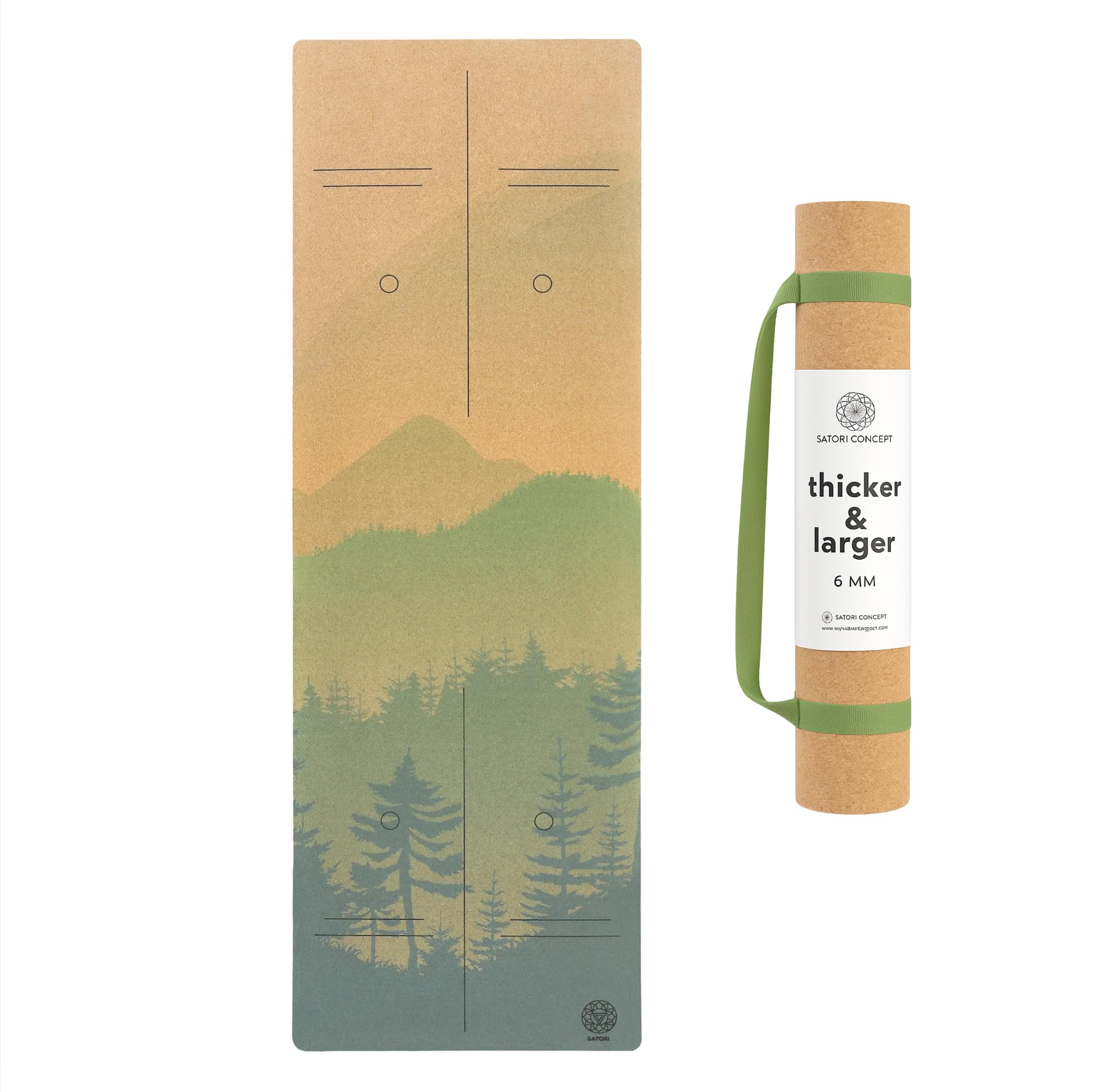
Satori Concept Cork Yoga Mat

Satori Concept Cork Yoga Mat

Design-led practice

Our Score 8.8/10
Check Price

Worth Noting

  • About eight pounds
Base
Natural tree rubber
Weight
8 lb
Thickness
6 mm
Dimensions
80" x 26"
Read the full review

Most cork mats look like cork. This one is patterned with nature-inspired designs, and the effect is a mat you leave out rather than roll into a corner — the kind of thing a guest comments on before realizing it is exercise equipment.

The footprint is the same generous 80 by 26 inches as our top pick, over a natural tree rubber base, at 6 mm thick, with a strap in the box. It lies flat once it has been unrolled a while, it does not creep across the floor, and the cork grips as it dampens, exactly as cork should.

What we noticed most is the texture: soft against skin without being spongy, so kneeling is comfortable and standing poses stay steady. Cleaning is a wipe with a damp cloth, and the rubber base holds a smooth floor without drama.

It earns its place because the looks cost you nothing in use — same large footprint, same natural rubber approach, a slightly different feel underfoot and a little more mat to move around. If plain cork leaves you cold and you want the biggest surface here in a pattern you actually like looking at, this is the one to order.

Bottom line: We like it for the same generous footprint as our top pick, with a surface you will want to leave out on the floor.

How We Tested Cork Yoga Mats

I started with more than 30 cork mats sold in the U.S., then narrowed by construction — a cork surface bonded to natural rubber rather than a foam core — along with thickness, listed dimensions, price, and whether a carry strap came in the box. Nine made the cut, ranging from a thin travel mat to a 6mm cushion.

Every mat spent six months in my regular rotation: two hot classes a week, a home practice on hardwood, and a humid stretch in late summer when nothing dries. I kept a spray bottle on the floor and noted whether hand and foot grip improved with a little moisture or turned slick, and I watched for the moment in downward dog when a mat starts to bunch under the toes. Thickness went under a caliper, and I laid each one beside a standard studio mat to compare footprint — a narrow cut puts your foot on the floor in a wide stance.

Each mat got weighed on a kitchen scale and carried in a tote on a 15-minute walk to class, which is where a heavy mat shows its true colors. I sniffed every one out of the box, again at two weeks, and once more at the two-month mark, since cork's smell fades unevenly. Durability came down to weekly cleaning with a damp cloth and mild soap, then checking edges and corners for curling, cracking, and flaking. From there I judged appearance by whether the grain stayed even where hands and feet land most, and value by how the mat looked and held up six months in.

How to Choose the Right Cork Yoga Mat

Test the grip dry before you commit

Grip is the whole reason to buy cork, and it behaves differently from every other surface. Dry, it can be a little slick; as your hands and feet dampen, it goes tacky instead of sliding. That is a gift in a heated class and a small nuisance in a slow, seated practice, where you may spend the first ten minutes waiting for your palms to catch.

If your practice is yin, restorative or mostly floor-based, try a downward dog with dry hands before you commit, or keep a spray bottle beside the mat and give the cork a light mist at the start.

Thickness buys comfort, density buys stability

Two numbers describe a mat's underside, and they pull in opposite directions. Thickness buys comfort under knees, wrists and elbows. Density buys stability — a 5 mm mat over natural rubber sits far more firmly than a 7 mm mat over soft foam.

Kneeling-heavy practices want 6 or 7 mm. Balance-heavy practices want the firmest thing you can find and will happily trade cushioning for it. Our top pick splits the difference at a quarter inch of cork over dense rubber, which is why it works for both.

Match the length to your body, not the label

Cork mats come in 68, 72 and 80 inches. The trap is that a 68-inch mat feels perfectly adequate for a year of standing poses and then your heels leave the cork the first time you take a wide-legged forward fold.

If you are tall, or your practice is wide, treat 72 inches as the floor and 80 as the comfortable choice for a mat that lives at home. Width matters too: 26 inches gives broad shoulders somewhere to go, and 24 is fine for most everyone else.

The weight decides where the mat lives

Cork over natural rubber is dense, and the figure on the spec sheet tells you whether you will ever carry it. Mats in the two-to-three pound range go to a studio and back without complaint; the six-to-ten pound mats lie flatter and stay put, and they are miserable on a ten-block walk.

Be honest about your commute before you fall for a big mat. If you drive to class, weight matters far less than it does on the bus, and the heavier mat will reward you every time you unroll it.

Cleaning is a damp cloth, not a washing machine

Cork and natural rubber are hand wash only. The trap is unrolling a mat after a hot class, wiping it half-heartedly and stuffing it back in the bag while it is still damp — that is how a cork mat starts to smell like a gym locker.

Wipe it, let it dry flat, and roll it loosely once it is fully dry. A new mat may smell of rubber for a few days, so air it out unrolled before your first class rather than after.

Frequently Asked Questions

Final Verdict

For a home practice, the Body By Yoga mat is the one we recommend. The 80-inch deck and quarter-inch cork over dense rubber give you room and steadiness the lighter mats here cannot match, and the grip improves as you warm up rather than fading.

If the mat has to travel, take the GURUS instead: it weighs a fraction as much and still grips when damp. And if the class is hot above all else, the Yoga Design Lab mat holds its surface when everything else in the room goes slick.