Tech & Wearables

Best Waterproof Headphones for Running of 2026

Sweat is what kills running headphones, not rain. The pair that shrugs off a drizzle often starts swimming around mile eight, when the seal gives up and one side cuts out for good. I've retired a couple that way. So waterproofing was only the entry fee when we went hunting for the best running headphones — what mattered was whether the sound held up with wet ears, whether the fit survived a hard 10 miles without a reseat, and whether the charge outlasted a training week. Get those right and you stop thinking about your ears and start thinking about your pace.

Over six months my team and I ran in 14 pairs, from open-ear clips to sealed in-ears, through heat, drizzle, and a treadmill room with no air moving. The keepers had less to do with the IP rating on the box than with the details around it: controls that worked with wet fingers, Bluetooth that held at a busy intersection, a case that survived the bottom of a gym bag. The list below is what I kept reaching for on race-pace days, not just what survived.

#1

HAOYUYAN BX17

Top Pick
HAOYUYAN BX17

Everyday running

Our Score 9.0/10
Check Price

Worth Noting

  • Warranty runs only 90 days
Driver
14.3 mm
Battery
15 hrs per earbud, 80 hrs with case
Controls
Button
Water Resistance
IPX7
Read the full review

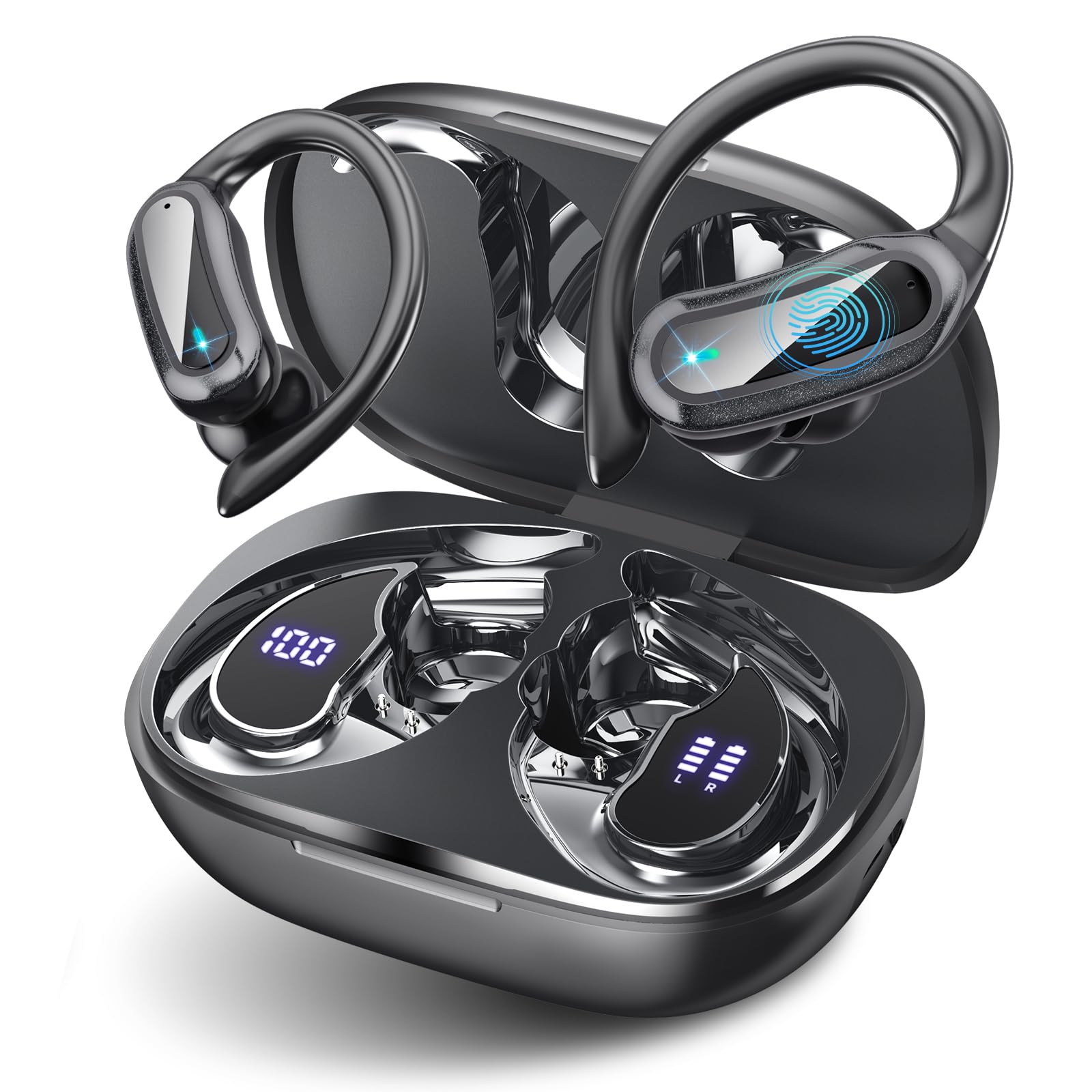
An IPX7 rating and 15 hours in each earbud decided this one for us. IPX7 is the rating that survives more than sweat: a rinse under the tap, a soaked singlet, a downpour two miles from home. It is the difference between a pair you baby and a pair you just wear. Fifteen hours per earbud means the case is a top-up rather than a lifeline, so leaving it at home for a week of short runs changes nothing.

The fit is why we keep reaching for it. The hooks are soft and elastic, they curl behind the ear instead of pressing into it, and they stayed seated through intervals and a wet, windy long run without the mid-stride re-shove. The 14.3mm drivers give the low end real weight without smothering voices, which matters more on a podcast than on a playlist.

Two details we appreciated. The controls are buttons, not a touch panel, so wet fingers and gloves work and nothing pauses when you wipe your face. Isolation is passive, though, and the noise-canceling wording on the box oversells it; on a run we count hearing traffic as a feature rather than a flaw.

The PSIER X12 is the better tool if you want your ears open, and the TRAUSI i27 is lighter and cheaper. Neither matches this one on the combination of a genuine IPX7 rating and a 15-hour earbud.

Bottom line: We recommend the BX17 to most runners: IPX7 sealing, 15 hours an earbud and hooks that stay put make it the strongest default here.

#2

PSIER X12

PSIER X12

Road awareness

Our Score 8.6/10
Check Price

Worth Noting

  • Bass is light next to the in-ear picks
  • IPX5, so no rinsing or dunking
Frame
Memory titanium
Weight
0.81 oz
Battery
Up to 10 hrs at 50% volume
Water Resistance
IPX5
Read the full review

If your runs share a road with traffic, the case for open ears makes itself in about thirty seconds. The X12 sits in front of the ear and sends sound through the cheekbone, so the canal stays empty and a car easing out of a driveway never gets buried under a bass line.

The frame is the part we did not expect to like as much as we do. It is a memory-titanium band at 23 grams, light enough to stop registering after the first mile, and it flexes to grip rather than clamp. Bone conduction gives up low-end weight, and there is less bass here than in any of the in-ear picks, but that is the trade for hearing the world around you.

Battery is 10 hours at 50 percent volume, which is honest arithmetic rather than a headline; run it loud and you get less. IPX5 covers sweat and rain, the 13mm bone-conduction driver keeps voices clear, and the buttons are easy to find mid-stride without looking down.

Two things to weigh. It is the wrong choice for a treadmill or a loud gym, where an open design simply lets everything in, and it costs more than our top pick. What you are paying for is the shape, and for road runners that is usually worth it.

Bottom line: We point road runners at the X12: the open band keeps your ears on traffic, and it is the most comfortable open-ear here despite the light bass.

#3

PocBuds T60

PocBuds T60

Secure fit

Our Score 8.6/10
Check Price

Worth Noting

  • Charge can fade after months of use
  • Bluetooth dropouts can interrupt a run
Driver
13 mm
Battery
8 hrs per earbud, 80 hrs with case
Bluetooth
5.3
Water Resistance
IPX7
Read the full review

The T60's earhooks loop over the top of the ear rather than curling behind it, and that single design choice is why we point runners with awkward ears at this pair. It is the shape that survives a cap, a helmet strap or a ponytail pushing at it.

Thirteen-millimeter drivers give it the fullest sound at this end of the group, and the single button is easy to work by feel: one press for play, two to skip. Eight hours per earbud and 80 with the case, plus a display that shows the charge left, which is a small thing you notice only after living with a pair that does not have one.

The caveats are about months rather than miles. Charge can fade and stop holding properly, and Bluetooth dropouts turn up on some units; if yours starts cutting out, unpair and reconnect before writing the earbuds off. The case is also big enough to take real pocket space, so it tends to live in a bag.

For fit confidence in the rain, with a button you can find by touch, it is a good buy. The BX17 wins on water rating and per-earbud runtime; the T60 wins on holding a difficult ear.

Bottom line: For ears that reject every other hook, the T60 is the one: the over-ear shape locks down and the button works with wet fingers.

#4

TRAUSI i27

TRAUSI i27

Budget and travel

Our Score 8.6/10
Check Price

Worth Noting

  • Six hours per earbud, the shortest here
  • 90-day warranty
Weight
7 g per earbud
Battery
6 hrs, 54 hrs with case
Bluetooth
5.4
Water Resistance
IPX7
Read the full review

At seven grams an earbud, the i27 is the lightest thing here, and lightness is the feature you notice on mile eight. If pressure behind the ear is the reason you gave up on earbuds, this is the pair to try first.

IPX7 and Bluetooth 5.4 put it ahead of several pricier picks on paper, and the case adds 54 hours on top of six per earbud. Six is the number to weigh: it is the shortest single charge in this group, so a week of long runs means carrying the case with you.

Touch controls are the other compromise. A wet finger across the bud can pause something you did not mean to pause, and there is no way to lock them. Three tip sizes come in the box, and the tips do more for stability than the hook does, so spend five minutes finding the right pair.

The 90-day warranty is the shortest here, and it is why we treat this as a value pick rather than the default: you are buying light and cheap, not long-term cover.

Bottom line: The i27 is what we hand someone who wants to spend little and barely feel the earbud, as long as six hours a charge is enough.

#5

JOYWISE U18C

JOYWISE U18C

Long single charges

Our Score 8.4/10
Check Price

Worth Noting

  • Can stop working within months
  • Pairing can be stubborn
Fit
In-ear with ear hook
Battery
16 hrs
Bluetooth
5.3
Water Resistance
IPX7
Read the full review

Longevity is the open question with the U18C, so it is worth saying plainly: this is a pair that can quit inside a season. What you get in exchange is the longest single charge in this group at 16 hours, plus IPX7 sealing, and that is a trade plenty of runners make at the cheap end of the market.

The rest of the package is better than the price suggests. Bluetooth 5.3, real buttons rather than a touch panel, and hooks that held through tempo work without a mid-run adjustment. Sound is loud and clear with more low end than the money implies, and calls come through without you shouting into the mic.

Where it earns its place is the double session: a run in the morning, a gym trip at lunch, no charger involved anywhere. We rate it for exactly that, with the caveat that you are buying a workhorse rather than a pair to keep for years.

Bottom line: We rate the U18C for long training days when no charger is coming, with the honest caveat that it may only last a season.

#6

Otium U8

Otium U8

Cheap spare pair

Our Score 8.4/10
Check Price

Worth Noting

  • Bluetooth 4.1 and a Micro-USB port
  • Hooks suit average-to-large ears
Weight
0.63 oz
Battery
10 hrs
Bluetooth
4.1
Water Resistance
IPX7
Read the full review

The U8 has been on sale long enough to outlive several brands in this category, and the hardware shows it: Bluetooth 4.1 and a Micro-USB charging port in a market that moved to 5.3 and USB-C years ago. It still works, and it still costs about what it always did.

What you get is IPX7 sealing, 18 grams, and a hook that holds. Sound is loud and clear rather than refined, the controls are physical, and the battery runs about 10 hours, which is mid-pack here but a full week of commutes for most people.

The five-year warranty is the longest in this group by a wide margin, and it is the reason the U8 stays on a page with much newer hardware. Slow pairing is the day-to-day tax: the connection is solid once it is made, but getting there takes longer than the 5.3 pairs here.

For a second pair in a gym bag, or for anyone who wants cover that outlasts the novelty, it still makes sense. The newer picks here are simply easier to live with day to day.

Bottom line: Our pick if you want a waterproof pair you can replace without wincing, so long as old Bluetooth and a larger-ear fit do not bother you.

#7

Ortizan I10

Ortizan I10

Lightweight open-ear

Our Score 8.4/10
Check Price

Worth Noting

  • Band fit varies with head size
  • Proprietary magnetic charging cable
Design
Open-ear, air conduction
Weight
0.67 oz
Battery
10 hrs
Water Resistance
IPX6
Read the full review

Fit splits the i10 by head size rather than by taste. The band rests against the side of the head above the ear; on a bigger head it holds through a run, and on a smaller one it floats, and the sound thins out as it drifts. If you sit at the small end of hat sizes, try before you commit.

Nineteen grams with nothing in the ear canal is a genuinely nice way to run. Air conduction aims sound at the ear instead of buzzing through bone, so there is more body down low than the bone-conduction picks here, while your ears stay open to traffic and to a running partner.

Charging is the weak spot. The magnetic cable is proprietary, so losing it strands the headset, and charging trouble is the fault to watch for. The rating is IPX6 and the battery is rated at 10 hours.

We like it for easy runs, walking and commuting, the places where a light open band beats a sealed earbud. For hill repeats in the rain, or for a small head, it is not the pair.

Bottom line: We like the i10 for easy runners who want open ears and almost no weight, but try the fit first because head size decides whether it works.

#8

H2O Audio TRI 2

H2O Audio TRI 2

Runners who swim

Our Score 8.0/10
Check Price

Worth Noting

  • Costs many times what the in-ear picks do
Memory
4 GB MP3 mode
Battery
8.5 hrs
Bluetooth
5.3
Waterproofing
Waterproof, swim-rated
Read the full review

The TRI 2 is the only headphone here that costs like equipment rather than an accessory, and the only one that solves a problem the others cannot touch: swimming. Four gigabytes of onboard memory play MP3s with nothing paired and no Bluetooth signal to lose underwater, and the bone-conduction band sits outside the ear canal so it works under a swim cap.

On land it is a competent open-ear bone-conduction headphone, with 8.5 hours of battery, comfortable clamping and clear calls, and sound that is thinner than any of the in-ear picks here. In the water it makes far more sense, especially with the included earplugs in, because the plug creates an air pocket that firms up what you hear.

Two things to know before you commit. Pause for long and the auto-off can catch you, and Bluetooth mode is fussier here than on the rest of this group. A one-year warranty covers defects in materials and workmanship.

So: a specialist. We recommend it to the runner who swims laps and is tired of leaving music at the pool edge. If your week is dry, the BX17 does the running job for a fraction of the money with better sound.

Bottom line: Only for runners who also swim do we recommend the TRI 2: it is the one pair here that follows you into the pool, and you pay for the privilege.

How We Tested 14 Pairs Through Sweat, Rain, and Treadmill Miles

We started with roughly 60 pairs sold as waterproof or sweat-resistant for runners and cut the list by IP rating, form factor, price, and whether replacement tips and parts were actually available. That left 14 pairs, all bought at retail the way you would, and we ran in them for six months. Every pair went through the same routine: a sweaty interval session outdoors, a long run in whatever weather showed up that week, a treadmill session in a small gym with no air moving, and a rinse under the tap afterward to see what routine cleaning would do to them.

Fit was usually the first thing to go, so we logged how many times we had to reseat an earbud per run and whether a hard sprint knocked one loose. We listened to the same three tracks on every pair at low volume and again with wet ears, noting when the bass vanished as the seal broke. Wet fingers got their own test: pausing, skipping, and nudging the volume mid-run to see which controls ignored us once sweat was involved.

Battery life we measured instead of trusting, charging each pair to full and running at a normal volume until it died, then comparing the number to the box. For connectivity we left the phone on a bench and jogged away, and took calls at a busy intersection to see how often the Bluetooth dropped; noise cancellation and awareness modes got judged on the same road with traffic going by. At the end we checked charging contacts and cable joints for corrosion and fraying, noted whether the case slid into a shorts pocket or needed its own bag, and weighed what each pair cost against how it had held up.

How to Choose Waterproof Headphones for Running

Start with the IP rating, not the word waterproof

IPX4 is the floor: it shrugs off sweat and spray but not a soaking. IPX5 adds low-pressure water jets, which covers heavy sweat and steady rain. IPX6 and IPX7 are where a running pair becomes genuinely carefree, because IPX7 means the earbuds survive brief immersion, so a rinse under the tap after a hot run is not a risk. A product that calls itself waterproof without an IP number is telling you nothing you can check against your own training.

Our rule of thumb: if you sweat heavily, run in a wet climate, or want to rinse the earbuds weekly, pay for IPX7. If your runs are short and dry, IPX5 is enough and you will spend less.

Open ear or in ear changes the run, not just the sound

An open design, whether bone conduction or air conduction, leaves the ear canal clear. On roads and shared paths that is the difference between hearing a cyclist call out and not hearing them at all. In-ears with hooks seal the canal, give you more bass and block more noise, which is what you want on a treadmill or in a gym.

The trade is sound. Bone conduction gives up the most low end; air-conduction open designs like the Ortizan I10 sit between the two. Pick the design by where you run, then accept the sound that comes with it rather than shopping for the shape and hoping for the bass.

Fit and controls decide whether you actually wear them

Hooks are not one shape. Some curl behind the ear, some loop over the top, and some sit on a band across the head; which one holds depends as much on your ear as on the design. With in-ears, the tip usually matters more than the hook, so work through every size in the box before deciding a pair does not fit.

Controls count just as much once your hands are wet. Physical buttons work with sweaty fingers and gloves, while touch panels pause things when you wipe your face. Weight compounds it: the lightest pairs here run around 7 g an earbud, and that is the weight you stop noticing on a long run.

Count the per-earbud hours, then read the warranty

Case totals are the easiest figure to inflate. What matters on a daily run is how long one earbud lasts without the case, and among these picks that ranges from six hours to sixteen. If you run without a bag, a 15-hour earbud is worth more than an 80-hour case sitting at home.

The connector decides how annoying the upkeep is. USB-C is the cable you already own; Micro-USB and proprietary magnetic cables are the ones you lose. Then check the warranty, because it runs from 90 days to five years in this group, and battery or charging faults are what you end up claiming on.

Frequently Asked Questions

Final Verdict

The HAOYUYAN BX17 is the pair we recommend to most runners: IPX7 sealing, 15 hours in each earbud, and hooks that stay put through intervals and wet weather. It is the safest place to put your money in this group.

Change one requirement and the answer moves. If your runs share a road with traffic, the PSIER X12's open band is worth the extra spend and the lighter bass. If the pool is part of your week, the H2O Audio TRI 2 is the only pair here that follows you in, and the only one that asks you to pay for the privilege.