Tech & Wearables

Best Heart Rate Monitors of 2026

Halfway up a climb, you glance at your wrist and the number hasn't moved since you were standing at the bottom of it — or it's reading twenty beats high and you know it. Wrist sensors are fine for an easy jog, but they lose the thread exactly when you want the data most: cold hands, sweaty skin, a wrist bent around a handlebar, a hard set of intervals. A dedicated heart rate monitor fixes that. Strapped to your chest or your forearm, it pairs with the watch or phone you already own and holds a steady signal through the parts of a workout where the numbers actually change the decisions you make.

The catch is that accuracy alone doesn't make one worth wearing. I've had straps that were dead-on and still stayed in the drawer because they chafed after forty minutes, and armbands that were comfortable right up until the battery died mid-run with no warning. My team and I have spent the last six months wearing twelve monitors through intervals, long rides, and gym sessions, and the difference between a good one and a frustrating one rarely shows up on the spec sheet. It shows up in whether it's still locked on at minute fifty, and whether you reach for it tomorrow.

#1

Garmin HRM 600

Top Pick
Garmin HRM 600

Data-driven training

Our Score 9.0/10
Check Price

Worth Noting

  • Rated battery life of about two months
  • Premium price for metrics many runners ignore
Data
HR, HRV, running dynamics
Battery
Rechargeable, 2 months
Strap Sizes
XS–S and M–XL
Onboard Recording
Workouts sync to Garmin Connect
Read the full review

The step up in price from our top pick buys a different job description rather than a fancier strap. The HRM 600 adds running dynamics — stride length, vertical oscillation, ground contact, plus a step-speed-loss figure — and onboard recording for sessions where a watch isn't allowed, like team sports. If you read your training data the way some people read the news, that's the upgrade. If heart rate is the only number you act on, it's money you don't need to spend.

We noticed the extra metrics earn their keep on long, steady runs, where form drifts before pace does. Watching stride shorten while effort holds is the kind of warning a heart rate number alone won't give you. The recording half is just as useful: leave the watch in the bag and the strap captures heart rate, calories, speed and distance, then syncs it to Garmin Connect afterwards. For team sports, that's a genuinely different capability rather than a line on a spec sheet.

Comfort is a step up too, with a thicker silicone strap that's machine washable and a pod that comes off so you can rinse the band. That pod connection is the one place to be careful. The rivets that hold it are stiff, and a pod that won't budge turns washing the strap into a wrestling match, so ease it off by the body rather than the edge. It's rechargeable rather than coin-cell as well, which is a small routine to adopt.

Bottom line: For runners who actually use their data, the HRM 600 earns the premium: running dynamics, workout recording without a watch, and a comfortable strap that survives the wash.

#2

Garmin HRM 200

Garmin HRM 200

Everyday training

Our Score 8.6/10
Check Price

Worth Noting

  • No running dynamics or onboard recording
Data
Heart rate and HRV
Battery
Up to 1 year, replaceable
Strap Sizes
XS–S and M–XL
Water Rating
3 ATM
Read the full review

A year on a single coin cell is the detail that makes the HRM 200 easy to live with. There's no charging cradle to lose, no cable rattling around a kit bag, and no half-hour window before a ride when you discover the pod is flat. You wet the electrodes, clip the pod onto the strap, and it's broadcasting. When the year is up, the replacement is a drawer job rather than a purchase.

We kept coming back to it because it asks nothing of you. The strap is machine washable, the pod unclips, and the 3 ATM rating covers sweat and rain without a second thought. Through our sessions the trace stayed steady on easy miles and moved the way it should when we lifted the pace. Two strap sizes, XS–S and M–XL, make a snug fit easier to find than a single band does, and a loose strap is the usual reason a monitor gets blamed for bad readings.

It also carries heart rate variability, which matters more than it sounds, because HRV is what most recovery and training-load apps actually want and this strap feeds it without extra hardware. The thing to check before ordering is the rest of your setup: the HRM 200 is built around Garmin watches, bike computers and apps, so if you train on a Wahoo computer or a Polar watch, confirm it pairs with yours first. For everyone else it does the core job without drama, which is why it's the one we point to first.

Bottom line: We recommend the HRM 200 to most people who want a strap to disappear into their kit: steady readings, a washable band, and a year on one battery.

#3

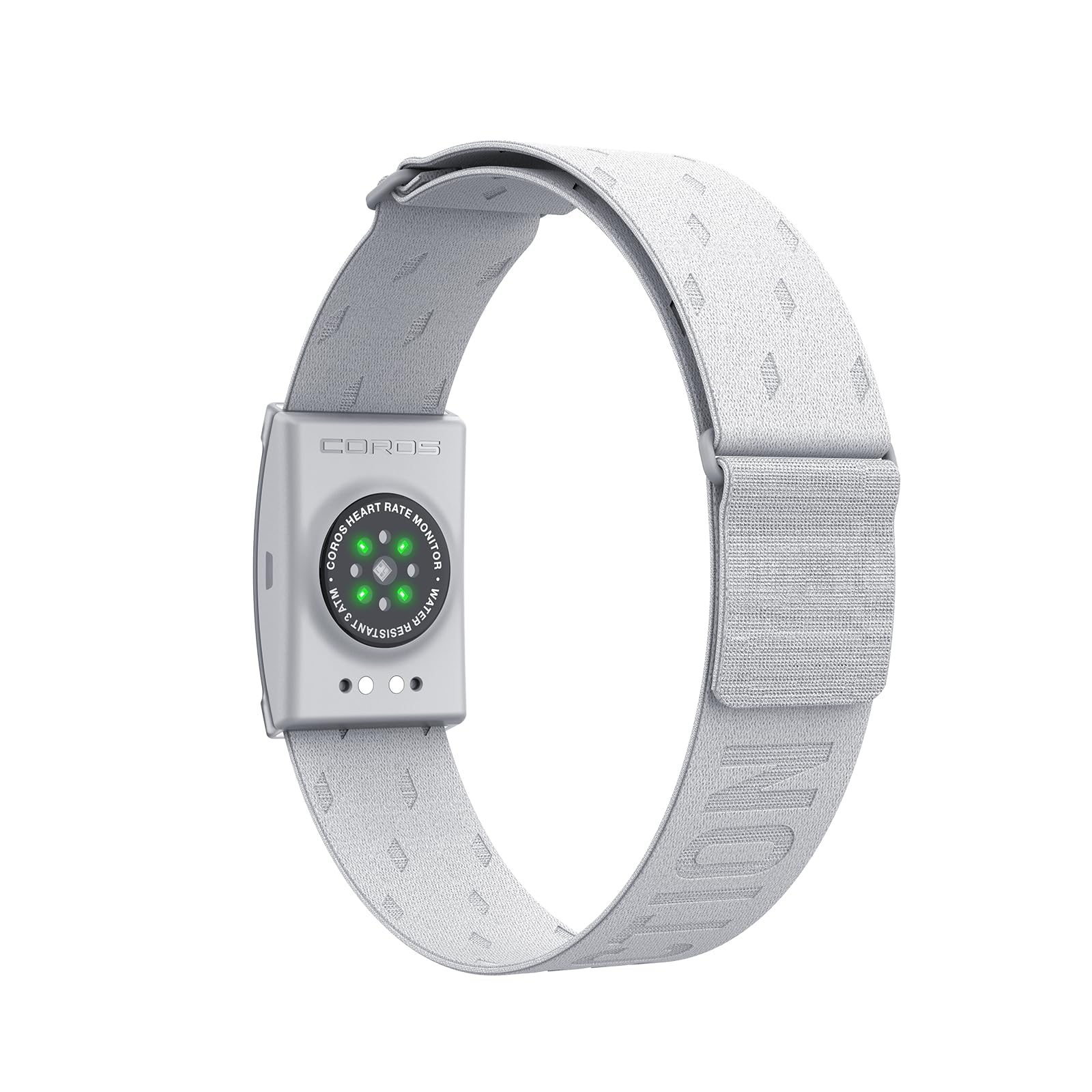
COROS Heart Rate Monitor

COROS Heart Rate Monitor

Strap-free comfort

Our Score 8.4/10
Check Price

Worth Noting

  • Occasional dropouts until the band is re-seated
  • App support trails the hardware
Band
Fabric armband
Weight
1.76 oz
Battery
38 hours, rechargeable
Devices At Once
Up to 3
Read the full review

If a chest strap is the reason you stopped tracking your heart rate, the COROS band is the fix. It wraps a soft fabric band around your upper arm and it's light enough that you forget it's there: no ribcage strap, no electrodes to wet, nothing to adjust mid-run.

It's optical, and that's the trade. An armband sits where the artery is close to the skin and the band doesn't move the way a wrist does, so steady running and tempo work read well. The very short, very hard efforts — 30-second intervals, a heavy set — are where any optical sensor lags a chest strap, and we noticed the gap in the first seconds of an interval rather than in the middle of one.

The practical design is thoughtful: the sensor pops out so you can wash the band, it pairs with up to three devices at once, and the battery is rechargeable with a rated 38 hours. Two things keep it out of the top spot. The app is the weakest link in the chain, and sessions can connect without passing heart rate data until you re-seat the band. And this is a workout tool rather than an all-day tracker, so don't buy it expecting a full day of readings.

Bottom line: We send anyone who finds chest straps unwearable to the COROS band: comfortable enough to forget, steady through tempo work, and happy to feed three devices at once.

#4

CooSpo H6

CooSpo H6

Low-cost setup

Our Score 8.4/10
Check Price

Worth Noting

  • Readings can wander during hard intervals
  • Battery life varies widely between units
Weight
1.94 oz
Battery
300 hours
Connection
ANT+ and Bluetooth 4.0
Water Resistance
IP67
Read the full review

Both radios for very little money is the H6's pitch, and it delivers: Bluetooth 4.0 and ANT+ on the same strap, so a phone app and a watch or bike computer can listen at once. The strap is a wide, soft cloth band with a pod that unclips for washing, the battery is rated 300 hours, and IP67 means sweat, rain and a rinse under the tap aren't a problem.

We liked it most as a second monitor: the one that lives in the gym bag, the one a new rider borrows, the spare you don't mind losing. In our sessions it paired quickly with a phone and a watch, and the numbers landed close to what a far dearer chest strap showed at the same effort. Comfort is the surprise at this end of the market, with a wide band that stays put without digging in.

Where it gives ground is consistency under pressure. Readings that look rock steady in an easy session can wander when you go deep into an interval, and starting a workout sometimes means re-pairing before anything shows up. Buy it as a value pick with a spare battery in the bag, not as the monitor you'll still be wearing in five years.

Bottom line: Our budget pick: both radio protocols, a comfortable wide strap and a 300-hour cell for very little money, as long as you accept it won't last forever.

#5

Wahoo TRACKR

Wahoo TRACKR

Rechargeable chest strap

Our Score 8.4/10
Check Price

Worth Noting

  • Rechargeable cell can stop accepting a charge
Weight
30 g pod
Battery
Up to 200 hours, rechargeable
Connection
ANT+ and Bluetooth
Read the full review

The LEDs are why we reach for this one: a light confirms the pod is awake, paired and charged before you start, so you're not staring at a blank heart rate field in the first interval wondering which end is broken. Plenty of straps leave you guessing. The TRACKR doesn't, and it does it with a rechargeable pod rated for up to 200 hours instead of a coin cell you have to remember to buy.

It's slim and soft on a 30-gram pod, and it stayed comfortable through long sessions. Readings held up through steady riding in our sessions, and swapping the strap for a wash is a one-second job. The thing to get right before ordering is the strap itself, which comes in a single size and runs snug at the top of its range; a broad chest is the case where this one stops working, so measure before you buy, because the strap decides it.

Bottom line: A strap for people who forget to buy batteries: the TRACKR's status lights and rechargeable pod make it the least fussy option here, provided the single strap size fits.

#6

GEOID HS500

GEOID HS500

Tightest budget

Our Score 8.4/10
Check Price

Worth Noting

  • Readings get jumpy at high effort
  • Thin setup instructions
Battery
Up to 800 hours
Connection
ANT+ and Bluetooth
Wake-up Time
Under 1 second
Water Resistance
IP67
Read the full review

Eight hundred hours is the number the HS500 leads with, and it isn't marketing arithmetic: that's a CR2032 lasting a couple of years at an hour a day, four days a week. Add IP67, ANT+ and Bluetooth, and a wake-up time under a second, and you have the cheapest credible chest strap in this group.

What we found is that it's at its best when you're not asking much of it. Cruising on the bike or the rower, the readings held; push into a hard effort and they got jumpy, which is exactly the moment you want the number to be right. The flashing LED is a small kindness, since you can see at a glance that it's awake without opening an app. Setup instructions are thin, so budget twenty minutes to work out which app sees it and how. Treat it as a second monitor — one for the gym bag, one left attached to the rower — rather than the strap you build a training block around, and it earns its keep.

Bottom line: We keep the HS500 in mind for spares and first straps: it wakes fast, runs for years on a coin cell, and only gets shaky when you push hard.

How We Tested Heart Rate Monitors

We started by pulling every monitor we could find that broadcasts both Bluetooth and ANT+, since that dual signal is what lets a strap talk to a watch, a phone, and most gym equipment without a fight. From there we filtered by replaceable batteries or honest charge claims, strap sizing beyond the one-size range, and the failure patterns buried in customer reviews — dropouts, corroded contacts, apps that forget the device. Twelve made the cut, spanning chest straps, armbands, and a couple of optical arm units at different price points.

For six months we wore them in pairs, one on each side or one against a strap we already trusted, and compared what each recorded after the same session. Testing happened where people actually train: treadmill intervals with a phone propped on the console, a Sunday ride with hands down in the drops, studio classes where the monitor had to pair with the bike's display, weight sessions, and a handful of cold morning runs when the pads were the last thing anyone wanted to wet down. We counted how many seconds each took to lock on from cold, how often the signal dropped when a phone sat in a back pocket, and whether two devices could read the same strap at once.

Comfort got judged at the hour mark, not the first minute — whether a strap had left a raw line, whether an armband slid during burpees, whether either was annoying enough to skip. We washed every strap on the label's instructions and checked the electrode pads for crusting, swapped or recharged batteries on the manufacturer's schedule and logged where the estimate was optimistic, and noted which units survived being tossed in a gym bag without a case. The monitors that stayed in rotation were the ones we never had to think about mid-workout.

How to Choose Heart Rate Monitors

Chest strap or armband

Start here, because this decides whether the monitor ever leaves the drawer. A chest strap sits closest to the source and reacts fastest to sharp changes in effort, which is why it is still the choice for intervals, lifting and anything where a lag ruins the point of measuring.

An armband trades a little of that speed for comfort, and the COROS band is the one to beat in this group if a ribcage strap is what put you off tracking. If you have owned a chest strap and quietly stopped wearing it, buy the armband. If you are chasing numbers in short, hard efforts, buy the strap.

Coin cell or rechargeable

A coin cell is the low-effort answer: the Garmin HRM 200 is rated for a year, and a spare battery in a drawer is the whole maintenance plan. Rechargeable pods such as the Wahoo TRACKR and the COROS band remove the battery purchase but add a routine, and a strap that lives in a gym bag and gets charged occasionally is a strap that is flat when you need it.

Either way, open the pod and let the strap dry after a sweaty session. A damp strap left sealed in a bag is how contacts corrode and cells drain.

Sizing, fit and washing

A loose strap behaves exactly like an inaccurate monitor, so fit is a performance question, not a comfort footnote. Snug enough that it does not shift when you breathe hard, not so tight that it restricts; if you can slide a flat hand underneath, it is too loose.

Buy the size, not the hope — Garmin offers the HRM 200 and 600 straps in XS–S and M–XL for a reason, and the COROS band has its own arm range. Wash the strap when it stiffens or smells, and check before ordering that a replacement strap is sold separately for the model you pick.

Protocols and pairing

Bluetooth and ANT+ are the two ways a strap talks to the world, and dual-mode straps such as the CooSpo H6 and GEOID HS500 let a phone and a watch or bike computer listen at the same time. The trap is pairing in the wrong place: pair inside the app, watch or head unit that wants the data, not in your phone's Bluetooth menu, or you end up with a connected strap that no training app can see.

If your setup is Garmin-first, the HRM 200 and 600 are the natural fit. If you mix a Polar watch with a Wahoo computer, buy a strap that states both protocols.

What extra data is worth paying for

Heart rate variability is worth having if you use a recovery or readiness app, and both Garmin models carry it. Running dynamics — stride length, ground contact, vertical oscillation — are the preserve of the HRM 600, and they only pay off if you review your runs afterwards and change something as a result.

Onboard recording, also the 600, matters if you play a sport where a watch is not allowed. Everything else is a heart rate number, and every pick here delivers that.

Frequently Asked Questions

Final Verdict

Start with the Garmin HRM 200 unless something specific pulls you away. A year on a coin cell, a strap that goes in the wash, and heart rate plus HRV is the combination most training actually needs, and nothing about it demands attention between sessions.

Step up to the HRM 600 only if running dynamics and watch-free recording change what you do with your data. If a chest strap is the reason you stopped tracking, the COROS band is the alternative that sticks. And if the budget decides, the CooSpo H6 covers the basics for a fraction of the money.