Tech & Wearables

Best Earbuds for Working Out of 2026

A good playlist is half the reason a hard workout feels doable — right up until a bud slips out during the third interval and you spend the rest of the set with one ear half-open. The right pair fixes that: it locks into your ear and stays there through sprints and burpees, shrugs off sweat instead of corroding on the charging pins, and lets enough of the room in that you can hear a car or a coach. Everything else — bass, battery life, the app — is a bonus on top.

Fit is where most people get burned, and it's less about ear size than about the seal, which is what makes bass sound full and noise canceling actually do something. I've run in a dozen pairs over the years, and my team and I spent six months living with 14 of the most-recommended models — running, lifting, sweating through classes, and commuting in the rain — to see which held up. The ones below earned their spot.

#1

TRAUSI T6

Top Pick
TRAUSI T6

Cheapest open ear

Our Score 9.4/10
Check Price

Worth Noting

  • Fixed hook, no rotation or extension
  • 90-day warranty is the shortest here
Battery
80h total with case
Warranty
90 days
Bluetooth
5.4
Water Resistance
IPX7
Read the full review

Eighty hours of total playtime is the headline on the T6, and it is not a typo — that is the buds plus the case, and it is the largest total in this group. Bluetooth 5.4, IPX7 and an open-ear hook, for less than almost anything else here.

The shape is the familiar open-ear hook: nothing in the canal, so nothing to swell or itch over a long session, and the bud sits light enough to forget between sets. Touch controls handle playback and the ENC microphones take calls.

Sound is the usual open-ear compromise — clear vocals, modest bass, a wide sense of space that suits podcasts and mid-tempo playlists. IPX7 covers sweat and rain, and Bluetooth 5.4 paired quickly with everything we tried.

The honest position is that this is a lot of specification with a short record behind it. As a cheap way to find out whether an open-ear hook suits your ears, or as a pair to leave in a gym bag, that is a reasonable bet. As your only pair, we want more behind it.

Bottom line: We see it as a cheap way into open-ear training: 80 hours total, IPX7 and Bluetooth 5.4, with a short record behind it.

#2

Soundcore V20i

Soundcore V20i

All-round workouts

Our Score 8.8/10
Check Price

Worth Noting

  • IP55, so sweat and rain only
Fit
Four-position rotating hook
Driver
16mm dynamic
Battery
8h per charge, 36h total
Water Resistance
IP55
Read the full review

The hook on the V20i rotates through four positions, and each one shifts where the driver sits against your ear. That sounds like a small mechanical detail until you have spent a session pushing a one-shape hook back into place. We set ours at different angles on each side, and neither bud wandered through a session that mixed floor work, a treadmill and a lot of bending over.

Open-ear is why this is our default pick. You hear the gym, the door, the car coming up behind you on the road, and you never get that plugged-in fog that makes an hour on the bike feel longer. The 16mm drivers push real low end, more than most open designs here, and vocals stay clear when you are breathing hard.

The practical side holds up too. IP55 covers sweat and rain, Bluetooth 5.4 with multipoint keeps a phone and a laptop connected at once, and the case adds three and a half full recharges on top of the eight hours in each bud, so a week of workouts between wall outlets is realistic. The touch controls take a session or two to learn.

What you surrender is isolation, and it is worth naming plainly: on a packed gym floor with the music blaring, the V20i asks you to raise the volume in a way a sealed pair does not. Outdoors, or in a quieter studio, that is the trade we happily make.

Bottom line: The pair we recommend first: adjustable open-ear hooks, 36 hours of case charge, and the situational awareness outdoor training needs.

#3

TOZO OpenEarRing

TOZO OpenEarRing

Glasses and piercings

Our Score 8.6/10
Check Price

Worth Noting

  • Water resistance has no IP rating
EQ
32 app presets
Design
Clip-on open ear
Battery
10h per charge, 40h total
Bluetooth
5.4
Read the full review

The OpenEarRing clips to the outer ear instead of wrapping behind it, and that one difference is why we keep pointing people toward it. Glasses arms, a helmet strap, a row of piercings — none of them share space with the clip. If conventional hooks have always felt crowded on your head, this is the shape to try.

We are also fond of how little there is to it. Nothing sits in the canal, so there is nothing to swell or itch after an hour, and you can wear it through an afternoon without noticing. The 10mm drivers give a clean, forward sound; bass is not the point of an open design and TOZO does not pretend otherwise. A 60ms latency figure keeps video in sync, which matters if you wear them on the trainer.

Ten hours per charge and 40 with the case, Bluetooth 5.4 with a 20-metre range, and 32 EQ presets in the app if the default tuning is not to your taste. The touch panel handles playback and calls without much fuss.

The clip arms take the stress a hook would spread across your whole ear, so treat the case as part of the routine rather than an afterthought. Leave them loose in a gym bag and the clock runs faster.

Bottom line: The clip-on we point people to when hooks and glasses fight: no canal pressure, 40 hours with the case, and a shape that clears the ear entirely.

#4

Aptkdoe HD65

Aptkdoe HD65

Budget gym sessions

Our Score 8.6/10
Check Price

Worth Noting

  • Charging faults show up within months
Driver
14.2mm dynamic
Battery
15h per charge, 75h total
Controls
Physical buttons
Water Resistance
IPX7
Read the full review

Physical buttons are the reason we still hand people the HD65. You can pause a track with a wet thumb, through a hood, or with gloves on, mid-set, without the double-tap lottery that touch panels become when your hands are sweaty. At this end of the price range that alone is worth more than a slightly better driver.

The rest of the specification is generous for the money: 15 hours per charge and 75 total with the case, IPX7, 14.2mm drivers, and Bluetooth that paired with everything we tried. The TPU hooks flex enough to clear glasses, and the three tip sizes cover ordinary ears.

What it is not is quiet. The 'ENC noise cancelling' in the title works on the microphone — it cleans your voice for whoever is on the call — and does nothing for what you hear. A gym at full volume comes straight through, which is fine for lifting and less fine for anything where you want to disappear into the music.

Bottom line: Our budget pick for the gym: real buttons, 15 hours per charge and IPX7 protection for less than most pairs here.

#5

Soundcore Sport X20

Soundcore Sport X20

Heavy sweat sessions

Our Score 8.2/10
Check Price

Worth Noting

  • Longevity is the weak spot
Fit
30-degree rotating hooks
Battery
12h per charge, 48h total
Noise Control
Active noise cancelling
Water Resistance
IP68 with SweatGuard
Read the full review

IP68 is the toughest water and dust rating in this group, and it is the reason the Sport X20 exists. Soundcore's SweatGuard seals the cavity behind the driver so sweat running into the housing never reaches the electronics — the specific death that takes out ordinary earbuds in a hot gym. If your shirt is soaked by the end of a session, start here.

The fit hardware backs it up. The hooks rotate 30 degrees and extend 4mm, so you can move the bud deeper or shallower and angle the hook to sit behind the ear rather than on it. Add three ear-tip sizes and the HearID hearing test in the app, and this is the pair here with the most ways to solve a difficult ear.

The 11mm drivers with BassUp suit intervals far better than acoustic sets, and the noise cancelling genuinely earns its place in a weights room where plates are clanging. Twelve hours per charge and 48 with the case means the case is nearly optional.

Set it against our top pick and the trade is clean: you gain isolation, noise cancelling and a tougher seal, and you give up the awareness that makes the V20i so easy to live with outdoors. Different workouts, different answers.

Bottom line: Our pick for soaked shirts and loud weight rooms: IP68 sealing, rotating hooks and noise cancelling that earns its place.

#6

Beats Powerbeats Pro 2

Beats Powerbeats Pro 2

Heart-rate training

Our Score 8.2/10
Check Price

Worth Noting

  • ANC trails the cheaper Sport X20
Battery
Up to 45h with case
Charging
Qi wireless case
Heart Rate
Ear-based sensors
Noise Control
ANC with transparency
Read the full review

The Powerbeats Pro 2 is the most expensive pair here, and it is the only one that measures heart rate from your ear. The sensors pulse more than 100 times a second, so a run or a spin class gives you zones without a chest strap or a watch on your wrist.

The shape is the classic Powerbeats hook, and it is a shape that either locks in or does not. When it does, nothing in this group is more stable for sprint work — the hook holds its curve and the tip sizes cover most canals. The housing behind the ear is large, though, and that is the spot where glasses start to press.

What you are paying for is the integration and the data, and we think the heart-rate readout is the part that justifies the money for anyone training to zones. The H2 chip gives one-touch pairing and automatic device switching, the ANC is tuned for gym noise, and the Qi case means you drop it on a pad instead of hunting for a cable. Forty-five hours with the case covers a week of classes.

The catch is fit. The hook holds its shape, the housing is big, and the result suits some ears exactly and others not at all. If you cannot try before buying, that is the risk you are taking.

Bottom line: Our premium pick for ear-based heart rate inside Apple's ecosystem; if you want a sure fit, the V20i is the safer call.

#7

JBL Endurance Race 2

JBL Endurance Race 2

Wettest, dustiest days

Our Score 8.0/10
Check Price

Worth Noting

  • Wing shape does not suit every ear
  • Bluetooth dropouts are the weak link
Fit
Twistlock wing enhancer
Battery
12h per charge, 48h total
Noise Control
ANC with Smart Ambient
Water Resistance
IP68 dustproof and waterproof
Read the full review

JBL's own listing opens with a warning: dry the buds and the case before they go back in to charge. That is not so much a flaw as the truth about sealed earbuds — the gaskets protect the electronics, not the charging pins — and it is the most useful sentence on the page.

The IP68 rating is the real thing, though: fully dustproof and waterproof, plus a wing that twists into the bowl of your ear to hold a seal. That combination is what makes this the pair for water aerobics, muddy trails and anything where the bud ends up in the dirt before it ends up back in your ear.

We rate it the most protected pair at the mid price, and the noise cancelling does its best work once the wing has given you a proper seal — the passive isolation carries half the load. Twelve hours per charge and 48 with the case sit right at the top of this group, and the app handles EQ and how much of the room Smart Ambient lets through.

Bottom line: Our pick for the wettest, dustiest sessions: IP68 sealing and a Twistlock wing, provided the wing suits the shape of your ear.

#8

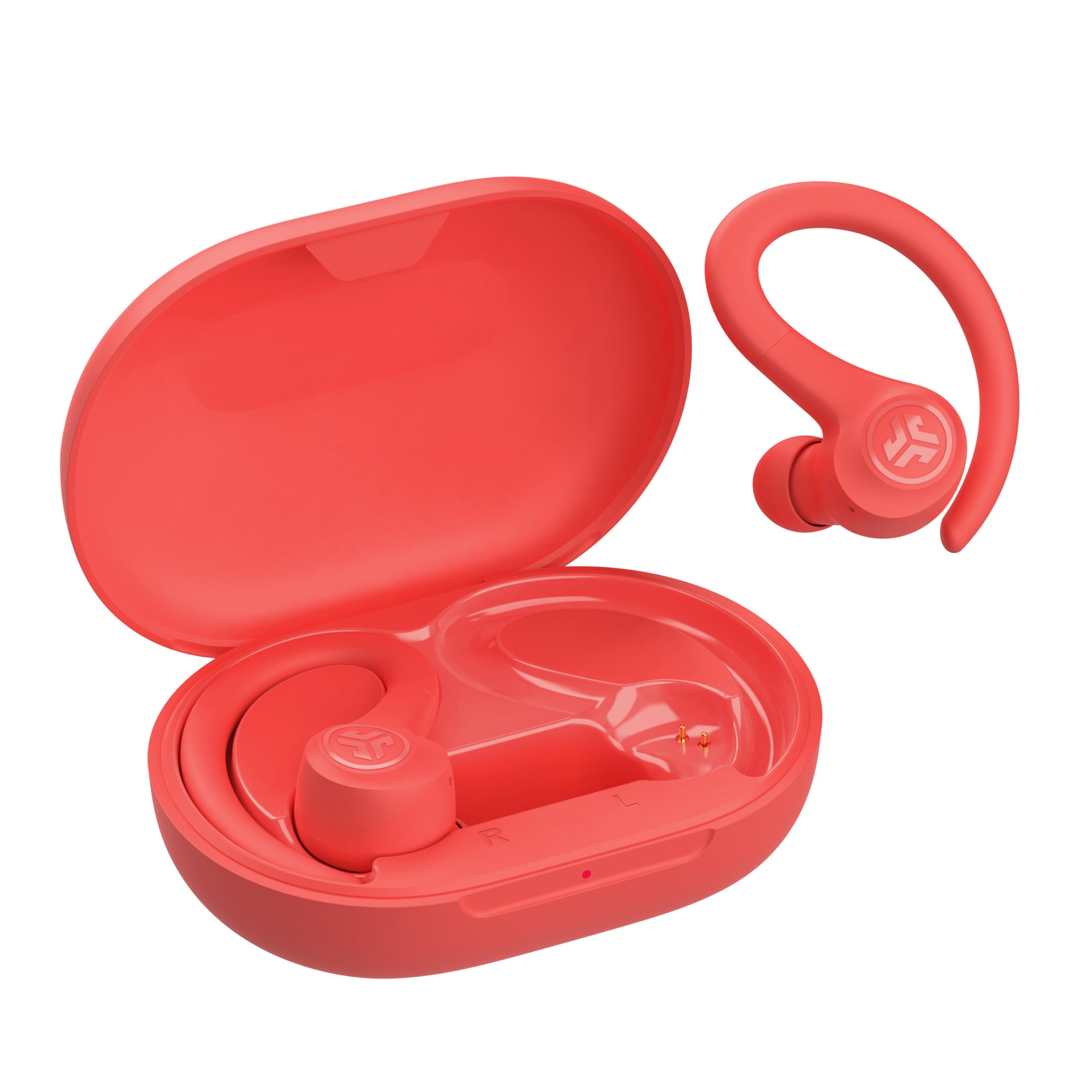
JLab Go Air Sport+

JLab Go Air Sport+

Small ears

Our Score 8.0/10
Check Price

Worth Noting

  • Connection is the least steady here
  • Built-in charging cable is a stub
Fit
Hook sized for small ears
Battery
9h per charge, 35h total
Controls
Touch with app EQ
Water Resistance
IP55 sweat resistant
Read the full review

The hook on the Go Air Sport+ sits close to the head, and JLab builds it to fit ears that other sport buds leave behind. If every pair you have tried has left a hook floating off the back of your skull, this is the one to try first.

Be Aware Mode is the other feature worth having: it pipes the room in without taking the bud out, and paired with Google Fast Pair on Android it makes a genuinely convenient little package. Nine hours per bud and 26 more in the case, IP55, and an app that lets you retune both the EQ and the touch controls.

Sound is the compromise. The 6mm drivers are the smallest here and it shows — clarity in the mids, not much weight underneath, so podcasts and pop land better than anything with a bassline. That is a fair trade for a bud this small.

Where it lands for us is as a first pair or a gym-bag spare: the only set here built specifically around small ears, with the awareness mode that matters for road work, and enough left in the budget to upgrade later without regret.

Bottom line: We keep it in mind for small ears: the smallest hook here, an awareness mode, and a price that makes it a sensible second pair.

How We Picked and Tested the Best Workout Earbuds

We started with roughly 40 pairs that keep turning up in running forums, gym-bag roundups, and retailer reviews, then cut the list by the things that matter before you ever put them in: a real sweat rating, a wing or fin that anchors the bud, an honest battery claim, and a price that doesn't edge into second-pair territory. That left 14 pairs, which we wore for six months across treadmill intervals, heavy lifting sessions, humid outdoor runs, spin classes, and a rainy walk to the gym. Two testers wore each pair so we could compare notes on fit.

Fit came first, because everything else follows from it. Testers ran 30-minute interval sets and noted whether they had to re-seat a bud, whether their ears ached after a 90-minute session, and whether the seal broke when they clenched their jaw or lay back on a bench. We also timed how long each pair took to pair with a phone and whether the connection held when we left the phone on a rack and walked to the far water fountain.

For durability, we did what people actually do: dropped them on rubber gym flooring, tossed them loose in a bag next to a damp towel, wiped them with a sweaty shirt, and checked the charging pins weekly for crust or corrosion. We logged real battery life over a week of workouts, noted how far a ten-minute top-up got us, and once a week played the same three tracks on each pair, listening for whether the bass held up against a gym's background noise and whether the noise canceling muffled the room or the music.

How to Choose Earbuds for Working Out

Open ear or sealed: decide by where you train

An open-ear bud rests the driver outside your ear canal and fires sound at it; a sealed bud pushes a tip into the canal and can add active noise cancelling on top. That single choice decides more about your ownership than any driver size. Open designs keep traffic, gym announcements and training partners audible, which is why we reach for them outdoors. Sealed designs give you bass, isolation and a quieter weights room.

The trap is a listing that promises both. On an open design, 'noise cancelling' almost always refers to the microphones cleaning up your voice on calls, not to quieting the room for you. Read the phrase active noise cancelling literally: if the word active is missing, you are not getting it.

Fit is a mechanism, not a size

Workout buds stay in through one of three structures: a hook that wraps behind the ear, a wing that wedges into the bowl of the ear, or a clip that grips the outer ear. Each carries the weight somewhere different. Hooks spread it over the back of the ear, clips take it off the canal entirely, and wings rely on a seal inside the ear to hold on.

Adjustability matters more than the number of ear tips in the box. A hook that rotates or extends can be aimed at your ear; a fixed one asks your ear to match it. If you wear glasses, a hook competes with the arm that already lives behind your ear, so a clip-on design is the quieter answer.

What a water rating promises, and where moisture actually bites

IPX7 means the earbud survives a dunking in fresh water; IP68 adds full dust protection; IP55 handles sweat and sprayed water but not immersion. Those numbers describe the sealed electronics, not the two metal contacts sitting in the charging case.

So the failure that actually ends a workout pair's life is sweat carried into the case on the buds. Dry both before they dock, leave the case open overnight once in a while, and never rinse a bud under a tap. A pair with a tougher rating buys you margin, not immunity.

Battery, controls and the case in your bag

Total playtime is the marketing number; playtime per charge is the one you live with. Anything around eight hours per charge covers a week of normal sessions, and the case total only matters for travel or forgotten cables. If you train for two hours a day, the difference between 8 and 12 hours per charge is the difference between charging weekly and charging monthly.

Controls deserve a thought too. Physical buttons work through a hood, a glove or a wet thumb; touch panels look cleaner and ask for a precise tap. Neither is wrong, but if you have ever finished a set jabbing at an earbud, you know which side you are on.

Frequently Asked Questions

Final Verdict

Week in and week out, the Soundcore V20i is the pair we hand to most people. The four-position hook solves the fit problem that ruins workout earbuds for so many ears, IP55 and 36 hours of case charge cover the practical side, and the open design keeps you aware on the road.

If your sessions end drenched and indoors, the Sport X20's IP68 sealing is the better answer. If you wear glasses, the TOZO OpenEarRing's clip sidesteps the argument entirely.