Strength & Weights

Best Suspension Trainers of 2026

A suspension trainer is a deceptively simple idea: one strap, one anchor, your own bodyweight as the resistance. That's also the catch. Every row, push-up, and split squat hangs off a single point, so the anchor has to hold and the straps have to adjust without a fight while you're already hanging from them. The good ones turn a hotel room door or a park branch into a full gym.

I've kept a suspension trainer in my garage and in my carry-on for years, and the difference between one you use weekly and one that stays in the closet is mostly in the details. Over the past eight months, my team and I ran 12 of them through the same routines at the same anchors. We cared less about the marketing claims than about whether the straps slipped, whether the length markings were readable mid-set, whether the setup sheet assumed prior knowledge, and whether the webbing still looked sound after months of sweat. The picks below cover garage lifters, frequent travelers, and the space in between.

#1

TRX All-In-One

Top Pick
TRX All-In-One

Full-body home gym

Our Score 9.6/10
Check Price

Worth Noting

  • Premium price
Warranty
1 year limited
Item Weight
1.7 lb
Weight Limit
700 lb
Included Components
Trainer, door anchor, mesh bag, workout guide, DVD
Read the full review

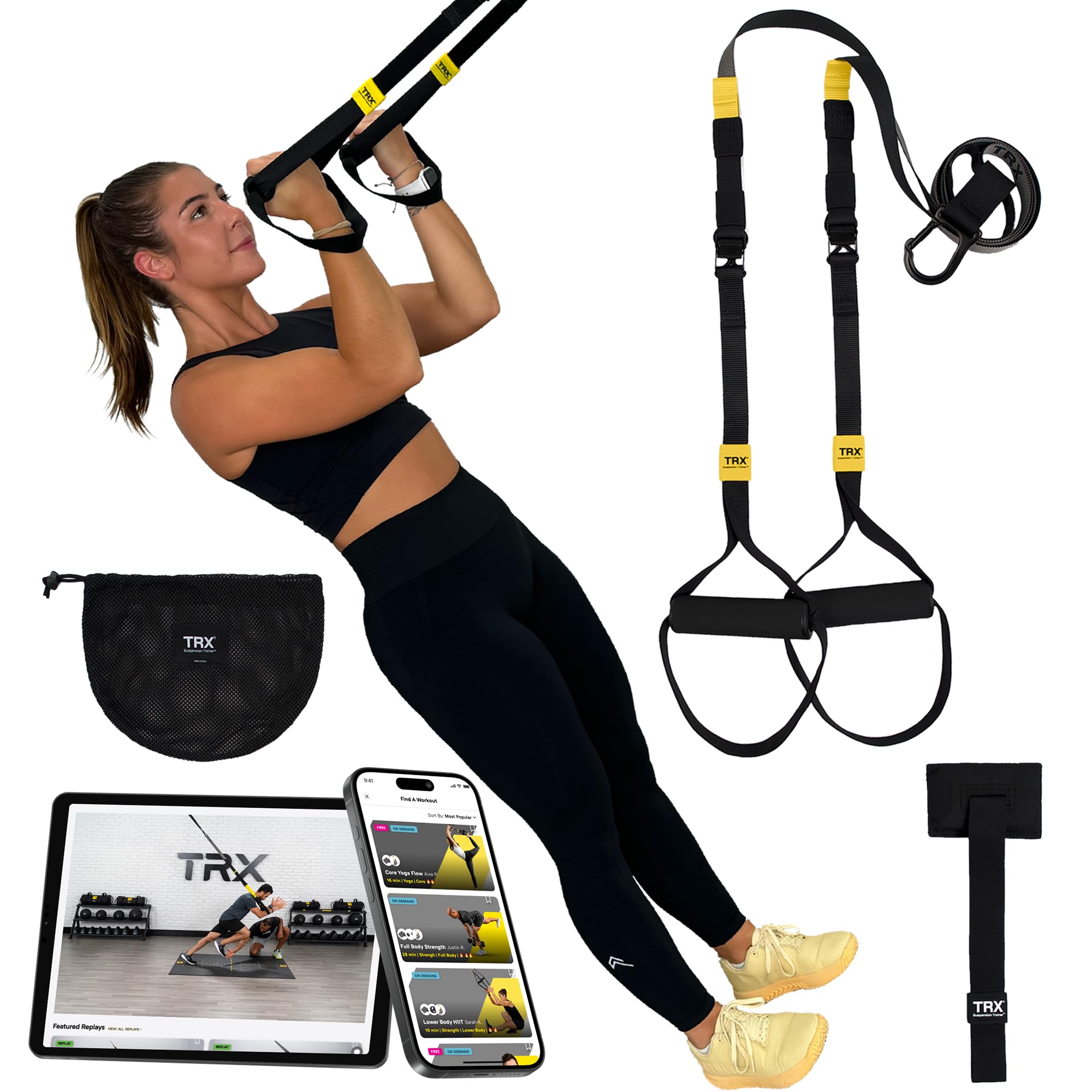
The TRX All-In-One is the closest thing here to a full home gym in a bag. You get the P2 suspension trainer, a door anchor, a mesh carry bag, a printed workout guide, a DVD, and access to 500-plus workouts in the TRX app. TRX rates the system to 700 pounds, the highest stated limit among these picks, and the anchor set works indoors on a door or outdoors on a beam, post, or tree. We like that combination for someone who wants one kit to cover strength, HIIT, and mobility without adding a rack or bench.

What makes it our top pick is not a single feature but the way the pieces fit together. The door anchor is simple to loop over a sturdy door, the trainer packs into the mesh bag at 1.7 pounds, and the app gives a beginner a plan rather than a pile of straps. We found the All-In-One easier to recommend than the GO for a permanent home setup because it includes more guidance and a more complete anchor package. The GO is the one we reach for when space in a suitcase matters more than the extras.

The one-year limited warranty is the only spec we pause over. The GO gets three years, which is unusual in a lineup where the bigger kit usually gets the longer coverage. That does not change how the All-In-One performs, but it is worth knowing before you commit. The rest of the package is complete enough that we stop looking for add-ons.

Bottom line: We recommend the All-In-One as the default home kit: it anchors indoors or out, rates to 700 pounds, and comes with real workout guidance.
#2

TRX GO

TRX GO

Travel and home

Our Score 9.4/10
Check Price

Worth Noting

  • 350-pound user weight limit
Warranty
3 years
Item Weight
1.5 lb
Weight Limit
350 lb
Included Components
Trainer, indoor/outdoor anchors, mesh bag
Read the full review

The TRX GO is the one we reach for when the workout has to travel. It packs into a small mesh bag, sets up on a door or an outdoor anchor, and weighs 0.68 kilograms, so it disappears into a carry-on rather than taking over the bag. We like that it keeps the TRX strap feel without the bulk of a full home-gym kit. The door anchor is the part we use most, and it is simple to loop over a sturdy door; the outdoor anchor adds a tree or beam when you have one.

We were pleasantly surprised that the GO carries a three-year warranty, longer than the All-In-One's one-year coverage. For a travel kit that gets folded, stuffed, and hung in unfamiliar rooms, that longer coverage is a real vote of confidence. The strap adjusters need a firm pull to seat, especially when the strap is new; give each side a tug before you start. We also like that the GO does not try to be a full home gym. It is a strap, two anchors, a bag, and an app, and that focus is why it packs so well.

The kit is lean: a strap, indoor and outdoor anchors, a mesh bag, and app access. If you want a printed guide and DVD, the All-In-One is the better fit. That is the trade-off with a travel-first kit—you give up some hand-holding, but you get a system that stays packed and ready.

Bottom line: We keep the GO packed for travel: it sets up fast, includes indoor and outdoor anchors, and its three-year warranty beats the bigger kit's coverage.

#3

Bodytorc Suspension Trainer

Bodytorc Suspension Trainer

Attachment variety

Our Score 9.2/10
Check Price

Worth Noting

  • 250-pound user weight limit
  • Heavier at 3.4 pounds
Handles
Detachable
Item Weight
3.4 lb
Weight Limit
250 lb
Included Components
Door anchor, extension arms, foot straps
Read the full review

The Bodytorc's party trick is that the handles come off. That turns a standard suspension trainer into a frame for ropes, bars, or other attachments, and the separate straps can hang vertically from a chin-up bar instead of meeting at a single V. We like that flexibility for someone who already owns accessories and wants to build a varied home circuit.

The kit includes a door anchor, extension arms, and advanced foot straps, and the cam buckles bite firmly when you set them. We paid attention to the printed markings on the straps, though: they are not a reliable way to match sides, so set the length by feel and check both handles at eye level. The heel hooks also take a little practice to step into, especially barefoot. Neither is a dealbreaker for a home gym where you set the straps once and leave them.

Those details aside, the Bodytorc is the pick for attachment variety. The separate straps and removable handles give you more ways to load a press or row than a fixed-loop trainer, and the included foot straps cover split squats and hamstring curls. It sits between the TRX kits and the Moulyan on price, which is the right middle ground for a home setup that will see regular use.

Bottom line: We choose the Bodytorc when attachment variety matters: the handles come off, the straps hang independently, and the kit includes foot straps and a door anchor.

#4

Moulyan Training Straps

Moulyan Training Straps

Budget starters

Our Score 9.2/10
Check Price

Worth Noting

  • No published user weight limit
Material
Nylon, polyester
Item Weight
2.65 lb
Included Components
2 straps, door anchor, extension, guide
Read the full review

The Moulyan kit is the budget option that still covers the essentials: two adjustable straps, a door anchor, an extension strap, and a training guide. At 1.2 kilograms, it packs down for a gym bag or a trip, and we like that it gives a beginner a full-body setup without a big commitment. The carabiners are the most substantial-feeling parts of the kit, which is reassuring where it counts.

The trade-off is that the package is basic. The straps and extension come unlabeled, so lay everything out and identify the door anchor before you start. Once it is set, the cam buckles hold and the length adjustments are straightforward. We also noticed the handles are firm rather than padded, which is fine for shorter sessions but less comfortable on high-volume pulling work.

For a first suspension trainer or a spare set for travel, the Moulyan is an easy recommendation. It is the least expensive kit here, and the included extension gives you more anchoring options than the price suggests. We do not choose it over the TRX GO for frequent hotel workouts because the GO has a cleaner setup and a stated 350-pound limit, but the Moulyan is the one we keep as a second setup for a different room.

Bottom line: We recommend the Moulyan as the low-cost starter: it includes straps, a door anchor, and an extension, and it packs small for light home use.

#5

Lifeline Jungle Gym XT

Lifeline Jungle Gym XT

Wide-angle work

Our Score 9.2/10
Check Price

Worth Noting

  • Short 90-day limited warranty
Warranty
90 days limited
Item Weight
16 oz
Anchor Design
Split anchor
Included Components
Two door anchors, trainer straps
Read the full review

The Lifeline Jungle Gym XT uses a split anchor: two straps that can be set close together, shoulder-width, or wide instead of meeting at a single V. That is the reason to consider it. The wide setting opens up chest and back angles that a single-anchor trainer cannot match, and the two non-scuff door anchors make it practical for a home door frame. The two door anchors are non-scuff, which matters in a rental or a finished room. At 16 ounces, it is light enough to toss in a bag.

The adjustment is the part we paid closest attention to. The cam locks are quick to lengthen and shorten, and the split design lets you match the straps by eye. But the buckles can shift if the strap is not seated squarely, so pull the tail tight and tug each side before you load it. That is a setup habit, not a reason to avoid the kit, but it matters more here than on the TRX.

The Jungle Gym XT is a good fit for someone who wants angle variety without stepping up to a premium kit. It is also the pick for a garage setup where you can leave two anchors in place; the split anchor takes longer to set up than a single strap. The wide setting is the one we keep coming back to for chest flys and rows, where the extra angle makes the movement feel more natural. We like it as a second trainer or a dedicated wide-angle station, not as the simplest travel kit.

Bottom line: We recommend the Jungle Gym XT for wide-angle work: its split anchor opens exercise angles a single-point strap can't match, provided you seat the cam buckles firmly.

What We Put Every Suspension Trainer Through

We started with the suspension trainers from the brands that actually show up in this category, then cut the list by reading specs: stated weight limits, webbing width, stitching at the load points, anchor style, and whether the straps carried printed length markings. Price factored in too, because we wanted systems across the range rather than only the expensive end. That narrowed it to 12.

Each one spent the full eight months in my garage, anchored to a steel beam for rows, push-ups, pikes, and split squats three or four mornings a week. Every trainer also traveled: hotel room doors, a park branch on a Saturday, a friend's apartment doorframe, the open hatch of a rental car. We hung our full bodyweight off each anchor and watched for creep, and a door anchor that shifted even half an inch under load got written down.

Strap adjustment got timed, not eyeballed. We moved each system from a row to a chest press with one hand and counted the seconds, then checked whether the printed markings still lined up after a few months of sweat and chalk. We recorded where the webbing fuzzed, where stitching loosened, and which buckles started slipping under a slow descent. Setup had its own test: we built each system from scratch using only what came in the box, and counted thin or missing instructions against a trainer's final score.

Portability was measured by whether a system fit a carry-on with room left for clothes, and whether it weighed the bag down on the walk to the park. At the end we went back to the price tags and asked whether each one earned its spot against the best of the group. Durability decided most of the close calls.

How to Choose a Suspension Trainer

Start With Your Anchor

A suspension trainer is only as secure as the point it hangs from. Door anchors are the most convenient for home use, but the door needs to close and lock, and the anchor should sit where the strap will not rub the frame. Outdoor anchors open up trees, posts, and beams, though you need a branch or beam that will not flex or fail. If you want one kit for both, choose one with indoor and outdoor anchors, like the TRX All-In-One. A split-anchor design adds angle variety but takes longer to hang and usually wants two solid points.

Check the User Weight Limit

A strap's breaking strength is not the same as the user weight limit. The number that matters is the manufacturer's stated maximum for the person using it, and it should be printed plainly. In this set, the TRX All-In-One is rated to 700 pounds, the TRX GO to 350, and the Bodytorc to 250. If a kit does not publish a limit, treat that as a reason to ask before loading it heavily rather than assuming it is fine. Heavier users should start with the highest stated rating they can find.

Look at Adjustment and the Included Kit

Cam buckles are the parts you touch every set, so they deserve a close look. A good buckle releases smoothly, bites firmly, and lets you match both sides without fighting the strap. Printed length markings are a nice shortcut, but they are not a precision scale; set the handles at eye level and check them before you start. The kit matters too: handles, foot cradles, a door anchor, and an extension strap cover more exercises than a bare set of straps. A printed guide or app is useful if you are new to suspension training.

Weigh Portability Against Long-Term Coverage

Travel kits earn their place by packing small, but a light bag is not automatically the right home kit. A single-anchor strap is faster to hang in a hotel room; a split-anchor system can be worth the extra setup if you want wide-angle presses and rows. Check the warranty as part of the value, too. In this group, the TRX GO carries a three-year warranty while the All-In-One gets one year, and the Lifeline is covered for 90 days. A longer warranty does not make a kit stronger, but it tells you how long the maker will stand behind it.

Frequently Asked Questions

Final Verdict

The TRX All-In-One is the kit we recommend first for a home gym. It anchors indoors or outdoors, carries the highest stated weight limit here, and includes the guide and app support that make suspension training easier to start. If your workouts happen in hotel rooms or small apartments, choose the TRX GO instead; it packs smaller and carries a longer warranty. For a budget entry or a split-anchor setup, the Moulyan and Lifeline make sense, but they are second sets rather than the default.