Strength & Weights

Best Medicine Balls of 2026

A medicine ball looks like the simplest thing in the gym — a heavy sphere, no moving parts, nothing to plug in. That simplicity is where the trouble hides. The weight stamped on the side has to be the weight you feel at the end of a throw, the surface has to hold when your hands are slick, and the shell has to survive a few hundred slams. Get it right and the ball disappears into your workout; get it wrong and you're dodging a sand leak, a rubber smell that won't fade, or a wobble in mid-air that means the fill has shifted.

I've lifted long enough to have opinions here, and over seven months my team threw, slammed, and rolled 12 medicine balls through garage sessions, basement floor work, and a few group classes. The good ones were balanced, honest about their weight, and grippy even when wet. One thing first-timers don't always know: a dead-bounce slam ball and a lively wall ball are different purchases, and plenty of balls are mediocre at both. The picks below sort by which job you actually need done.

#1

Amazon Basics Rubber Medicine Ball

Top Pick
Amazon Basics Rubber Medicine Ball

Tosses and rehab

Our Score 9.6/10
Check Price

Worth Noting

  • 4 lb is light for real strength work
  • Bounces hard enough to rule out slams
Bounce
Bounces off hard surfaces
Weight
4 lb
Diameter
7.6 in
Material
Rubber
Read the full review

This is the ball we pick up when the drill involves letting go. Where the slam balls here die on contact, the Amazon Basics rubber ball bounces off a wall or a floor and comes back to your hands, which makes it the right tool for partner tosses, wall throws, and shoulder work where you are catching more than you are lifting.

At 4 pounds and 7.6 inches it handles like a heavy mini basketball, and the pebbled surface is the reason it works: it holds when your hands are wet, and the rubber gives enough that a mistimed catch does not jam a finger. It arrives smelling strongly of tire — ours spent a week in the garage before the smell dropped to something you notice only with your nose against it.

Four pounds is the catch. It is a rehab, warm-up, and rotational ball rather than a strength load, and the bounce that makes it fun rules it out for slams, because throw it down hard and it comes back at you. For shoulder work and for anyone building toward a heavier ball, it is the easiest recommendation here.

Bottom line: The ball we reach for when the drill involves letting go: a grippy, bouncy 4-pounder for tosses, twists, and shoulder work.
#2

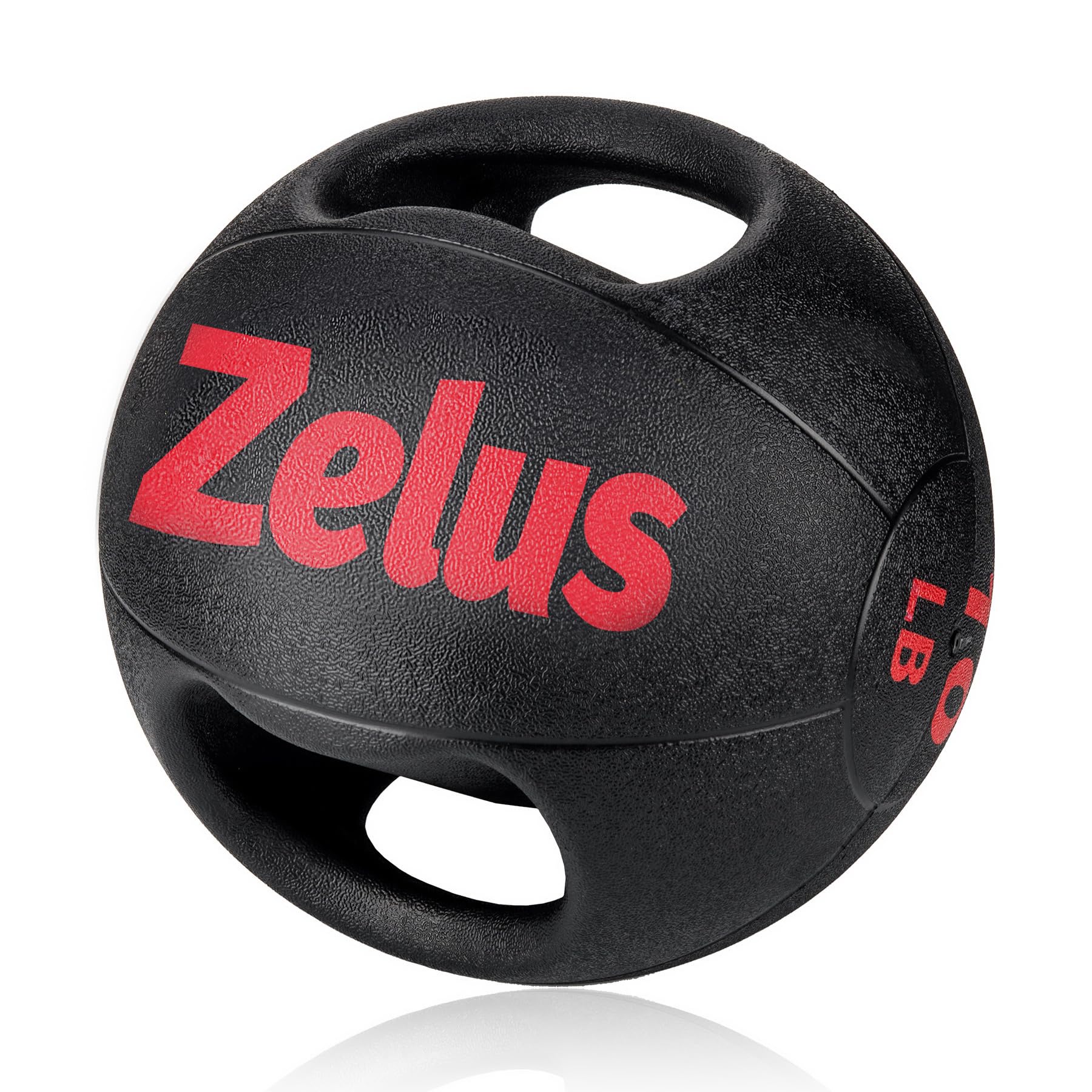
ZELUS Dual-Grip Medicine Ball

ZELUS Dual-Grip Medicine Ball

Grip-limited workouts

Our Score 9.6/10
Check Price

Worth Noting

  • Only two weights: 10 and 20 lb
Grip
Dual handles, textured
Weight
10 lb
Diameter
14 in
Material
Molded rubber
Read the full review

Two molded handles, one on each side, and a 14-inch rubber shell: the ZELUS is the only ball here you can hold like a kettlebell. If grip is what stops you loading a movement — a press, a swing, a lunge with a twist — the handles solve the problem the other balls leave you to solve with chalk.

The rubber is molded rather than filled, with a textured surface that has held up to our floor work, and the handles make it a ball you never have to pick up between sets. Fourteen inches is a lot of ball, though, and the handles sit exactly where your hands want to be when something needs to leave them, so this is not the ball for slams or wall throws.

Where it earns its place is a small home setup where one ball has to stand in for two dumbbells: presses, twists, goblet squats, and lunges all work with the handles. Where it does not is any workout built on throwing things.

Bottom line: The only handled ball here, and the right buy if grip rather than throwing power is what limits your workout.

#3

Champion Sports Rhino Elite

Champion Sports Rhino Elite

Light throws

Our Score 9.6/10
Check Price

Worth Noting

  • 2 lb is a warm-up weight, not a strength load
Bounce
Consistent bounce
Weight
2 lb
Diameter
8 in
Material
Synthetic rubber
Read the full review

At 2 pounds and 8 inches, the Rhino Elite is the ball for work that is not about load: overhead throws, rotational warm-ups, rehab tosses, and high-rep arm work where anything heavier just wears you down.

It is hollow synthetic rubber with a textured surface, and the bounce is controlled rather than springy. It comes back off a wall or a floor without ricocheting, and the rubber is tough enough to use against concrete without shredding.

The size is the detail we did not expect to care about. Eight inches is big enough that it does not feel like throwing a softball, so you can catch it cleanly in one hand and keep a rhythm going instead of resetting your grip every rep.

Its job is the light end of the range, and it does that job well. Buy it as the ball you keep by the door for warm-ups and shoulder work, or as the second ball beside a heavier slam ball. As your only medicine ball, 2 pounds will not challenge much.

Bottom line: A 2-pound controlled-bounce ball for overhead throws, warm-ups, and rehab work, not for anyone who needs a strength load.

#4

ProsourceFit Slam Medicine Ball

ProsourceFit Slam Medicine Ball

Slams and conditioning

Our Score 9.4/10
Check Price

Worth Noting

  • Dead weight rules out catch-and-throw drills
  • Tread texture is rough on bare palms
Fill
Sand core, PVC shell
Grip
Tread-textured
Weight
15 lb
Diameter
9 in
Read the full review

A sand-filled slam ball drops like a bag of sand and stays where it lands, with no rebound into your shins and no chase across the garage. At 15 pounds in a 9-inch shell, the ProsourceFit sits in your hands like a slightly undersized basketball, and the tire-tread surface gives your fingers something to lock into at the bottom of a swing.

That dead drop is why this is the ball we hand most people first. The line runs from 5 to 50 pounds, so the design you start with is the one you keep as your strength grows, and the limited lifetime warranty covers the shell rather than just the stitching. It has the widest weight range in this group and a tread pattern that stays put in sweaty hands, which is the combination that matters when you are throwing something at the floor a hundred times a week.

Two things we noticed in use. The fill moves: set the ball down between sets and the sand settles to one side, so the first slam of the next round lands a little heavier on that side. And the tread is slickest when it is new — it holds better once your hands are sweaty and the surface has scuffed, the reverse of how a solid rubber ball behaves.

Where it stops earning its keep is speed work. For long high-rep conditioning, a lighter ball in the same line does more for you than muscling this one up, and 15 pounds is a strength-and-power weight rather than a cardio weight. Buy it for slams, ground throws, and carries, and add a lighter one later if the circuits get long.

Bottom line: The best all-rounder here for slams and conditioning: dead weight that stays put, a wide weight range, and a shell that takes a beating.

#5

Champion Sports Leather Medicine Ball

Champion Sports Leather Medicine Ball

Traditional core work

Our Score 9.4/10
Check Price

Worth Noting

  • Fill can sit off-centre in the shell
Cover
Synthetic leather
Seams
Reinforced stitching
Weight
9 to 10 lb
Diameter
7.79 in
Read the full review

Nine or ten pounds in a 7.79-inch shell is a dense, small ball, and that is the whole feel of the Champion leather medicine ball: it sits in your palms rather than your hands, the way old-school gym equipment does. The cover is synthetic leather stitched into panels, and it is the only ball here that does not announce itself with a rubber smell when you open the box.

The panels are why we like it for rotational work. Leather gives slightly under your fingers, so a Russian twist or a wood chop does not turn into a grip fight, and sweaty hands do not slide the way they do on smooth PVC. We used it for core work, sit-ups, and light wall throws, and it is also the ball we hand anyone who finds tread texture unpleasant.

It will not take a slam. Panels and stitching are built for throwing and catching, not for a hundred reps of ground contact, and the seams will scuff and eventually split if you treat it like a slam ball. Everything above the floor is a different story, and for traditional medicine-ball training this is the best-feeling ball in the group.

Bottom line: For traditional medicine-ball training above the floor, the nicest-feeling ball here: dense, quiet, and grippy without rubber odor.

#6

ProsourceFit Soft Wall Ball

ProsourceFit Soft Wall Ball

Wall-ball circuits

Our Score 9.4/10
Check Price

Worth Noting

  • Fill can sit unevenly and throw off aim
  • 14 inches is too bulky for one-handed work
Fill
Padded interior
Cover
PU leather, double-stitched
Weight
8 lb
Diameter
14 in
Read the full review

Wall-ball circuits have their own standard: a 14-inch ball you catch with both hands and throw back at a target above your head. The ProsourceFit soft ball is built to that spec — 14 inches, 8 pounds, a padded PU leather shell over a stuffed core with double-stitched seams — and if wall balls are the reason you are shopping, this is the shape you want.

The soft shell is the point. A stitched ball with give absorbs the catch in a way hard rubber does not, so a fumbled catch stings less and the ball does not ring off your forearms. It also sits still when you set it down, which matters in a circuit where you are moving between stations.

It is emphatically not a slam ball. The padding that makes the catch comfortable is exactly what a floor would destroy, and stitched seams are the first thing to go under repeated ground contact. Treat it as a throwing ball, throw it at a wall or straight up, and it holds together.

At the top of this group's price range it is a considered buy, and it only makes sense if wall balls are a real part of your week. For a home gym that throws them twice a month, something cheaper covers the same ground.

Bottom line: If wall balls are the reason you are shopping, this 14-inch soft ball is the right shape and the right catch, at a premium.

#7

Amazon Basics Slam Medicine Ball

Amazon Basics Slam Medicine Ball

Budget slams

Our Score 9.2/10
Check Price

Worth Noting

  • Sand fill shifts between sets and changes the swing
Fill
Sand core, PVC shell
Grip
Textured non-slip
Weight
10 lb
Diameter
7.87 in
Read the full review

The least expensive way into dead weight here is also the plainest ball in the group: a 10-pound PVC shell with a sand core, no tread, and nothing on it but a logo.

We expected to dismiss it and did not. It drops dead, it does not wander across the floor, and at 10 pounds it is light enough for high-rep conditioning sets where a 15 would have you quitting early. The shell is softer and squishier under the thumb than the tread balls, and it scuffs rather than chunks when it meets concrete.

That softness is also the trade. A squishy shell gives you a vaguer feel at the bottom of a slam than a firm tread ball, and 10 pounds is a conditioning weight rather than a strength one. For straight slams, carries, and high-rep work it does the job for less than anything else here, and it is gentler on a wood floor than the harder shells.

Bottom line: The cheapest way into dead-weight slams, and a sensible first ball if your conditioning is high-rep rather than heavy.

#8

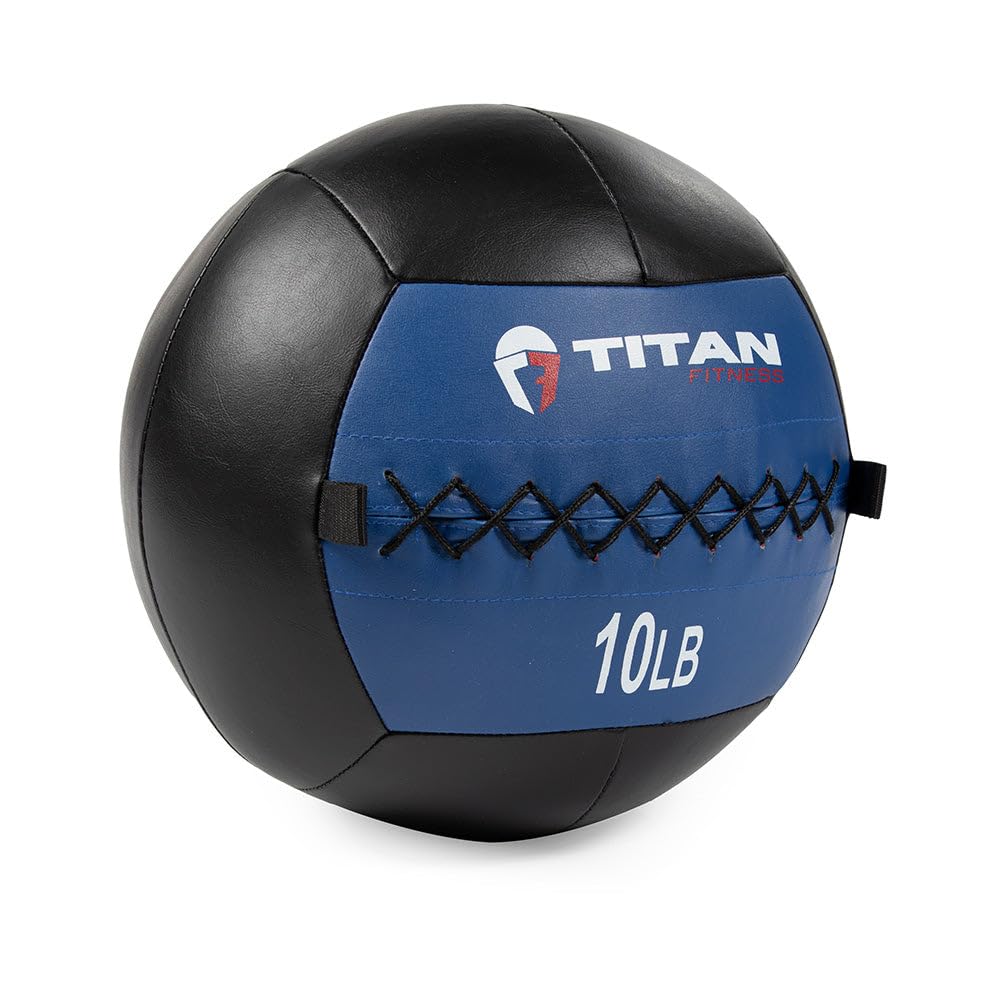
Titan Fitness Wall Ball

Titan Fitness Wall Ball

Gym wall balls

Our Score 9.2/10
Check Price

Worth Noting

  • Cotton fill and stitching rule out slams
Fill
PP cotton
Cover
PU leather, double-stitched
Weight
10 lb
Diameter
14 in
Read the full review

Somewhere in our wall sessions, the Titan stopped being a sphere. Set it on the floor and it rolled a few inches off line before it settled, and catches got less predictable as the fill packed toward one side.

Before that it is a proper wall ball: 14 inches, double-stitched PU leather around a cotton fill, soft enough to catch bare-handed and firm enough to throw at a target. The seams held through our sessions with no splits, and the shell shrugged off contact with a block wall.

Shape is the cost. A stitched soft ball with a loose fill can go lopsided under repeated impact, and once it does, your throws stop landing where you aimed, which is the one thing a wall ball has to do. For occasional use that is a manageable trade. For a class or a team throwing every day, it is the wrong buy.

What it does well is the group setting: a soft ball that does not punish a bad catch, in a size everyone can grip with two hands. If you throw at a wall a few times a week and want something gentle on the hands, it is a reasonable pick. If you want a ball that keeps its shape, a solid rubber one is the safer buy.

Bottom line: A soft, seam-tough 14-inch wall ball for class use, as long as you accept that it will not stay perfectly round.

How We Tested 12 Medicine Balls

We pulled together every ball we could find in the 6- to 30-pound range — rubber, leather, and sand-filled shells — and cut the list down to the ones with a stated diameter, a stated material, and a weight we could verify on a scale. That left 12. Testing ran for seven months, mostly in a garage gym with a concrete slam wall, plus a second setup in a basement for floor work and core drills, with six people rotating through: a 5-foot-4 lifter, a former college athlete, and four of us in between.

Every ball got weighed on a kitchen scale the day it arrived and again at the end, so we could see how far the printed number drifted from reality and whether the fill settled over time. We rolled each one down two meters of level floor to check whether it tracked straight or wobbled, and dropped it from waist height ten times, marking the landing spots to catch a fill that had slumped to one side. Grip was checked bare-handed, with chalk, and with wet hands after a set of slams, because a slick shell is the fastest way to eat a medicine ball.

Then we abused them: 200 wall balls against concrete, partner tosses, Russian twists, and a few overhead slams that were not in anyone's program. After each session we ran a thumb along the seams looking for grit, since a sand-filled ball fails slowly at the seam before it fails all over your floor. Each one also spent a night locked in a car trunk, and we smelled it the next morning. The balls below came through without a wobble, a leak, or a smell they couldn't shake.

How to Choose Medicine Balls

Dead weight, bounce, or soft shell

Three families cover this category, and they are not interchangeable. Slam balls are sand- or shot-filled PVC that dies on impact, which is what you want for ground slams, over-the-shoulder throws, and loaded carries. Solid rubber medicine balls bounce, so they suit partner tosses, wall throws, and rehab work where the catch is half the exercise. Stitched soft balls are the 14-inch wall-ball standard.

Decide which drill you cannot do without, then buy that family first. Most people who stick with this end up owning two balls rather than one.

Pick the weight by the reps you will do

This is where most shoppers overshoot. A 4- to 8-pound ball covers shoulder work, rehab, warm-ups, and fast high-rep sets; 10 to 15 pounds is the meat of adult strength and conditioning; 20 pounds and up is for loaded slams, squats, and carries where the ball is the resistance.

The test is simple: choose the weight you can throw for ten clean reps, not the one you can lift once. A line with a wide range, like the 5-to-50-pound ProsourceFit slam balls, lets you add a second ball later without changing brands.

Grip, and what your hands will put up with

Tread-textured PVC is the grippiest option once your hands are wet and the roughest on dry palms, so high-volume slam days become glove days. Solid rubber has a basketball feel that holds with sweat and shows every bit of chalk and floor grit. Leather and PU panels feel softest and skip the rubber smell, but they scuff.

Handles are worth the compromise only if grip, not throwing, is your limit — a handled ball is a kettlebell substitute, not a slam ball.

Size, shape, and how it ages

Diameter tells you what the ball is for. Anything from about 7.5 to 9 inches is a one-hand ball: dense, easy to wrap your fingers around, and the right shape for slams and rotational work. Fourteen inches is a two-handed ball built for wall-ball catches, and it is awkward for everything else. Buying a 14-inch ball for slams is a common and expensive mistake.

Then there is shape. Sand-filled PVC keeps its form but the fill migrates; stitched soft balls can go lopsided with repeated throws. Set the ball on the floor and see whether it rolls straight.

Frequently Asked Questions

Final Verdict

The ProsourceFit slam ball is the one we point most people to. Dead weight that behaves, a 5-to-50-pound range that grows with you, and a tread grip that holds when your hands do not.

If your training is built on catch-and-throw rather than slams, the Amazon Basics rubber ball is the better buy and the cheaper one. If wall balls are the whole point, go straight to the 14-inch ProsourceFit soft ball and skip the rest.