Strength & Weights

Best Kettlebells of 2026

A kettlebell looks like a cannonball with a handle bolted on, but the handle is the whole point — every swing, clean, snatch, and get-up runs straight through your grip. That's also where buying one gets annoying. Fixed cast-iron bells are close to indestructible, but a full set eats a shelf and a paycheck; adjustable models save the space and can rattle or pinch when you move fast. The right bell sidesteps that tradeoff: it swings clean, it doesn't shred your palms, and it weighs what it claims to weigh.

I've swung kettlebells in a cramped apartment corner and in a garage cold enough to make bare steel sting, so I know what a rough seam does to a workout. Over the past six months, my team and I worked through 12 bells, fixed and adjustable, weighing each one on a kitchen scale and running it through swings, cleans, snatches, presses, and get-ups. Finish and handle shape mattered more than the number stamped on the side. A few picks below are built to be your only bell; others suit someone building a rack a paycheck at a time.

#1

Amazon Basics Cast Iron

Top Pick
Amazon Basics Cast Iron

Everyday home training

Our Score 9.6/10
Check Price

Worth Noting

  • Chipped coating rusts if the bell stays outside
Weight
25 lb
Material
Cast iron, powder coat
Dimensions
7.9 x 4.6 x 9 in
Handle Diameter
1.5 in
Read the full review

The handle on this bell measures 1.5 inches across, against 1.13 to 1.3 inches on several others here, and that width is the difference between a two-hand swing that feels locked in and one where your hands stack awkwardly. It's the first thing we check on a cast-iron kettlebell, because no amount of finish quality fixes a handle that's too narrow for both hands.

We recommend the 25-pound Amazon Basics as the default home bell because it gets the two things that matter right. The casting is one piece, with no seam running through the handle to cut into your palm, and the textured grip holds well in dry hands. It also costs little enough that a second, heavier bell is realistic, which is how most people actually progress.

Two things to know before you order. The enamel is glossy, and once your palms heat up the handle gets slick — chalk or a towel within reach solves it, and a handle scuffed from use grips better than a new one. Smaller hands may also prefer a narrower bar for one-arm presses and snatches, where 1.5 inches starts to feel like a lot.

Bottom line: The 25-pound Amazon Basics is our default recommendation: a seam-free casting, a genuinely wide textured handle, and a price that leaves room for a second size.

#2

BowFlex SelectTech 840

BowFlex SelectTech 840

Small spaces

Our Score 9.6/10
Check Price

Worth Noting

  • Tall, boxy body is awkward for under-leg passes
  • Not built to be dropped or slammed
Settings
8, 12, 20, 25, 35, 40 lb
Footprint
8.82 x 7.01 in
Weight Range
8 to 40 lb
Handle Diameter
28 mm
Read the full review

Six cast-iron kettlebells need a rack or a line of floor space. The SelectTech 840 needs one square of it, and that square is the entire argument: 8, 12, 20, 25, 35 and 40 pounds in a single unit that tucks into a corner when you're finished.

A dial on the side moves between the six settings, and the changes are quick enough to happen between sets rather than between exercises. The handle measures 28 millimeters, closer to a competition bell than the wide cast handles here, which suits smaller hands and one-arm work.

The catch is the shape. This is a tall, boxy bell with a plastic shell, and anything that passes it under a leg or around the body gets awkward fast. It's also not a bell you drop or slam. Treat it as gym equipment rather than a lump of iron and it does everything it was built to do.

We recommend it for anyone whose constraint is space rather than strength: a small apartment, a shared room, a single cupboard. If you have the floor and the budget, cast iron still feels better in a swing; if you don't, this is the compromise that keeps you training.

Bottom line: Choose the SelectTech 840 when floor space is the constraint — six weights in one footprint, changed with a dial, though it won't swing like cast iron.

#3

Yes4All Vinyl 10 lb

Yes4All Vinyl 10 lb

Beginners and warm-ups

Our Score 9.6/10
Check Price

Worth Noting

  • Base can rock and tip on carpet
Base
Flat
Shell
Vinyl over cast iron
Weight
10 lb
Handle Diameter
1.2 in
Read the full review

A 10-pound kettlebell isn't the one you build a program around. It's the one you buy to learn the movements without wrecking your shoulders, or to keep beside a heavier bell for warm-up sets and get-ups. For that job this one works: cast iron under a vinyl shell, a 1.2-inch handle, and a flat base for upright storage.

Two details earn it a place. The vinyl is genuinely kind to a wood floor — no clang when you set it down, no scratched boards — which is why it's the bell we suggest for apartments. And the handle is smooth rather than textured, comfortable for high-rep work without chalk, which matters when you're doing twenty reps of anything.

The base is the weak spot. It's meant to sit flat, and some of these arrive with a slight rock, so the bell tips when you set it down on carpet. On a hard floor it's fine. Check yours on a hard surface before the return window closes; a bell that won't sit still is annoying every single set.

Bottom line: We like the 10-pound Yes4All vinyl as a learner's bell or a warm-up weight: quiet, floor-friendly, and cheap enough to sit beside a heavier bell.

#4

Marcy Hammertone

Marcy Hammertone

Building a set

Our Score 9.4/10
Check Price

Worth Noting

  • Enamel chips with steady use
Range
10 to 55 lb, 5 lb steps
Weight
20 lb
Warranty
2 years
Handle Diameter
1.25 in
Read the full review

Marcy sells this bell in ten sizes, from 10 to 55 pounds in 5-pound steps, and backs it with a two-year warranty — a combination nothing else here offers. That makes it the one we point to when someone plans to add a kettlebell every few months rather than buy a set all at once.

The hammertone finish has a fine texture to it, and it's why cleans feel comfortable rather than grabby: enough friction for a secure hold without the roughness that tears up forearms. The handle is 1.25 inches, a middle-of-the-road width that suits one-arm work better than the wide 1.5-inch bars. We also like how compact the 20-pounder is at 7 by 4.5 by 7.5 inches — it stores on a shelf without drama.

One caution: run a finger around the inside of the handle before your first session. Some bells arrive with casting burrs there, and five minutes with a file saves your palms. Past that, ours has handled swings, goblet squats and rows without complaint, and at this price the 5-pound ladder is the real argument for choosing it.

Bottom line: Our pick for building a set: ten sizes in 5-pound steps, a two-year warranty, and a hammertone finish that keeps cleans comfortable.

#5

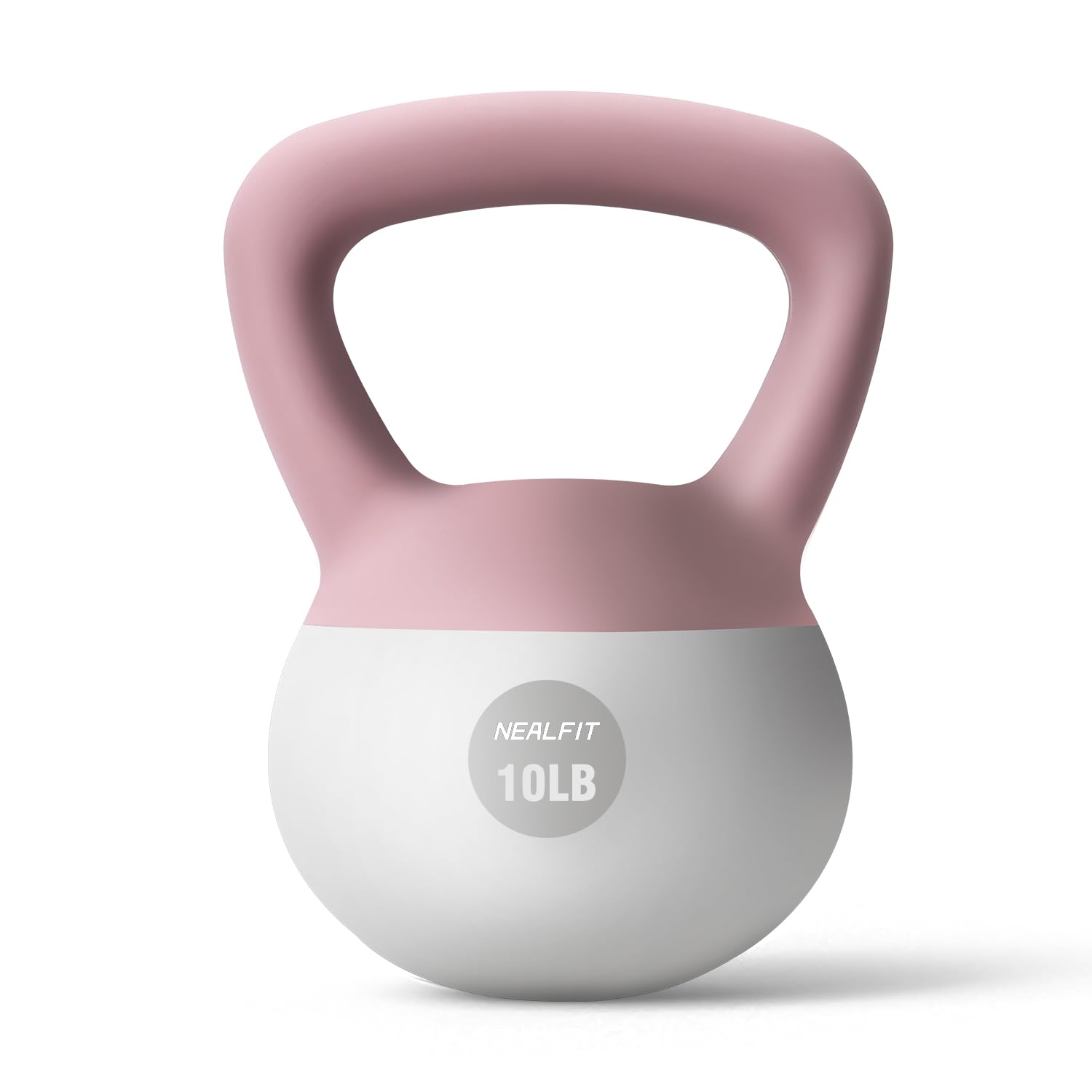
NEALFIT Soft Kettlebell

NEALFIT Soft Kettlebell

Quiet floor work

Our Score 9.4/10
Check Price

Worth Noting

  • Range stops at 25 pounds
  • 10-pound version is light for most adults
Fill
Sand
Shell
PVC
Sizes
5, 10, 15, 20 and 25 lb
Weight
10 lb
Read the full review

Setting a kettlebell down is usually where a home gym gets loud. This one is sand inside a soft PVC shell, and the difference is immediate: it lands with a thud rather than a clang, and it doesn't gouge a floor. That alone is why we keep it on the list for apartments, rooms above a neighbor, and anyone training over tile.

A soft shell takes the sting out of a clipped swing or a bumped knee in a way cast iron never will, which is why it suits older lifters rebuilding strength and anyone easing back into training. The handle is wide and non-slip, and the soft texture makes it easier to hold for presses than a bare cast handle.

The limits are real. The range stops at 25 pounds, so this is a bell you'll outgrow if you stick with it, and the 10-pound version is light enough that most adults will want a heavier one beside it. Buy it as the quiet, safe bell in a small collection rather than the only one you own.

Bottom line: For hard floors and careful comebacks, the soft NEALFIT earns its place: sand-filled and quiet, forgiving against a shin, easy on the hands.

#6

Lifeline Cast Iron

Lifeline Cast Iron

Cleans and snatches

Our Score 9.4/10
Check Price

Worth Noting

  • Costs more than the cast-iron picks
Weight
44 lb
Material
Iron, matte powder coat
Dimensions
8 x 8 x 11 in
Handle Diameter
1.5 in
Read the full review

Chalk sticks to this bell's matte powder coat instead of sliding across it, and if you've ever tried to hold a glossy handle through a set of cleans, you'll know why that matters. Add a seamless one-piece casting and a machined flat base, and you have the best-finished single bell in this group.

At 44 pounds it's the heaviest single here, and it's the one for cleans, snatches and presses rather than high-rep swings. The handle is 1.5 inches — wide for this group — with a texture that lands in the middle ground: rough enough to grip, smooth enough that it doesn't sand your palms. The matte coat is also the most forgiving finish here for a bell that travels between rooms.

Where it earns the premium is the finish. There's no gloss to scuff, the seams are gone, and the base sits dead flat, details you notice every time you set it down between sets. It costs more than the cast-iron default here, and for cleans and snatches we think the extra is worth it.

Bottom line: For cleans and snatches we point experienced lifters to the Lifeline: a seamless 44-pound bell whose matte coat holds chalk.

#7

Yes4All Adjustable

Yes4All Adjustable

Budget adjustability

Our Score 9.2/10
Check Price

Worth Noting

  • Odd increments like 7.8 and 23.9 pounds
  • Taller, bulkier body than a cast bell
Height
13.39 in
Settings
7
Weight Range
7.8 to 40 lb
Plate Material
Cast iron
Read the full review

The settings on this bell are 7.8, 12.4, 17.9, 23.9, 29.9, 35.4 and 40 pounds. Odd as they look, that's what stacking cast-iron plates on a core produces, and it's the first thing to understand: you aren't choosing round numbers, you're choosing seven usable weights.

Changing weight means moving plates and locking them down, which is slower than turning a dial — a job for the start of a set, not the middle of one. In exchange you get a bell that behaves like a bell: cast-iron plates, a non-slip handle and a flat base that stores upright.

Two trade-offs. The body stands about 13 inches tall, noticeably taller than a cast bell of the same weight, so it hangs differently in a swing. And the assembled bell can come in slightly under its marked weight, so treat the seven positions as reference points rather than exact loads.

We recommend it to anyone who wants adjustable weight without the premium price and can live with plate changes and a bulkier body. It's the practical choice for a first home gym where the budget matters more than the footprint.

Bottom line: We keep the Yes4All adjustable for the price: seven settings to 40 pounds of cast-iron plates, in a taller body that's slower to change than a dial.

#8

CAP Vinyl Set

CAP Vinyl Set

Learning the movements

Our Score 9.2/10
Check Price

Worth Noting

  • Nothing heavier than 20 pounds
Core
Cement
Bells
10, 15 and 20 lb
Shell
Vinyl
Set Weight
45 lb total
Read the full review

Forty-five pounds here is the total, not the bell. You get three kettlebells — 10, 15 and 20 pounds — each a cement core in a vinyl shell, and that's the whole pitch: three weights for roughly what one cast-iron bell costs.

The shell does what a vinyl shell should. It protects a floor, mutes the noise when you set a bell down, and the wide 1.5-inch handle takes both hands while the flat bottom sits steady on a hard floor. What it isn't is a tool for hard swings: a cement-filled bell is a compromise on the material, and the smooth shell gets slick once your hands heat up, so keep chalk or a towel nearby.

Nothing here goes past 20 pounds, so the set is a starting point rather than a system. If you already know you'll stick with kettlebells, one good cast-iron bell and a plan to add to it is the better path. If you're still deciding whether you'll use them at all, this is the cheapest way to find out — just don't expect the heaviest one to feel like a serious bell.

Bottom line: Worth buying only as a starting point: three vinyl-coated weights to learn on, with cast iron the better long-term investment.

How We Tested Every Kettlebell (and Weighed Them)

We started with spec sheets and several hundred customer reviews, then narrowed the field by handle diameter, finish type (powder coat, e-coat, bare steel), available weight increments, and whether an adjustable model locked down solidly or shifted mid-rep. That left 12 kettlebells — fixed and adjustable, competition-style and classic — which we used three to four times a week for six months in a garage gym and a living-room corner.

Every bell went on a kitchen scale so we could flag the ones running heavy or light against their stated weight. We ran a thumb along each handle to find seams and burrs that would bite during a snatch, and measured handle thickness with calipers. Then, with chalked hands and again with sweaty ones, we did sets of 50 swings to see where grip started to slip, and cleaned and pressed each bell to check whether the body rubbed the forearm.

Most of the work happened inside real workouts: swings and snatches in 20-minute sessions, get-ups on a hardwood floor, cleans that reveal fast whether a handle is too fat or too slick. We dropped each bell from waist height onto a rubber mat and onto the garage floor to see what chipped, and timed how long an adjustable took to switch weight between sets, plus whether it rattled afterward. Value came down to what held up — a bell that still grips and looks the same after six months of chalk and sweat is the one worth the money.

How to Choose Kettlebells

Start with a weight you can press overhead

Most people end up needing two bells, not one: a lighter one for presses, get-ups and anything overhead, and a heavier one for swings, squats and rows. Buying a single heavy bell is the most common mistake we see, because the weight you can swing comfortably is usually a weight you can't press safely. If you're buying one to start, choose a bell you can press five times with clean form, then plan the heavier one.

A line that moves in small increments makes that second purchase easier. Marcy's 5-pound steps from 10 to 55 pounds are the clearest ladder in this group, and they're the reason we point set-builders there rather than at a single do-everything bell.

The handle decides how it feels

Handle diameter and surface matter more than the finish on the body. Two-hand swings want width — 1.5 inches is generous, and the cast-iron default here uses it — while one-arm work and smaller hands are happier nearer 1.1 to 1.3 inches. If you're between the two, go narrower: a handle you can close your hand around beats one that only just fits both hands.

Surface matters just as much. Glossy enamel looks good and turns slick the moment your palms sweat, while matte and textured coats hold chalk. If you plan to train hard, pick texture over shine and keep chalk within reach.

What each finish buys you

Cast iron is the training standard: dense, compact, and it stays put in a swing. Vinyl and soft shells exist for the room around the bell — they protect wood floors, mute the noise when you set one down, and forgive a bump against a shin. The trade is that a coated shell scuffs, a soft bell gives up some density, and cement-filled sets are how three weights get sold for the price of one bell.

If your gym is a living room, or a bedroom above someone else's, that protection is worth more than a prettier finish. If it's a garage with a rubber mat, buy cast iron and stop worrying about the floor.

Adjustable or a rack of bells

An adjustable bell replaces a shelf of weights with one footprint, and dial-based models change fast enough to use mid-set. The compromises are shape and durability: adjustable bodies are taller and boxier than cast iron, which shows up in anything that passes under a leg, and they aren't built to be dropped. If you have a corner of a room and no storage, an adjustable is the smarter buy; if you have a garage and plan to swing hard for years, two or three cast bells will outlast it.

Frequently Asked Questions

Final Verdict

Our default recommendation is the 25-pound Amazon Basics: a clean one-piece casting, a wide textured handle, and a price that leaves room for the heavier bell you'll want later.

If you're furnishing a gym over months rather than weeks, start with Marcy and its 5-pound ladder. If floor space is the whole problem, the SelectTech 840 puts six weights in one square — just don't expect it to swing like iron.