Strength & Weights

Best Arm Workout Machines of 2026

Most arm workout machines look like they belong in a late-night infomercial. The worry is that you'll spend money on something that wobbles, squeaks, or ends up in the closet by week two. I get it—I once bought a cheap resistance device that snapped mid-curl. But after putting a dozen machines through seven months of real workouts, I can tell you the good ones are solid, adjustable, and genuinely effective. They solve a simple problem: you want to train arms at home without a full gym, and you need something that fits in a corner and doesn't wake the neighbors.

Our team tested 12 arm workout machines over seven months, from compact cable systems to lever-based designs. One thing first-time buyers don't realize: resistance adjustment matters more than the number of attachments. A machine that's a pain to switch between weights will collect dust. We also paid close attention to noise—some units hum quietly, others clank like a broken dishwasher. The picks below are the ones we kept reaching for, even after the novelty wore off.

#1

FLYBIRD Twister Arm Trainer

Top Pick
FLYBIRD Twister Arm Trainer

Travel and small spaces

Our Score 9.4/10
Check Price

Worth Noting

  • Resistance bands are not included
  • Priciest hydraulic trainer in this set
Included
Backpack and yoga pad
Handle Positions
12
Resistance Range
22-440 lbs
Resistance Levels
15
Read the full review

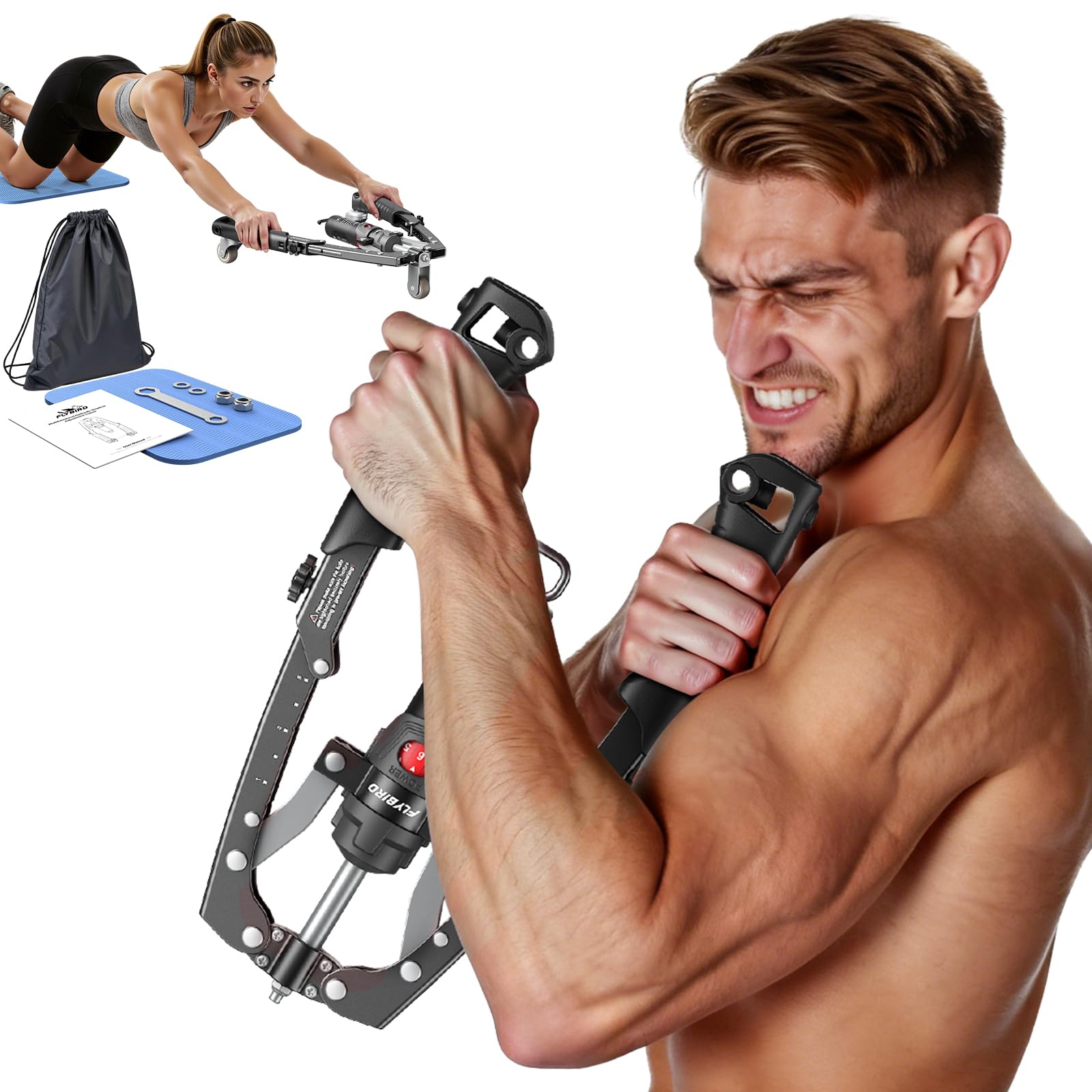
The backpack gives away what this is for. FLYBIRD ships the trainer with a bag and a pad, and the handles slide through 12 positions so two people with very different arm spans both find a clean press. Folded, it's about 9 by 2.8 by 13.8 inches and 2.72 kg, which means a carry-on and a hotel floor. We think it's the one to take if your training travels.

Mechanically it's the same idea as our top pick: a sealed hydraulic cylinder, 15 levels, 22 to 440 lb, held in a triangular frame of double-layer titanium steel tubes. The motion is smooth, the rebound is gentle, and nothing about it felt less controlled than the WAKISA.

The extra outlay buys fit, finish and the travel kit rather than a different workout, and the warranty runs one year against the two we get elsewhere. Resistance bands aren't included even though the hooks are there, so plan on buying a set if you want the band movements. For a machine that stays in one room, that's a lot of money for a bag. For one that follows you, it's the pick.

Bottom line: The one to take with you: same hydraulic mechanism as our top pick, plus a backpack, a pad, and 12 handle positions — worth it only if the machine travels.
#2

WAKISA Twister Arm Trainer

WAKISA Twister Arm Trainer

Home upper-body training

Our Score 9.2/10
Check Price

Worth Noting

  • Band hooks need your own bands
Weight
5.84 lb
Included
3 ab wheels, knee pad
Resistance Range
22-440 lbs
Resistance Levels
15
Read the full review

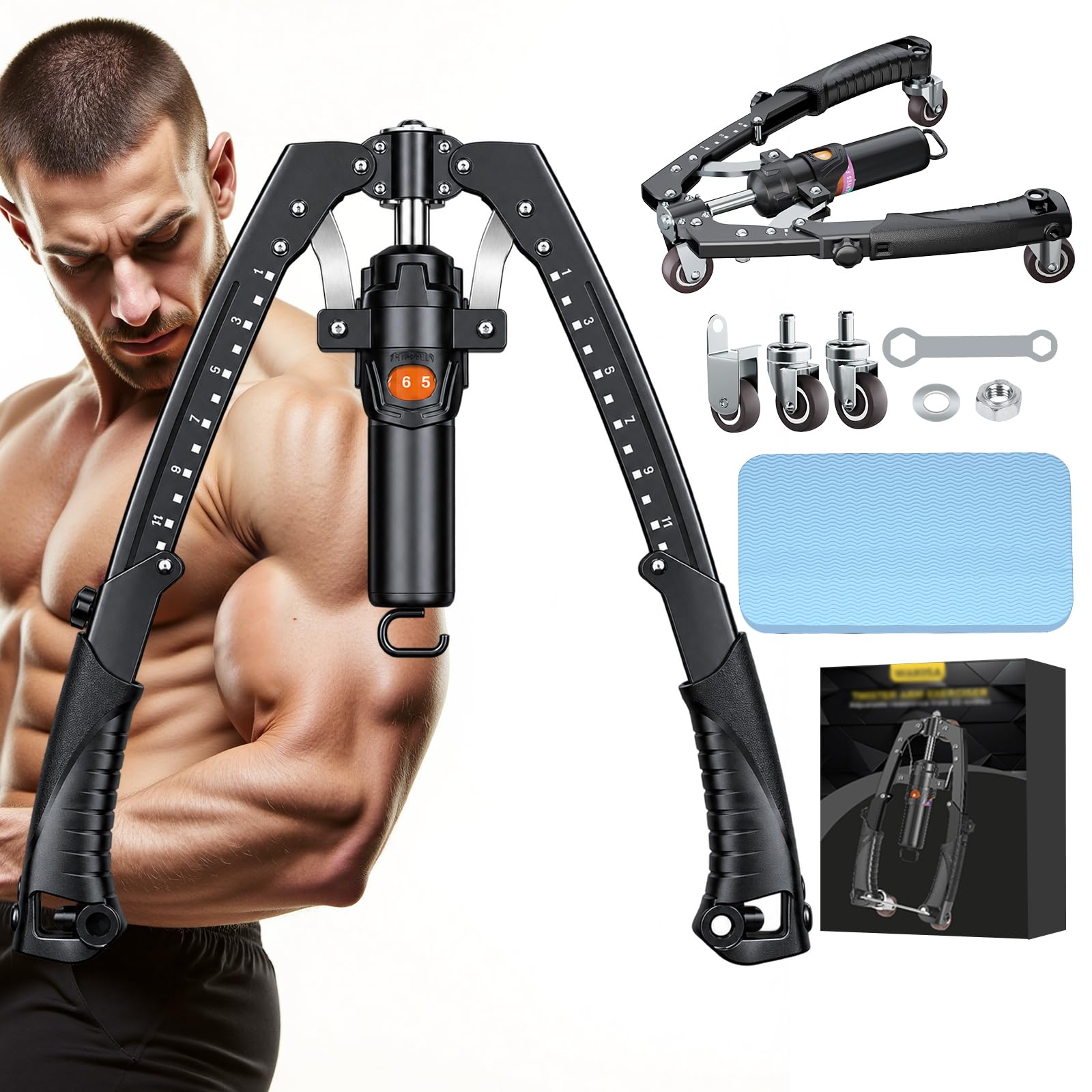
Twenty-two pounds is light enough for a warm-up, a cautious return from a shoulder strain, or a teenager who has never lifted anything heavier than a school bag. Four hundred and forty is a hard press for most of us. That spread, split across 15 clicks, is why this one sits at the top of our list: a single machine a household can share. The handles slide in and out to fit different arm spans, so the shorter person isn't overreaching just to get a grip.

What settled it was the cylinder. Hydraulic resistance moves smoothly and gives a little at the end of a rep instead of snapping back the way a coiled spring does, and that control is what makes the heavy settings feel like training rather than a stunt. The triangular center and double-layer steel tubes held firm when we worked toward the top of the range. It runs out of road for a genuinely strong presser, though — the last few levels feel shorter than the numbers suggest.

Three detachable wheels turn it into an ab roller, and the band hooks take straps you already own, because none come in the box. At 2.65 kg it moves between rooms without a second thought, and the two-year warranty is the longest here. The knee pad looks like an afterthought until the first time you roll out on a wooden floor.

Bottom line: Our default pick: the widest usable resistance range here, handles that fit two different people, and ab wheels thrown in — buy it if you want one machine for arms.

#3

Abahub Twister Arm Exerciser

Abahub Twister Arm Exerciser

A second machine

Our Score 9.2/10
Check Price

Worth Noting

  • Printed guidance is a single sheet
  • Sliding arms can drift mid-set
Weight
4.4 lb
Warranty
2 years
Closed Size
11.4" x 6.2"
Resistance Range
22-440 lbs
Read the full review

Take our top pick, drop the ab wheels and the band hooks, and you're close to this. Abahub uses the same sealed hydraulic cylinder with a 22 to 440 lb range on a knob and the same sliding arm-length adjustment, in a 4.4 lb frame that closes to about 11.4 by 6.2 inches.

In the hand it feels like the more expensive machines: carbon steel, a knob that moves through the range in firm steps, a slight rebound at the end of each press. The handles turned smoothly enough that we stopped thinking about them, which is the compliment a grip deserves.

Where it fits is as a second unit — an office, a locker, a bag — because you get the full range without paying for parts you'd never attach. As a main machine it asks more of you: there's nothing in the box to expand the menu beyond pressing and curling, and the sliding arms are friction-fit, so seat them firmly before a set.

Bottom line: Our pick for a second hydraulic trainer: the full 22-440 lb range in a smaller, lighter frame, as long as you don't need the attachments.

#4

Lifepro ShredForce

Lifepro ShredForce

Tracking every set

Our Score 9.0/10
Check Price

Worth Noting

  • Counter can work loose from the cylinder
Weight
5.1 lb
Folded Size
16.93" x 6.30" x 1.97"
Resistance Range
22-440 lbs
Resistance Levels
10
Read the full review

Only one machine here counts your reps for you. The ShredForce has a small digital counter set into the frame, with an on/off switch and a button battery in the box. You dial in a resistance level, press start, and stop doing arithmetic in your head halfway through a set.

Everything else is tidy. Ten hydraulic levels cover 22 to 440 lb, the grips are PU rubber rather than bare steel, two lock bars keep it folded, and the whole thing comes down to 16.93 by 6.3 by 1.97 inches at about 5 lb — flat enough for a shelf and light enough to carry downstairs.

The counter earns its place because of how progress works on a machine like this: you add reps at a fixed resistance first, then click up a level, and a display makes that visible in a way a notebook never quite does. Durability is the open question. Some units have failed inside the first couple of months, which is why the lifetime support is worth registering on day one.

Bottom line: Buy it if you like your training measured: the counter turns a vague pump session into something you can progress, and it folds flat between workouts.

#5

Spinning Burn Rotator

Spinning Burn Rotator

Shoulders and wrists

Our Score 9.0/10
Check Price

Worth Noting

  • Costs more than the rest of this set
Material
Alloy and stainless steel
Device Weight
12 lb
Resistance Levels
5
Resistance Control
Knob
Read the full review

The first thing you notice is the weight. Twelve pounds of steel in one hand changes the exercise: you're holding a small dumbbell while you rotate, which is why the shoulders and forearms start complaining inside a minute.

The motion is a continuous circle. A knob on the side sets resistance across five levels, and the wheel turns on stainless and alloy steel with barely any friction of its own. It's a different animal from the pressing machines here: nothing about it loads a chest press, and it won't build a bench.

Where it earns its keep is rotation — wrists, rotator cuff, the small shoulder muscles nothing else here reaches, which is why boxers use this kind of tool. A minute is a workout and five is plenty. A drop of silicone oil on the wheel now and then keeps it quiet.

Twelve pounds of steel will humble you in a way a chest press never does, and the next-day soreness lands in places you forgot you had. Treat it as a specialist: buy it for shoulder health, rehab or rotational strength, and keep a twister alongside it for pressing.

Bottom line: A specialist worth owning if shoulder rotation and wrist strength are your gap — buy it alongside a twister, not as your only arm machine.

#6

Core Prodigy Python Power Twister

Core Prodigy Python Power Twister

Desk-side strength

Our Score 9.0/10
Check Price

Worth Noting

  • Top resistance is 110 lb
  • Handles are firm rather than cushioned
Length
28 inches
Weight
3.6 lb
Tension
45-110 lb
Material
Carbon steel
Read the full review

There's no knob on this one, and that's the appeal. The Python is a single 28-inch carbon steel bar with rubber grips, and the resistance comes from bending it — 45 to 110 lb depending on where you put your hands. No cylinder, no seals, no battery, nothing to leak or squeak. We like it for exactly that: it's the trainer here that can sit in a drawer for a month and work the moment you pick it up.

It's also the least forgiving place to start. A coil rated to 110 lb doesn't bend easily, and 45 lb is a real push for a beginner — the lightest setting catches people out. Slide your hands toward the middle and it eases off. The build is the strongest in this set: 3.6 lb of steel with grips that stay put when your palms are wet.

Variety is the trade-off. You can press it, curl it, and hold it at tension, and that's the whole menu; there's no ab wheel, no band hooks, no counter. As a desk-side pump or a finisher after a gym session, none of that matters. As the only arm machine in the house, it asks more of your imagination than the hydraulic picks do.

Bottom line: The one to keep by the desk or in a drawer: 110 pounds of steel with nothing to break, as long as the lightest setting isn't too much for you.

#7

NOONCRAZY Twister Arm Trainer

NOONCRAZY Twister Arm Trainer

Budget spring training

Our Score 9.0/10
Check Price

Worth Noting

  • Forearm pads are the weak point
  • Resistance changes mean swapping bars
Material
Stainless steel
Spring Bars
4 (two resistances)
Resistance Range
30-120 lbs
Resistance Levels
4
Read the full review

No dial here: the resistance is in the parts. Two sets of spring bars, four in total, give four levels between 30 and 120 lb, and the second stage of adjustment is the handle position. Fit the light pair to start, swap to the heavy pair as you get stronger. Stainless steel body, foam grips, a training poster and an assembly manual in the box.

For a good deal less than the hydraulic machines you get a trainer with no cylinder to leak and no battery to replace, and 120 lb is 120 lb at every rep. What the money doesn't buy is polish — the parts you touch are where the savings show, and the resistance itself is the cleanest-performing part of the whole package.

It's also the easiest of these to hand to someone else: a guest can use the light bars without a tutorial. If you already press heavy, you'll run out of ceiling at 120 lb before the year is out. For a first year of arm and chest work, or a second machine for the office, it's a lot of trainer for the money.

Bottom line: A sturdy, quiet first trainer for the money: four spring levels from 30 to 120 pounds and no seals to fail, as long as you don't need to train heavy.

#8

LYKAN Twister Arm Trainer

LYKAN Twister Arm Trainer

Packing small

Our Score 8.6/10
Check Price

Worth Noting

  • Top resistance is 100 lb
  • Three levels leave wide gaps
Design
Detachable
Weight
1,500 g
Resistance Range
40-100 lb
Resistance Levels
3
Read the full review

Two halves, four spring bars, and a leather wrap. The LYKAN separates in the middle so it stores in a bag or a drawer, and at 1.5 kg it's the lightest trainer here. Fit the bars, join the halves, and you have a 40 to 100 lb chest and arm trainer with padded grips.

Resistance comes from which bars you fit — three levels across that range — so you choose the load before the set rather than during it. For straight sets that's fine. For anything needing a drop, it means stopping and rebuilding the machine between efforts.

The leather wrap over the springs is the detail we appreciate most. It covers the coil exactly where your forearm crosses it and takes the sharpness out of a hard bend, which matters more than it sounds on a trainer you use for reps. The padding on the grips themselves is thinner, and long sets leave marks.

Judged as a gym-bag machine it makes sense: light, compact, and cheap enough to keep as a spare. Judged against the hydraulic picks, its 100 lb ceiling is a fraction of theirs, so it suits a beginner, a teenager, or a second setup rather than the main event.

Bottom line: A sensible starter or spare: it splits for storage and costs little, though 100 pounds and three levels won't carry you past your first year.

How We Tested the Best Arm Workout Machines

We started with a shortlist of 30 machines, narrowing by price, footprint, resistance type, and brand reputation for build quality. That left us with 12 units, which we tested over seven months in home gyms, living rooms, and a cramped apartment. Every machine got used at least three times a week for arm curls, tricep extensions, shoulder presses, and rows—sometimes during a lunch break, sometimes while watching TV. We noted how long assembly took and whether the instructions made sense without a second person.

For workout performance, we tracked whether resistance felt smooth or jerky, and whether the range of motion matched what the exercise called for. We adjusted resistance mid-set with sweaty hands to see how easy it was. Comfort came down to padding: after 15 minutes of curls, we checked for pressure points on forearms and elbows. Noise was measured by having a colleague in the next room note whether they could hear the machine over a podcast. We also weighed each unit and noted its footprint when folded or stored.

Durability and build quality got the long view. After seven months, we looked for frayed cables, loose bolts, wobbly bases, and squeaks that developed over time. Value for money wasn't about the cheapest option—it was about whether the machine still felt solid after dozens of workouts. The ones that scored highest were the ones we forgot were even there because they just worked.

How to Choose Arm Workout Machines

Look at the resistance floor first

Almost everyone reads the top number on the box. The figure that decides whether you'll actually use the machine is the bottom one. A hydraulic trainer starting at 22 lb lets you warm up, work back from a shoulder strain, or hand the thing to a beginner; a fixed spring bar that starts at 45 lb is already work before your first rep.

If two people will share it, pay for the low end and treat the maximum as a bonus. Our top pick and the Abahub both open at 22 lb; the YKAN and the power twister bar do not.

Hydraulic, spring, or rotating weight

Sealed hydraulics give smooth, controlled resistance with a slight rebound at the end of a rep, and they cannot be serviced when a seal starts to creak. Steel springs are cheaper and have nothing to leak, but they store energy and get harder to bend the further you push. A rotating wheel holds tension through a circle, which is why it suits shoulders rather than chest presses.

Decide which motion your training needs before you compare numbers. Pressing and curling want a twister; rotator-cuff and wrist work want the wheel.

Judge the frame, not the burn

At the top of the resistance range the part that fails is rarely the spring or the cylinder — it's the arms and the pivot points. A triangular center with double-layer tubes holds shape under a hard press; a single thin tube with bolted joints flexes, and flexing at chest height with heavy stored energy is not something to shrug off.

If you plan to train near the ceiling, spend for the braced frame, check the bolts monthly, and retire anything that has visibly bent.

Storage, grip, and the guidance in the box

A trainer you have to unpack is a trainer you skip. Folding machines close to around 11 inches, the power twister is a 28-inch bar, and the rotating wheel needs shelf space — that difference decides whether it lives in a drawer or a closet you never open.

Grips matter as much. Padded contact points and a leather or rubber wrap are what let you finish a set instead of stopping at the forearm burn. A poster, a manual, or a rep counter sounds like filler until you're three weeks in and out of ideas.

Frequently Asked Questions

Final Verdict

Buy the WAKISA if you want one machine for a home upper-body session: 22 to 440 pounds of hydraulic resistance, handles that fit two different people, and ab wheels that fold core work into the same purchase. It is the pick we keep coming back to.

Take the FLYBIRD instead if the machine has to travel — same mechanism, backpack included, more money. And if the goal is shoulder health rather than pressing strength, the Spinning Burn earns a place beside a twister rather than replacing one.