Strength & Weights

Best Ankle Weights of 2026

Ankle weights look simple until you strap on a pair that slides toward your shoe mid-set, digs into your ankle bone, or loses its grip after a few weeks. A good pair should feel like an extension of your leg—secure enough for side-lying leg lifts, comfortable enough for a 30-minute walk, and adjustable enough to add resistance without swapping gear. The right design fixes that by staying put, spreading weight evenly, and making on/off quick.

I've worn them for physical therapy exercises, strength circuits, and long walks, and over the past four months my team and I put 14 pairs through the same routines. We paid attention to fit on different ankle sizes, how easy the weights were to remove or change, whether the stitching and Velcro held up, and how bulky each pair felt under real clothes. The pairs worth keeping tend to share a wide, grippy strap and a low-profile stack of weights, which is where the value shows up. The picks below are the ones that earned a spot by my shoes.

#1

HEALTHYMODELLIFE Ankle Weight Set

Top Pick
HEALTHYMODELLIFE Ankle Weight Set

Walking and rehab

Our Score 9.2/10
Check Price

Worth Noting

  • Weight is fixed at 3 lb per side
Closure
Velcro
Pair Weight
6 lb
Fill And Shell
Sand in padded neoprene
Weight Per Ankle
3 lb
Read the full review

Some mornings you want a weight you can strap on and forget, and this is the pair that does it for us. It is a 6-pound set, 3 pounds per cuff, in a padded neoprene shell, with no bags to pull out and no pockets to line up. The only thing you adjust is the strap.

That simplicity shows up in wear. There are no compartments to work loose, so the fill sits flat around the ankle and stays there through a walk or a set of leg lifts, and the padding is generous enough to leave on through a whole session rather than counting the minutes until you can take it off.

Sizing is the other thing in its favour. The cuff and strap tighten down far enough for genuinely slim ankles, which is more than most of this group manages, and there is still room for a sock or a thin legging underneath. Wear it for walking, Pilates, and chores around the house and it stops registering.

Bottom line: The pair we reach for when we just want to walk out the door: 3 pounds on each ankle, padded, with nothing to load or rearrange before you start.

#2

Henkelion Adjustable Ankle Weights

Henkelion Adjustable Ankle Weights

Easy weight changes

Our Score 9.2/10
Check Price

Worth Noting

  • Cuff runs wide on slim ankles
Closure
Velcro strap
Adjustment
Removable weight packets
Pair Weights
2, 3, 5, or 10 lb
Read the full review

Comfort is the reason this pair is here. The cuff is soft rather than structured, the hook-and-loop strap is long enough to close over a sock or a thick ankle, and the weight changes by pulling a packet out or adding one, a job that takes seconds rather than a session. That makes it the adjustable set we point most people to after the top pick.

The weights come as pairs from light options up to a 10-pound set, so there is a version for a first pair and a version for someone doing serious leg work. Sold in 1-pound increments, it steps up in the sizes most people actually use, and the whole thing rolls up small enough to disappear into a gym bag.

The strap is where it gives ground. It is a single long wrap, and over the course of a walk it can work loose enough to want a second cinch. Fasten it over a sock rather than bare skin, check it after the first few minutes, and it holds through a normal session without further fuss.

Bottom line: The comfortable middle of the range: a soft cuff, packets that swap in seconds, and pair weights running up to 10 pounds.

#3

BAGAIL Ankle and Wrist Weights

BAGAIL Ankle and Wrist Weights

Pilates and barre

Our Score 9.2/10
Check Price

Worth Noting

  • Hand wash only
Care
Hand wash only
Shell
Three-layer Lycra-SBR
Pair Weight
2 lb
Weight Per Ankle
1 lb
Read the full review

At 1 pound per cuff this is a resistance layer rather than a strength load, and that is exactly what Pilates, barre, and a walk around the block call for. The shell is a three-layer Lycra-SBR fabric meant to resist sweat and chafing, and it is slim enough to vanish under a wide-leg pant. It is also the least expensive pair here.

What you get for that is a cuff that stays put. The strap cinches down far enough for a wrist or a slim ankle, the hook-and-loop holds through a full mat session, and nothing about it feels like gym equipment. We keep it for floor work and for wearing on the wrist on a dog walk, which is more use than a heavier pair would get from us.

Bottom line: Our pick for Pilates, barre, and wrist work: a slim, sweat-resistant 1-pound cuff that stays where you fasten it.

#4

Sportneer Adjustable Ankle Weights

Sportneer Adjustable Ankle Weights

All-round training

Our Score 9.0/10
Check Price

Worth Noting

  • Seam stitching can wear under the heaviest loads
Fits Ankle
7.5 to 12.5 inches
Pair Weight
2 to 10 lb
Fill And Shell
Iron sand in neoprene
Weight Per Ankle
1 to 5 lb
Read the full review

The most useful number on the Sportneer listing is one you will not find on most ankle weights: it fits ankles from 7.5 to 12.5 inches around. Fit is where this category goes wrong, and a published range means you can measure your ankle before you order instead of finding out a block into your walk. Each cuff carries five 1-pound iron sand bags, so you get 1 to 5 pounds per ankle and 2 to 10 pounds for the pair.

Both of those details do more work than the feature list suggests. You can start at a single bag for Pilates or a first week back at the gym, then load the rest for leg lifts and glute work, and the neoprene cuff sits over leggings or a sock without bunching. Nothing else here covers that much ground, and the pair has the largest body of use behind it of anything in this group.

Loading is the one chore we noticed. Pulling the bags in and out of the pockets takes patience, especially when you are reinserting the fourth and fifth, and the strap has enough hook-and-loop that you line it up rather than slap it down. Pack the weight you want before the cuff goes on your ankle, and leave a spare bag out if you are between settings.

The ceiling is real, though. If your ankle measures under 7.5 inches, the cuff will run out of strap before it runs out of weight, and no amount of adjustment fixes that. Everyone else can treat this as the default pair for walking, mat work, and leg day without thinking about it again.

Bottom line: This is the pair we recommend first: one set that covers rehab, walking, and leg day, with a 7.5 to 12.5 inch fit range you can check before ordering.

#5

APEXUP Adjustable Ankle Weights

APEXUP Adjustable Ankle Weights

Heavy leg work

Our Score 9.0/10
Check Price

Worth Noting

  • Modules are stiff to slide into the sleeves
Adjustment
Five 1 lb modules per cuff
Pair Weight
10 lb
Fill And Shell
Iron sand in neoprene
Weight Per Ankle
1 to 5 lb
Read the full review

Five 1-pound iron sand modules sit in each neoprene sleeve, and the fill is the reason to look here. Iron sand packs tighter than the loose sand in a stitched fabric cuff, so 5 pounds per ankle arrives in something closer to a slim cuff than a beanbag. That is the difference between a weight you can wear under a tracksuit pant and one you cannot.

The range runs from 1 to 5 pounds per ankle, 10 pounds for the pair, and stepping up is a matter of sliding one more module into the sleeve. That makes it the pair we reach for on leg day: you can add a pound at a time across a training block instead of buying a second set when the first one stops being enough.

Where it earns its place is the top of the range, with one caveat: load both cuffs to 4 or 5 pounds and the strap starts to lose its grip on a walk. Keep the heavy settings for floor work and glute sets, drop to 2 or 3 pounds for walking, and fasten it over a sock for extra hold.

Bottom line: The pick for building up to real load: five 1-pound modules per ankle in a dense iron-sand fill that stays compact at 5 pounds.

#6

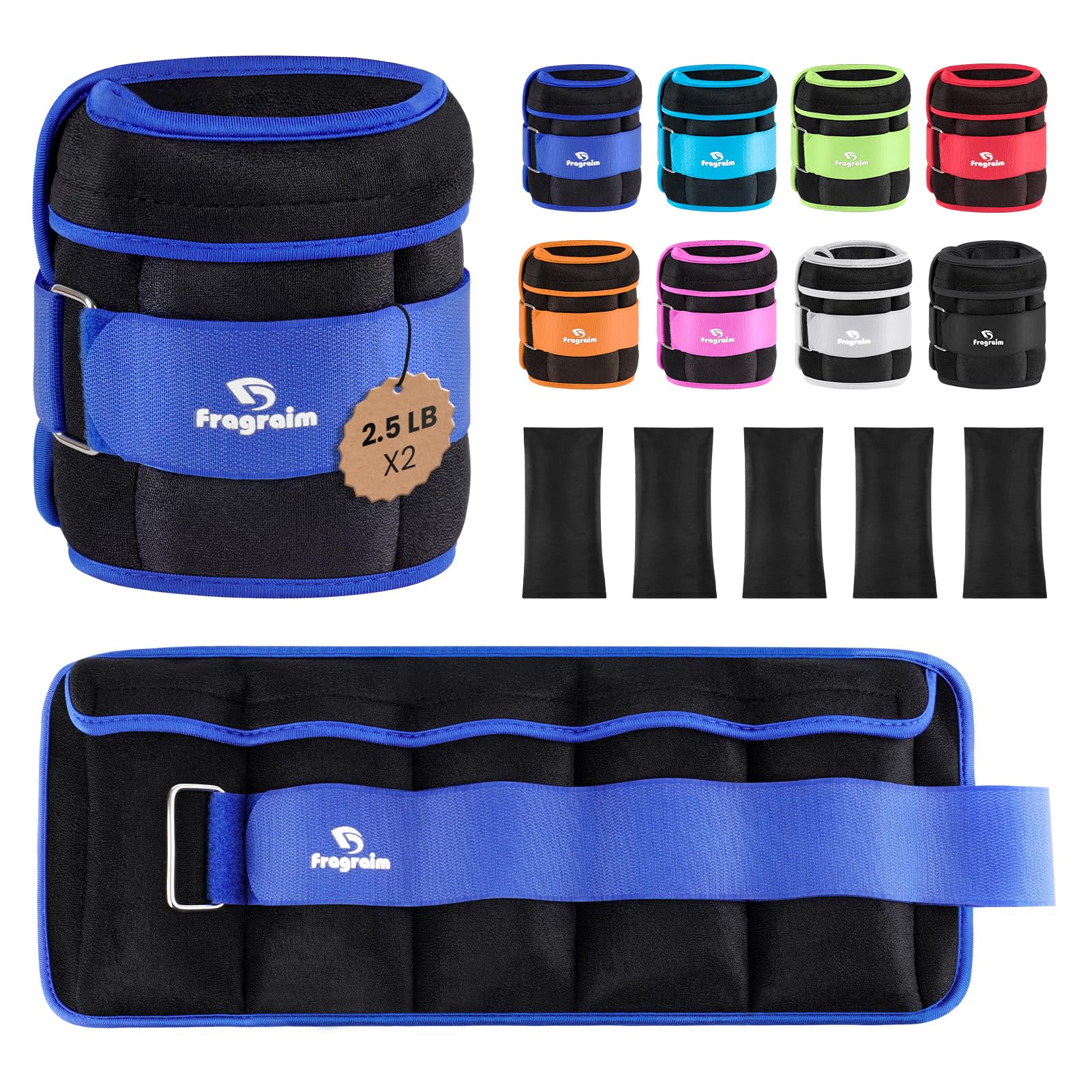
Fragraim Adjustable Ankle Weights

Fragraim Adjustable Ankle Weights

Rehab progressions

Our Score 9.0/10
Check Price

Worth Noting

  • Bulky package on small frames
Adjustment
Five 0.5 lb sandbags per cuff
Pair Weight
5 lb
Fill Material
Iron shot
Weight Per Ankle
Up to 2.5 lb
Read the full review

Five half-pound bags per cuff take each ankle from nothing to 2.5 pounds in half-pound steps, and the pair tops out at 5 pounds. Half-pound steps matter more than they sound. Coming back from an injury or working through a rehab protocol, a full pound can be a jump you cannot take, and this is the pair that lets you take the small one instead.

The shell is mercerized cotton with a moisture-absorbing lining, and of the cuffs in this group it is the softest against bare skin, closer to a sweatband than a weight. Bags sit in sewn pockets behind a long hook-and-loop strap, so nothing shifts once you have the strap closed where you want it.

The strap is the other thing to plan for. It is a long single wrap, and a slim ankle ends up with a tail of hook-and-loop hanging past the closure, which will catch on a legging if you leave it. It suits a fuller ankle or a sock underneath; on a narrow one, we point people to the Sportneer or the padded HEALTHYMODELLIFE cuff instead.

Bottom line: Our pick for rehab and gradual loading: five half-pound bags per cuff let you creep up on a load, in the softest shell here against skin.

#7

nooncrazy Wrist and Ankle Weights

nooncrazy Wrist and Ankle Weights

Sensitive skin

Our Score 9.0/10
Check Price

Worth Noting

  • Only sold as a 1 lb pair
Care
Waterproof, wipes clean
Fill
Steel wrapped in silicone
Pair Weight
2 lb
Weight Per Ankle
1 lb
Read the full review

There is no sand in these. Each 1-pound cuff is a steel core wrapped in soft silicone, which makes it the odd one out here and sidesteps the two failures that plague fabric ankle weights: nothing can escape a seam, and there is no grit or rough hook side against your skin.

That construction pays off in upkeep. The silicone wipes clean and the maker lists it as waterproof, so sweat and floor grime do not sink in the way they do with a padded cuff, and the strap is a wide hook-and-loop band that tucks its own tail rather than flapping. It ships with a small pouch, which is more than most of this group offers.

One pound per cuff is the whole range, so treat this as a Pilates, barre, walking, and wrist pair rather than a strength-training one. What it does have is grip: the silicone sits against the skin instead of sliding over it, and the strap adjusts down far enough that it stays on a wrist through a mat session.

If you have had a fabric cuff leave a trail of sand on the carpet or rub above your ankle bone, this is the pair we point you to. It is the tidiest, most forgiving thing here. Just do not expect to load it past a pound.

Bottom line: The pair for anyone whose fabric cuff has shed sand or rubbed a raw line: steel wrapped in silicone, 1 pound per cuff, and nothing to leak.

#8

Amazon Basics Adjustable Ankle Weights

Amazon Basics Adjustable Ankle Weights

First adjustable pair

Our Score 8.8/10
Check Price

Worth Noting

  • 2.5 lb per ankle ceiling
  • Less comfortable than the neoprene cuffs here
Closure
Dual Velcro straps
Adjustment
Inserts from 0.5 to 2.5 lb
Pair Weight
5 lb
Weight Per Ankle
2.5 lb
Read the full review

Two separate hook-and-loop straps close this cuff instead of one. That gives the closure roughly twice the surface to hold onto, and on paper it is the most secure fastening in this group; it is also slower, because you are lining up two straps and tightening each one, and doing that on your own ankle takes a bit of aiming.

The 5-pound set is 2.5 pounds per cuff, with inserts that step down to half a pound, so the progression is finer than most cuffs here. What it is not is heavy. If your leg work has moved past 3 pounds per side, this pair has nothing left to give, and you will be shopping again within a couple of months.

The cut is generous, so a smaller ankle ends up with a lot of fabric and strap to manage, and the polyester shell does not have the give of neoprene. Fastened over a sock and cinched properly it does the job; on bare skin at the end of a long session you notice it is there.

Where it makes sense is a first adjustable pair, a spare set for travel, or something cheap enough that you do not mind it living in a bag. If you will wear it four days a week, we think the extra spend on a softer, 5-pound cuff is money well used.

Bottom line: The cheapest way into an adjustable pair, with fine half-pound inserts and a two-strap closure, as long as 2.5 pounds per ankle is enough load.

How We Tested the Best Ankle Weights

We started by pulling together ankle weights that were widely available and represented the range of styles shoppers actually see: closed cuffs, adjustable straps with removable inserts, and fabric sleeves. We filtered out pairs with thin straps, vague weight labels, or stitching that looked likely to fray, then narrowed the shortlist by size range, price, and whether replacement weights were sold separately.

Fourteen pairs made the cut, and we used them for four months. They went into living-room strength circuits, around the block on walks, and through physical-therapy-style leg lifts and side steps. We strapped them over leggings and bare ankles, wore some under wide-leg pants, and kept notes on slipping, pressure points, and rubbing after 20 minutes. We also timed how long each pair took to put on and take off, and tested the Velcro by shaking the cuff and doing repeated side steps to see if it crept loose.

Adjustability got a more hands-on check: we moved or removed inserts mid-set and noted whether the cuff still fit well, whether the weights sat flat, and whether the strap had enough room for larger ankles. For durability, we checked seams, stitching, and Velcro lint after every couple of weeks of use, and we hand-washed the removable-insert styles as directed. Bulkiness was judged under real clothes and during floor exercises—did the cuff catch on the other leg, or could we forget it was there? We compared what each pair offered for the money, not just the number of pounds on the label.

How to Choose Ankle Weights

Start With How Much Weight You Need

Buy for the weight you expect to be using in a few months, not the weight you can handle today. One to two pounds per side is what Pilates, barre, walking, and early rehab call for; three to five pounds per side is where leg lifts, glute work, and strength sets live. A pair that tops out at 2.5 pounds per ankle runs out of headroom quickly, while 5 pounds per side covers nearly everything short of dedicated strength work. If you are buying your first pair, aim for the upper end of that range rather than the middle.

Adjustable or Fixed Weight

Adjustable cuffs let you progress without buying again, which is why they suit most people starting out. The cost is handling: bags and modules come out and go back in, and at the top of the range you are strapping a stack of them to your ankle, which is bulkier and less steady than a fixed cuff carrying the same weight.

Fixed pairs like the HEALTHYMODELLIFE set sit flatter and go on in seconds, but the load you buy is the load you own. Watch the wording, too: plenty of listings call a cuff adjustable when only the strap adjusts.

Fit Is Where Most Pairs Fail

Measure around your ankle at its narrowest point, just above the bone, and buy against that number. A published fit range is worth more than any feature list: the Sportneer pair states 7.5 to 12.5 inches, so you can rule it out before it arrives. One size fits most is where the trouble hides: slim ankles end up with a cuff that stands off the leg and a strap tail that flaps. Wrist use needs a shorter wrap again, so a pair you plan to move between ankle and wrist should tighten down well past the cuff itself.

Fill, Bulk, and How Long They Last

Two cuffs at the same weight can feel nothing alike, because the fill differs. Iron sand and iron shot pack densely, so 5 pounds fits in something close to a slim cuff; loose sand in stitched fabric pockets takes up far more room and sits further off the ankle. Dense fill also puts less strain on the seams.

The seam is what fails on a fabric cuff. Heavier loads pull at the corners, and once a pocket opens, the fill escapes. If you plan to work at 5 pounds per side, look closely at the construction before you buy.

Keeping Them Where You Put Them

A closure holds by surface area, not by how hard you pull it. Wide hook-and-loop bands and two-strap designs hold better than a narrow single strap, though they take longer to fasten. What you wear underneath matters just as much: bare skin lets a loaded cuff creep, while a sock or a thin legging gives the strap something to bite. Fasten it snug, walk a minute, then tighten again. A cuff that felt secure at the kitchen counter can be halfway down your heel by the end of the block.

Frequently Asked Questions

Final Verdict

For most people the Sportneer pair is the one to buy. It covers 1 to 5 pounds per ankle in 1-pound steps, publishes a 7.5 to 12.5 inch fit range so you can check your ankle against it, and the neoprene cuff is comfortable enough to forget about mid-session.

If loading bags sounds like a chore, the HEALTHYMODELLIFE set is simpler and stays put beautifully. Just be sure 3 pounds per side is the load you want, because there is no stepping down.